

This introduction orients readers to a modern scaling solution that connects public and private chains into one cryptographically secured network.
The guide explains how zkSync Era scales the ethereum blockchain while keeping security via zero-knowledge proofs and minutes-to-Ethereum finality.
Key metrics show production readiness: 18 chains, $4B+ in TVL, and 700M+ transactions processed. These figures back real-world use for payments, DeFi, and tokenized assets.
Powered by Airbender, the stack achieves subsecond block proofs and ultra-low costs—about $0.0001 per transfer—on commodity GPUs. Matter Labs leads the roadmap and the open-source codebase is independently audited.
In short, this section sets the stage so users can learn what the network is, why it matters now, and what practical benefits make it a compelling scaling solution for high-volume crypto applications.
What zkSync Mainnet Is and Why It Matters Today
Learn how zkSync Era improves everyday crypto interactions with faster, cheaper settlement and strong security.
What it does: zkSync Era is a Layer 2 scaling solution on the ethereum blockchain that delivers faster cheaper transactions while preserving strong security with zero-knowledge proofs.
How the architecture works: The rollup batches transactions off-chain, then publishes proofs on Ethereum. This design keeps data availability and finality while reducing per-transaction cost.
User intent and onboarding
The guide helps users start using the network by walking through wallet setup, chain selection, and a first transaction. Clear steps reduce friction and let users interact with decentralized applications quickly.
Why it matters now
The elastic network enables ~1-second hops and minutes-to-Ethereum finality. That speed and low fee model make the solution viable for payments, exchanges, and responsive dApp UIs.
| Feature | Benefit | Typical Metric |
|---|---|---|
| Rollup architecture | Ethereum-grade security | Proofs on-chain |
| Elastic network | Low latency under load | ~1s hops |
| Fee model | Predictable, cheap transactions | ~$0.0001/transfer |
Key Benefits of zkSync Era for Faster, Cheaper Transactions
This section breaks down the performance, cost, and security gains that matter to developers and users.
High throughput and tiny costs: Airbender’s high-frequency proving produces subsecond proofs. That keeps the network responsive under heavy load.
Typical transfers cost about ~$0.0001/transfer. Low fees make micropayments and frequent transactions practical for consumer apps.

Security and settlement
Security relies on zero-knowledge proofs that validate state transitions before they hit the base chain.
Proofs are posted to the ethereum mainnet and finality follows in minutes, reducing settlement risk for counterparties.
Real-time UX and elastic design
The elastic network offers ~1-second hops for near-instant UI updates. Users see confirmations quickly, improving engagement.
| Benefit | Impact | Typical Metric |
|---|---|---|
| Subsecond proving | Responsive under load | Subsecond proofs |
| Low fees | Enables micropayments | ~$0.0001 per transfer |
| On-chain verification | Strong, auditable security | Proofs on ethereum mainnet |
| Elastic network | Real-time UX | ~1s hops |
These advantages support cheaper transactions and faster cheaper outcomes. Developers keep immutability and verifiable details while delivering web-scale user experiences.
zkSync Mainnet: Network Details and Block Explorer
Get the core network settings and learn how to use the block explorer to verify on-chain activity.
Confirming network settings in your wallet prevents wrong-chain transactions and token mismatches. Use the RPC URL https://mainnet.era.zksync.io, Chain ID 324, and currency symbol ETH to connect reliably.

RPC and chain configuration
Add the RPC endpoint and Chain ID to your wallet manually or via an official setup flow. Developers benefit from a consistent configuration when moving from staging to production.
- RPC: https://mainnet.era.zksync.io
- Chain ID: 324
- Currency: ETH
Using the block explorer to verify transactions
The block explorer at explorer.zksync.io shows transaction hashes, block heights, timestamps, and logs.
Use the explorer to confirm recipient addresses, token decimals, and total supply before approving transfers. That extra check helps avoid scams and phantom token listings.
| What to check | Why it matters | Where to find it |
|---|---|---|
| Transaction hash | Confirm finality and gas | Explorer tx page |
| Token contract | Verify decimals and supply | Token details page |
| Spender allowances | Reduce approval risk | Contract logs / approvals |
For official guidance and deeper developer resources, see the official zkSync docs. With low costs and quick hops, routine checks on the explorer stay affordable and effective.
How to Start Using zkSync with MetaMask
Begin by preparing your wallet so you can access Era-powered dApps and tokens.
Install and secure your MetaMask wallet
Install MetaMask from metamask.io. Create a strong password and write your Secret Recovery Phrase on paper. Store that phrase offline and never share it.
Add zkSync Era Mainnet automatically or manually
Add the Era network via the official docs or enter the RPC and chain values manually:
- RPC: https://mainnet.era.zksync.io
- Chain ID: 324
- Explorer: https://explorer.zksync.io/
Confirm the network name and Chain ID in your wallet so transactions route to the right network. This step helps prevent lost funds when using decentralized applications.
Add zkSync Era Sepolia Testnet for developers
For testing, add the Sepolia test network with RPC https://sepolia.era.zksync.dev and Chain ID 300. Use the Sepolia explorer to get test token addresses and verify behavior before moving to production.
Import tokens and verify contracts via the block explorer
Import tokens in MetaMask by pasting the contract address from the block explorer. Check token name, symbol, and decimals on the explorer before adding to avoid imposters.
Approve small allowances and revoke unused approvals. When bridging, remember gas and finality settle on the ethereum mainnet, so confirm fees and timing.
To learn about secure smart contract patterns and developer workflows, see this smart contract development guide. These steps make onboarding smoother and help users start using the Era network safely.
Bridging Assets and First Transactions on the zkSync Network
Bridge assets into the Era network with a few wallet clicks and a clear confirmation flow.
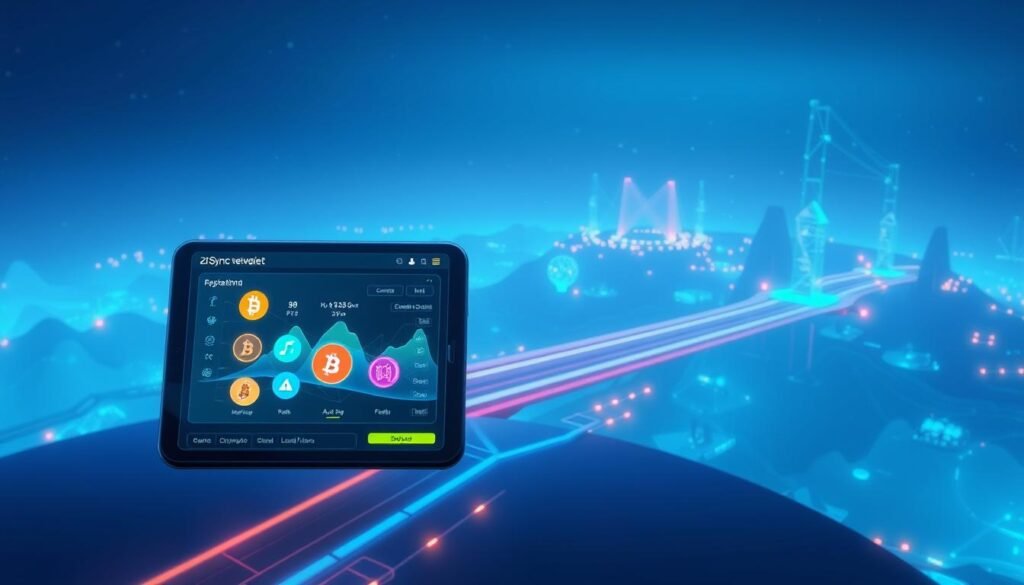
- Connect your MetaMask wallet, then pick the source chain and the token you want to move.
- Input the amount and confirm. Expect to pay gas on the ethereum mainnet when depositing.
- Wait for minutes-to-Ethereum finality; subsecond proofs and ~1s hops keep the UX responsive.
After the deposit, send a small transaction on the network to verify balances and UI updates. This test helps confirm your wallet and token flow work end-to-end.
For security, always verify the bridge contract and destination address on the explorer. Keep L1 funds for bridge fees and L2 funds for app use. Stage multi-asset moves in batches and log transaction hashes for reconciliation.
| Action | Why it matters | Typical cost | Tip |
|---|---|---|---|
| Connect wallet | Authorizes transfers | Free | Use MetaMask and confirm network |
| Deposit to L2 | Moves assets into the zksync network | Gas on ethereum mainnet | Deposit ETH first for fees |
| Small test tx | Validates wallet and token | ~$0.0001 on L2 | Send minimal amount |
| Withdraw to L1 | Return flow requires L1 settlement | Gas on ethereum mainnet | Plan for minutes-to-Ethereum finality |
When you need fiat conversion or cash-out options, refer to a practical guide on how to convert cryptocurrency to cash to minimize costs and timing friction.
Real-World Use Cases and the Growing zkSync Ecosystem
Real deployments now show how ZK tooling and an elastic network enable new business models.
Real projects are already using the stack to turn bank-grade assets into tradable tokens with built-in privacy. Institutions tokenize treasuries, fund shares, and private credit while using selective disclosure to meet compliance without exposing PII.
Tokenization, privacy, and compliance
Prividium enables privacy plus auditability so regulated issuers can publish proofs without leaking sensitive data.
Partners like Memento and Tradable demonstrate tokenization at scale, with Tradable reporting roughly $2B in tokenized alternatives.
Programmable capital markets
Private order flow can coexist with public price integrity. That model lets markets capture MEV under preset rules while keeping latency low thanks to subsecond proofs.
Cross-border, near-real-time settlement
The elastic network supports ~1-second hops for UX and minutes to finality on Ethereum, reducing third-party settlement risk.
For developers: ZK Stack and Airbender
ZK Stack lets teams launch customizable chains that interoperate natively and inherit strong base-chain security. Airbender’s prover delivers subsecond proofs on commodity GPUs, unlocking latency-sensitive applications and on-chain verification for AI workloads.
- Capital efficiency: ZKsync Connect enables atomic, privacy-preserving settlement across systems.
- Interoperability: Composable chains let developers build cross-chain decentralized applications with consistent UX.
- Community and partners: Integrations with Chainlink Labs (CCIP, feeds) and enterprise partners grow the ecosystem.

| Use case | Benefit | Example |
|---|---|---|
| Asset tokenization | Compliance with privacy | Memento / Tradable |
| Programmable markets | Private flow, public price | MEV-aware matching |
| Cross-border settlement | Faster finality, lower risk | ZKsync Connect + partners |
Conclusion
The network unites speed and verifiable security so the modern blockchain experience meets web-scale expectations.
Using zksync and a configured wallet lets users verify token contracts and inspect transaction details via the explorer. Send a small test token transfer to confirm flows and balances.
The underlying technology—Airbender, ZK Stack, and privacy tooling—supports consumer and institutional use without trading off security. The growing ecosystem and community add integrations and tooling over time.
Keep strong, good wallet hygiene: protect your Secret Recovery Phrase, verify addresses on the explorer, and manage approvals. With low fees (~$0.0001/transfer) and fast finality, the path from setup to first transfer is simple and practical today.
FAQ
What is zkSync Era and why does it matter today?
zkSync Era is a Layer 2 scaling solution built to run alongside the Ethereum blockchain. It uses zero-knowledge proofs to bundle many transactions off-chain, then submit succinct proofs to Ethereum for security. This lowers fees, speeds up transactions, and lets developers build high-throughput dApps while relying on Ethereum’s finality.
How does this guide help me start using zkSync Era?
The guide walks you through practical steps: configuring wallets, bridging assets, verifying transactions on a block explorer, and testing on a Sepolia testnet. It explains network settings, common costs, and developer tools so both users and teams can onboard quickly and securely.
What are the typical fees and throughput on the network?
Fees are extremely low — transfers can cost around
FAQ
What is zkSync Era and why does it matter today?
zkSync Era is a Layer 2 scaling solution built to run alongside the Ethereum blockchain. It uses zero-knowledge proofs to bundle many transactions off-chain, then submit succinct proofs to Ethereum for security. This lowers fees, speeds up transactions, and lets developers build high-throughput dApps while relying on Ethereum’s finality.
How does this guide help me start using zkSync Era?
The guide walks you through practical steps: configuring wallets, bridging assets, verifying transactions on a block explorer, and testing on a Sepolia testnet. It explains network settings, common costs, and developer tools so both users and teams can onboard quickly and securely.
What are the typical fees and throughput on the network?
Fees are extremely low — transfers can cost around $0.0001 — and the architecture supports high throughput with subsecond proof generation. Finality on Ethereum takes minutes when proofs are posted, while user experience often feels near-instant thanks to fast L2 confirmations.
How does the security model work?
Security relies on zero-knowledge proofs and Ethereum settlement. The network generates cryptographic proofs that attest to the correctness of many transactions; Ethereum validates those proofs, which preserves decentralization and immutability without running every operation on-chain.
What is the real-time user experience like?
Users typically see about one-second network hops for confirmations on the Layer 2, creating a smooth UX for transfers and dApp interactions. The elastic network adapts to demand, helping keep latency low during spikes in activity.
What network details do I need to connect a wallet?
To connect manually, add the RPC URL provided by the network, set Chain ID 324 for the Era main chain, and use the platform’s native currency symbol. Many wallets also offer an automatic add option to simplify configuration.
How can I verify transactions and token details?
Use the official block explorer to search by address, transaction hash, or token contract. The explorer shows confirmations, gas usage, and token metadata so you can confirm receipts and contract authenticity before interacting.
How do I add the network to MetaMask?
Install and secure MetaMask, then choose “Add Network.” You can let MetaMask add the Era chain automatically or enter the RPC URL and Chain ID 324 manually. After adding, switch networks and confirm addresses before sending funds.
Is there a testnet for developers?
Yes. Developers can use the Sepolia testnet variant (Chain ID 300) to deploy and test contracts without spending real ETH. Testnets are ideal for debugging bridges, token approvals, and contract interactions before main-chain use.
How do I bridge assets from Ethereum to the Era network?
Use the official Portal Bridge: connect your wallet, select the token and amount, approve the transaction, and confirm on Ethereum. The bridge locks or burns assets on layer one and mints or releases them on the Layer 2, with gas paid on Ethereum and finality achieved when proofs post.
What costs and confirmations should I expect when bridging?
Bridging requires an Ethereum gas fee for the initial transaction. Layer 2 confirmations happen quickly, but full settlement on Ethereum depends on proof submission timing; expect minutes to finality in most cases.
What real-world use cases exist for the network?
Use cases include tokenizing physical assets with privacy controls, programmable capital markets that preserve public price integrity, and cross-border settlements that reduce third-party risk. Many projects also use the stack for scalable DeFi, NFTs, and enterprise workflows.
What tools and stacks do developers use?
Developers leverage the ZK stack, provers such as Airbender, and elastic network primitives to build efficient dApps. Standard tooling supports Solidity contracts, familiar RPC endpoints, and integrations with wallets and block explorers for smooth deployment and testing.
How do I import tokens and verify contracts in my wallet?
After bridging or deploying, add token contract addresses to your wallet using the block explorer to confirm the contract. Verify contract source code and token metadata on the explorer before importing to avoid scams and ensure trust.
How does the ecosystem support growing demand?
The ecosystem combines prover improvements, elastic scaling, and broad developer adoption to increase throughput and reduce costs over time. Community tools, bridges, and marketplaces help onboard users and expand decentralized application offerings.
.0001 — and the architecture supports high throughput with subsecond proof generation. Finality on Ethereum takes minutes when proofs are posted, while user experience often feels near-instant thanks to fast L2 confirmations.
How does the security model work?
Security relies on zero-knowledge proofs and Ethereum settlement. The network generates cryptographic proofs that attest to the correctness of many transactions; Ethereum validates those proofs, which preserves decentralization and immutability without running every operation on-chain.
What is the real-time user experience like?
Users typically see about one-second network hops for confirmations on the Layer 2, creating a smooth UX for transfers and dApp interactions. The elastic network adapts to demand, helping keep latency low during spikes in activity.
What network details do I need to connect a wallet?
To connect manually, add the RPC URL provided by the network, set Chain ID 324 for the Era main chain, and use the platform’s native currency symbol. Many wallets also offer an automatic add option to simplify configuration.
How can I verify transactions and token details?
Use the official block explorer to search by address, transaction hash, or token contract. The explorer shows confirmations, gas usage, and token metadata so you can confirm receipts and contract authenticity before interacting.
How do I add the network to MetaMask?
Install and secure MetaMask, then choose “Add Network.” You can let MetaMask add the Era chain automatically or enter the RPC URL and Chain ID 324 manually. After adding, switch networks and confirm addresses before sending funds.
Is there a testnet for developers?
Yes. Developers can use the Sepolia testnet variant (Chain ID 300) to deploy and test contracts without spending real ETH. Testnets are ideal for debugging bridges, token approvals, and contract interactions before main-chain use.
How do I bridge assets from Ethereum to the Era network?
Use the official Portal Bridge: connect your wallet, select the token and amount, approve the transaction, and confirm on Ethereum. The bridge locks or burns assets on layer one and mints or releases them on the Layer 2, with gas paid on Ethereum and finality achieved when proofs post.
What costs and confirmations should I expect when bridging?
Bridging requires an Ethereum gas fee for the initial transaction. Layer 2 confirmations happen quickly, but full settlement on Ethereum depends on proof submission timing; expect minutes to finality in most cases.
What real-world use cases exist for the network?
Use cases include tokenizing physical assets with privacy controls, programmable capital markets that preserve public price integrity, and cross-border settlements that reduce third-party risk. Many projects also use the stack for scalable DeFi, NFTs, and enterprise workflows.
What tools and stacks do developers use?
Developers leverage the ZK stack, provers such as Airbender, and elastic network primitives to build efficient dApps. Standard tooling supports Solidity contracts, familiar RPC endpoints, and integrations with wallets and block explorers for smooth deployment and testing.
How do I import tokens and verify contracts in my wallet?
After bridging or deploying, add token contract addresses to your wallet using the block explorer to confirm the contract. Verify contract source code and token metadata on the explorer before importing to avoid scams and ensure trust.
How does the ecosystem support growing demand?
The ecosystem combines prover improvements, elastic scaling, and broad developer adoption to increase throughput and reduce costs over time. Community tools, bridges, and marketplaces help onboard users and expand decentralized application offerings.

No comments yet