
This guide explains why on‑chain systems matter for modern games in the United States. In 2025 the foundational stack moves control from central servers to decentralized rails so players can truly own and trade digital items.
The difference is clear. Traditional backends keep items tied to developer servers and often remove them if services end. Web3-native systems record state on ledgers and enforce rules with smart contracts. That change boosts trust and makes economies more transparent.
Readers will get a practical walkthrough of the core layers: network, smart contracts, tokenization, wallets, marketplaces, and indexing. We show how each layer supports smoother play, fewer fraud losses, and portable assets without heavy cryptography.
Later sections answer key developer choices—scalability, fees, security, tooling, and compliance—and include real proofs like Microsoft Xbox + EY royalties and Mythical Games’ large-scale tests to show this is production-ready today.
Start here to understand how better backend design improves player experience and powers next‑generation gaming platforms.
Read the technical primer for a deeper dive.
What Blockchain Gaming Changes for Players, Developers, and Publishers Today
Ownership is moving into players’ hands, changing how value flows in games. Players hold in-game assets in personal wallets rather than renting them from a publisher database. That means ownership can survive server shutdowns or company changes.

NFTs and digital assets map neatly to familiar items: avatars, skins, weapons, and equipment. Players can list, sell, or move these items, and scarcity is verifiable on public records.
Smart contracts make transactions transparent and tamper-resistant. Transfers are recorded immutably, which reduces duplication, unauthorized edits, and opaque balancing decisions.
Clear transaction history improves trust and the player experience. When rules enforce fairness automatically, competitive and economy-heavy games feel more predictable.
- Player-led economies: communities trade, price, and circulate items while developers add sinks and guardrails.
- New business models: creator royalties, marketplace fees, and hybrid free-to-play + token incentives replace one-way sales.
- Across multiple titles: realistic cross-title movement today usually means shared ecosystems, partnerships, or standard collections that require coordination.
Blockchain Gaming Infrastructure Layers and Core Components
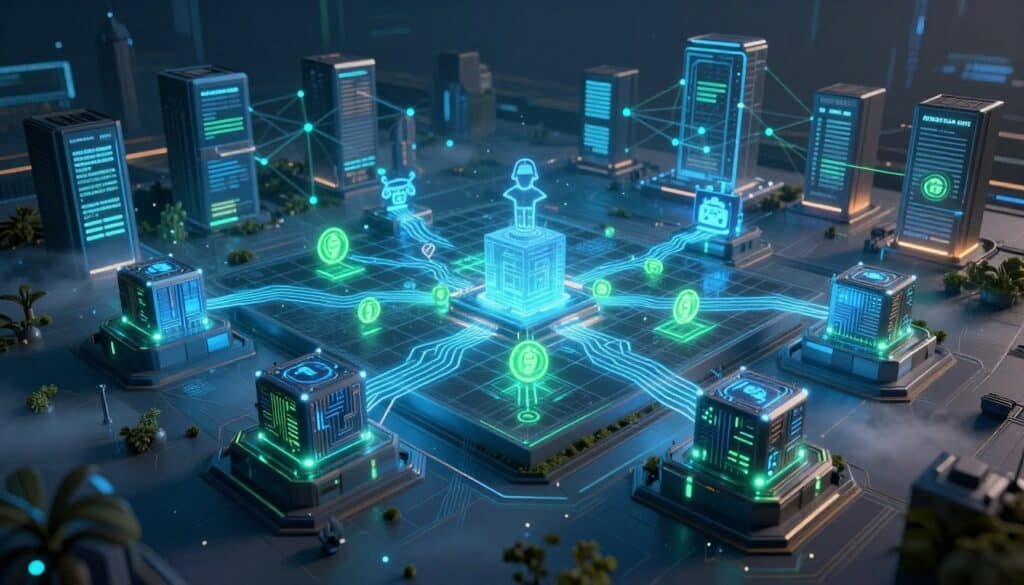
A robust backend for today’s titles combines consensus, on‑chain rules, and off‑chain storage to deliver smooth play and verifiable ownership.
Network layer
The network ensures when a transfer truly “counts.” Consensus and finality cut reorg risk so items don’t disappear mid‑match.
Low latency and high uptime matter for real‑time play. Developers choose networks based on throughput and security tradeoffs.
Smart contracts layer
Smart contracts act as the enforcement engine. They mint items, automate rewards, and enforce royalty splits without manual edits.
When a player claims loot, a contract call replaces a centralized database update and logs the change immutably.
Asset layer
Tokens and NFTs map to currencies, tickets, cosmetics, and progression. Ownership rules travel with the asset so transfers remain consistent across titles in an ecosystem.
Wallets and identity
User onboarding must be simple. Custody options, social logins, and session keys reduce friction so players start fast without deep blockchain knowledge.
Marketplace and payments
Market rails handle primary sales, secondary trades, and royalties. Fiat on‑ramps and crypto settlement let in‑game value connect to real‑world money.
Data, storage, and indexing
Not everything belongs on‑chain. Use on‑chain records for finality and move large state, media, and analytics off‑chain with reliable storage and indexers for fast queries.
Analytics pipelines help balance economies and detect fraud before it spreads.
End‑to‑end flow: player action → wallet signature → contract call → indexer updates → UI reflects state. This chain ties the layers into a smooth user experience and operational solution.
Choosing the Right Blockchain Technology Stack for Game Development
Start with gameplay needs, not buzzwords. Real‑time action titles require networks that handle high TPS and low confirmation times. Turn‑based or asynchronous games can accept slower finality and prioritize cost savings.
Scalability and TPS requirements
Map expected concurrency to block times and confirmation strategy. High peak loads show as delayed mints, stuck trades, or slow reward claims. Design for predictable throughput during spikes to keep player experiences smooth.
Fees and Layer‑2 solutions
Transaction costs shape monetization. Use Layer‑2 or batching to keep micro‑actions affordable. Decide when to subsidize fees versus passing them to users.
Developer support and tooling
Prioritize SDK maturity, audit tooling, wallet integrations, indexers, and testnets. Good tooling shortens build time and lowers launch risk for developers.
Network comparisons and tradeoffs
- Ethereum: deep ecosystem, higher gas, robust composability.
- Polygon: lower fees, L2 compatibility with Ethereum tooling.
- Solana: high throughput, low cost, operational complexity.
- Immutable X: NFT focus, gas‑free UX for instant trades.
- Flow & BSC: specialized tooling or cost efficiency with tradeoffs in decentralization.
Stack checklist: chain + wallet + indexer + marketplace + data layer. Use this when evaluating vendors and documenting technical tradeoffs for product, legal, and publishing stakeholders.
Smart Contracts, Tokens, and NFTs as the Engine of Web3 Gaming
Code‑based contracts act as the referee, executing rewards, trades, and item rules exactly as written. Smart contracts run minting, crafting, and marketplace rules without manual reconciliation. That makes outcomes verifiable and repeatable for players and studios.
Automated rewards and fair play-to-earn
Smart contracts automate reward distribution for play‑to‑earn and hybrid models. They enforce limits, sinks, and skill checks so inflation stays in check.
Fairness and verifiability come from code: reward logic is auditable and cannot be altered quietly by a back office.
Tamper‑proof transactions and fraud resistance
On‑chain transaction records reduce double‑spend and unauthorized item creation. Immutable logs improve security and build trust in ownership and provenance.
Tokens, NFTs, and combined design
Tokens act as fungible currency while NFTs represent unique collectibles. Combining both supports progression, marketplace liquidity, and sustained value loops.
DAO governance and practical limits
DAOs let communities vote on parameters, treasury use, and content cadence. Keep anti‑cheat and user safety centralized to avoid slow or risky governance decisions.
Interoperability patterns across multiple ecosystems
Teams use shared metadata standards, contract adapters, and licensing rules to enable assets to work across titles. Design assets for the ecosystem, not assumed universal portability.
- Creators: programmable royalties ensure attribution and ongoing compensation in secondary markets.
- Transparency: public contracts make fees and splits visible to players.
- Security: on‑chain rules reduce manual errors and fraud vectors.
Data Infrastructure, Storage, and Always-On Backend Services
A resilient data back end is as critical as on‑chain accounting for a smooth player session. Even when ownership is recorded on ledgers, games need fast reads, matchmaking, inventories, telemetry, and UX state that cannot wait on confirmations.
Why managed databases can become a bottleneck
Traditional managed Postgres instances often force maintenance windows and single‑master scaling limits. That creates outages that hurt live titles where players expect 24/7 access.
Mythical Games: a concrete case
Mythical built the Mythical Platform and Blankos Block Party and saw GCP Cloud SQL for Postgres impose forced downtime and global scaling constraints. They migrated to CockroachDB to enable rolling upgrades, automated failover, and multi‑region scaling.
Result: the platform sustained 100,000 concurrent users for 30 minutes without failover, proving the approach for large scale play.
Designing for maintenance, failover, and backups
Multi‑region distribution lowers latency and improves resilience during regional cloud incidents. Automated incremental backups and repair reduce operational risk.
- Architecture tips: separate hot‑path gameplay services from indexing and analytics.
- Design idempotent writes and treat the database layer as part of the player experience.
- Choose storage and services that support rolling upgrades and automated repair.
Real-World Implementations: Royalties, Marketplaces, and Developer Services
Real deployments prove that legal terms can live inside executable contracts for fast settlement. Large partners are turning royalty agreements into code so payouts follow rules automatically.
Microsoft Xbox and EY: encoding IP rights into running code
Microsoft and EY converted legal royalty contracts into smart contracts that encode IP rights and payment terms. This automated approach cut manual reconciliation and kept confidentiality between partners.
The result was measurable: access to royalties moved from 45 days to about 4 minutes. That compression in settlement time improves cash flow for creators and reduces operational hours for publishers.
Managed platform services for studios
Blockchain infrastructure as-a-service offers a ready stack: wallets, marketplaces, compliance hooks, SDKs, and support. Studios adopt these services to avoid building every piece from scratch.
Mythical Platform is a concrete example. It lets developers and publishers launch play-to-earn features and run a marketplace where players can sell digital assets for fiat or crypto.
Player-first marketplaces and secure trading
A true player-first market needs secure listing flows, clear royalty handling, and anti-fraud controls. UX should feel like an in-game store so users trust listings and trades.
- Faster settlement: reduces lag between sale and payout for creators.
- New revenue lines: secondary markets and royalties improve lifetime value for publishers.
- Stronger retention: transparent rules and reliable transfers keep players engaged.
Conclusion
Real-world results show that architecture decisions directly impact player trust and studio economics. Smart contracts and tokenized assets make transactions auditable, ownership portable, and economies more player-driven.
Recognize the core layers: network, contracts, wallets, marketplaces, and backend data services. Each layer shapes how a game ships and scales.
Select technology based on performance, fees, security, and the developer toolset you need for production. Microsoft Xbox + EY and Mythical Games prove that choices yield measurable outcomes.
Next steps: define gameplay needs, pick a network/L2 approach, model assets, plan wallet onboarding, and design indexing and storage for scale. See play-to-earn examples: play-to-earn examples.
The teams that treat infrastructure as product—balancing UX, compliance, and scalability—are best positioned to deliver lasting Web3 gaming solutions.
FAQ
What does blockchain gaming mean for players, developers, and publishers today?
It introduces true ownership of digital assets through NFTs and token standards, enables transparent, tamper-resistant transactions that boost trust, and opens player-led economies and new business models across gaming platforms. This shifts value to creators and players while giving publishers new monetization paths.
What are the core layers of a modern gaming infrastructure built on distributed ledgers?
Core layers include the network layer for consensus and transaction finality, smart contracts handling game logic and rewards, an asset layer for tokens and NFTs, wallets and identity for custody and onboarding, marketplaces and payments for trading and royalties, plus data, storage, and indexing for game state and analytics.
How do smart contracts, tokens, and NFTs power Web3 game mechanics?
They automate rewards, enforce rules without intermediaries, make in‑game transactions tamper‑proof, and enable decentralized governance via DAOs. Tokens and NFTs let players own, trade, and transfer items across multiple games and marketplaces, creating new revenue streams.
What should developers consider when choosing a technology stack for games that use distributed ledgers?
Key factors are scalability and TPS for real‑time play, transaction fees and Layer‑2 options to keep experiences affordable, robust developer tooling for rapid, secure builds, and network tradeoffs—Ethereum, Polygon, Solana, Immutable X, Flow, and BSC each offer distinct performance, cost, and ecosystem benefits.
How can transaction fees and latency affect player experience, and what are common mitigation strategies?
High fees and slow finality break real‑time play and discourage small transactions. Common solutions include Layer‑2 rollups, sidechains, batching, off‑chain game state with periodic settlement, and hybrid architectures that keep fast gameplay while recording value on the main ledger.
Why is data infrastructure and storage critical for always-on gaming backends?
Traditional managed databases can bottleneck scale and availability. Games need multi‑region replication, low-latency indexing, incremental backups, and failover strategies to support large concurrent users and continuous gameplay without degrading experience.
What are the security and compliance considerations when handling player wallets and identity?
Protecting private keys, enforcing secure custody (self‑custody or custodial options), implementing KYC where required, and encrypting sensitive data are essential. Developers should use audited smart contracts, hardware security modules for key storage, and clear user consent flows.
How do marketplaces and royalty systems work for in‑game assets?
Marketplaces enable trading of tokens and NFTs, with smart contracts enforcing royalties so creators receive a percentage of secondary sales. This creates persistent value for creators and transparent revenue flows, while marketplaces handle listings, order matching, and settlement.
Can assets move across multiple games and platforms? What enables interoperability?
Yes. Interoperability uses cross‑chain bridges, token standards, wrapped assets, and shared metadata schemas. Proper indexing, off‑chain metadata storage, and standardized smart contracts let assets retain identity and utility across different ecosystems.
What role do developer services and infrastructure providers play in Web3 game launches?
Providers offer integration tools, managed nodes, scalable APIs, marketplace integrations, and security audits to speed development. They reduce time to market, handle transaction load, and let teams focus on gameplay rather than low‑level ledger operations.
How have large companies applied this technology to real products and rights management?
Examples include major console and enterprise partnerships that encode IP rights and speed royalty settlements using smart contracts. These implementations cut settlement times dramatically and ensure immutable records of ownership and licensing terms.
What are common challenges when integrating tokenized assets into existing game economies?
Challenges include balancing tokenomics to avoid inflation, designing fair play-to-earn models, keeping onboarding simple for nontechnical players, handling regulatory issues, and ensuring marketplace liquidity so players can realize real value.
How do teams design for maintenance and high uptime without impacting live players?
Teams use blue/green deployments, canary releases, hot backups, rolling updates, and regional failovers. They separate game state from value settlement, so core gameplay remains live while ledger-related operations can be upgraded safely.
What metrics should publishers and devs track to measure success of a tokenized game economy?
Track active users, retention, transaction volume, average order value, secondary market liquidity, royalty flows, and on‑chain gas costs. Monitor fraud, chargebacks, and user sentiment to ensure the economy remains healthy and sustainable.

No comments yet