

This introduction lays out a practical, structured path for readers who want a clear price-and-volume framework to read large participant behavior. Richard Wyckoff’s ideas about accumulation and distribution help explain how smart money may move markets. In crypto, on-chain transparency and whale signals often amplify those moves.
Who is this for? Active US spot and derivatives traders who face high volatility and want repeatable steps to turn chart analysis into entries, stops, and targets.
This guide will teach you to spot trading ranges, label phases, and map schematic concepts to real trades. Expect a focus on volume clues, whale activity, and how to avoid false breakouts.
Core promise: the approach helps avoid chasing pumps, buy nearer support during accumulation, and sell or short closer to resistance during distribution—while keeping stop-losses and position sizing front and center.
Remember: the method is probabilistic, not certain. The rest of the article explains foundations, three laws, chart identification, and a trade execution playbook with safeguards against black swan events.
Why Wyckoff Still Works in Today’s Crypto Market
A large holder can leave clear fingerprints on price charts, and decoding those marks helps traders stay one step ahead.
How whale behavior shows up:
- Sudden spikes in trading volume that coincide with sharp wicks or fast reversals.
- Shakeouts and traps that flush weak hands before a sustained move.
- Visible on-chain transfers often precede big directional moves and spark chatter among traders.
Why the approach still applies: Participants respond to the same incentives, even with continuous trading hours. Liquidity hunts and stop runs leave traces in price action that map to accumulation and distribution behavior.
What this helps you do: Anchor decisions to range boundaries, follow phase progress, and judge effort vs. result to avoid reacting to noise. That makes it easier to tell whether selling pressure is being absorbed or whether demand is being dumped into.

For a deeper primer on the original framework and how to spot patterns on charts, see this concise guide and a practical list of chart patterns.
Read a concise primer · See common chart patterns
Wyckoff Foundations: The Composite Man, Trading Ranges, and Market Cycles
The century-old institutional lens remains useful for decoding modern price behavior. Richard Wyckoff formalized a practical way to read how big operators move markets, and his ideas still map to current structures.

Who he was and why it fits modern markets
richard wyckoff studied tape reading and volume patterns in the early 1900s. His work frames how institutional desks and whales influence supply and demand.
The Composite Man as a teaching model
The composite man is a simple concept that represents smart money behavior, not one literal actor. In crypto, this maps to large holders who build positions during weakness and sell into strength.
Ranges, cycles, and practical rules
Trading ranges are the battlefield where accumulation and distribution balance. A range shows that supply and demand are roughly equal and sets clear boundaries for entries and invalidations.
Markets cycle: accumulation often follows a downtrend, markup follows a breakout, distribution forms near highs, and markdown comes after a breakdown. Re-accumulation or redistribution appear as continuation ranges. Once you spot the cycle and range, defining entries and stops becomes far easier and less emotional.
- Key micro takeaway: identify phase, then match entries to the range structure.
- Practical: use volume and price to confirm who has control.
The Three Wyckoff Laws You’ll Use on Every Chart
Mastering three core laws makes price and volume reading faster and more reliable. These rules let you turn raw market action into repeatable analysis and clearer entries.
Law of supply and demand
Read direction and balance: mark where demand overcomes supply with higher highs and higher lows, or where supply wins with lower highs and lower lows.
When price tightens into a range, supply and demand are near balance. The next clear imbalance often arrives as a spring, upthrust, breakout, or breakdown.

Law of cause and effect
View the trading range as the cause and the breakout or markdown as the effect. Measure the range to estimate the move potential and set objective targets.
Many traders use range height or classic point-and-figure logic to avoid arbitrary profit targets and to keep analysis disciplined.
Law of effort vs. result
Compare volume (effort) to price movement (result). High volume with little upward progress often signals supply absorption or distribution.
Conversely, heavy volume with limited downside movement points to demand absorption or accumulation. In volatile markets, check effort vs. result before trusting big candles.
- Quick checklist: identify supply vs. demand, measure cause to project effect, and confirm effort matches result across timeframes.
- Apply these laws on every chart to improve top-down analysis and reduce false signals.
How to Identify the Wyckoff Method in Crypto Trading on Real Charts
Start top-down: define the market bias on weekly and daily charts, then refine entries on shorter frames. This gives trend context and reduces false signals in volatile markets.
Step-by-step identification workflow
- Higher timeframe first: mark the primary trend on weekly/daily charts.
- Execution timeframe next: drop to 4H/1H to label phases and find precise entries.
- Confirm with volume: check trading volume for sponsorship of moves before acting.
Map the trading range boundaries
Locate support near selling climaxes and secondary tests. Mark resistance at automatic rallies and repeated highs. Clean support and resistance show multiple touches and decisive closes, not just wick-to-wick reactions.
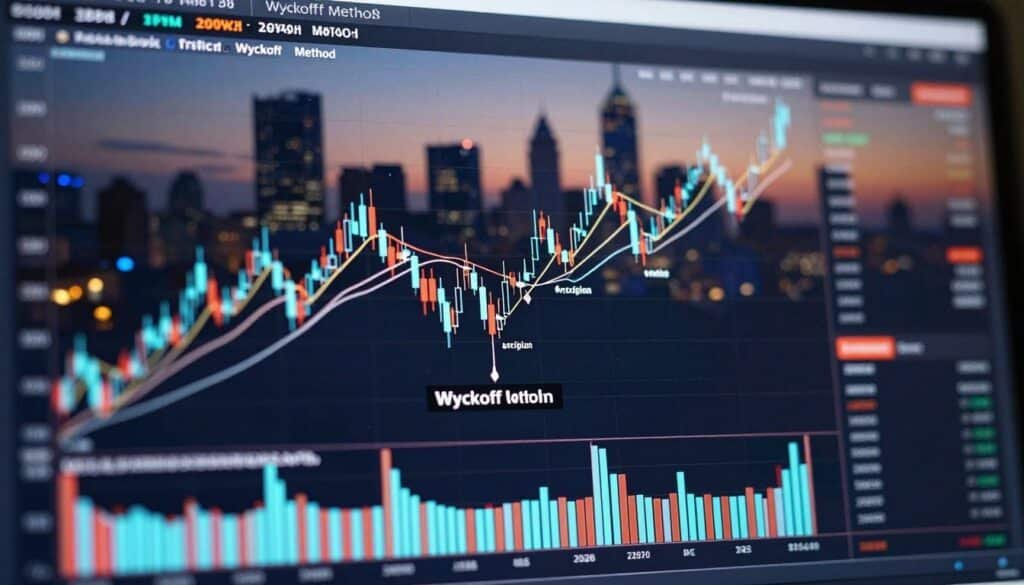
Read volume and price volume clues
Watch for absorption: large volume with limited price progress. Watch for exhaustion: shrinking volume as momentum fades. Use effort vs. result by comparing candle spread and close against volume to judge real sponsorship.
Spot manipulation and protect risk
Look for false breakouts above resistance, shakeouts below support, and crowd traps that lure late entries. Confirm phase signals (SOS/LPS or SOW/LPSY) and set invalidation points before entering to manage risk.
Wyckoff Accumulation: Phases and Key Events Traders Watch
Accumulation unfolds after a downtrend as a structured range where smart participants gather inventory before prices resume an uptrend. Watch the sequence of phases A–E to read intent: absorption, failed breakdowns, and rising demand are the clues that matter.
Phase A shows preliminary support and a selling climax (SC): panic selling with high volume and wide spreads. An automatic rally (AR) follows and a secondary test (ST) revisits lows with reduced selling pressure to set range boundaries.
Phase B is range building. Prices chop as supply and demand tussle. Look for lower volume on down moves — a common sign that selling pressure is waning.
Phase C may include a spring, a short false breakdown below support that shakes weak holders. Not every market shows a spring, but when present it often precedes reliable rallies back into the range.
Phase D gives a sign of strength (SOS) — stronger rallies on improving volume — followed by a last point of support (LPS) on lighter pullbacks. Traders often treat the LPS as the actionable confirmation.
Phase E marks markup: prices leave the range with sponsorship and prior resistance becomes support. Pullbacks to that area can serve as add-on entries if volume and trend remain healthy.
- Practical label tip: emphasize sequence and behavior — absorption, failed breakdowns, stronger rallies — rather than forcing a perfect schematic on every chart.
Wyckoff Distribution: Phases and Red Flags Before a Markdown
Distribution is the late-cycle process where the composite man and other large holders shed inventory into public demand after an uptrend. It usually unfolds inside a sideways range and can look deceptively bullish while supply builds beneath the surface.
Phase A — early supply and the climax
Preliminary supply shows up as early selling that slows the rally. A buying climax follows when retail enthusiasm peaks and volume spikes. An automatic reaction sets the lower boundary, and a secondary test revisits highs on weaker demand.
Phase B — range and rising selling pressure
During Phase B price chops inside the range while selling pressure quietly rises. Watch volume: downswings often show heavier volume and bounces grow weaker. This builds the cause for a later breakdown.
Phase C — UTAD and bull traps
Phase C can include an upthrust after distribution (UTAD), a false breakout above resistance that traps late buyers. In modern markets, leverage and breakout-chasing make these bull traps common and fast.
Phase D — sign of weakness and LPSY
A sign of weakness (SOW) is a decisive drop with strong volume and poor recovery. A last point of supply (LPSY) appears as a weak rally that fails below resistance and often gives the cleanest short or exit setup.
Phase E — markdown and role reversal
When support fails, Phase E begins: prices decline and prior support becomes resistance. Use failed retests and rising volume on down moves as confirmations that the markdown has momentum.
Red flags: repeated failure to advance despite heavy effort, increasing aggressive selloffs, and rebounds that are sold faster each time. These warn that supply outweighs demand and the range is likely to break down.
Trade Execution Playbook: Entries, Stops, Targets, and Scaling
A practical plan ties entries, stops, targets, and scaling to the range you mapped on higher timeframes. Use that structure to make objective choices during fast moves.
Long setups and decision tree
Aggressive entry: buy near support after a spring or a secondary test when price reclaims the range. Stop below the spring low.
Conservative entry: wait for a sign of strength breakout, then add on an LPS pullback with a stop below the reclaimed support.
Short setups and tiered logic
Aggressive short: enter after an UTAD rejection or early sign of weakness (SOW) near resistance. Stop above recent range highs.
Conservative short: wait for breakdown below support and a failed LPSY retest before adding size.
Stops, targets, and scaling rules
Place stop-losses at structure-based invalidation points, not arbitrary percent levels. Use the range height (cause) to project targets (effect) and refine with prior support or resistance.
- Scale in only after confirmations (LPS, breakout retest, LPSY).
- Cap total position risk so one wick does not wipe the account.
- Take partials at nearby highs/lows and on momentum shifts when effort no longer matches result.
Concrete example
For ETH ranging ~$1,800–$2,200, buy near $1,750 spring with stop below $1,730; add on a breakout toward $2,200. For BTC ranging ~$68k–$72k, treat a UTAD near $73k as a short setup with stops above $73.5k and targets at range support.
Confirmations and Precautions: Avoiding False Signals in Crypto
Avoid taking signals at face value — validate that price and volume tell the same story across timeframes. False breakouts, sudden reversals, and major news can turn a clean range into a loss fast. Manage risk first; only trade setups with clear invalidation levels.
Common failure modes
Crypto-specific failure modes include sharp breakout wicks that reverse instantly, leverage-driven cascades, sudden liquidity gaps, and news shocks that wipe out structural ranges.
How to confirm before committing size
- Require alignment across timeframes: higher-timeframe trend should not be fighting your trade.
- Make sure price holds reclaimed levels after a breakout, not just a quick spike through them.
- Set predefined stops at logical invalidation points to limit risk.
Complementary tools and context
Use simple indicators without clutter: RSI for momentum context, moving averages for trend bias, and clean horizontal support and resistance for structure clarity.
Volume still matters but can be noisy. Focus on relative changes at key events (springs, UTADs, SOS/SOW) rather than every spike. Monitor sentiment, macro headlines, and large wallet transfers as secondary context — they add color but should not override chart evidence.
Practical safeguard: if you cannot define a clear invalidation level, reduce size or stand aside. For a concise guide on chart confirmation for U.S. traders, see how to analyze crypto charts for U.S.
Conclusion
When you map price swings and volume shifts, the market’s likely path becomes easier to forecast. This approach frames accumulation and distribution as repeatable, visible processes that show who holds control inside a range.
Remember the cycle: accumulation often precedes a markup and distribution often precedes a markdown. Spotting those transition points gives traders a practical edge when paired with clear stop-loss rules.
Do this next: mark support and resistance, identify phase evidence, wait for confirmation (SOS/LPS or SOW/LPSY), then plan entries with invalidation-based stops. Keep position size small enough to survive volatility and avoid overtrading when timeframes conflict.
Finally, treat the method as probabilistic. Replay historical BTC and ETH charts, label phases, and log trades to sharpen skill and judgment.
FAQ
What is the core idea behind applying the Wyckoff framework to crypto markets?
The core idea is to read supply and demand using price and volume to spot where large players accumulate or distribute positions. Traders map trading ranges, identify key phases, and use volume behavior to anticipate the next markup or markdown. This helps create objective entries, stops, and targets in volatile markets.
Why does this framework remain relevant for today’s crypto market?
Crypto markets still reflect human psychology and concentration of capital. Large holders and institutions create recognizable patterns—accumulation, distribution, springs, and upthrusts—that show up in price action and volume. These patterns let traders infer intent and predict possible directional moves despite volatility.
How do “whale” actions and market psychology show up on charts?
Whale activity often appears as unusually high volume on key tests, sudden absorption of selling, or engineered false breakouts. Market psychology appears in repeated tests of support/resistance, panic sell-offs, and tight ranges before a decisive move—signs that smart money and retail are interacting.
What basic wins does this approach provide in a volatile environment?
It gives structure: clear range boundaries, objective invalidation points, and a method to project move size from cause built during a range. Traders gain rules for scaling, risk placement, and recognizing when a move has real follow-through versus a trap.
Who was Richard Wyckoff and why does his work translate to digital assets?
Richard Wyckoff was an early 20th-century market analyst who developed a price-action and volume-based framework describing how big operators move markets. His focus on cause/effect, supply/demand, and trading ranges maps well to crypto because those same forces drive price regardless of asset class.
What is the “Composite Man” and how does that concept help crypto traders?
The Composite Man represents large, informed operators acting as one market force. Thinking this way helps traders look for footprints of smart money—accumulation before uptrends or distribution before declines—rather than following noisy retail behavior.
How do trading ranges indicate accumulation or distribution zones?
Ranges show balance between buyers and sellers. Long sideways action with tests, reduced selling, and absorption suggests accumulation. Range activity with rising supply, frequent upthrusts and failed rallies points to distribution. Volume patterns within the range confirm the interpretation.
Where do markup and markdown phases fit relative to accumulation and distribution?
Markup follows a successful accumulation once demand overwhelms supply, creating a trending up phase. Markdown follows distribution when supply exceeds demand, leading to a downward trend. Identifying the end of the range gives clues about which phase will follow.
How does the law of supply and demand guide direction and market balance?
By reading price movement alongside volume, traders infer whether demand or supply dominates. Rising price with increasing volume signals increasing demand. Declines with rising volume indicate growing supply. This assessment shows likely short-term direction and balance shifts.
How is the law of cause and effect used to estimate potential move size?
The width and time spent in a trading range form the “cause.” Traders project an effect—an estimated target—by measuring range size and applying that as a guideline for a probable move once the range resolves. It provides a disciplined way to set targets and risk-reward.
What does the law of effort vs. result reveal about trend strength?
Comparing volume (effort) to price change (result) shows efficiency of moves. Heavy volume with little price change suggests absorption or selling into strength. Large price moves on low volume often lack conviction. This helps detect whether a breakout or breakdown is trustworthy.
How should traders start analyzing charts with this framework?
Start top-down: check higher timeframes for context, then zoom in to identify trading ranges. Mark support and resistance, study volume at tests and rallies, and watch for telltale events like springs or upthrusts. Multiple timeframe alignment strengthens signals.
What volume signals indicate absorption, exhaustion, or manipulation?
Absorption shows heavy volume on down moves with limited price decline. Exhaustion appears as extreme volume on a climax followed by a failure to continue. Manipulation clues include quick false breaks on higher volume, followed by swift reversals that trap momentum traders.
What are common manipulation clues such as false breakouts or shakeouts?
False breakouts occur when price briefly breaches a range boundary but lacks follow-through, often reversing sharply. Shakeouts or springs are quick drops below support that lure sellers before rapid recovery. Both are used by large operators to accumulate or distribute at better prices.
What events define Phase A of accumulation?
Phase A features a preliminary support where selling slows, a selling climax marked by heavy volume and volatility, an automatic rally, and one or more secondary tests that probe for remaining supply. These events mark the end of the prior downtrend.
What occurs during Phase B of accumulation?
Phase B is range building, where the market digests supply and reduces selling pressure. Price oscillates within the range, often with repeated tests and signs of absorption. This phase builds the cause for a future markup.
Why is Phase C’s spring important and how should traders treat it?
The spring is often a final shakeout that clears weak holders and tests supply. It can produce a sharp reversal and acts as a reliable entry when confirmed. Traders should wait for signs of demand—recovery on volume—before committing.
What signals define Phase D and how do traders use them?
Phase D shows a sign of strength: higher lows, rising price on increased demand, and the last point of support (LPS) acting as confirmation. Traders use these confirmations for entries and to scale positions as the markup begins.
How does Phase E mark the transition to a trend?
Phase E begins the clear markup: price trends upward, prior resistance becomes support, and pullbacks are shallower. Traders treat pullbacks as add-on opportunities while managing risk around invalidation points.
What are the key events in distribution Phase A?
Distribution Phase A shows preliminary supply where buying slows, a buying climax with heavy volume, an automatic reaction, and secondary tests that probe demand. These signs indicate the end of the uptrend and the start of the range.
What happens during distribution Phase B?
Phase B features internal range activity with rising selling pressure. Price may make new highs or fail to sustain advances. This phase builds the cause for a future markdown as supply accumulates.
What is an UTAD and why is it a red flag?
UTAD—upthrust after distribution—is a false breakout above the range that entices buyers and creates a bull trap. It often precedes a rapid reversal as supply overwhelms demand, making it a strong short-setup signal when confirmed.
How do traders use Phase D of distribution to set short entries?
Phase D shows signs of weakness: lower highs, failed rallies, and the last point of supply (LPSY). Traders look for breakdowns from support or failed retests to enter short positions with defined stops above recent highs.
What indicates that markdown Phase E has begun?
Markdown begins when support gives way and price accelerates downward on rising volume. Lower lows form, prior support turns into resistance, and short-sided momentum confirms the move.
What long setups work during accumulation?
Long entries include buying the spring or secondary test when volume shows absorption, breakout entries on clear range highs with conviction, and LPS confirmations after a sign of strength. Position sizing and stop placement follow the range’s invalidation points.
What short setups work during distribution?
Short setups include entering after UTAD signals and failed rallies, shorting breakdowns from range support, and using LPSY retests to add. Stops sit above recent supply zones to limit risk against potential false moves.
Where should stop-loss orders be placed using this structure?
Place stops beyond invalidation points: above a clear resistance after a failed rally for shorts, or below a spring or recent low for longs. Use the range structure to define logical, objective stops rather than arbitrary percentages.
How can traders scale in without overexposure during volatile moves?
Scale with predefined tranches: enter a base position at the first reliable signal, then add on confirmations like LPS or breakout follow-through. Keep position sizing disciplined and use tight invalidation points to protect capital.
What logic should guide profit-taking decisions?
Use prior support/resistance, range projections from cause/effect, and momentum shifts. Partial profit-taking at logical barriers and trailing stops on the remainder lets traders lock gains while allowing for extended trends.
What are common failure modes to watch for in crypto markets?
Watch false breakouts, sudden reversals from news or liquidity shocks, and extreme volatility that invalidates patterns. These events can break schematics quickly, so maintain strict risk management and confirmation rules.
How can other tools complement this framework to avoid false signals?
Combine price-volume analysis with indicators like RSI for divergence, moving averages for trend context, and clean support/resistance for confluence. These tools reduce reliance on a single pattern and help filter weak setups.
How should traders use market context and sentiment to reduce overfitting?
Always weigh on-chain metrics, macro news, and market sentiment alongside chart patterns. Use context to judge whether a schematic fits current conditions rather than forcing trades into textbook setups.

No comments yet