

Entering the world of digital assets starts with a crucial first step. You need a reliable way to turn your traditional money, like US dollars, into cryptocurrency. These essential services act as gateways, connecting the familiar financial system with the new digital economy.
For both individual users and companies, these access points are more important than ever. They provide a compliant and efficient path to start trading and investing. Without them, participating in the growing digital asset market would be far more difficult.
The industry has matured significantly. Modern providers now offer institutional-grade security and streamlined integration. This evolution means better options and safer experiences for everyone involved.
Our guide uses a detailed evaluation method. We rank top services by their geographic coverage, variety of payment methods, and transaction costs. We also closely examine their regulatory compliance and overall user experience.
This analysis is designed to help you make a smart commercial decision. We will break down how these platforms function, compare leading providers, and explore specialized use cases. Our goal is to guide you to the right solution for your specific needs.
Understanding Fiat On-Ramps and Their Importance in Crypto
The process of acquiring digital assets begins with a service that bridges traditional finance and blockchain networks. These platforms let individuals and businesses convert government-issued money into tokens like Bitcoin or Ethereum. They act as essential gateways for new participants.

From a user’s perspective, the flow is straightforward. You select the desired digital currency and enter payment details. Common methods include credit cards or bank transfers.
Next, you complete identity verification requirements. This step ensures security and regulatory compliance. Finally, you receive the crypto directly into your personal wallet.
Behind the scenes, the service handles complex tasks. It integrates with payment processors and complies with KYC and AML regulations. It also manages liquidity pools and bridges multiple blockchain networks simultaneously.
This infrastructure is crucial for mainstream adoption. It removes technical barriers, allowing new capital to enter the ecosystem. Users can then participate in DeFi, purchase NFTs, or start trading with ease. For both retail and institutional investors, these ramps provide the initial access point to a growing market.
The Evolution of Crypto On-Ramps: From Early Beginnings to Modern Solutions
The landscape for converting cash into digital tokens has evolved from risky experiments to regulated services. In the beginning, acquiring cryptocurrencies meant mining them or arranging peer-to-peer trades on community forums.
Early exchanges like Mt. Gox, launched in 2010, marked a milestone. They also revealed the fragility and lack of oversight in first-generation gateways.
A major shift occurred around 2014-2015. New platforms entered the market with institutional-grade infrastructure. They introduced bank-level security, comprehensive compliance frameworks, and clearer fees.
Today’s services are not one-size-fits-all. For newcomers, a smooth purchase feels like a normal online checkout. Active users and traders prioritize transaction speed and reliability alongside cost.
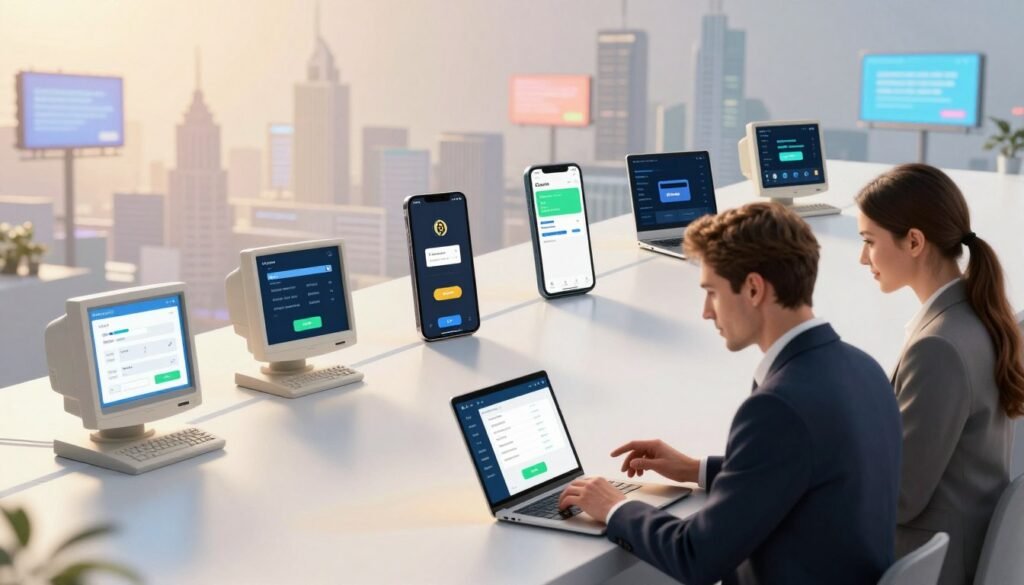
Regulation and technology continue to drive change. Modern solutions offer faster settlement and embedded purchase options inside wallets. Stronger regulatory compliance, guided by frameworks like Europe’s MiCA, is now standard.
This journey shows how these essential gateways have matured. They have moved from experimental projects to legitimate financial products with proper licensing and consumer protections.
How Fiat On-Ramp Providers Bridge Traditional Finance and Crypto
To connect traditional banking with decentralized networks, specialized platforms must master dual operational frameworks. They function as a critical bridge between traditional finance and digital, navigating two distinct worlds simultaneously.
Regulatory Compliance and Security Measures
Operating legally requires strict adherence to financial rules. Reputable providers implement comprehensive KYC (Know Your Customer) and AML (Anti-Money Laundering) protocols for user verification.
Institutional-grade security standards are non-negotiable. This includes PCI-DSS compliance, with firms like Paynote achieving Level 1 certification. Established names like Stripe and Coinbase maintain robust fraud monitoring and regulatory oversight.
This layered approach protects user funds and data. It builds essential trust in the platform while preventing illicit activities.
Payment Processing and Integration Technologies
On the technical side, seamless integration with traditional payment processors is crucial. These services must handle currency conversion, payment routing, and instant settlement.
They also manage complex backend operations. This includes maintaining liquidity pools across various digital assets and bridging multiple blockchain networks.
The goal is a smooth experience for users. Leading providers balance advanced security with minimal friction during transactions.
Key Criteria for Evaluating Fiat On-Ramp Providers
Evaluating providers that facilitate the conversion of cash into tokens involves analyzing their global reach, payment options, and fee clarity. Our recent research assessed eight leading services using a weighted scoring model.
This method establishes objective benchmarks you can use for your own selection.
Geographic Coverage and Payment Method Variety
Top platforms vary dramatically in the markets they serve. Some support over 180 countries, while others focus on specific regions.
This geographic coverage directly impacts which users can access the service. Payment method diversity is equally critical.
Look for credit cards, bank transfers, and regional systems like SEPA or UPI. More options lead to higher conversion rates and a better overall experience for users worldwide.
Fee Structures and Transparency in Pricing
Understanding costs is essential. Most providers charge transaction fees between 0.49% and 4.5%.
The final fee depends on your payment method and transaction size. Transparent platforms clearly disclose all fees and any spread markups upfront.
This transparency helps you avoid hidden costs and compare services accurately.
Other important criteria include business integration tools, the range of digital assets supported, and strong regulatory compliance. Specialization for specific use cases is also a key differentiator.
best crypto fiat on-ramps 2026
The market offers a diverse range of solutions, each tailored to specific user needs and regions. Our ranking compares eight top-tier providers across critical dimensions like geographic reach, payment options, and cost.
This comparison helps you match your requirements with the optimal gateway. Consider coverage, supported methods, and fee transparency.
- Paynote (SeamlessChex): Operates across all 50 US states. Supports ACH, cards, and bank transfers. Offers custom pricing from 0.49%. Ideal for high-volume US businesses.
- Onramper: Available in 160+ countries with 175+ payment methods. Fees vary by integrated ramp. Best for aggregated global access.
- MoonPay: Serves 160+ countries. Accepts cards, Apple Pay, and bank transfers. Charges 1% to 4.5%. Top choice for consumer platforms.
- Stripe: Available in 70+ nations. Works with cards, ACH, and digital wallets. Fees range from 1% to 2%. Excels at developer integration.
- Transak: Supports 125+ countries and 175+ methods. Costs approximately 1% plus network fees. Built for Web3 DApps.
- Ramp Network: Accessible in 150+ countries. Uses cards, SEPA, and bank transfers. Fees are 0.49% to 2.9%. Perfect for non-custodial wallets.
- Coinbase Onramp: Works in 100+ countries. Takes cards, bank transfers, and PayPal. Fees from 0% to 2.5%. Suits exchange integration.
- Banxa: Available in 100+ countries. Processes cards and bank transfers. Charges 1% to 3%. Strong in global compliance.
Each service has distinct strengths. Your decision should balance regional support, available payment options, and clear fee structures.
Detailed Reviews of Top Providers for 2026
Our detailed reviews break down the standout features and real-world performance of top platforms. This analysis goes beyond basic lists to help you understand each service’s core value.
Comparative Analysis of Provider Features and Services
Each platform offers distinct features. Paynote specializes in high-volume US business with dedicated account support. Onramper aggregates over thirty individual gateways into one integration.
MoonPay provides wide global reach for consumers. Stripe delivers excellent developer tools. Transak builds infrastructure for decentralized applications.
Ramp Network focuses on a non-custodial model. Coinbase Onramp leverages its parent exchange for extensive token assets. Banxa emphasizes strong regulatory compliance.
Other notable services include Coinify for beginners and Bleap for low fees.
User Experience and Performance Feedback
Review scores offer insight into real user experience. Paynote earns a 4.7 rating for handling complex business needs. Stripe scores 4.5, praised for its documentation quality.
Merchants highlight Paynote’s ability to process transactions others reject. Developers appreciate Onramper’s simplified integration process.
Operational details matter. Paynote holds PCI-DSS Level 1 certification. Onramper uses intelligent routing across many variables.
Active traders often value transparent fee structures and reliable support. These factors significantly influence long-term satisfaction with a gateway.
Adapting to Regulatory Compliance in a Rapidly Evolving Market
The foundation of trust in any financial gateway is built upon rigorous compliance and security protocols. Providers must constantly adapt to new rules across different countries and regions.
This legal landscape is complex and always changing. For a platform to operate legitimately, it needs proper licenses in every market it serves.
KYC, AML, and Licensing Essentials
Strong compliance starts with mandatory Know Your Customer (KYC) and Anti-Money Laundering (AML) checks. These processes verify user identities and monitor transactions.
Requirements vary by location. In the United States, a service like Coinbase Onramp holds full state licenses. In Europe, providers prepare for the MiCA framework.
Global firms like Banxa maintain multiple money services licenses. They partner with traditional payment processors to ensure legitimacy.
This verification protects user data and prevents fraud. While it adds a step for users, it provides essential legal protection for everyone.
Leading platforms balance these rules with a smooth experience. They use automated systems for fast checks without sacrificing security.
Choosing a properly licensed service is a primary selection criterion. It offers greater safety and reliability in these dynamic markets.
Innovations in Real-Time Transaction Processing and Security
Leading payment gateways now deploy sophisticated systems to process transactions in real-time while fortifying security. Credit card purchases often complete in minutes, and services like Stripe offer instant settlement for digital assets.
This speed is matched by advanced protection. Machine learning systems, like those from Mercuryo, scan for suspicious patterns. They allow legitimate trades to clear quickly while flagging potential fraud.
Specialized infrastructure handles market stress. Paynote’s transaction routing technology manages volume spikes during volatility. Integrated chargeback management adds a layer of security rare in this space.
Liquidity management is another key innovation. Platforms maintain deep pools to ensure reliable exchange rates and token availability, even when trading demand surges.
Together, these advancements create a more reliable and secure experience for acquiring digital assets. Users benefit from faster access and stronger safeguards for their funds.
Integrating Fiat On-Ramps with Digital Wallets and Trading Platforms
Developers and businesses have multiple pathways to embed purchase functionality directly into their products. A smooth integration makes the service feel like a native part of the user’s app or wallet.
This seamless connection is crucial for user retention and conversion. It allows traders to fund accounts without leaving their preferred trading interface.
APIs, SDKs, and Developer Integration Tools
Providers offer a range of technical tools for integration. The choice depends on the desired level of control and development resources.
Stripe sets a high standard with its comprehensive API documentation and embeddable widgets. Paynote provides flexible APIs tailored for business needs.
For Web3 platforms, Transak offers highly customizable SDKs. These tools are built for decentralized applications and NFT marketplaces.
- API-Based: Offers maximum control for custom fintech stacks.
- SDK Options: Reduce development time while keeping brand consistency.
- No-Code Widgets: Enable rapid deployment with simple embed codes.
Ramp Network’s JavaScript SDK is a popular choice. It embeds an overlay so users never leave the host application.
This embedded approach typically leads to higher completion rates. Keeping the user in your app or wallet creates a better experience.
Quality technical support, including detailed documentation and testing environments, is a key feature for developers. It ensures a reliable integration process.
Specialized Use Cases: Business Versus Consumer On-Ramps
Not all services for acquiring digital assets are created equal. Their design caters to distinct user profiles and commercial needs.
Companies processing high volumes have different priorities than someone buying tokens for the first time. The right choice depends entirely on your specific use case.
High-Volume, High-Risk Business Processing
Exchanges, wallet providers, and NFT platforms need robust solutions. Mainstream payment processors often decline these high-risk verticals.
Specialized services like Paynote offer white-glove support. They provide dedicated account managers and custom pricing starting at 0.49%.
This model prioritizes reliability, scalability, and compliance. The trade-off is often a narrower geographic focus, but the support for complex business needs is unmatched.
User-Friendly Options for Crypto Beginners
First-time buyers value simplicity and trust. An intuitive interface and familiar payment methods reduce the learning curve.
MoonPay excels here with a consumer-first design. It supports Apple Pay and is available in over 160 countries.
The experience is streamlined, though fees can be higher. For newcomers, this ease of use is often worth the cost.
Other options serve different niches. Onramper connects global users, while Coinbase Onramp supports a vast range of assets.
Future Trends: What to Expect from Next-Generation Fiat On-Ramps
Looking ahead, the tools for converting cash into digital tokens will become faster, smarter, and more deeply woven into the user’s journey. Instant settlement will shift from a premium feature to a standard expectation.
Buy buttons will be embedded directly in wallets and decentralized apps. This creates a seamless experience where purchasing digital assets feels like a native part of the application.
The range of supported assets is expanding well beyond Bitcoin and Ethereum. Stablecoins like USDC and USDT are now crucial for onboarding.
They provide immediate access to DeFi trading without exposure to volatility. Support across multiple blockchains offers greater flexibility for traders.
Regulation is professionalizing the entire market. Frameworks like Europe’s MiCA set clear rules, pushing platforms toward stronger compliance.
This builds trust and enables broader institutional adoption. Artificial intelligence will play a larger role in managing liquidity and detecting fraud.
Machine learning can analyze data to personalize fees and intelligently route transactions. The era of these services feeling like experimental fintech is ending.
Next-generation gateways are becoming robust, regulated financial infrastructure. This evolution makes accessing cryptocurrencies safer and more efficient for everyone.
Comparing Custodial and Non-Custodial On-Ramp Models
Choosing how to acquire digital tokens involves a fundamental decision about who controls your assets. This choice defines your experience and level of responsibility.
Custodial services, like those from major exchanges, hold your digital tokens for you. You access them through a login to your account on their platform.
This model offers convenience. If you forget your password, you can reset it. The platform can freeze an account if unauthorized access is suspected.
These services provide strong security measures. They store most customer funds in offline cold storage and maintain insurance. This security is a key advantage for many users.
The trade-off is trust. You must trust the exchange not to freeze assets or face insolvency.
Non-custodial options, like Bleap, work differently. They send purchased tokens directly to a self-custody wallet you control. The service never holds your funds.
This eliminates third-party custody risk. You gain complete sovereignty over your assets.
The responsibility shifts entirely to you, the user. If you lose access to your wallet, there is no password recovery. No support team can reverse a transaction sent to the wrong address.
Market preferences split along these lines. Custodial models dominate for beginners and active traders who value convenience. Non-custodial wallets attract users prioritizing asset sovereignty.
Hybrid solutions, like Ramp Network, recognize that one size doesn’t fit all. They offer both custodial accounts and direct-to-wallet purchases.
Conclusion
Ultimately, the platform you select shapes your entire experience in the digital asset economy. Your ideal gateway depends on your specific situation.
High-volume businesses need specialized services. Global users require broad access. Beginners prioritize simple interfaces, and developers value seamless integration.
Look beyond just transaction fees. Consider geographic coverage, payment options, and regulatory compliance. Strong security measures and support for various tokens are equally critical.
Today’s leading services offer robust, institutional-grade infrastructure. This maturity means better safety and smoother experiences for all participants.
Choosing wisely affects your operational costs, conversion rates, and long-term growth. Think about future scalability as your needs evolve.
Reliable entry points remain essential bridges between traditional finance and digital markets. Making an informed decision is a crucial step for successful participation.
FAQ
Why are fiat on-ramps crucial for cryptocurrency adoption?
These services are essential because they provide the primary entry point for new capital. They allow individuals to use familiar currencies, like the US Dollar or Euro, to purchase digital assets. Without easy and secure on-ramps, entering the ecosystem becomes a significant barrier for most people.
What are the most important factors to consider when choosing a service?
Key factors include strong security protocols, clear regulatory compliance, and transparent fee structures. You should also evaluate the variety of payment methods offered, such as credit card or bank transfer, and the platform’s geographic availability. A smooth user experience with quick verification is vital.
How do leading providers ensure the safety of my funds and data?
Top platforms implement rigorous security measures. These include mandatory identity verification (KYC), advanced encryption for data, and secure storage solutions for digital assets. Many are fully licensed and adhere to strict anti-money laundering (AML) regulations to protect users and the integrity of their service.
What is the difference between custodial and non-custodial on-ramp models?
A custodial model, used by exchanges like Coinbase, means the platform holds your assets in their wallet. A non-custodial option allows you to send purchased tokens directly to your own private wallet, such as MetaMask, immediately. This choice balances convenience with personal control over your assets.
How do these services integrate with wallets and trading platforms?
Integration is often seamless through APIs and SDKs. Many digital wallets have built-in purchase options powered by third-party providers. Trading platforms like Binance and Kraken have their own integrated on-ramps, allowing you to fund your account and start trading spot markets without leaving the app.
Are there different solutions for businesses compared to individual users?
Yes, solutions are often specialized. Businesses require high-volume processing, dedicated support, and advanced compliance tools for high-risk transactions. For individual users, especially beginners, the focus is on a simple interface, educational content, and support for common payment methods like debit cards.

No comments yet