
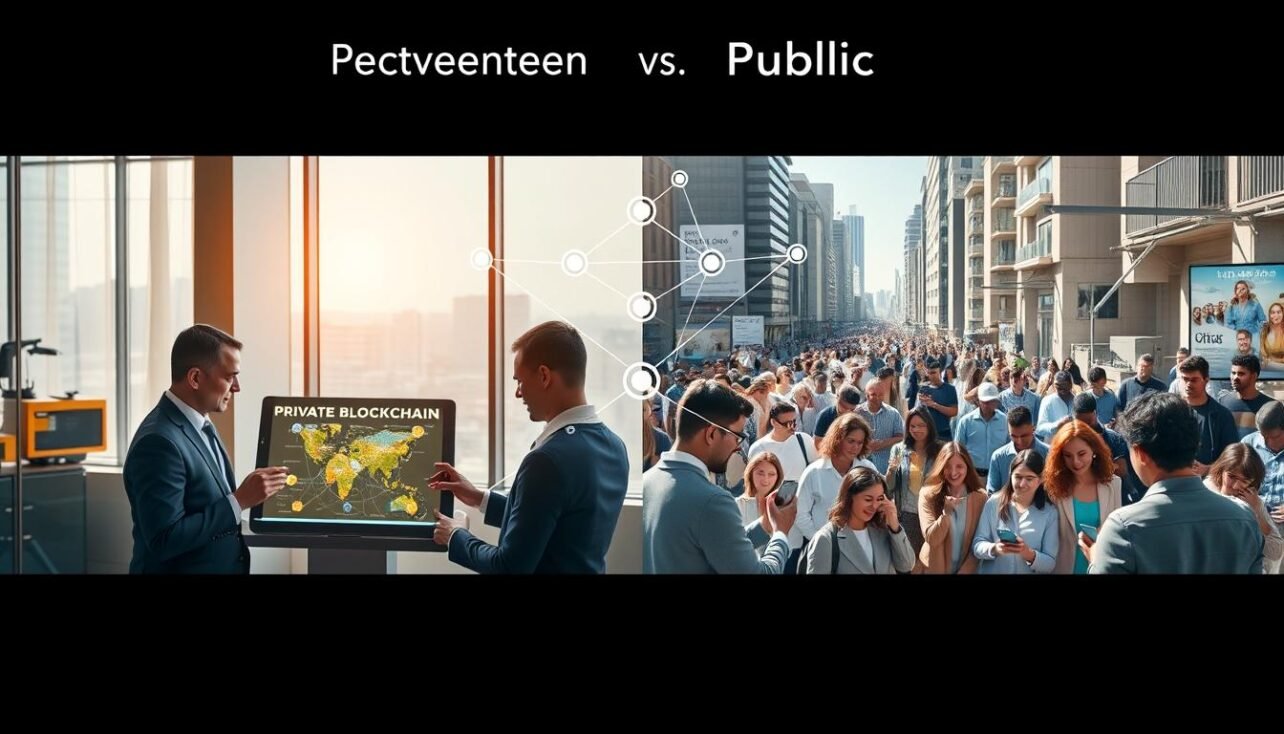
Distributed ledger technology has come a long way since its early days. What started as a single concept has grown into hundreds of unique solutions. These systems are designed to solve specific business problems across many industries.
Two main categories have emerged in this space. One is open to anyone, while the other is built for private groups. Understanding the split between these models is crucial for any organization considering this technology.
Business leaders and IT teams need a clear comparison. They must weigh factors like control, speed, and security. This guide breaks down the core distinctions.
We will look at how these systems agree on data, their design, and safety features. Real-world applications and rules for compliance are also covered. Our goal is to provide a complete framework for your decision-making process.
Blockchain Fundamentals: A Dual Perspective
The journey of blockchain began with a single, revolutionary idea in 2008. Today, hundreds of unique systems exist. Each one tackles specific needs across various fields.
This growth created two main viewpoints. One serves private groups, while the other is open to all. Grasping this split is key for making smart technology choices.
Understanding the Role of Blockchain in Enterprises
For companies, these ledgers offer controlled settings. Data visibility and participant access can be customized. This fits strict corporate rules and privacy needs.
These solutions prioritize scalability and smooth system integration. They are ideal for handling sensitive information. The focus is on governance that businesses can trust.

The Evolution of Public Blockchain Technology
Public systems evolved from the original Bitcoin design. They emphasize decentralization and permissionless access. Anyone can join the network and help validate transactions.
This model provides unmatched transparency. It creates a shared ledger in a completely open environment. Trust is built among participants who don’t know each other.
The core difference lies in data visibility and consensus rules. This evolution led to three primary models: public, private, and hybrid. Each serves different trust and operational goals.
enterprise blockchain vs public blockchain: A Side-by-Side Comparison
The core architectural choice in ledger technology pits open participation against restricted membership. This table clarifies the key differences between the main system types.

Feature Comparison and Core Principles
A public blockchain is a permissionless network. Anyone can join and help validate transactions. No single entity controls the data or protocols.
Private blockchains work very differently. A single organization controls access and the ledger. The operator can validate users and even edit entries.
A third model, called permissioned, blends features of both. It requires identity checks but allows more transparency than a fully private system.
| Feature | Private Blockchain | Public Blockchain | Permissioned Blockchain |
|---|---|---|---|
| Participant Access | Selected, verified users only | Open to anyone | Verified identity required |
| Network Control | Single entity has full control | Decentralized, no central authority | Consortium or governing body |
| Data Rules | Operator can override entries | Fully immutable and transparent | Select permissions for reading/writing |
| Information Visibility | Restricted, multi-layer access | Complete transparency to all | Configurable based on role |
Understanding the nature of these systems is crucial. It helps you pick the right type for your data sensitivity and trust needs.
Consensus Mechanisms and Transaction Validation
How a network agrees on the truth of data is governed by its consensus mechanism. This protocol is the fundamental process for validating transactions and adding new blocks. The approach differs dramatically between open and restricted systems.
Proof of Work vs. Proof of Stake in Public Blockchains
Public blockchains like Bitcoin use Proof of Work (PoW). Nodes solve complex puzzles to mine blocks, which is hard but easy for others to verify. This method consumes significant energy.
Ethereum showcases evolution by moving to Proof of Stake (PoS). This model needs less computation. Validation rights depend on how much currency a node holds.
The Proof of Stake consensus operates on a key principle. Participants with more stake have stronger incentives to act honestly. Unethical behavior would hurt their own holdings.
Validation Processes in Private and Enterprise Systems
Private networks use a completely different process. They rely on authorized participants, not intensive algorithms. A limited number of known partners handle transaction processing and consensus.
This eliminates energy-heavy mining. Rules are predetermined about which validated participants can approve transactions. The result is faster processing with fewer verification steps.
Understanding these consensus differences is crucial. They directly impact performance, energy use, and the trust model of each system type.
Network Latency and Performance Dynamics
A network’s architecture directly influences how fast its nodes communicate and validate actions. Latency, the delay in moving information, varies greatly between ledger types.
Private and permissioned systems often show faster data transmission. They have a smaller number of identified participants. This lets information travel shorter distances between nodes.
Node Connectivity and Information Speed
In these controlled environments, operators maintain fuller control over network topology. They can optimize connections between all participants. This design minimizes delay and maximizes the speed of sharing data.
Impact of Network Size on Transaction Processing
Public blockchains operate at a much larger scale. An unlimited number of users could theoretically slow things down.
In practice, efficient core groups of well-connected nodes form. This natural clustering offsets size disadvantages. It optimizes overall performance.
Transaction speed reveals a surprising dynamic. Private ledgers can achieve up to 1,500 transactions per second (TPS). Public implementations, however, can reach 50,000+ TPS with theoretically unbounded capacity. These latency performance factors show architecture often matters more than raw size.
Data Security, Immutability, and Trust
At the heart of distributed ledger value lies the promise of unchangeable records. Data security and permanence are core selling points, but how they are achieved varies greatly.
Encryption Techniques and Data Protection
Public ledgers are designed to be permanent and tamper-proof. Changing a valid entry requires controlling over half the network’s power, a feat that is both costly and obvious.
Any attempted modification is publicly detectable. This creates a strong foundation for trust based on proof, not promises.
Advanced encryption further bolsters data security. Information can be encrypted multiple times before being added to the chain. It can also be split into random fragments.
Each fragment is separately encrypted. Only the intended recipient can reassemble the information. Constant re-anonymization of participant identities adds another layer of protection.
This approach makes open networks highly secure. It relies on cryptographic complexity rather than hiding the ledger itself.
In contrast, restricted systems face different risks. A small group of validators from the same industry could collude. They might rewrite the ledger if governance fails.
True immutability in public chains comes from massive, distributed validation. Private networks depend on organizational rules and access controls. This immutable nature fosters deep trust among users. Understanding this distinction is key when evaluating private vs public blockchains for your needs.
Identity Management and Access Controls
The approach to verifying participants separates open networks from private ones. Identity management is a major operational difference. It defines how users join and what actions they can perform.
Management Solutions in Private Blockchains
Private ledgers feature built-in identity tools. These allow participants to plug in existing solutions. Organizations keep tight control over verification and access.
Individuals can store identity data on their devices. They choose what to share with validators. Third-party tools like password managers add extra protection.
Self-Registration and Permissioning in Public Networks
Public networks lack native identity management. Users self-register and guard their own private keys. There is no central account recovery.
Transactions use new addresses each time. This creates pseudonymous participants. An outside entity can only link actions if the master identity is known.
Permission structures are uniform for all. In contrast, private systems grant granular access levels. Third-party identity systems can still layer on top of public ledgers.
Compliance and Analytics in Blockchain Environments
The ability to meet legal standards and extract valuable insights from data are two pillars of successful ledger implementation. For organizations, these factors directly influence technology selection and long-term viability.
Adapting to Regulatory Requirements
Regulatory frameworks for this technology continue evolving. This creates challenges for public ledger adoption by enterprises concerned about privacy issues.
Private and permissioned blockchains show advantages. Their governance can align with existing business protocols from the start. The rules can be updated rapidly to stay compliant.
Public blockchains generally follow existing laws. However, making changes across a decentralized network takes longer. This is due to consensus needs among a large number of participants.
Leveraging Analytics for Business Insights
Analytics tools generate graphical views of transaction trends. They provide real-time alerts on high-risk activities. This lets compliance teams focus on urgent cases.
Businesses use this data to track consumer behavior and popular products. The insights help create forecasts and inform decisions.
Public ledger analytics can reveal more information due to transaction variety. Companies can enhance private network insights by combining on-chain and off-chain data stores. This approach delivers richer intelligence for any entity.
Enterprise Applications and Use Case Scenarios
Real-world adoption of this technology is no longer theoretical, with proven solutions across key industries. Practical implementations are transforming how businesses manage complex operations and data sharing.
Supply Chain, Financial, and Operational Applications
A classic use case is supply chain management. These applications track a product from creation to consumer.
They manage movement, process payments at each stage, and create a clear audit trail. This is vital for complex chains with many organizations.
A single shared ledger simplifies the entire export, transport, and import process. It also makes auditing transparent and efficient.
An added benefit is easy provenance tracking. Companies and consumers can trace a product’s history back to its origin. This solves authentication issues and supports ethical sourcing.
For many enterprises, a hybrid or consortium blockchain is the best solution. This type is accessible to authorized participants but not the general public.
Real-World Implementation Examples
Several platforms lead in real-world applications. Hyperledger Fabric offers a modular architecture and is highly rated for diverse business needs.
VeChain supports a high number of enterprise use cases. It focuses on efficient collaboration within supply chains.
For financial solutions, the Ripple Transaction Protocol is a specialized example. It was designed specifically for markets and institutional transactions.
Ethereum serves as a popular general-purpose blockchain for proof of concept projects. Choosing the right platform depends on factors like the number of participants and data sensitivity.
Conclusion
In summary, the path forward depends on understanding the fundamental philosophies behind each system type. The choice between open and restricted ledgers represents a trade-off between transparency and control.
Public networks excel where trust must be decentralized and access is open. Private solutions prioritize data privacy and regulatory alignment for known participants.
Your organization’s specific needs should guide the selection. Consider sensitivity of information, existing network structures, and compliance requirements. Hybrid solutions offer a middle path, blending features from both models.
Ultimately, successful adoption of this technology hinges on matching the ledger‘s inherent properties to your operational goals. Make an informed decision based on these core distinctions.
FAQ
What is the main difference between an enterprise and a public distributed ledger?
The core difference lies in access and governance. A public network, like the one powering Bitcoin, is open for anyone to join and participate. An enterprise, or private, system is permissioned. Access is restricted to known, vetted participants like business partners, which allows for greater control over the network’s rules and data.
How do validation methods differ between these two types of systems?
Public networks often use protocols like Proof of Work or Proof of Stake, which rely on a large, anonymous group of participants to secure the chain. In contrast, private solutions typically employ faster, more energy-efficient consensus models, such as Practical Byzantine Fault Tolerance (PBFT), where a known set of nodes validates transactions.
Which type offers better security for business data?
Both provide strong security through cryptography, but they excel in different areas. A public chain offers robust immutability and censorship resistance due to its decentralized nature. A private network provides enhanced confidentiality and access control, as sensitive information is not broadcasted to the world, making it suitable for handling proprietary business data.
How is user identity handled differently?
Identity management is a key distinction. In an enterprise setting, identities are managed and verified by the governing organization, similar to a corporate directory. Public networks are typically pseudonymous; users interact with digital wallet addresses without revealing their real-world identity, though tools for compliance like Know Your Customer (KYC) can be layered on top.
Can a private system meet strict industry regulations?
Yes, this is a major advantage for organizations. Private ledgers can be designed to comply with regulations like GDPR or HIPAA from the ground up. Administrators can control data location, implement data deletion protocols, and provide necessary audit trails, which is much more challenging on a transparent, immutable public chain.
What are common real-world uses for a private business network?
They are ideal for streamlining multi-party processes. Common applications include tracking goods in a supply chain from manufacturer to retailer, facilitating secure and instant trade finance between banks, and managing digital identities for customers across different service providers within a consortium.

No comments yet