
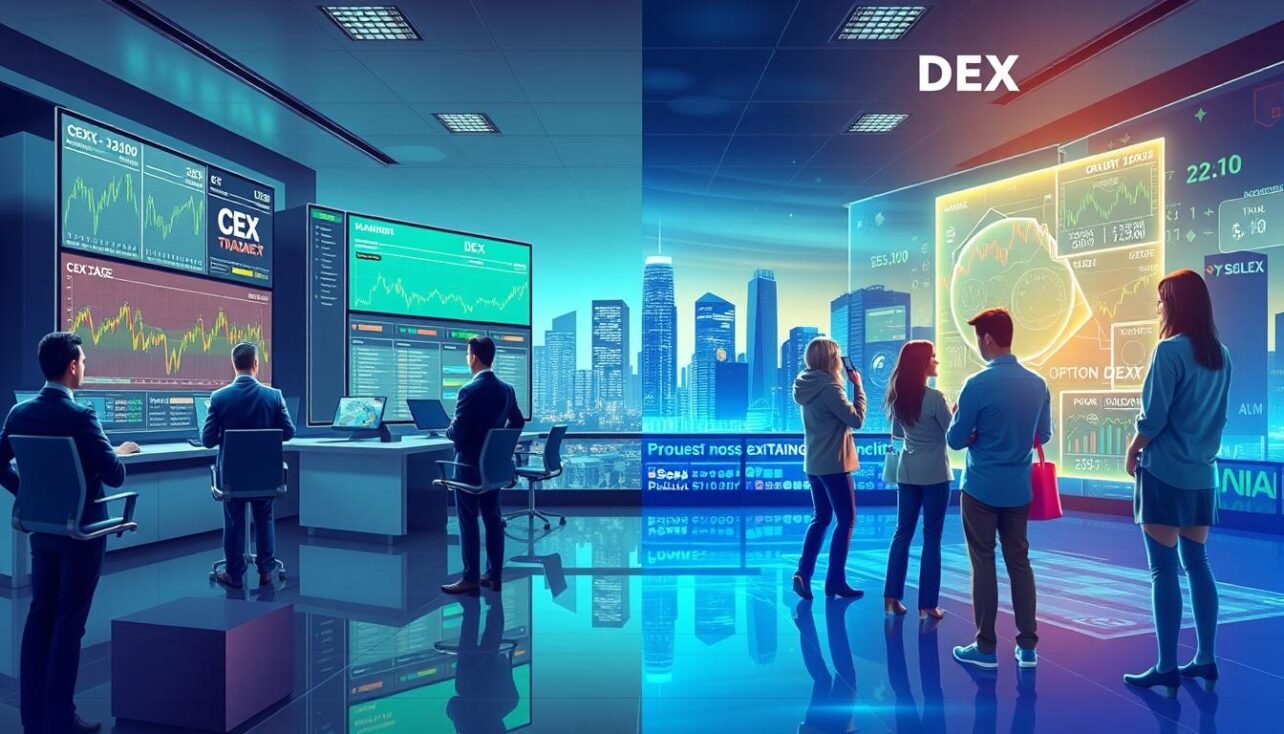
Navigating the world of digital assets means choosing where to trade. Two main paths exist: centralized and decentralized platforms. This choice fundamentally determines who controls your money and how much risk you take.
Centralized exchanges, or CEXs, are like familiar banks. Big names include Coinbase and Binance. They act as the middleman in every transaction. You trust them to hold your crypto and match your buy and sell orders.
Decentralized exchanges, known as DEXs, work differently. Platforms like Uniswap cut out the intermediary. They use blockchain-based smart contracts. This allows for direct, peer-to-peer trading.
Neither type is the single best option. Each model offers distinct pros and cons. Your preference for ease of use versus total control will guide your decision.
This guide will break down the details. We’ll look at security, fees, liquidity, and rules. Understanding these key differences helps every investor make smarter, safer choices in the crypto ecosystem.
Overview of CEX vs. DEX Trading
Today’s digital asset markets are defined by a vibrant competition between two distinct exchange architectures. The journey began with simple peer-to-peer Bitcoin transactions. It progressed to the first official crypto exchange in 2010.
Now, we have sophisticated decentralized protocols on blockchain networks. This evolution sets the stage for understanding current market dynamics.
Market Dynamics and Trends
The crypto derivatives landscape is transforming rapidly. Perpetual swaps are now the dominant instrument for leveraged exposure. Both major platform types fiercely compete for user attention and market share.
Shifting user preferences around control and privacy continue to reshape this landscape. Technological advances also play a key role in this ongoing shift.
Comparative Insights from the Crypto Landscape
When examining the broader ecosystem, several key contrasts stand out:
- Centralized platforms (CEXs) lead in total trading volume and mainstream user adoption. They offer familiar infrastructure and deep liquidity pools.
- Decentralized protocols (DEXs) show rapid growth in novel token launches and privacy-focused activities. They provide self-sovereign asset control and transparent settlement.
- Regulatory developments and Layer 2 scaling solutions are reshaping the competitive environment for all exchanges.
Both models serve vital but different roles. Ongoing innovation continues to blur some of their traditional distinctions. This creates a more diverse and robust ecosystem for all participants.
What Are Centralized Exchanges (CEX)?
For most newcomers, buying digital assets begins on a centralized platform. These centralized exchanges act as trusted intermediaries. They hold user funds and match buy and sell orders using an internal system.
Well-known CEXs include Coinbase, Binance, and Kraken. Their core engine is a central limit order book. This digital ledger lists all open order requests. A matching engine pairs them by price and time.

Advantages for Beginners
These platforms excel at onboarding. Their interfaces mimic familiar banking apps. This makes the first steps in crypto much less intimidating.
Major centralized exchanges offer deep liquidity. This means trades execute quickly at stable prices. It’s crucial for both new and experienced users.
Another key benefit is customer support. If you lose a password, help is available. This safety net is vital for building trust in the space.
Disadvantages and Security Concerns
The main risk is security. Holding vast sums makes CEXs prime targets for hackers. History shows catastrophic losses from platform breaches.
Regulatory compliance also brings trade-offs. Customer verification reduces privacy. It can also limit users based on their location.
You surrender control of your private keys for convenience. This fundamental custody trade-off is a critical consideration. For a deeper dive into the trade-offs, explore this detailed comparison.
What Are Decentralized Exchanges (DEX)?
At the heart of cryptocurrency’s promise lies a revolutionary way to trade: the decentralized exchange. These platforms enable direct peer-to-peer transactions without a middleman.
They operate on a blockchain using self-executing smart contracts. The most common model is an automated market maker (AMM). Popular examples include Uniswap and PancakeSwap.
Benefits of Non-Custodial Trading
You maintain complete control. Trades happen directly from your personal wallets. You never surrender your private keys to the exchange.
This model offers enhanced privacy. Most DEXs don’t require personal information. It often leads to lower overall fees when network conditions are good.
Challenges in Liquidity and Technical Knowledge
These decentralized exchanges typically have lower liquidity. This can cause price slippage, especially for large trades. Execution may be slower than on centralized venues.
Using a DEX requires technical know-how. Users must understand wallet management and gas fees. There is also no customer support if something goes wrong.
Custody, Security, and Control in CEXs and DEXs
Custody models separate centralized and decentralized platforms more than any other feature. This core distinction determines who actually holds your assets and manages the keys.
Custodial vs. Non-Custodial Models
On a CEX, you use a custodial model. The exchange generates and stores your private keys. Your deposited funds are technically under their control.
This creates convenience but introduces counterparty risks. You trust the platform’s security against hacks or insolvency. Account freezes are also possible.
With a DEX, you maintain a non-custodial wallet. Your private keys never leave your possession. This eliminates exchange default risk.
You gain true ownership of your assets. However, you face smart contract vulnerabilities. There is no customer support to recover lost funds.
The choice is a trade-off. Do you trust an institution with security, or do you trust yourself with complete control? Your answer shapes your entire trading experience.
Liquidity, Fees, and Transaction Costs
The financial efficiency of your crypto trades hinges on two critical factors: liquidity and fees. These elements define your real execution price and total cost.
Liquidity Comparison
Centralized exchanges typically offer superior liquidity. They aggregate countless orders in one place. This attracts professional market makers.
The result is tight bid-ask spreads and minimal price slippage. Large trades execute quickly at stable prices on major CEXs.
Decentralized platforms often face liquidity challenges. Automated market maker models can lead to wider spreads. Slippage is common, especially for less popular tokens.
Liquidity on DEXs varies greatly by token. However, Layer 2 scaling solutions are significantly improving execution performance.
Fee Structures and Gas Costs
Understanding all fees is key. CEXs use maker/taker trading fee models. They offer discounts for higher volumes.
On decentralized exchanges, users pay protocol fees plus blockchain gas costs. These gas fees are unpredictable during network congestion.
Always calculate the total cost before you trade. Include slippage, platform fees, and network costs. This ensures your expected price movement covers all transactions expenses.
User Experience and Platform Accessibility
Your first impression of a crypto exchange is shaped by its design and how easily you can execute trades. The user experience spectrum ranges from guided, beginner-friendly platforms to those requiring advanced technical knowledge.
User Interface and Trading Tools
Centralized venues prioritize user-friendly design. Their interface often mirrors familiar banking apps. This reduces friction for newcomers.
These platforms offer sophisticated trading tools. You get advanced charting, multiple order types, and portfolio tracking. Mobile applications deliver professional-grade functionality.
Decentralized exchanges have improved. Aggregators simplify the experience. However, users still need to understand wallet management and network fees.
Customer Support and Educational Resources
Major centralized exchanges provide robust support. Channels include live chat, email, and phone. Help is available for account or transaction issues.
They also offer vast educational libraries. Tutorials and video courses help beginners learn. This guided experience builds confidence.
Decentralized platforms lack traditional support. Assistance comes from community forums and documentation. The trade-off is truly global access.
Anyone with an internet connection and a wallet can trade. There are no sign-up forms or geographical gates. This permissionless nature defines decentralized access.
Regulatory Landscape and KYC Procedures
Regulatory frameworks impose significant obligations on trading venues. They shape everything from user sign-up to transaction limits.
These rules create a clear divide. Centralized exchanges operate as regulated financial entities.
Compliance Requirements in CEXs
Major CEXs must follow strict anti-money laundering laws. A core part of this is Know Your Customer, or KYC.
Users provide and verify sensitive documents. This includes government IDs and proof of address.
This compliance makes these platforms more secure but less private. Users sacrifice anonymity for institutional accountability.
Geographical restrictions are another result. Some jurisdictions prohibit certain activities. This limits how exchange customers can trade based on location.
For those comfortable with verification, regulated centralized exchanges offer legal recourse. They are a primary choice for many top crypto exchanges for U.S.
In contrast, decentralized protocols typically avoid these requirements. This preserves privacy but offers less consumer protection. The regulatory environment for all platforms continues to evolve.
Difference between CEX and DEX Trading
Understanding the distinct philosophies behind each exchange type is crucial for informed participation. These core operational models create practical differences in how you interact with digital assets.
Key Takeaways on Security and Control
The most critical distinction lies in asset custody. A centralized exchange requires you to trust a third party with your funds. In contrast, a decentralized exchange enables direct, self-sovereign ownership from your personal wallet.
Liquidity and user experience also diverge. Centralized exchanges generally provide deeper order books for faster execution. They offer guided interfaces ideal for newcomers.
Decentralized platforms prioritize permissionless access over ease. They allow pseudonymous trading without identity checks. However, users manage variable blockchain gas fees.
Your ideal choice balances convenience against total control. It weighs institutional security with personal responsibility. There is no single superior option for all crypto activities.
Perpetual Swaps: CEX vs. DEX Trading Insights
In the fast-paced world of crypto derivatives, perpetual swaps have emerged as the go-to tool for leveraged speculation. These instruments function distinctly across centralized and decentralized venues.
Understanding Perpetual Contracts
Perpetual contracts let traders speculate without an expiry date. They use a funding rate mechanism to track the spot market price.
Three core parts make them work. The index price comes from several spot exchanges. The mark price is for calculating profit and triggering liquidations.
The funding rate involves periodic payments between long and short positions. This creates ongoing arbitrage chances and keeps prices aligned.
Execution Quality and Cost Implications
For execution, cex trading offers deep liquidity and tight spreads. Orders fill in milliseconds, ideal for active strategies.
Dex trading often has wider spreads and more slippage. However, Layer 2 networks are significantly improving speed and cost.
Pricing models also differ. A cex controls its mark price internally. A dex relies on external oracle networks, which can cause brief delays.
Liquidation risk is managed differently. Centralized platforms may attempt partial closures backed by large insurance funds. Decentralized contracts execute automatic liquidations.
Smart traders weigh these execution and risk factors. They choose the platform that best fits their perpetual swap strategy.
Innovations in Hybrid Exchange Models
A new generation of trading platforms is emerging. These innovative models blend the best features of centralized and decentralized architectures.
They aim to solve the classic trade-off. You get the smooth interface of a centralized exchange with the asset control of a decentralized exchange.
Combining Ease of Use with Decentralized Control
Solutions like Ledger Wallet demonstrate this fusion. They integrate fiat on-ramps so you can buy crypto directly into a self-custody wallet.
This removes the risky step of withdrawing from a custodial platform. You maintain full control from the very first purchase.
These platforms also partner with defi aggregators. They scan hundreds of liquidity sources to find you the best rate.
All this happens within an interface as intuitive as any mainstream app. Innovations like account abstraction and Clear Signing reduce technical barriers.
While these hybrid models show great promise, they involve architectural choices. Users should evaluate each implementation based on their own priorities for security and convenience in the defi space.
Risk Management and Best Trading Practices
Successful digital asset trading isn’t just about picking winners. It’s about systematically managing potential downsides. Smart practices differ depending on whether you use a centralized or decentralized platform.
Managing Security and Custodial Risks
On centralized platforms, your first line of defense is personal. Use strong, unique passwords and enable two-factor authentication. Always research an exchange’s reputation and regulatory standing before depositing funds.
The biggest custodial risk is leaving assets on an exchange. Treat these platforms as temporary gateways. Withdraw your funds to a self-custody wallet after trading to minimize exposure.
For decentralized platforms, security starts with the smart contract. Only interact with protocols that have public audit reports. Start with a small test transaction to ensure everything works before committing larger amounts.
Mitigating Liquidity and Transaction Cost Challenges
Decentralized trading often faces liquidity challenges. Focus on the most liquid trading pairs, especially during peak market hours. Use limit orders to avoid high taker fees and control your entry price.
Apply conservative leverage, typically 3x to 5x. This provides a buffer against sudden price moves. Always calculate the total cost of a trade before executing. Include expected slippage, platform fees, and blockchain gas costs.
Effective Strategies for Both Platforms
Monitor key metrics like funding rates and oracle update frequencies. Prepare for gas cost variations by keeping a balance of the native network token. Avoid trading during known low-liquidity periods, like weekends or before major news.
Leverage analytics tools for real-time data on open interest and long/short ratios. Sophisticated traders often use both platform types strategically.
- Use centralized venues for high-frequency, active strategies.
- Utilize decentralized protocols for privacy-focused transactions and access to novel assets.
- Maintain financial sovereignty by holding a core portfolio in self-custody.
This balanced approach to risk management helps you navigate the unique challenges of each environment confidently.
Conclusion
Finalizing your approach to crypto involves selecting tools that align with your goals. Centralized exchanges (CEX) provide a smooth onboarding path. They offer intuitive interfaces and reliable support for users.
Decentralized exchanges (DEX) prioritize sovereignty and privacy. This platform type enables permissionless access aligned with blockchain values.
Neither model is inherently better. The optimal choice depends on your technical comfort and strategy. Many experienced users leverage both CEX and DEX for different trading activities.
Always apply disciplined risk management in crypto markets. Protect your capital and stay informed as the exchange landscape evolves. Preparation is key for successful trading.
FAQ
Which type of exchange is easier for a new crypto trader to use?
Centralized exchanges like Binance or Coinbase are generally easier for beginners. They offer a familiar interface, direct customer support, and handle complex processes like security and key management. This simplifies the overall trading experience for newcomers.
Do I have more control over my assets on a CEX or a DEX?
You have significantly more control on a decentralized exchange. On a DEX, you trade directly from your personal wallet using smart contracts, retaining full custody of your funds. On a CEX, you surrender control to the platform, which holds your assets in its custodial wallets.
Why are transaction fees sometimes higher on decentralized platforms?
Fees on a DEX often include gas costs paid to the blockchain network (like Ethereum) to execute transactions and smart contracts. During times of high network congestion, these gas fees can spike. Centralized exchanges usually have simpler, fixed fee structures as they operate off-chain.
What is the main security risk with using a centralized crypto exchange?
The primary risk is custodial. Since the exchange holds your assets, it becomes a prime target for hackers. If the platform is breached, user funds can be stolen. This is a key difference from the non-custodial model of DeFi platforms.
How do decentralized exchanges provide liquidity for trading?
Most DEXs use liquidity pools. Users, called Liquidity Providers, lock their crypto assets into smart contracts to create a market. Traders then execute trades against these pools, and providers earn a share of the fees. This is a core innovation in DeFi.
Are decentralized exchanges subject to KYC regulations?
Typically, no. One of the hallmarks of a true DEX is the lack of mandatory Know Your Customer (KYC) procedures. Users interact pseudonymously through their wallets. In contrast, virtually all major centralized exchanges require KYC to comply with financial regulations.
Can I trade perpetual swaps on both CEX and DEX platforms?
Yes, but the experience differs. Major CEXs like Bybit offer deep liquidity and advanced tools for perpetual contracts. DEXs like dYdX also offer them on-chain, but execution quality and costs can vary due to network speed and gas fees.
What is a hybrid exchange model?
A hybrid model aims to combine the best features of both exchanges. It might offer the user-friendly interface and high liquidity of a CEX while allowing users to maintain control of their private keys and assets, similar to a DEX. This seeks to balance ease of use with security.

No comments yet