
Last updated: November 25, 2026. This guide is general information for US taxpayers, not tax advice. Rules change; check IRS guidance or a tax professional for your situation.
Part of our Crypto Tax & Regulation Guide: everything on this topic in one place.
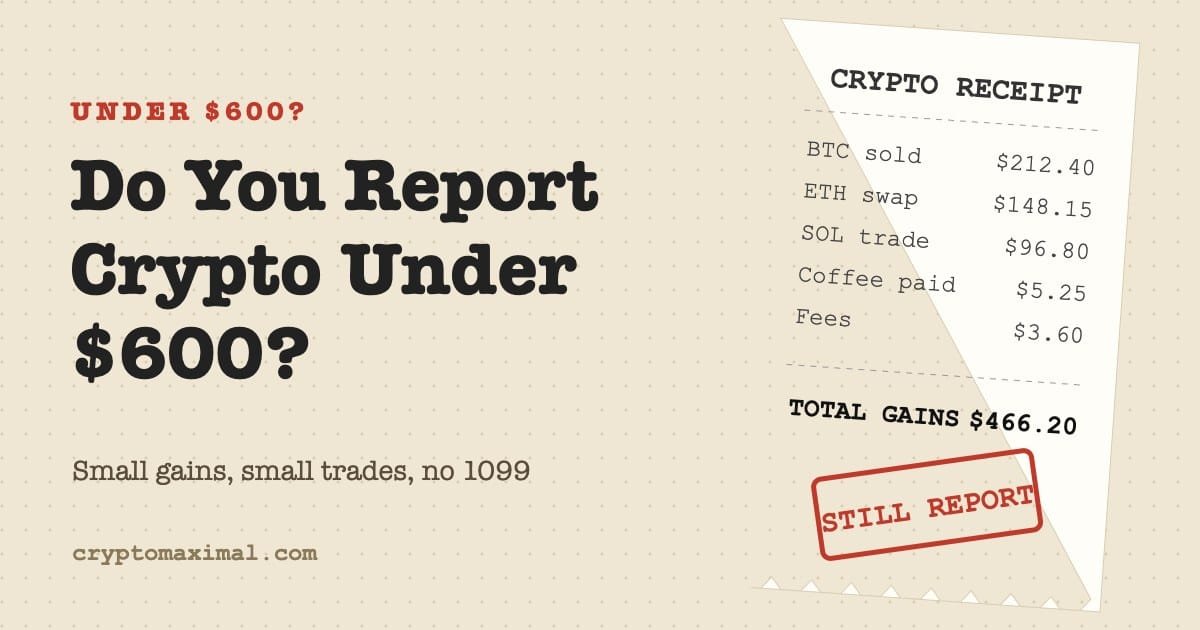
Yes. In the US you must report all crypto gains and crypto income on your tax return, even if the amount is under $600 and even if you do not get a 1099 form. The $600 figure is only the old threshold for when platforms must send Form 1099-MISC for rewards (it rises to $2,000 for tax year 2026). Crypto sales and trades are reported by brokers on Form 1099-DA with no minimum.
Where the “$600 rule” comes from
| Form | Threshold for the platform to send it | Do you still report below it? |
|---|---|---|
| Form 1099-MISC (rewards, staking, bonuses) | $600 for 2025; $2,000 for 2026 | Yes |
| Form 1099-DA (sales and exchanges) | No minimum for most sales | Yes |
| No form at all | – | Yes |
These thresholds only decide whether the platform must send a form. They do not change what is taxable.
What counts as taxable crypto activity
- Selling crypto for dollars.
- Trading one coin for another.
- Spending crypto on goods or services.
- Earning crypto: staking, rewards, mining, airdrops, payment for work.
Buying crypto with dollars and holding it is not taxable. See crypto taxes if you don’t sell.
Why you should report small amounts
- The IRS gets copies of 1099-DA and 1099-MISC forms.
- The digital asset question on Form 1040 asks every filer whether they received, sold or exchanged digital assets.
- Losses help you: small losses can offset other gains and up to $3,000 of ordinary income per year.
Is there a small-transaction exemption?
Not under current law. Even a small purchase made with crypto is technically a taxable disposal. A de minimis exemption for small transactions has been proposed in Congress, including in the Digital Asset Tax Certainty Act approved by the House Ways and Means Committee in September 2026, but it is not law yet.
How to report small crypto gains
- List each sale or trade on Form 8949 (or use tax software that creates it).
- Carry totals to Schedule D.
- Report crypto income on Schedule 1 (or Schedule C for a business).
- Answer “Yes” to the digital asset question.
Small amounts might mean little or no tax, especially if you are in the 0% long-term capital gains bracket. See crypto tax rates.
FAQ
I made $50 on crypto. Do I need to report it?
Yes, technically all gains are reportable, though the tax may be very small.
I lost money. Do I have to report?
You should, because the loss can reduce your taxes.
I never received a 1099. Am I off the hook?
No. You still report all taxable activity. See Coinbase tax documents and Form 1099-DA.
More crypto tax guides
- Crypto tax rates 2026
- Crypto tax-loss harvesting
- Form 1099-DA explained
- How to report crypto on Form 8949
- Crypto staking rewards tax
- Crypto tax calculator
Related: Lost money on small trades? Read do you have to report crypto losses.

No comments yet