
Lost money on crypto this year? You might think there is nothing to report. In fact, you should report crypto losses, and doing so can lower your tax bill. Here is when losses must be reported, how much they can save you, and how to claim them for the 2026 tax year.
General information for US taxpayers, not tax advice.
Quick answer
- If you sold, swapped or spent crypto at a loss, report it on Form 8949 and Schedule D. Every disposal is reported, gain or loss.
- Losses first cancel out capital gains, then up to $3,000 a year ($1,500 if married filing separately) can reduce your other income.
- Anything left over carries forward to future years with no expiration.
- A drop in price while you still hold the coin is not a loss you can claim yet. You claim it when you sell.
- You still answer “Yes” to the digital asset question on Form 1040 if you sold or swapped crypto, even at a loss.
Why reporting losses helps you
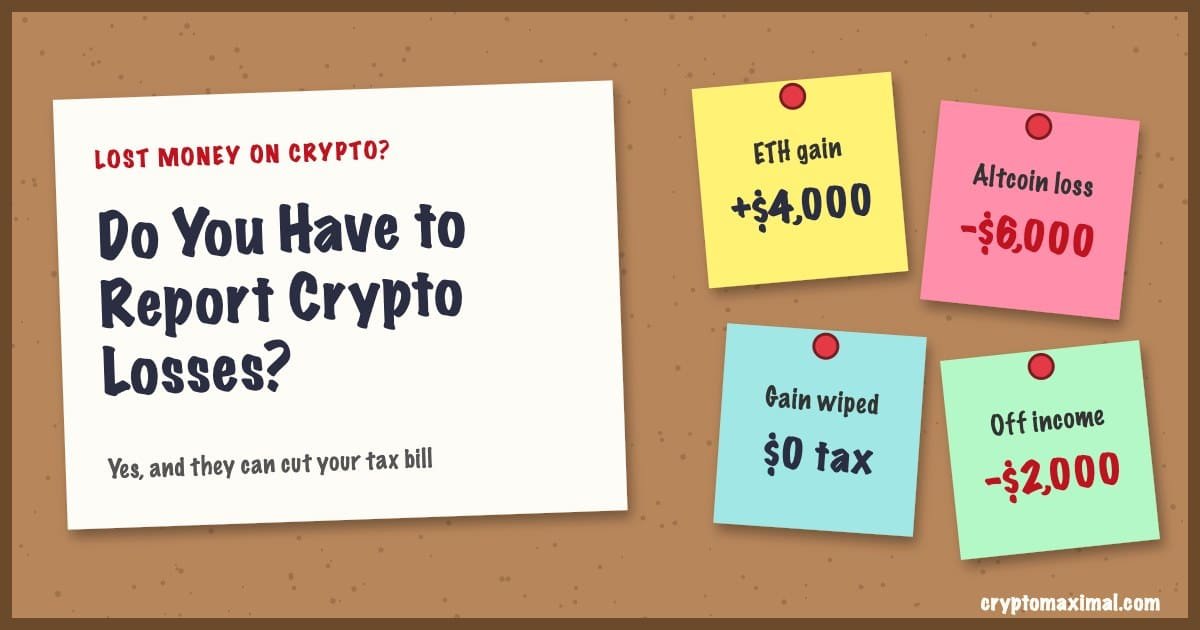
A realized loss is a tax tool. Say you made a $4,000 gain selling ETH and lost $6,000 on an altcoin. The loss wipes out the $4,000 gain, then $2,000 reduces your wages or other income. If you skipped the losing sale on your return, you would pay tax on the full $4,000 gain for nothing.
Brokers now send Form 1099-DA for many sales, so the IRS sees your proceeds. If your return does not show the sale with its cost basis, the IRS may assume the whole amount was profit (see Form 1099-DA explained).
How capital losses are used
| Step | What happens |
|---|---|
| 1. Net short-term | Short-term losses offset short-term gains first |
| 2. Net long-term | Long-term losses offset long-term gains first |
| 3. Combine | A net loss on one side offsets a net gain on the other |
| 4. Other income | Up to $3,000 of net loss reduces ordinary income ($1,500 married filing separately) |
| 5. Carry forward | The rest moves to next year, keeping its short-term or long-term character |
Because short-term gains are taxed at higher ordinary rates, a short-term loss that offsets them saves more. See 2026 crypto tax rates.
Which losses count, and which do not
- Counts: selling crypto for less than you paid, swapping a coin that fell into another coin, spending crypto that dropped in value.
- Counts: fees paid to buy and sell, which are added to basis or subtracted from proceeds.
- Does not count yet: an unrealized drop in a coin you still hold.
- Usually does not count: coins lost because you forgot the seed phrase or sent them to the wrong address.
- Special rules: hacks and scams may be a theft loss instead of a capital loss (see can you deduct stolen or scammed crypto).
- Worthless tokens: if a token still trades, selling it for a tiny amount locks in the loss cleanly.
How to report crypto losses step by step
- Download the year’s transaction history from every exchange and wallet.
- Calculate each disposal: proceeds minus cost basis. Crypto tax software can do this automatically.
- List each sale on Form 8949, split into short-term and long-term.
- Carry totals to Schedule D, which applies the $3,000 limit and calculates any carryover.
- Keep the carryover amount for next year’s return.
Plan ahead: harvest losses before December 31
If you have gains this year and coins sitting at a loss, selling the losers before year end can cut your bill. Read our crypto tax-loss harvesting guide, and check the status of the proposed crypto wash sale rule before buying back the same coin.
FAQ
Do I have to report crypto losses if I had no gains?
Yes, every sale should be reported, and you want to: the loss can reduce other income by up to $3,000 and the rest carries forward.
What if I forgot to report losses last year?
You can usually file an amended return to claim them and get a refund while the window is open. See how to amend your tax return for crypto.
Is there a limit on how much crypto loss I can claim?
No limit against capital gains. The $3,000 limit only applies to the part that reduces ordinary income in a single year.
Do I need a 1099 to report a loss?
No. You report sales whether or not you received a form. Your own records of what you paid and what you received are enough.

No comments yet