

Imagine a powerful computer that is completely cut off from the internet. It can process information perfectly, but it cannot see or interact with the outside world. This is the core challenge facing many decentralized networks today.
These secure digital ledgers have a built-in limitation. They cannot natively access external data or send information to other systems. This isolation creates a significant hurdle for their growth and practical use.
Smart contracts are self-executing agreements that live on these networks. They hold immense potential to automate complex processes in finance, insurance, and logistics. However, to be truly useful, they need real-world information. They need to know if a payment arrived, a flight was delayed, or a shipment reached its destination.
This gap between the on-chain and off-chain environments is a critical barrier. Bridging this gap is essential for unlocking the full potential of decentralized technology. This guide will explore how specialized tools connect these isolated systems to the vast world of external data.
Key Takeaways
- Decentralized networks are inherently isolated and cannot access external data on their own.
- This limitation severely restricts the real-world applications of self-executing smart contracts.
- Specialized services are required to securely bring off-chain information onto a digital ledger.
- Solving this connectivity issue is crucial for automating processes in finance, insurance, and supply chains.
- Different approaches exist, ranging from simple, centralized data feeds to complex, decentralized networks.
- Understanding these bridging mechanisms is key to building robust and trustworthy automated systems.
Introduction to Blockchain Oracles
The true potential of automated agreements hinges on a critical connection to the real world. These digital contracts are powerful but operate in isolation. They need a trusted source of outside information to function effectively.
Definition and Role of Oracles
A blockchain oracle is secure middleware that enables communication. It acts as a bridge between a blockchain network and external systems. This allows smart contracts to use real-world data.
These services perform several key tasks. They listen for requests, fetch external data from APIs, and format it for the ledger. They also validate the information and broadcast it back on-chain.
Historical Context and Evolution
The need for oracles became clear as smart contract technology advanced. Early contracts were limited to simple, on-chain actions. They could not react to external events.
This limitation sparked the development of oracle technology. It transformed basic digital agreements into powerful tools. Modern oracles now connect to various systems, like IoT devices and payment platforms.
This evolution was a major milestone. It unlocked sophisticated applications across finance, insurance, and supply chains.
Blockchain Oracle Problem and Solutions
Self-executing agreements face a critical limitation: they cannot access the external data needed to trigger their functions. This creates a significant gap between their theoretical potential and practical utility.
Understanding the Oracle Problem
Digital ledgers operate in isolated environments by design. They cannot pull information from outside sources or send data to external systems. This architectural choice creates security but limits functionality.
Automated contracts require real-world inputs to be truly useful. Financial settlements need market prices. Insurance policies need weather or IoT sensor readings. Without these connections, most applications remain theoretical.
Key Solutions for Overcoming Data Feed Challenges
Decentralized networks provide robust answers to data reliability concerns. Multiple independent sources supply information, reducing dependency on single providers.
Cryptographic validation ensures data integrity. Advanced techniques verify information authenticity before it reaches the ledger. Reputation systems track provider performance over time.
Potential Risks and Mitigation Strategies
Data manipulation represents a serious threat. Malicious actors could feed false information to automated systems. This could trigger incorrect contract executions.
Effective mitigation involves source diversification and aggregation. Using multiple providers and calculating median values prevents single-point failures. Regular security audits maintain system integrity.
How Blockchain Oracles Work
The operational mechanics of data-bridging services involve a carefully orchestrated sequence of steps. These systems create a secure pipeline for information flow between external sources and automated agreements.
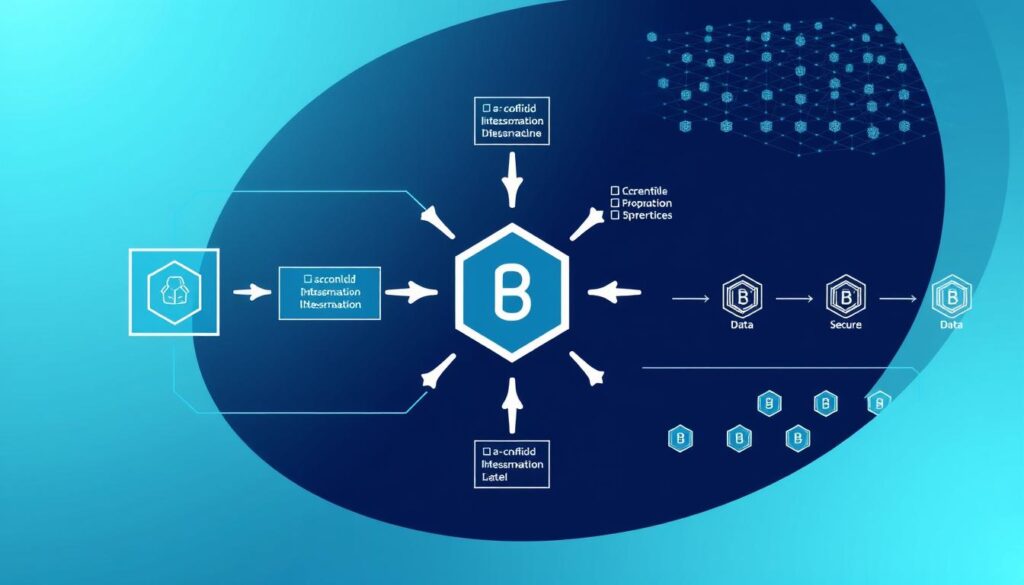
This workflow ensures that digital contracts receive accurate, timely information from the real world. The entire process maintains security and reliability throughout each phase.
Data Retrieval and Validation Process
Smart contracts initiate the data retrieval process when they need external information. They send specific requests detailing the required data type and source parameters.
The oracle system then fetches this information from designated APIs, databases, or sensors. Multiple validation techniques verify data authenticity before transmission.
Cryptographic signing and source comparison ensure information integrity. The system packages validated data into blockchain-compatible formats for secure delivery.
On-Chain vs. Off-Chain Operations
Oracle systems operate through a dual architecture that balances security with flexibility. On-chain components handle blockchain-specific tasks like transaction broadcasting.
Off-chain operations manage external data retrieval and computational tasks. This separation allows efficient processing while maintaining network security.
| Operation Type | Primary Functions | Key Characteristics |
|---|---|---|
| On-Chain | Monitoring requests, broadcasting data, maintaining reputation scores | Direct blockchain interaction, cryptographic proofs, transparent records |
| Off-Chain | Data retrieval, validation, computation, formatting | External system access, flexible processing, scalable operations |
The final step involves contract execution based on the received information. This completes the cycle of external data integration into automated systems.
Challenges with Centralized Oracles: Single Point Failure & Data Authenticity
When automated agreements depend on one external data source, they inherit all the weaknesses of that centralized entity. This creates a fundamental contradiction in systems designed for decentralization.

Centralization Risks and Impact on Smart Contracts
A single point failure represents the core vulnerability. When one provider controls critical information flows, the entire system becomes vulnerable. Technical issues like server downtime can halt operations completely.
Security breaches pose significant threats. Hacking attempts or DDoS attacks can compromise data integrity. Human errors in data management further increase reliability concerns.
Data authenticity becomes questionable in these architectures. Smart contracts cannot verify if information comes from legitimate sources. Malicious operators could fabricate data for financial gain.
The economic impact grows with contract value. As funds increase, operators face greater temptation for corruption. Bribes, intimidation, and regulatory pressure become real concerns.
Historical evidence shows even well-intentioned services eventually face challenges. They struggle to maintain 24/7 availability and absolute accuracy required for critical infrastructure.
The Chainlink Advantage: Decentralized Oracle Networks
Distributed trust mechanisms provide a robust framework for secure external data access. Chainlink’s approach eliminates single points of failure through multiple independent operators.

This architecture ensures continuous operation even if individual components experience issues. The system maintains high reliability for critical applications.
Key Features and Security Benefits
Chainlink employs several security layers to protect data integrity. Multiple node operators retrieve information from diverse sources.
Each provider must cryptographically sign their data submissions. This creates an immutable audit trail for verification purposes.
Service agreements establish binding commitments with automatic penalties. Performance failures trigger immediate economic consequences.
| Security Feature | Implementation Method | Primary Benefit |
|---|---|---|
| Data Source Diversity | Multiple independent APIs and feeds | Prevents manipulation through redundancy |
| Cryptographic Signing | Node-specific digital signatures | Verifiable data origin and authenticity |
| Reputation Tracking | On-chain performance metrics | Transparent operator quality assessment |
| Economic Incentives | Automatic reward/penalty systems | Aligns operator behavior with network goals |
Real-World Implementations
Financial applications use price feeds for billions in asset values. Insurance systems integrate weather data for automated claim processing.
Gaming platforms employ verifiable random number generation. Enterprise solutions bridge traditional payment networks with digital settlement.
These diverse applications demonstrate the practical viability of decentralized data provisioning. The technology supports complex use cases across multiple industries.
Exploring Alternative Solutions and Use Cases
As decentralized technology matures, specialized data providers have emerged to serve specific vertical markets and use cases. Different approaches cater to unique industry requirements and security needs.
Diverse Industry Applications
Financial platforms rely on real-time price feeds for lending and trading activities. Insurance companies use weather data for automated claim processing.
Supply chain systems integrate tracking information for product provenance. Gaming platforms employ randomness generation for fair outcomes.
These applications demonstrate the versatility of external data integration. Each sector requires tailored connectivity solutions.
| Service Type | Primary Function | Common Applications |
|---|---|---|
| Software-Based | API data retrieval | Financial markets, weather information |
| Hardware-Connected | Physical sensor data | Supply chain tracking, IoT monitoring |
| Inbound Services | External data delivery | Price feeds, event verification |
| Outbound Services | Trigger external actions | Payment processing, system notifications |

Comparing Service Providers
Evaluation criteria include data source diversity and update frequency. Security audit history and community adoption also matter.
Cost structures and blockchain compatibility influence selection decisions. Provider track records with significant value management provide confidence.
These factors help developers choose appropriate connectivity services. The right selection depends on specific application requirements.
Practical Strategies for Implementation & Security
Successful deployment of automated systems requires meticulous planning around external data connectivity. This planning phase establishes the foundation for reliable smart contracts that depend on accurate information feeds.
Comprehensive development begins with clearly defining data requirements and identifying trusted sources. Teams must determine acceptable latency levels and establish security parameters based on contract value.
Best Practices for Integration
Multi-oracle architectures provide robust security by aggregating information from independent providers. This approach eliminates single points of failure and enhances system reliability.
Effective integration strategies include using median calculations to filter outliers. Threshold requirements ensure execution only occurs when consensus exists among multiple data sources.
Cryptographic verification of oracle signatures adds another layer of protection. On-chain validation checks reputation scores before accepting information. Time-bound freshness checks reject stale data.
Thorough due diligence when selecting services is crucial for successful implementation. Evaluate provider history, audit results, and decentralization levels. Testnet deployments validate behavior before mainnet launch.
Continuous monitoring systems detect anomalies and notify developers of failures. Fallback mechanisms allow manual intervention during disruptions. This defense-in-depth approach combines multiple security layers.
Regular performance reviews and periodic audits maintain system integrity. Staying informed about emerging technologies ensures ongoing improvement across all applications.
Conclusion
Secure data bridges have become indispensable infrastructure for practical blockchain implementations. The blockchain oracle problem represents a fundamental challenge that must be solved to unlock transformative potential.
Decentralized networks provide robust answers through multiple validation methods. These approaches ensure reliable information flow between isolated systems and external sources.
The evolution from centralized architectures to sophisticated distributed networks mirrors broader technology maturation. Future developments will incorporate advanced cryptographic techniques and cross-chain capabilities.
Successful implementation requires careful evaluation of security properties and data quality. The growing ecosystem offers flexibility for diverse application requirements across industries.
As decentralized technology reshapes business processes, reliable data connectivity becomes foundational. Solving this infrastructure challenge enables the next generation of trustless automation.
FAQ
What is the blockchain oracle problem?
The blockchain oracle problem refers to the challenge of securely and reliably bringing external data onto a distributed ledger. Since these networks are closed systems, they cannot natively access information from the outside world. This creates a critical issue for smart contracts that need real-world data to execute, as the data source can become a single point of failure.
Why is a single point of failure a major risk for oracles?
A single point of failure is a huge risk because it undermines the core security of a decentralized application. If a smart contract relies on just one data source and that source is compromised, manipulated, or goes offline, the contract’s execution becomes unreliable. This can lead to massive financial losses and break the trustless nature of the application.
How do decentralized oracle networks like Chainlink solve this problem?
Decentralized oracle networks (DONs) solve the problem by using multiple independent nodes to fetch and validate data. Instead of one source, a DON aggregates data from many sources. The network then uses a consensus mechanism to deliver a single, validated data point on-chain. This approach removes the single point of failure and greatly enhances security and reliability.
What are some common use cases for blockchain oracles?
Oracles enable a wide range of applications. Common use cases include decentralized finance (DeFi) for price feeds, insurance for weather data or flight status, gaming for verifiable randomness, and supply chain management for tracking real-world shipment events.
What is the difference between on-chain and off-chain oracle operations?
Off-chain operations involve fetching data from external systems and APIs outside the network. On-chain operations refer to the process of submitting that validated data into a transaction on the distributed ledger. A complete oracle service manages both steps securely.
How can developers mitigate risks when integrating an oracle?
Developers should use reputable, decentralized oracle networks, implement multiple data sources for critical information, and set up monitoring for data anomalies. Choosing a provider with a strong security track record and a transparent validation process is a key best practice for safe integration.

No comments yet