
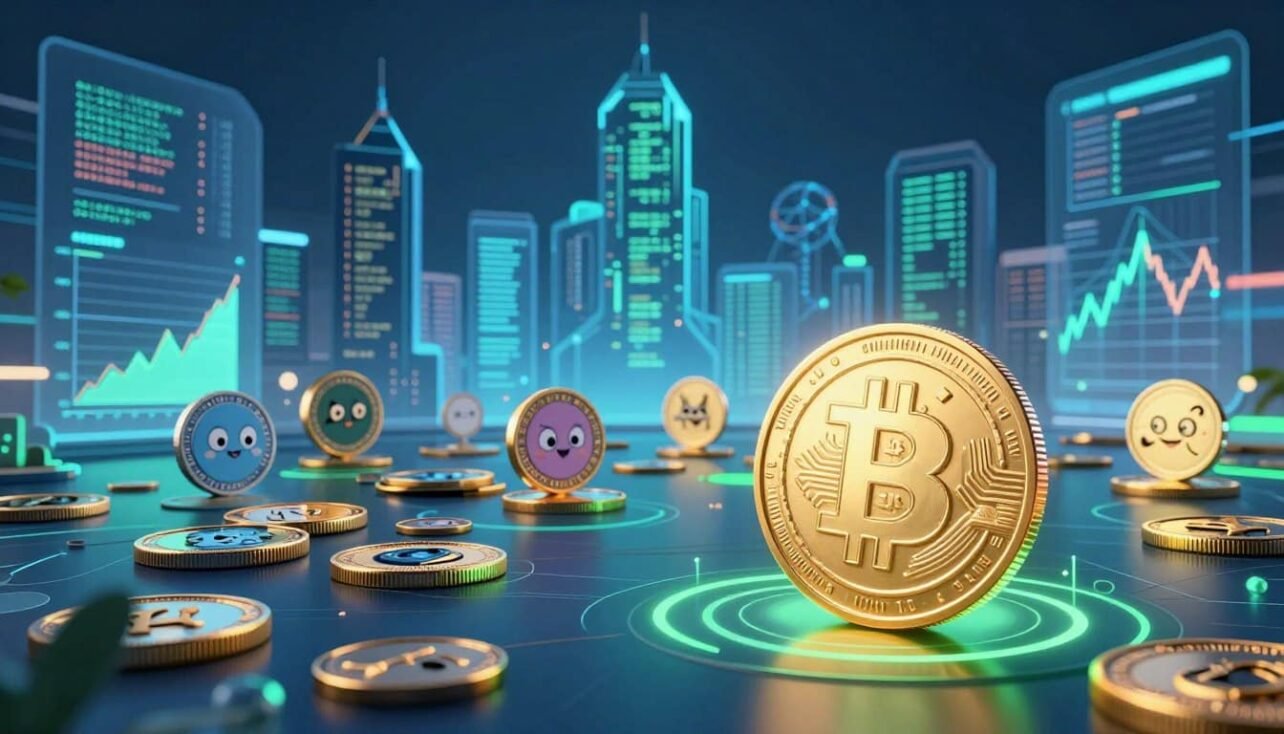
What are AI meme coins and why does the question matter to US investors navigating a crowded crypto market?
The phrase frames a simple comparison: short-term excitement versus long-term fundamentals. Many tokens show bursts of attention, then fade. Some keep working through development, listings, or use cases.
Data from 2025 matters: the meme sector saw market cap fall about 22% year-to-date and trading volume drop near 27% by November, after a brief Q3 rebound. That cooling makes fundamentals and risk controls more important than branding.
This article is informational, not financial advice. It will explain how these tokens work, what drives price moves, and what might count as real value beyond catchy names.
Expect high volatility and low survivability for many memecoins. The goal is to give US-facing investors a practical framework to assess assets, spot speculation, and weigh regulatory and exchange risks.
What AI meme coins are and why they exploded in the crypto market
What started as joke tokens evolved when teams paired community-driven concepts with claims of cutting-edge features.
Practical definition: A meme coin is a trend-driven cryptocurrency built on humor, pop culture, and group identity. Most launch with little intrinsic utility and rely on social interest and trading momentum.
How memecoins differ when labeled with technology
Projects that add tech branding keep the same community focus but claim agents, chatbots, automated art, or other features. That label can raise attention without proving product depth.
On-chain mechanics and common platforms
These tokens are simple contracts on an existing blockchain. Creators distribute supply to wallets and liquidity pools, then price discovery happens on DEXs and exchanges.
Base and Solana are common launch platforms for fast, low-cost experiments. That combination speeds distribution and short cycles of attention.
Why launches are so fast
- Token factories automate contract creation and liquidity pairing.
- Social pushes and simple launch scripts move new tokens into trading quickly.
- Low fees let many creators mint tokens, which raises saturation risk.
Takeaway: Easy creation means supply often outpaces demand. The presence of a technology label does not guarantee usable systems. For background on agent-branded projects, see what are AI agent meme coins.
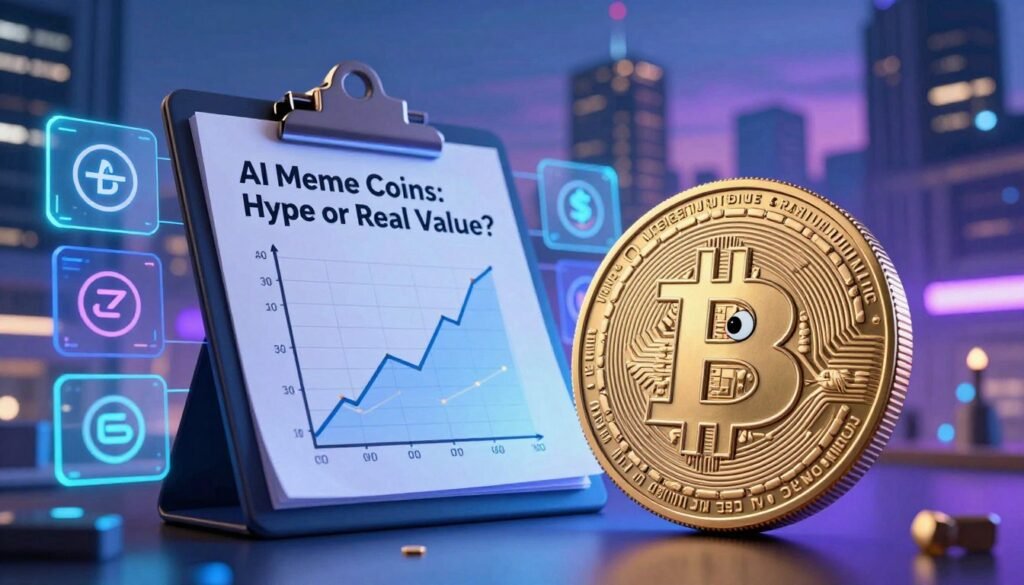
AI Meme Coins: Hype or Real Value?
Social buzz can lift a token overnight; lasting adoption needs repeat users and clear utility.
The quick surge: social media, retail traders and reflexive price action
Hype often starts with storytelling and viral posts. Influencers, forums, and retail buyers create reflexive buying that pushes price up fast.
That surge can be profitable. It is fragile: low liquidity, concentrated holders, and sentiment swings can erase gains just as fast.
Where durable demand can come from
Fundamentals mean measurable utility, governance that works, and product traction that draws repeat users.
Look for projects with on‑chain use, steady retention, and verifiable data rather than marketing claims.
What credible utility must include
- Verifiable automation or execution, not just branding;
- Clear user workflows and limits;
- Open code, audits, and retention metrics.
Quick checklist to spot wrappers
Roadmap realism, evidence for data claims, public repos and audits, and genuine on‑chain activity separate substance from speculation.
For context on market narratives and top project lists see speculative hype analysis and a curated top picks for 2025. Use these signals as a decision framework for investment and trading in the US crypto market.
2025 reality check: market cap, volume, and volatility trends for meme coins
By late 2025 the market showed clear signs that speculative attention had thinned across the sector. Data through November make the point: overall market cap for meme coins fell about 22% year-to-date, while trading volume declined roughly 27% in the same period.

Dominance shifted dramatically. Early 2025 saw these tokens account for near 11% of total crypto trading volume. By April that share dropped below 2%, signaling a broad risk-off move and weaker marginal buyer demand.
- Blue‑chip volatility: DOGE down ~57% and SHIB (shiba inu) down ~61% illustrate category-wide stress.
- Supply glut: more than 800,000 new tokens launched in H1 2025, fragmenting capital and communities.
- Liquidity risk: many tokens never secure steady volume and become, in practical terms, effectively dead — wide spreads, zero sustained trading, and abandoned channels.
In a shrinking market with high volatility, branding without clear product or users rarely reverses these trends. Investors should treat this data as a cautionary lens on token survivability and platform churn.
Risks for US investors: regulation, fraud, and trading pitfalls
Before buying, US investors need to separate legal labels from practical safety measures in token markets.

SEC guidance in context
The SEC has said most meme coins are not securities if they lack yield or an investment-contract design. That label only narrows one regulatory path.
It does not stop misleading marketing, undisclosed insider allocations, fake partnerships, coordinated dumping, or deceptive technology claims.
Enforcement realities
The DOJ prosecuted bot-driven manipulation in 2024, a case that showed trading activity can be manufactured to lure buyers. These actions target fraud, not every misleading statement.
Common memecoin risk factors
- Low liquidity that causes slippage and poor fills.
- Extreme volatility that can wipe out positions fast.
- Developer abandonment and roadmap promises that never ship.
- Inflated price signals from bots and wash trading.
Practical due diligence for US investors: verify contract addresses, check holder concentration, review audits, and confirm exchange quality. Match your investment or trading purpose—short-term speculation differs from long-term asset selection.
For context on top sector picks and trends see top picks for 2025.
Conclusion
, Short-term social runs often create big trading swings, but lasting gains need governance, users, and clear product fit.
2025 showed that falling market cap and weaker volume make many coins hard to revive after initial media attention. Weak projects often lose liquidity and fade quickly.
For US investors, treat meme coins primarily as speculative trading instruments unless a project proves sustained on‑chain utility, transparent data, and user traction.
Keep a short checklist: credible roadmap, public audits, steady user metrics, and controls that match the asset’s volatility. If the only technology is branding, the proposition rests on hype; if users show up, fundamentals may support potential.
Understand market structure, use reputable platforms, size positions carefully, and expect extreme volatility as the default in these cycles.
FAQ
What are AI-themed memecoins and how do they differ from traditional tokens?
AI-themed memecoins combine playful internet culture with artificial-intelligence branding. Unlike utility tokens built for specific services, these assets often rely on community engagement, viral marketing, and social platforms for price momentum. They may claim AI ties, but many use the label more as a marketing hook than evidence of technical integration.
How do these tokens operate on-chain and which platforms are common?
These tokens are standard smart-contract assets issued on blockchains like Ethereum, Solana, and Base. They follow token standards such as ERC-20 or SPL, move via wallets like MetaMask or Phantom, and frequently launch through token factories, DEXes, or launchpads. Transactions, liquidity pools, and on-chain supply mechanics govern their behavior.
Why can anyone create a new memecoin so quickly?
Token templates and automated minting tools let developers deploy new contracts in minutes. Launch services and copy-paste code reduce barriers to entry. That speed means thousands of tokens appear with little vetting, creating a supply glut and raising the risk of low-quality projects.
Are these assets purely driven by hype or can they hold lasting value?
Many are driven by social momentum and retail speculation, which fuels rapid price swings. Some projects attempt to build lasting value through real utility, governance, or product adoption. Long-term value usually requires measurable user traction, transparent roadmaps, and credible teams rather than marketing alone.
What would meaningful AI-related utility look like for a token?
Credible AI utility includes on-chain data services, verified ML model access, real user payments for AI features, or governance tied to model updates. The key is measurable usage, audited tech claims, and integration with existing developer or enterprise workflows—not vague buzzwords.
How can investors tell genuine projects from tokens that are just a wrapper?
Look for transparent roadmaps, independent audits, verifiable team identities, on-chain activity metrics, and meaningful user or developer adoption. Beware of exaggerated data claims, anonymous teams with no track record, and marketing-heavy launches with no clear product milestones.
What do 2025 market trends say about sector health?
By late 2025, the niche experienced a notable drawdown: market cap and trading volumes fell, dominance dropped from double digits to low single digits, and many tokens showed persistent volatility. These signals point to a maturing yet correction-prone segment where only a few projects retain attention.
How have blue-chip community tokens performed as volatility indicators?
High-profile community tokens such as Dogecoin and Shiba Inu acted as bellwethers. Their large drawdowns highlighted sector risk: steep losses reflected sentiment shifts and underscored that even widely held community assets can lose substantial value during market stress.
How big is the supply problem and what does it mean for liquidity?
Hundreds of thousands of new tokens launched in early 2025, creating a supply glut. Most of these lack sustained trading interest, leading to shallow order books, high spreads, and a high chance that projects become effectively dead—holders can struggle to exit positions without heavy slippage.
What regulatory risks should US investors keep in mind?
US investors face regulatory uncertainty. SEC guidance suggests many community tokens aren’t securities, but that classification doesn’t eliminate fraud, tax obligations, or enforcement actions. DOJ prosecutions have targeted market manipulation, and regulators can still pursue misleading claims or illicit fundraising.
What common red flags indicate a risky token?
Red flags include anonymous teams, lack of audits, fake trading volume, aggressive influencer marketing, locked liquidity that later unlocks, and sudden token burns or supply changes. Low liquidity and steep concentration of holdings among a few wallets also increase risk.
How should retail investors approach trading these assets?
Treat them as highly speculative. Use position sizing, set stop-losses, and avoid investing money you can’t afford to lose. Verify on-chain data, check audits, and prefer projects with transparent teams and demonstrable user activity. Diversify to manage idiosyncratic risk.
Can governance tokens add protection or value to a project?
Governance tokens can offer community control over protocol parameters, funding, or product direction, which may add long-term value if participation is active and decisions lead to growth. However, weak governance or voter apathy can render such tokens ineffective as safeguards.
Should institutions consider exposure to this segment?
Institutions should apply strict due diligence, clear investment mandates, and robust custody and compliance procedures. Many firms treat these assets as trading rather than strategic holdings due to volatility, regulatory ambiguity, and concentration risks.
Where can I find reliable on-chain and market data for due diligence?
Use reputable sources like CoinGecko, CoinMarketCap, Dune Analytics, Nansen, and on-chain explorers such as Etherscan and Solscan. Cross-check liquidity, holder distribution, and contract code to avoid misleading metrics and inflated volume claims.

No comments yet