
The digital asset landscape reached a historic peak in 2025. The total crypto market valuation soared past $4 trillion for the first time.
Bitcoin led the charge, smashing records above $122,000. Now, a powerful shift is underway. Momentum is building for other major players like Ethereum.
This change is about the flow of money, or capital, between assets. Investors move funds based on timing and new opportunities. Recognizing this pattern is key to capturing growth.
Bitcoin’s share of the cryptocurrency market hit 65% in June 2025. It has since fallen nearly 7% in one month. This is the biggest drop since late 2022.
This signals a major transition in the crypto market. Money is starting to flow into other high-potential digital assets. Understanding how to navigate this rotation early can define your success.
It separates those who see modest gains from those who achieve exponential returns. The current market phase demands a strategic approach.
The Fundamentals of Altcoin Rotation
At the heart of every major market shift lies a fundamental principle: capital follows opportunity. In the crypto world, this movement is systematic and often predictable.
What is Altcoin Rotation?
This process describes a period where money flows from Bitcoin into other digital assets. It happens when Bitcoin’s price stabilizes after a big rally.
Investors then look for higher growth in smaller projects. This shift is not random. It follows the natural rhythm of market cycles and investor confidence.

Historical Market Patterns and Shifting Narratives
Past cycles show clear templates. After Bitcoin leads, new narratives drive interest in other coins.
Technological developments, like DeFi or NFTs, have historically fueled these phases. Recognizing these patterns is essential for timing.
Spotting the signs of an altcoin season early can be a major advantage. It allows for strategic capital allocation during key windows.
Key Market Trends Impacting Altcoin Rotation
Sharp declines in bitcoin dominance often precede powerful rallies in other digital assets. Tracking this metric is crucial for spotting the early stages of a major market shift.
Bitcoin versus Altcoin Performance
Bitcoin dominance measures Bitcoin’s share of the total crypto market cap. It recently fell nearly 7% in one month.
This is the largest drop since late 2022. The move was largely driven by Ethereum’s 56% surge. Bitcoin gained only 14% in the same period.
This performance gap shows capital is actively rotating. You can see more analysis on this capital rotation trend.
Indicators of an Emerging Altcoin Season
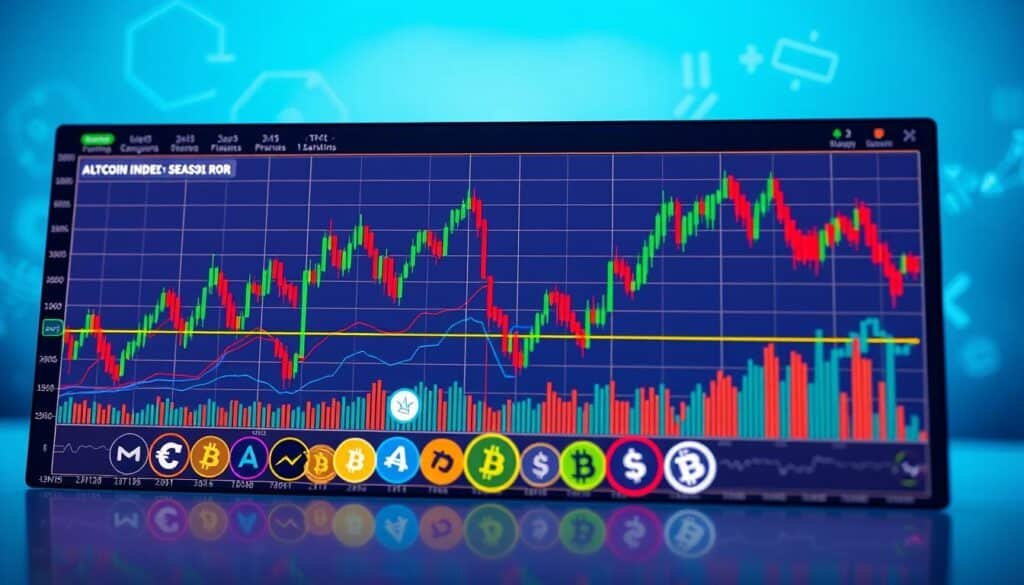
The Altcoin Season Index is a vital tool. It tracks the top 100 altcoins against Bitcoin over 90 days.
The index currently reads 57 out of 100. This signals a transition from a Bitcoin-led market.
Readings between 50 and 75 are considered the optimal entry zone. When the index exceeds 75, it often marks a peak.
In December 2024, it hit 87. The subsequent altcoin season quickly lost steam. At 57, conditions represent a strategic sweet spot.
Momentum is confirmed, yet significant upside potential remains.
Regulatory and Institutional Influences
A maturing market infrastructure is emerging from recent legislative wins and corporate treasury moves. This combination is reshaping market conditions for digital assets.
It creates a more stable environment for sustained capital movement.
Recent U.S. Regulatory Developments
2025 brought notable U.S. regulatory strides. The GENIUS Act establishes a federal framework for stablecoins.
The STABLE Act demands more transparency from issuers. The CLARITY Act proposes clear rules for asset classification.
In June 2025, the Federal Reserve removed “reputational risk” from bank supervision. This eliminates a major barrier for financial institutions serving crypto clients.
Institutional Treasury Activity and Crypto ETFs
Corporate treasuries are actively diversifying. They are acquiring major tokens like Bitcoin, Ethereum, and Solana.
Emerging assets like TAO are also gaining interest. This signals deep confidence in the asset class.
Access for traditional investors is expanding rapidly. New crypto ETFs for Solana, XRP, and Litecoin have launched.
Strong inflows into ETH ETFs show growing interest from asset managers. This maturing infrastructure supports broader participation.
These developments create the foundational market conditions needed for a healthy altcoin rotation. It is a shift from speculative cycles to sustained growth. Savvy investors can hedge against crypto volatility within this new framework.
Technical Analysis: Bitcoin’s Consolidation & Altcoin Opportunities
Charts and price data now point to a specific setup that has historically preceded major shifts in capital allocation. This technical view provides clear signals for the current market phase.
Fibonacci Retracement Levels and Market Consolidation
Bitcoin is consolidating between key Fibonacci retracement levels. This zone, from $117,000 to $121,500, follows a 76% yearly rally.
Such a pause is a classic cool-off period. It often sparks capital flow into other digital assets seeking higher returns. A common principle is when the king rests, the princes rally.
The ETH/BTC Ratio as a Signal for Rotation
The Ethereum-to-Bitcoin price ratio is a powerful indicator. After sitting at multi-year lows, it has broken into a key resistance zone near 0.032.
This breakout shows a meaningful shift in momentum. Ethereum surged 56% last month, far outpacing Bitcoin’s 14% gain.
Historically, a rising ETH/BTC ratio marks the start of broader market rotation. It signals that capital is moving, with Ethereum often leading the way for other major crypto assets.
Sentiment and Momentum in Crypto Cycles>
Beyond charts and metrics, the pulse of the market is found in the conversations and actions of its participants. Shifts in sentiment and momentum often provide the earliest signals of a changing phase.
These psychological cues appear before major price moves materialize.
Social Media, Narrative Shifts, and Trading Volume Trends
Rising social media discussion is a primary gauge. New narratives like decentralized physical infrastructure (DePIN) and AI-blockchain integration capture attention.
This buzz drives capital allocation decisions. However, social hype alone is not a reliable signal.
Sustained trading volume across multiple sectors confirms genuine capital flow. It distinguishes sustainable momentum from temporary speculation.
Traders should watch for strength in various crypto categories, not just one.
When high volume aligns with powerful new narratives, a meaningful shift is likely underway. Market sentiment evolves from conservative accumulation to risk-seeking behavior.
Traders gain confidence in the broader crypto market direction. This creates a self-reinforcing cycle.
More attention leads to more trading, which attracts more capital. This process can accelerate a major rotation.
Successful participants learn to view these indicators as a collective story, not in isolation.
Identifying When to Shift Your Capital
An Altcoin Season Index reading of 57 signals a strategic inflection point for portfolio managers. This metric places the market in a unique sweet spot. It confirms momentum has begun, yet significant upside potential remains.
Market Timing and Investor Sentiment
The goal is not to pinpoint the exact top or bottom. Instead, investors must recognize the phase transition. The current index reading represents the optimal window for action.
It balances early entry with confirmation. This avoids moving capital too soon or chasing exhausted rallies. Preparation matters far more than perfect timing.
Investors who research projects early can execute shifts strategically. They are not forced to react to sudden market moves. Understanding cycles is key.
Watch for concrete signals of a capital shift. Declining Bitcoin dominance and large-cap outperformance are primary indicators. Rising volume and strong new narratives provide confirmation.
Investor sentiment evolves through distinct phases. It moves from cautious accumulation to exploratory allocation. Successful participants monitor which crypto flows are strongest.
They adjust their timing based on institutional, retail, or speculative movements. This layered approach defines a successful strategy.
Developing a Diversified Trading Strategy
Investors seeking sustained growth must allocate capital across distinct risk categories. A single, concentrated position is vulnerable to sudden market shifts.
Sophisticated trading strategies use a layered framework. This approach manages exposure and captures gains from different capital flows.
Building Core, Tactical, and Speculative Layers
The core layer anchors your portfolio. It holds long-term assets like Bitcoin, intended as a “never-sell” position.
The tactical layer seeks momentum. It targets top-tier assets such as Ethereum and Solana during a capital rotation.
The speculative layer allocates high-risk capital. It chases emerging narratives like AI tokens, real-world assets (RWAs), or memecoins.
Allocating Assets Across Different Risk Profiles
Your risk tolerance dictates the allocation between these layers. A conservative portfolio might have 70% in the core.
An aggressive one could allocate more to tactical and speculative plays. Current conditions favor this strategy.
Strong institutional inflows support the tactical layer. Retail momentum fuels the speculative one. This balanced exposure lets you benefit from multiple trends at once.
It prevents the mistake of going all-in on a single altcoin or sector. Diversified trading strategies are your best defense against volatility.
Step-by-Step: Altcoin Rotation Strategy Explained
Implementing a successful capital shift requires a clear, actionable playbook. This guide breaks down the process into manageable steps for active market participants.
Rotation Playbook: The Sequential Flow
Market flows do not move in a simple, linear waterfall. They are overlapping waves where multiple assets can rally at once.
Ethereum might surge while Bitcoin holds steady. Solana can catch fire during an Ethereum rally. Small-cap tokens often pump as larger ones consolidate.
The key is identifying which “tap” has the strongest capital flow. The general sequence is recognizable:
- Bitcoin rally and consolidation sets the tone.
- Large-cap altcoins like Ethereum begin outperforming.
- Established mid-cap projects gain momentum.
- Small-cap and speculative tokens surge near peaks.
Successful traders position funds ahead of these flows. They avoid chasing performance reactively.
Portfolio Balancing Techniques for Maximum Return
Dynamic rebalancing is essential. Adjust allocations as the rotation progresses through its phases.
Key triggers include a drop in Bitcoin dominance and surging volume in mid-cap sectors. These signals confirm a shift in capital.
A practical example shows the shift. Start with 70% Bitcoin, 20% large-caps, and 10% speculative during Bitcoin’s season.
Move toward 40% Bitcoin, 40% large-caps, and 20% speculative during peak rotation. This technique captures momentum while managing risk.
It requires adding to winning positions and systematically taking profits. This disciplined approach defines advanced trading strategies.
Managing Risk and Maximizing Exposure
While momentum can create impressive returns, a disciplined approach to risk separates successful investors. The potential for rapid price increases is matched by the danger of sharp corrections.
Many projects rise on pure speculation rather than long-term value. They may never recover after the hype fades.
Assessing Risk Appetite and Capital Allocation
Your personal risk appetite must guide your capital allocation. It determines how much exposure you take on during a market shift.
Conservative investors might keep 60-70% in core holdings. Aggressive traders could shift to 70% in other digital assets.
This prevents a single bad trade from causing a major loss. Proper sizing makes overall portfolio risk manageable.
Establishing Exit Strategies and Profit Targets
Volatility demands clear plans set in advance. Emotional decisions during rapid price moves often lead to mistakes.
Set realistic profit targets based on technical levels. Use trailing stops to protect gains as an asset rallies.
Avoid chasing pumps after large gains. Do not let FOMO override your analysis.
Smaller tokens carry liquidity risk. They can be hard to sell at a good price when everyone rushes for the exit.
Remember, these high-momentum phases are temporary. Taking profits before the inevitable correction preserves capital.
Conclusion
For active participants, the present moment offers a distinct combination of signal and opportunity. The 2025 crypto market cycle presents favorable conditions. Regulatory progress, institutional adoption, and technical breakouts have converged.
The Altcoin Season Index at 57 marks a strategic sweet spot. It confirms momentum while leaving significant share of growth potential on the table. This is the optimal window for strategic capital allocation.
Success requires the framework outlined here. Implement diversified portfolio layers and strict risk management. Continuously monitor key indicators like Bitcoin dominance and trading volume across tokens.
Learn more about how to identify an altcoin season for precise timing. Remember, positive conditions don’t guarantee outcomes. The market remains volatile.
Retail and institutional players must balance opportunity with prudent analysis. Discipline and adaptation are your ultimate guides in any crypto cycle.
FAQ
What is the basic concept behind moving capital between different cryptocurrencies?
This approach involves strategically shifting investment from larger, established assets like Bitcoin to smaller, emerging tokens. The goal is to capture gains during different phases of the market cycle, as capital and investor attention flow between various sectors of the digital asset ecosystem.
How can I tell if a broader "altcoin season" is starting?
Key signals include a sustained period where assets like Ethereum and Solana consistently outperform Bitcoin. Traders also watch metrics like the ETH/BTC price ratio rising, increasing trading volume for smaller tokens, and a noticeable decline in Bitcoin’s overall market dominance share.
What role do regulatory changes play in this process?
Regulatory clarity, such as the approval of spot Bitcoin ETFs in the U.S., can significantly influence market dynamics. Positive developments often boost overall sentiment and attract institutional capital, which can later flow into other parts of the crypto market, fueling shifts in value.
Why is the ETH/BTC chart considered an important indicator?
The Ethereum to Bitcoin price ratio is a classic gauge of market risk appetite. When this ratio trends upward, it signals that investors are becoming more confident and are likely allocating funds to assets with higher growth potential beyond the largest cryptocurrency.
How does social sentiment affect these market shifts?
Social media buzz and evolving narratives drive significant attention and speculative flows. When discussion rapidly shifts from one sector, like decentralized finance, to another, such as memecoins, it often precedes and accompanies major capital movements within the ecosystem.
What is a core principle for timing these investment shifts?
Successful timing often involves observing momentum and sentiment extremes. A common tactic is to consider reallocating when Bitcoin’s dominance shows signs of peaking after a strong run and volatility in major tokens begins to stabilize, suggesting capital is seeking new opportunities.
How should I structure a portfolio for this active approach?
A robust framework uses layers: a “core” holding of major assets, a “tactical” portion for trending sectors, and a smaller “speculative” allocation for high-risk, high-reward plays. This balances stability with the flexibility to capitalize on emerging narratives.
What is the first step in executing a rotational plan?
The initial move typically involves securing profits from strong performers in one cycle phase, such as Bitcoin after a rally. This freed-up capital is then strategically redeployed into assets that are showing early strength but have not yet experienced their major price appreciation.
How do I manage risk with such a dynamic strategy?
A> Effective risk management requires pre-defined exit rules and profit targets for each position. It’s crucial to assess your personal risk tolerance and never allocate speculative capital you can’t afford to lose, as chasing momentum can lead to high volatility and sudden drawdowns.

No comments yet