

This guide explains how modern systems make digital records tamper-evident and easy to verify. It is aimed at U.S. employers, schools, and professionals who evaluate new ID tools. MarketsandMarkets forecasts the digital credentials market will top $1.13B by 2026, with rapid growth in ledger-based solutions.
What this page covers: clear definitions, how ledger technology secures certificates, the end-to-end verification flow, key security features, benefits, real-world uses, and simple evaluation criteria for buyers.
Real problems drive this need. Records get edited, forged, or lost inside siloed systems. That breaks trust and slows hiring when teams work remotely and share many files.
We view the topic from three angles: issuers (institutions), holders (people), and verifiers (employers). Unlike a normal database, a distributed ledger uses decentralization, immutable records, and cryptographic proofs rather than a PDF attached to an email.
Privacy matters: good systems keep personal data off-chain while letting verifiers check authenticity. Skim this guide by jumping from “what it is” → “how it works” → “implementation” → “evaluation.” For deeper reading, see a practical primer on verifiable records at verifiable credentials and a technical build note at how to build a ledger.
Why Blockchain-Based Digital Credentials Matter Now
The demand for instant, reliable proof of qualifications is reshaping how records are issued and checked.
Market momentum and why speed matters
MarketsandMarkets projects the digital credentials market will hit $1.13B by 2026, driven by tools that make verification fast and tamper-evident. Growth in ledger-led solutions (~21.7% CAGR) reflects higher demand for faster verification and lower credential fraud.
What’s broken in traditional US processes
Most verifiers still rely on phone calls, emails, or mailed transcripts. Those steps can take weeks and slow hiring.
Manual outreach to registrars or licensing boards creates delays. Rigid databases, vendor shutdowns, or insider edits can break long-term access and harm authenticity.
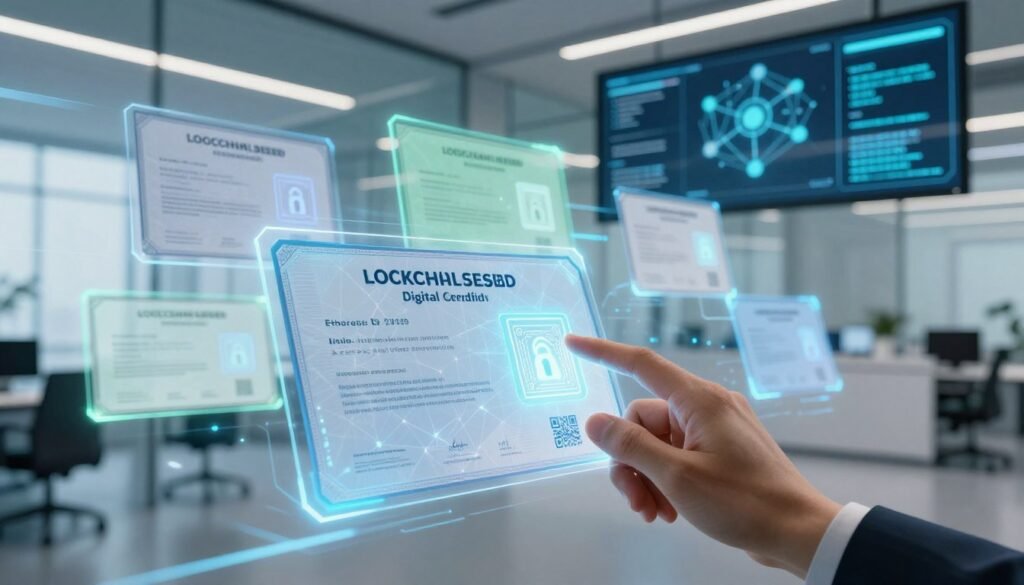
Trust as an operational requirement
Employers need confident verification with minimal risk. Institutions need to protect reputation. Individuals want portable proof that lasts over time.
- Speed: near-instant verification for remote hiring
- Accessibility: easy checks without gatekeepers
- Tamper-evidence: clear audit trails to reduce fraud
- Privacy: proofs that avoid public exposure of personal data
- Interoperability: work across employer and institution systems
Framing ledger-based digital solutions as practical responses—not hype—helps focus evaluation on speed, privacy, tamper-evidence, and cross-system interoperability. The next section explains how these systems keep personal data private while delivering verifiable proof.
What Blockchain Digital Credentials Are
Modern tamper-evident records change how schools, employers, and workers prove achievements.
Definition: A blockchain digital credential is a cryptographically secured record that represents degrees, transcripts, professional certifications, training completions, or identity attributes. Issuers sign each item and anchor a short hash on a public ledger so the document becomes tamper-evident and independently verifiable.

Common types you’ll see
- Academic records: diplomas, transcripts, course completions used by educational institutions
- Professional certifications and workforce training completions for compliance and hiring
- Continuing education badges and competency statements for career development
How these differ from PDFs and database records
PDFs can be copied, edited, or re-shared without reliable provenance. Ledger-backed items include issuer signatures and integrity proofs that make alteration detectable.
Database-backed certificates depend on a single organization’s uptime and willingness to respond. A ledger-based approach lets verifiers check a signed hash without relying on a central authority for routine checks.
What a credential can include
Beyond name and date, a credential may list skills, assessment criteria, learning outcomes, rubrics, and links to evidence artifacts. Sensitive files stay off-chain while a hash on the ledger preserves integrity.
To verify authenticity, a verifier matches the credential’s signature and hash to the anchored value and checks current status (valid, revoked, or expired). The result: faster hiring decisions, less admin work for issuers, and stronger ownership for holders. For more on practical uses, see blockchain digital credentials.
How Blockchain Technology Secures Digital Certificates
A few core mechanisms make modern verifiable records resistant to tampering and easy to check.

Decentralized ledger basics
The ledger groups transactions into blocks that many independent nodes store. Consensus among nodes means no single party can rewrite past entries.
Outcome: an immutable record that resists unilateral edits and improves system trust.
Cryptographic hashing
Hashing turns a credential’s data into a fixed fingerprint (for example, SHA-256). A one-character change produces a different hash, so tampering is obvious.
Digital signature fundamentals
An issuer signs using a private key; verifiers use the public key to confirm authenticity. That signature ties the item to the issuing organization.
Identifiers, timestamps, and traceability
Unique identifiers and timestamps give a clear audit trail. Verifiers can confirm when an item was issued and follow its status over time.
Privacy-forward options
Most systems keep personal data off-chain and store only integrity proofs on the ledger. This reduces exposure of sensitive information.
Selective disclosure lets a holder share only needed attributes (for example, “has license X”) while hiding other fields.
Zero-knowledge proofs let someone prove a claim about a record without revealing raw data, supporting compliance-sensitive workflows.
- Security features reduce forgery and speed verification.
- Traceability helps audits for institutions.
- Privacy methods protect personal information while preserving trust.
Blockchain Certificates and Credentials: The Issuing and Verification Process
Issuing a verifiable record follows a simple, repeatable process that makes later checks quick and reliable.

Issuance workflow
The issuer builds the credential payload, adds a digital signature, and creates a cryptographic hash of the data.
That hash, a unique identifier, is anchored on-chain as a transaction. Anchoring stores a short fingerprint, an identifier, and minimal metadata so changes are detectable later.
Verification workflow
A verifier validates the issuer’s signature, re-hashes the presented item, and compares the result to the anchored record. This lets employers quickly verify authenticity without contacting a central office.
Tools verifiers actually use
- Verification links shared by a holder for one-click checks
- QR codes on a credential page for mobile verification
- Blockchain explorers for deeper inspection of timestamps and transactions
Revocation, expiration, and automation
Systems add status checks to show revoked or expired items. Automated checks in HR workflows let verification take seconds, reducing time-to-hire and paperwork.
Outcome: verifiers see proof of issuer, hash match, and current status while personal data stays minimized to protect privacy and trust.
Security Features That Reduce Credential Fraud
Strong cryptography and consensus rules make altering an issued record extremely costly and detectable.
Why tampering is computationally infeasible: changing a past entry requires redoing all linked blocks after it and winning consensus across many independent nodes. That means an attacker would need large-scale control of the network and massive compute power. In practice, this barrier makes targeted tampering impractical.
Immutability in a credentialing context: once a credential is issued and anchored, any unauthorized edit breaks the hash and signature match. Verifiers immediately see mismatches, so edits, date changes, or title swaps become obvious.
- Common fraud scenarios: forged diplomas, altered dates, duplicate use across identities, and fake issuer branding.
- How the system reduces fraud: issuer digital signatures stop impersonation, hashes detect edits, and decentralized logs prevent undetected duplication.
- Auditability: clear audit trails let investigators and compliance teams trace issuance events and status changes, including revocations.
Protecting issuer reputation: tamper-proof records help institutions prove integrity without exposing private student files. Employers gain faster, defensible checks that lower screening risk and costly hiring errors.
Strong fraud resistance comes from combining cryptography, decentralized consensus, and operational controls like key management and revocation policies.
Benefits of Blockchain Credentialing for Key Stakeholders
All parties gain when verifiable records replace slow, manual practices.
For educational institutions and issuers
Automated issuance lets institutions generate hundreds of items fast. That cuts printing, shipping, and manual entry.
Dashboards and API integrations simplify credential management and reporting during audits. Fewer replacement requests and fewer phone verifications reduce admin time and costs.
For individuals
Holders get ownership and portability via digital wallets. That gives lifelong access even if a school portal changes.
People can share verified achievements quickly with employers or other institutions. Portability lowers friction when credits transfer or when professionals move between jobs.
For employers and verifiers
Instant verification shortens hiring cycles and lowers screening risk. Verifiers confirm authenticity without waiting for registrar replies.
Built-in status checks (valid, revoked, expired) make decisions faster and more defensible, saving time and reducing onboarding delays.
Interoperability across systems
Practical interoperability means credentials work together across LMSs, HR systems, and credential networks. Open standards let different systems work together with minimal conversion.
When institutions, employers, and individuals can share trusted records, trust improves across the ecosystem and real-world uses — like credit transfers and contractor checks — become routine.
Outcome: lower costs, faster verification, and stronger trust for institutions, individuals, and employers. These benefits are most visible in higher education, workforce upskilling, and regulated industries — topics covered next.
Real-World Applications in Education, Work, and Regulated Industries
Verified digital items let learners carry granular proof of skills from course to career.
Higher education: Universities such as MIT Media Lab, Georgia Tech, and McMaster University issue digital diplomas and transcripts that employers can check instantly. Stackable badges capture smaller achievements so learners show a chain of verified skills rather than a single line on a resume.
Professional environments: Employers use these items for workforce upskilling, internal training completions, and external professional certifications. Shared badges and verified records make hiring pipelines faster and reduce fraud.
Healthcare and licensing: Rapid status checks matter in clinical settings. Verifiers confirm a license or training is current, expired, or revoked to protect patient safety and meet compliance rules.
Identity attributes and access: The same model issues role eligibility or site-access proofs. That lets institutions grant facility access or verify required training without exposing sensitive information.
- Faster verification and fewer fraudulent certificates
- Clear status tracking across systems and organizations
- Better portability for lifelong achievements
Next: implementation success depends on standards, data design choices (on-chain vs off-chain), and tight integration with existing institutional systems.
Implementation Best Practices for Institutions and Credential Platforms
Adopt open protocols early to keep options open and speed integration across campus systems. Choosing standards first reduces vendor lock-in and makes later work smoother.
Standards: Use W3C Verifiable Credentials and decentralized identifiers (DIDs) so systems interoperate. Open specs let institutions reuse tooling and simplify verification for employers.
Data design: Anchor short hashes and minimal metadata on a public ledger while storing sensitive evidence off-chain (for example, IPFS or secure object storage). Linking evidence by hash preserves integrity without exposing personal information.
System integration: Connect LMS exports, HRIS/ATS ingestion, and issuer dashboards via APIs. Automate issuance, status checks, and revocation to cut manual work.
Privacy and compliance: Design for FERPA-aligned handling with data minimization, consent-based sharing, and retention policies that limit exposure of student education records.
Operational and user considerations
- Key management, role controls, and incident response for secure operations.
- Wallet UX: clear backups, recovery flows, and re-issuance policies so individuals keep long-term access.
- Pilot checklist: standards chosen, data map, integration points, privacy review, and rollout plan.
How to Evaluate a Blockchain Credential Solution
Buyers should measure verification speed, clarity, and portability before committing to a system.
Verification experience: Test links, QR codes, and embedded viewers in real hiring scenarios. Verify that employers can check authenticity without logging in and that results load across browsers and mobile devices.
What to test in demos and pilots
- One-click links and QR code scans that show issuer, hash match, and status.
- Mobile scanning across Android and iOS plus desktop browser checks.
- Clear, non-technical result screens so HR staff understand authenticity and status at a glance.
Security checklist
Confirm issuer key management, signature validation, tamper-evidence, and reliable revocation/expiration checks. Ask how keys are stored, rotated, and audited.
Portability and vendor lock-in
Require standards-based formats (for example, W3C Verifiable Credentials) so items remain usable across systems. Watch for proprietary formats, closed verification methods, or limits on exports—those are red flags for lock-in.
Fit checklist: secure issuance, fast verification, privacy-conscious design, and durable credentials that work across employers and platforms. Prioritize solutions that prove these points in live pilots before scaling.
Conclusion
Today’s systems make verifying achievements fast, auditable, and privacy-friendly.
Core takeaway: ledger-backed records combine issuer signatures with tamper-proof hashes so certificates and digital records can be checked instantly. This model improves trust while lowering administrative work.
Why this matters now: growing demand for fast checks and rising fraud risks push institutions to adopt standards that speed verification and preserve privacy.
Practical view: issuance = sign, hash, anchor; verification = signature plus hash match plus status check. That simple flow cuts fraud and boosts portability for individuals while protecting institutional reputation and reducing screening time for employers.
Before you choose a vendor, run the evaluation checklist and pilot on standards, privacy-by-design, and long-term interoperability. For a quick related test, try this crypto certification quiz.
FAQ
What are blockchain-based digital credentials and how do they differ from PDFs?
Blockchain-based digital credentials are verifiable records issued by schools, employers, or certifying bodies that use a decentralized ledger to store a tamper-evident fingerprint of the credential. Unlike static PDFs or database-backed certificates, these credentials include cryptographic hashes and digital signatures. That lets verifiers confirm authenticity without relying on a single central server, reducing forgery and edits while enabling instant checks via a verification link or QR code.
How does the verification process work for on-chain credentials?
Issuers sign credential data with a private key and anchor a hash on the ledger. Verifiers use the credential’s unique identifier or verification link to fetch the public record, validate the digital signature, and compare hashes. This confirms the record hasn’t changed and that the issuer is legitimate, all without contacting a central authority.
What types of information can a digital credential contain?
A credential can include the recipient’s name, issuing organization, award type, issue and expiration dates, learning outcomes or competencies, and proof of evidence such as project links. Sensitive personal data or large evidence files are usually stored off-chain, with only a cryptographic pointer and metadata on-chain to preserve privacy.
Are these credentials secure against tampering and fraud?
Yes. Cryptographic hashing creates a tamper-evident fingerprint, and digital signatures tie the record to the issuer’s keys. Because the ledger is distributed across many nodes, changing a past record would require infeasible computational effort. Revocation lists and timestamping add ongoing status checks and audit trails to strengthen trust.
How do revocation and expiration work?
Issuers publish revocation events or update a credential’s status on the ledger or in a trusted registry. Verifiers check the credential’s current status during validation. Expiration dates are embedded in credential metadata so verifiers can automatically flag out-of-date qualifications.
Can employers verify credentials without special tools or accounts?
Yes. Most solutions provide simple verification links, QR codes, or public explorers that allow employers to confirm authenticity without creating an account. This supports fast background checks and reduces screening friction while maintaining cryptographic assurance.
What privacy protections exist for recipients?
Privacy-forward options include storing only hashes on-chain, selective disclosure, and zero-knowledge proofs. These approaches let recipients reveal only the necessary attributes—such as skill verification—without exposing full records or personal data, aligning with data-minimization practices and regulations like FERPA in the U.S.
How do institutions integrate digital credentialing with LMS and HR systems?
Integration typically uses APIs and standards such as W3C Verifiable Credentials and decentralized identifiers. Issuers automate generation from LMS or HR workflows, anchor hashes on-chain, and deliver credentials to digital wallets and credential dashboards for recipients.
What should organizations look for when evaluating a credential solution?
Evaluate verification experience (speed and ease), security features (key management, signature validation, revocation), interoperability (support for open standards and portability), and privacy compliance. Also check wallet UX, recovery options, and whether the vendor avoids lock-in by enabling export to other ecosystems.
Are there real-world use cases beyond diplomas?
Yes. Use cases include professional certifications, workforce upskilling badges, healthcare license checks, continuing education units, and identity attributes for access control. These applications speed hiring, auditing, and license verification while reducing fraud and administrative overhead.
Do recipients own their credentials and can they carry them long term?
Recipients typically control access via digital wallets or secure links. Because the record is anchored in a distributed ledger and evidence can be stored off-chain with pointers, recipients retain lifelong access and portability across employers, schools, and platforms—subject to wallet recovery and key-management practices.
What standards support interoperability and long-term trust?
Open standards such as W3C Verifiable Credentials and decentralized identifiers promote interoperability. They define data models, signature formats, and discovery methods so credentials work across different wallets, verifier systems, and institutional platforms without vendor lock-in.

No comments yet