
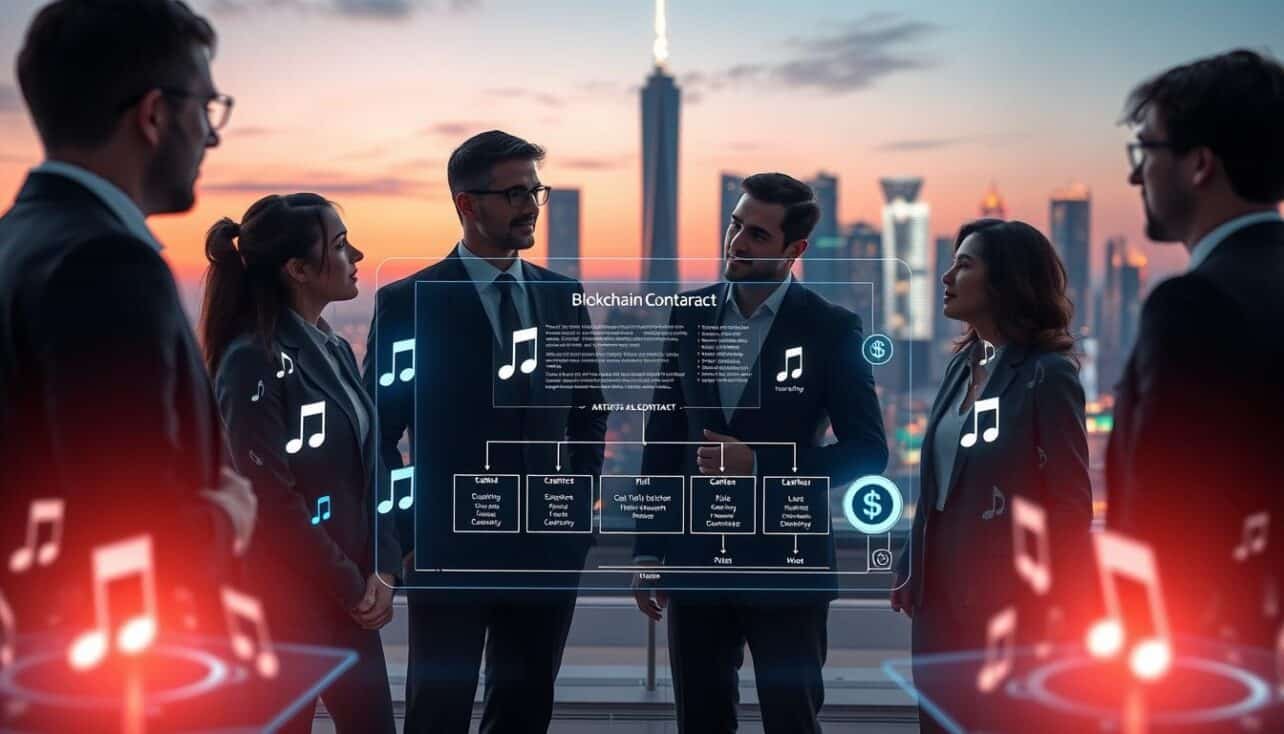
The global music industry is booming. In 2021, it grew by a staggering 18.5%. The United States market saw steady growth too.
Streaming services now dominate. They account for 84% of all music revenue in the U.S. Millions of plays happen every day.
Yet, a huge problem remains. The people making the songs often see very little money. In 2020, artists received only about 12% of the global revenue.
Where does the rest go? A long chain of middlemen and companies take their cuts. This system is slow and lacks clarity for creators.
A new kind of technology promises a fairer way. It creates a clear, unchangeable record of who owns a song and how it’s used.
This guide explores that entire ecosystem. We will look at how it enables direct payments from fans to artists. We’ll cover smart contracts and new ownership models.
Our goal is to show you a future where creators control their work and earnings. We’ll also discuss the real challenges ahead.
Introduction to Blockchain and Music Royalties
From songwriting to streaming, numerous entities shape how tunes reach our ears. This interconnected system has seen tremendous growth. Global streaming revenue jumped by 24.3% in a single year.
Overview of the Music Industry Ecosystem
Many players are involved in bringing a song to life. Composers, performers, and artists create the content. Record labels and publishers then market and manage the rights.
Collection societies and platforms handle the distribution and payments. Each party takes a portion of the revenue generated. This creates a long chain between creation and compensation.
The Role of Technology in Modern Royalty Distribution
Technology has moved consumption from physical albums to digital streams. Platforms are now the primary distribution channel, accounting for 84% of U.S. music revenue.
Yet, the payment mechanisms behind these services are complex. They lack transparency for the creators. Intermediaries like Performing Rights Organizations collect fees but operate with limited clarity.
This structure means financial success for the industry doesn’t always reach the artists. Understanding this gap is essential to see why new solutions are needed.
The Evolution of Traditional Royalty Distribution
For decades, the journey of a song from studio to listener has been paved with complex financial agreements. This system grew from physical sales to digital streams. Its core mechanics, however, remain largely unchanged.
How Music Royalties Currently Work
Music royalties stem from two distinct legal rights. Composition rights cover the song’s lyrics and melody. Master rights belong to the specific recording.
Separate organizations manage these parallel streams. Performing Rights Organizations collect fees for compositions. Publishers and record labels handle master royalty payments.
This creates a web of intermediaries. Each entity takes a fee before passing funds to artists. The process is slow and rarely transparent.

Challenges Faced by Artists and Intermediaries
Artists wait months or years for their payments. Contracts often favor labels with larger revenue shares. Creators have little power to negotiate better terms.
The complexity of tracking usage across borders creates errors. Disputes over ownership can delay payments further. Intermediaries operate with limited real-time data.
This structure relies heavily on trust. It lacks the tools for automatic verification. As a result, artists often receive minimal compensation for their work.
Understanding the Need for Disruption
Streaming platforms dominate consumption, yet their payment structures create an impossible math problem for musicians. In 2020, creators received only about 12% of global industry revenue. The rest flowed to a long chain of intermediaries.
Major services retain a large majority of generated income. They distribute the remainder among various rights holders. For a signed artist to earn significantly, a single track needs billions of plays.
The challenges run deeper than unfair splits. Systematic delays in payments are common. Calculations lack transparency, and disputes over ownership stall royalties.
Meanwhile, digital piracy continues to grow, threatening legitimate earnings. This outdated model persists despite technological advances in distribution.
Artists and independent creators urgently need a new system. It must provide faster, transparent accounting and direct fan connections. Understanding these profound issues shows why the entire music ecosystem requires a disruptive reimagining.
blockchain for music royalties explained: Unpacking the Technology
Imagine a ledger that isn’t locked in a single company’s server but is duplicated and synchronized across a global network. This is the essence of blockchain technology. It creates a transparent and permanent record of all activities.
Fundamentals of Blockchain Technology
This system operates as a distributed digital database. Many computers, or nodes, hold identical copies of the ledger. No single entity has control.
Changes require agreement from the network through a consensus process. This prevents fraud and ensures accuracy. Every transaction is cryptographically sealed, making the history unchangeable.
Introduction to Smart Contracts
Smart contracts are the next layer. They are self-executing contracts with the terms written directly into code. When preset conditions are met, the program runs automatically.
This eliminates the need for a trusted middleman to enforce agreements. Parties can engage in trustless transactions. The outcome is fast, precise, and reliable.
For managing creative rights, this combination is revolutionary. It provides a clear, auditable trail of ownership. Unlocking the potential of this technology means building systems where value flows directly and fairly.
Transforming Royalty Payments with Blockchain
Waiting years for compensation is a harsh reality many artists face under the old model. The traditional framework involves slow, batched payments that can take up to two years. This new approach rewrites those rules with speed and clarity.
Real-Time, Automated Payment Systems
Smart contracts are the engine of change. These digital agreements have all distribution rules coded in. When a song is played, the contract executes instantly.
It calculates each holder’s share and sends cryptocurrency to their wallet. This happens in seconds, not months. The delay from intermediaries is completely removed.
This creates a real-time payment flow. It matches the instant nature of digital consumption. Creators gain predictable, timely income.
Ensuring Accuracy and Transparency
Every micro-transaction is permanently recorded on the ledger. This creates an unchangeable, time-stamped audit trail. All stakeholders can view the complete history.
They see exactly how many streams occurred and how royalty payments were split. This level of transparency eliminates opaque accounting. Disputes over amounts or timing can be resolved definitively.
The system’s inherent accuracy builds trust among all parties. It also slashes administrative costs. More revenue flows directly to the people who create the art.
Benefits for Artists and Rights Holders
Creators stand to gain immensely from the shift toward decentralized systems. This new framework delivers concrete benefits that address long-standing financial and creative frustrations.
Empowering Creators Through Direct Compensation
Artists gain unprecedented control over their creative work. They can register ownership directly and manage their rights independently.
Direct payment models mean compensation arrives immediately upon consumption. This dramatically improves cash flow for creators.
By cutting out unnecessary middlemen, artists retain a significantly larger share of their earnings. Blockchain in music industry royalty distribution enables this shift toward fairer revenue splits.
Complete transparency allows every transaction to be tracked. Creators see exactly how their music is used and the revenue it generates.
Immutable records provide definitive proof of ownership. This helps resolve disputes quickly and protects intellectual property.
New revenue streams open through practical micropayments. Artists earn from every single play, not just bulk royalties.
Direct fan relationships flourish without gatekeepers. Creators can offer exclusive content while tracking all interactions.
Ultimately, this fosters greater artistic freedom. Sustainable earnings from their work reduce dependency on traditional label advances.
Integrating NFTs into the Music Ecosystem
Beyond simple payments, a deeper form of artist-fan connection is being built with digital tokens. Non-fungible tokens, or NFTs, are unique digital assets secured on a ledger.
They can represent anything from a full album to exclusive artwork. This creates new models for how fans interact with and support their favorite creators.
Minting Digital Assets for Music Ownership
Artists can “mint” these tokens to signify true ownership of a specific song or piece of content. Pioneers like Kings of Leon released a complete album this way.
Steve Aoki and Nas have also launched NFT-backed music. These digital items can be traded on secondary platforms like OpenSea. This establishes a direct distribution channel from creator to collector.
New Revenue Streams and Fractional Rights
This integration unlocks novel revenue streams. Artists sell exclusive access directly to their audience. Armin Van Buuren’s community offers NFT holders special DJ sets and unreleased cuts.
Fans can even purchase a share of the rights to royalty streams. It transforms a song into a micro-investment. Supporters share financially in the track’s success.
This model fosters community ownership. Dedicated fans become stakeholders. They are invested in promoting the content they help fund.
The most popular platforms for this operate with greater transparency. They enable a larger proportion of revenue to flow back to the artists themselves.
Disrupting Traditional Record Label Models
The traditional power dynamics between artists and record labels are undergoing a seismic shift. New technological tools are empowering creators to reach audiences directly.
Eliminating the Middlemen
Historically, major labels served as essential gatekeepers. They provided upfront funding and global distribution networks.
Yet these deals often came with steep costs. Contracts locked artists into long-term agreements with minimal royalty percentages.
Today, artists can bypass these intermediaries entirely. Smart contracts enable direct distribution and transparent royalty collection.
Creators retain full ownership of their master record. They capture the majority of revenue their music generates.
This doesn’t mean record labels disappear. Instead, they can transform into service providers.
Adapted labels offer marketing and production support with transparent accounting. They operate on fair partnership models.
The shift gives artists greater control over their careers. It also requires them to handle more business tasks.
A hybrid ecosystem is emerging. Some creators choose independence, while others partner with reformed intermediaries that add real value.
Real-World Web3 Case Studies in Music Royalties
Several pioneering artists and innovative platforms are already demonstrating the power of web3 in action. They move the concept of fair pay from theory to tangible practice.
Innovative Platforms and Emerging Projects
New distribution platforms are building complete ecosystems. Here, creators upload their work and define the terms in smart contracts.
When a song is played, payment is instant. This model is also being tested in publishing and film. It ensures transparent compensation across creative fields.
Lessons from Pioneering Artists
Kings of Leon released a full album as an NFT collection. It generated millions and set a major precedent.
Hip-hop artist Nas offered NFTs representing stakes in his song “Rare.” This lets fans share in streaming revenue directly.
Electronic artists like Steve Aoki use tokens for exclusive content. Armin Van Buuren built a dedicated community for his most devoted fans.
These early efforts teach valuable lessons. User experience must be simple for both artists and their fans. Educating audiences about digital wallets remains a key hurdle.
Scaling these systems for mass streaming is the next technical frontier. The success so far proves the model’s strong potential.
Addressing Challenges and Limitations
Achieving industry-wide change requires navigating a complex landscape of challenges. The promise of instant, fair pay faces real-world technical and legal hurdles.
Scalability and Regulatory Considerations
Processing millions of micro-payments for streams strains current blockchain infrastructures. These systems must handle vast data to match digital consumption speeds.
Fragmentation is another issue. Without universal standards, different platforms use incompatible formats. This makes it hard for musicians to distribute work across multiple networks.
Laws governing digital assets and smart contracts vary globally. This creates regulatory uncertainty for international platforms. Artists face complex tax and compliance questions.
Many creators lack the technical expertise to use these new systems. Setting up digital wallets and understanding contracts can be daunting. User-friendly interfaces are essential for adoption.
Established intermediaries may resist this shift. Transparent royalty distribution reduces their control and fees. Overcoming this institutional inertia is a significant challenge.
For mainstream use, these limitations must be solved. The goal is a seamless system that delivers on the promise of transparency and fairness for all creators.
Future Trends: Streaming, Digital Innovation, and Blockchain Integration
Tomorrow’s creative landscape will be defined by seamless, automated value exchange. The convergence of streaming platforms with new distribution technologies creates unprecedented opportunities. Artists will gain from real-time micropayments and transparent ownership records.
Convergence with Decentralized Finance
Smart contracts enable integration with decentralized finance tools. Creators can borrow against future revenue or sell fractional shares in their work. This opens sophisticated financial transactions previously unavailable.
These platforms allow artists to invest payments into yield-generating protocols. Supporters become stakeholders in the content they love. The line between fans and investors continues to blur.
Long-Term Industry Implications
The long-term shift redistributes power within the music industry. Traditional gatekeepers must adapt to offer genuine value. Integrated ecosystems will combine distribution, fan engagement, and financial services.
Standardized rights registries will simplify licensing across the industry. Micropayments for every stream make revenue flow in real time. This future points toward direct value transfer with minimal friction.
Wider adoption will follow as user interfaces improve. More fans and creators will join these transparent platforms. The entire creative economy moves toward fairer compensation models.
Conclusion
A new era of fairness is dawning for creators, powered by blockchain and transparent digital systems. This shift solves the music industry‘s chronic issues of unfair royalty distribution and delayed payments.
Smart contracts enable instant compensation when a song is streamed. Artists receive funds directly, ending waits of months or years. This provides predictable cash flow for sustainable careers.
Immutable records offer definitive proof of ownership. They protect intellectual property and resolve disputes quickly. The entire system becomes more trustworthy.
New models unlock fresh revenue streams. Fans can own a share of the content they love. This builds engaged communities and aligns supporter success with artist success.
The benefits extend across the industry. Operations become more efficient, and costs drop. Value flows to those who create genuine art.
Challenges in scalability and regulation remain. Yet ongoing development shows strong potential. The future points toward decentralized, automated ecosystems.
For musicians and professionals, grasping this change is crucial. It leads to a more equitable creative economy where technology empowers all creators.
FAQ
How does this technology ensure I get paid faster?
It uses smart contracts. These are self-executing agreements on a digital ledger. When your song is streamed, the contract automatically triggers a payment. This happens in near real-time. It cuts out the long wait times common with traditional quarterly or yearly distributions from labels and publishers.
Can this system really give me more control over my work?
Absolutely. The core idea is putting ownership data on an immutable public ledger. You can clearly define your share of a recording or composition. This information is transparent and cannot be easily altered. It reduces disputes and ensures you, not just intermediaries, have a verified record of your rights.
What are the practical benefits for an independent musician?
The main advantages are direct compensation and transparency. Platforms like Audius demonstrate how creators can receive a larger share of revenue directly from fans. You see exactly how many streams generate your earnings. This system also opens new funding models, like selling limited digital collectibles (NFTs) of your work to supporters.
Don’t record labels and publishers still have a necessary role?
Their role is evolving, not necessarily disappearing. This technology challenges the old model by making administrative tasks more efficient. It automates royalty splits and payment collection. This allows artists to potentially renegotiate deals, focusing a label’s role more on marketing and promotion rather than controlling complex payment systems.
Is my music safe and secure on these new platforms?
Security is a primary feature of the underlying technology. The distributed ledger is highly resistant to fraud and unauthorized changes. Your ownership claim is cryptographically secured. However, you must still practice good digital security with your private keys and choose reputable platforms with strong track records.
What’s the biggest hurdle for widespread adoption in the industry?
The main challenges are scalability and regulation. Handling the massive volume of micro-transactions from global streaming requires very fast networks. Furthermore, governments are still creating rules for digital assets and smart contracts. Widespread adoption needs these systems to work seamlessly at scale within clear legal frameworks.

No comments yet