
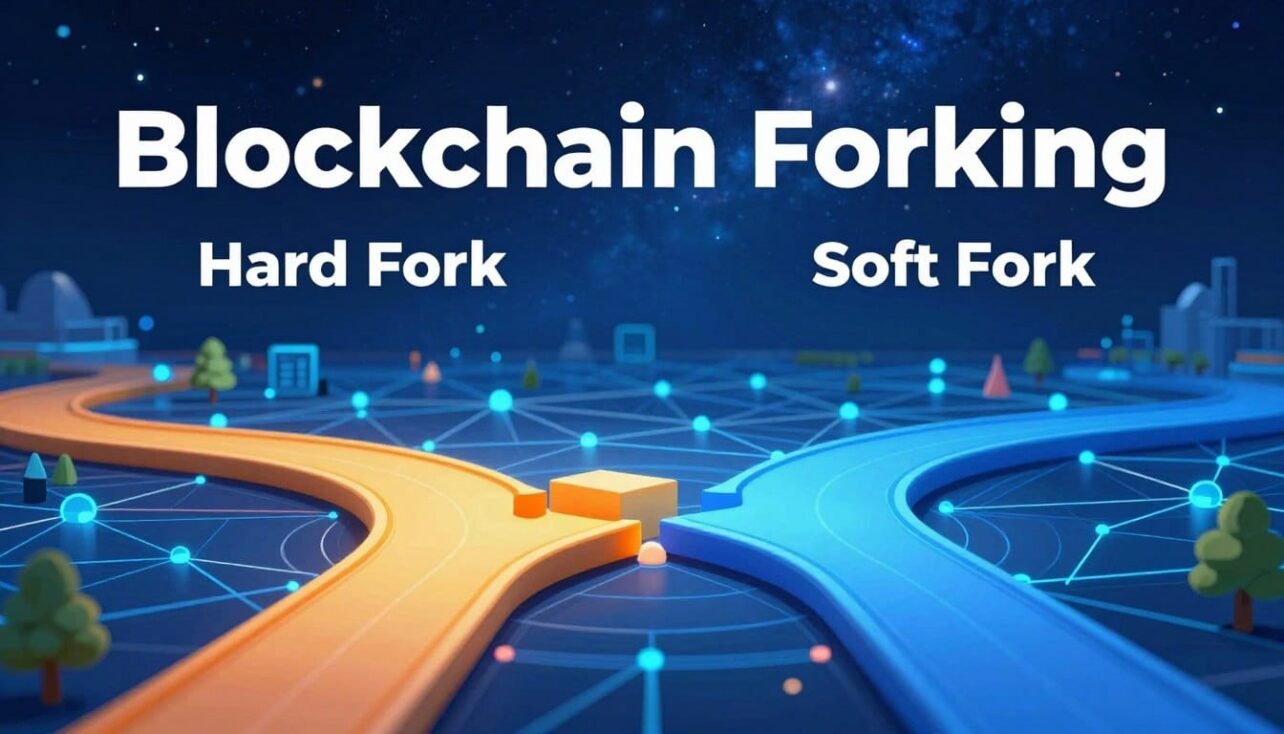
What is a blockchain forking in simple terms? It is a protocol change that can lead some participants to follow one set of rules while others follow another.
The result can be a chain split or a smooth upgrade. Planned upgrades aim for a clean transition. Unplanned splits can create temporary competing records.
This piece previews how a hard option differs from a soft option, focusing on compatibility, chain splits, and upgrade needs. You will get a practical, network-level view of what nodes do and how consensus forms.
Why it matters to U.S. crypto holders: forks can change how transactions are processed, affect asset safety, and influence which chain markets treat as the main one. We will note major past cases such as Bitcoin and Ethereum and explain risks for users and exchanges.
What Blockchain Forking Means in Practice for a Blockchain Network
When core protocol rules change, a network can follow two different histories. This happens because the protocol defines which blocks and transactions count as valid. If developers alter those rules, some nodes may accept the new standard while others keep the old one.

Why changes happen: teams add new features, fix security bugs, or try to scale the ledger. They also occur when the community disagrees on direction. Each reason drives different outcomes for network participants.
- Protocol rules are the shared standards that decide validity; changing them can create two paths for the chain.
- Developers propose and code updates. Miners and validators enforce rules when creating blocks.
- Full nodes verify compliance; users and businesses influence which path gains real economic support.
Community dynamics matter. Decentralized governance means technical merit alone does not decide outcomes. Social agreement and economic coordination shape which path the network and its participants follow.
How Consensus, Nodes, and Software Versions Determine a Fork Outcome
A network’s outcome often hinges on which software versions most participants run. Nodes check incoming blocks and transactions against the rule set coded in their software. That simple check decides which history a node accepts.

What node validation looks like
Each node validates a block and the included transaction list using its current version. If rules differ, two nodes can mark the same block as valid or invalid.
Majority support versus full agreement
Majority support means enough miners or validators enforce a rule so the network follows their chain. Full agreement is rare in decentralized systems; unanimous upgrades seldom happen.
Accidental and temporary competing blocks
Two miners can find blocks almost at once, creating brief competing tips. The network then follows the longer or heavier chain and the losing block becomes an orphan.
- Node role: checks blocks and transactions against its version and rule set.
- Why version matters: different software versions interpret validity differently.
- User impact: temporary forks can delay confirmations; planned upgrades change what the system accepts as valid and may cause a split.
Blockchain Forking: Hard Fork vs Soft Fork
Protocol choices force clear trade-offs. Some updates are backward-compatible; others reject older clients outright. The practical differences shape whether the ledger stays unified or splits into separate histories.

Backward compatibility vs. incompatibility
Incompatible rule changes—commonly called hard forks—introduce new validation that old software will not accept. By contrast, soft forks tighten rules so legacy nodes still see the chain as valid.
Chain split potential and a new chain
When both rule sets gain traction, a split can occur and a new chain may appear. The creation new ledger leaves balances duplicated at the fork point unless exchanges intervene.
Upgrade pressure: who must update and when
Hard forks typically require validators, full nodes, and exchanges to update or risk being left on a competing chain. Soft forks rely on enough miner or validator enforcement while some clients can lag.
Impact on users, exchanges, and transactions
Exchanges often pause deposits and withdrawals during upgrades. Wallets may need patches and confirmation rules can tighten. Transactions valid on one chain may be rejected on another, so users should follow trusted guidance.
For a deeper look at types and coordination around these block change types, see types and examples. This article will next define each fork type, then weigh tradeoffs, risks, and real-world cases.
Hard Fork Explained: Definition, Key Traits, and What Changes
A protocol change that breaks backward compatibility forces every participant to choose which rule set to follow.
Definition: A hard fork is a rule change that makes blocks created under new rules invalid to nodes running the older software.
Old nodes become incompatible because they keep enforcing the prior validation logic. They will reject new-format blocks and transactions that do not meet their expectations.
Permanent divergence happens when enough miners, validators, or users keep supporting both codebases. That sustained support produces two independent ledgers that continue separately.
Significant changes that trigger this kind of upgrade include increases to block size for throughput, swaps to a different consensus mechanism, or shifts in governance and upgrade rules.
Whether a hard fork leads to a new coin depends on social and economic support. If markets, exchanges, and users back both chains, creation of a separate currency often follows. If the community converges, the result may be a single upgraded chain.
User takeaway: After a lasting split, balances at the snapshot point may appear on both networks. Safe spending requires wallets and exchanges that recognize which chain and new rules you intend to use. For a deeper guide and practical examples, see types and examples.
Soft Fork Explained: Definition, Key Traits, and Why It’s “Backward-Compatible”
A soft fork tightens what the network accepts while keeping older clients able to follow the same chain.
Definition: A soft fork is a backward-compatible upgrade that narrows the set of valid blocks or transactions. New rules make some actions invalid that were previously allowed, rather than adding new valid cases.
The idea of tightening rules means new blocks must meet stricter criteria. Because those blocks still satisfy the older, broader checks, legacy nodes continue to accept them.
Operationally, soft forks reduce disruption. They lower the chance of a permanent split and let the network upgrade without forcing everyone to change their software immediately.
Activation depends on miner and validator enforcement. If enough miners enforce the updated rule set, the process works as intended. If enforcement is weak, the new constraints may not hold in practice.
- Some node operators may run older versions for a time.
- Mixed versions can coexist if block producers enforce the tightened rules.
- Soft forks are strong for incremental security or efficiency gains but cannot expand protocol features that require full incompatibility.
For a practical overview of how upgrades are coordinated across an ecosystem, see this guide on network upgrades.
Hard Fork Pros and Cons for Security, Scalability, and the Community
Radical rule changes unlock new technical paths but also raise coordination costs for everyone involved.
Advantages: Major upgrades let teams implement features that are impossible under backward compatibility. This enables rapid scalability gains and deep architectural redesigns.
New development paths: A split can create parallel projects. Each chain may pursue different priorities, accelerating innovation without blocking the other.
Security benefits: When an urgent exploit appears, a decisive rule break can neutralize flawed behavior and restore safety faster than staged changes.
Drawbacks and operational consequences
Community risk: A split can reduce network effects, slicing hash power, liquidity, and developer attention. That weakens perceived legitimacy and long-term value.
Operational disruption: Exchanges and wallets often pause services, re-index chains, and force users to update clients or select a preferred chain. That creates confusion and short-term downtime.
Asset and transaction risks
In a two-chain reality, people can accidentally send funds on the unintended chain. Mistaking UTXOs or account states between ledgers makes recovery complex.
Coordination is the real cost: Successful hard forks depend on social consensus, technical readiness, and market support. Without those three, the risks to users, security, and ecosystem health rise sharply.
Soft Fork Pros and Cons for Network Stability and Innovation
Many networks favor gentle rule changes that maintain one active chain and minimal disruption.
Advantages
Reduced disruption: Soft forks keep a single canonical chain, lowering shock for exchanges, wallets, and node operators.
Lower resource needs: Avoiding two live ledgers cuts ongoing validation, tooling work, and customer support overhead for businesses.
Security upside: Tightening validation rules can shrink the attack surface and improve overall security without forcing immediate client updates.
Disadvantages
Backward compatibility limits the scope of change. This makes soft forks poor fits for sweeping redesigns or new economic rules.
The need to remain compatible can slow protocol innovation and push larger ideas to other types of upgrades or layered solutions.
Enforcement challenges
If miners or validators do not provide majority support, blocks may ignore the new constraints and the intended benefits fail. Adoption by key block producers is essential for a successful upgrade.
Security and Transaction Risks During Forks
A split in rules can turn routine payments into complex cross-chain threats overnight. That change raises immediate concerns for funds, confirmations, and the incentives that protect the ledger.
Replay attacks and why protection matters
Replay attacks occur when the same signed transaction can be broadcast on both chains after a split. That means a single spend on one ledger may be replayed and accepted on the other.
Replay protection makes transactions chain-specific so users and exchanges can move funds without duplicating transfers.
51% risks on smaller or fragmented networks
When a hard fork reduces miner or validator resources, one chain can become easier to control. A 51% attacker can reorganize blocks and reverse payments more readily on a weakened chain.
Double-spend concerns and soft-fork contrast
Double-spend looks like a confirmed payment being undone after a reorg. This is more feasible on smaller networks with low hash power or stake.
Soft fork upgrades usually keep one active chain, which lowers split-driven risks like cross-ledger replay and duplicated attack surfaces.
- Wait for extra confirmations after a split.
- Follow exchange advisories before moving funds.
- Use updated wallets that include replay protection and understand the fork context.
Security depends not just on cryptography but on economic incentives, broad participation, and coordinated rule enforcement across the system.
Real-World Hard Fork Examples and What They Changed
High-stakes disputes over capacity, governance, or mining policy have produced several well-known alternative chains. These cases show how technical choices become social and economic splits.
Bitcoin Cash: block size and scalability debate
Bitcoin Cash split from Bitcoin on August 1, 2017 after a public fight over block size and transaction throughput. Supporters increased block size to pursue higher scalability.
The result was the creation of a new chain and a separate ecosystem that prioritized larger blocks and lower fees.
Ethereum Classic: governance and immutability
After the July 2016 DAO exploit, Ethereum implemented a rollback to return stolen funds. Dissenters kept the original history and continued as ethereum classic.
This example highlights a values-driven split: one path favored restitution, the other preserved immutable records.
Bitcoin Gold: mining decentralization
Bitcoin Gold changed the mining algorithm to reduce ASIC dominance and open mining to more participants. That move created a distinct project with different new rules for block production.
- Lesson: hard forks can create new assets and long-term parallel communities.
- They often introduce different technical priorities and governance models.
- Users should expect separate ecosystems and a potential need for careful custody during the creation new ledger.
Real-World Soft Fork Examples and Why They Were Chosen
Real upgrades often arrive as targeted rule changes that preserve compatibility while adding capability. Several notable changes in Bitcoin show how soft fork design keeps a single live ledger while improving function.
SegWit: transaction malleability fixes and practical capacity increases
Segregated witness (SegWit) was a classic soft fork. It fixed transaction malleability by separating signatures from the part of a transaction that determines its ID.
This change increased usable block capacity without breaking older clients. Exchanges and wallets benefited because transactions became more reliable.
Taproot: efficiency and privacy improvements
Taproot was a soft fork that improved efficiency and privacy for many transaction types. It lets complex spending conditions look like simple payments on-chain.
The upgrade reduced data size for some scripts and made smart-contract-like spending cheaper and more private.
P2SH and BIP 66: script capability and stricter validation
P2SH enabled more expressive scripts by changing how scripts are referenced, making advanced transactions easier to use.
BIP 66 tightened signature encoding with stricter DER rules, reducing ambiguity and strengthening node validation.
- Why choose soft forks: compatibility is preserved, disruption is minimized, and activation works through miner or validator support.
- These cases show how forks soft forks let protocols evolve while keeping one unified chain.
Conclusion
Forks shape how distributed ledgers adapt, from mild protocol tweaks to full chain splits. ,
In short, a hard fork lets projects make big, incompatible changes and can create two independent chains. A soft fork tightens rules while keeping most nodes on one unified chain with less disruption.
Which path wins depends on consensus and participant coordination. Support from miners, validators, exchanges, and users decides real outcomes when upgrades arrive.
Practical takeaways: update wallets and software, check exchange guidance, and confirm chain context before moving funds. That lowers replay and wrong-chain risks.
Understanding forks helps you read upgrade announcements and judge how protocol changes may affect market moves and network health over time.
FAQ
What does a protocol rules change mean for a distributed ledger network?
A rules change alters how nodes validate blocks and transactions. If the update tightens or relaxes validation criteria, some software versions may accept blocks others reject. That determines whether the network continues on a single path or splits into separate chains with different histories and rules.
How do changes create two possible paths for a chain?
When a subset of participants enforces new validation logic while others keep the old rules, blocks accepted by one group may be rejected by the other. That divergence can produce two competing chains that grow independently if both collect support from miners or validators.
Why do networks implement protocol updates or alterations?
Teams propose updates for new features, security patches, performance gains, or governance shifts. Some are technical improvements like transaction format changes; others respond to community disagreements over direction or priorities.
Who can influence whether an update succeeds or causes a split?
Developers write the code, miners or validators choose which software to run, full nodes enforce rules, and users and exchanges decide whether to accept ledger states. Broad alignment across these groups determines success.
What role do nodes play in validating blocks under new rules?
Nodes check each block and transaction against their local rule set. If a block violates a node’s rules, the node rejects it, preventing that block from extending its view of the chain.
How does majority support compare to full agreement in a decentralized system?
Majority support from miners or validators can make one chain dominant because it produces more blocks, but full agreement across all node operators avoids incompatibility and reduces the risk of user confusion or split chains.
What are accidental and temporary splits like orphan blocks?
Competing miners can temporarily produce blocks at similar times, creating short-lived branches. The network eventually converges on the longest valid branch; the discarded blocks become orphans and their transactions return to the mempool or are included later.
What distinguishes backward-compatible changes from incompatible ones at the protocol level?
Backward-compatible updates keep older clients able to validate new blocks, while incompatible changes make older clients treat new blocks as invalid. The former avoids forced upgrades; the latter risks creating a separate chain.
When does a chain split and create a new ledger?
A split happens if a sizable portion of participants continues on one rule set while another substantial group follows a conflicting set. If both groups keep producing blocks, two independent ledgers emerge with distinct transaction histories.
Who must upgrade their software during an enforcement change, and when?
Nodes that want to follow the new rules must update before activation. Miners and validators often need to upgrade promptly to avoid producing blocks that are rejected by the upgraded majority or to ensure they remain compatible with the chosen chain.
How are users, custodial services, and exchanges typically affected?
Users may face temporary uncertainty over balances and transaction finality. Exchanges and custodial wallets often pause deposits and withdrawals around an activation to prevent lost funds or replay problems and to ensure they credit the correct ledger.
What are common significant changes that force incompatible upgrades?
Examples include increasing block capacity limits, switching consensus mechanisms, or altering consensus-critical data structures. Such shifts can make old software unable to validate new blocks.
Do all incompatible upgrades result in a new token or coin?
Not always. A split only creates a separate tradable asset if both chains maintain replayable history and markets recognize the new ledger. If the community unanimously adopts the upgrade, no new asset appears.
How do tightening-rule updates allow older clients to remain compatible?
If new blocks follow stricter rules that are a subset of the old rules, older clients still see those blocks as valid because they satisfy the more permissive checks, avoiding immediate incompatibility.
What happens when not enough miners or validators enforce an activation?
Insufficient enforcement can prevent the update from activating, or it can lead to partial enforcement where some policy benefits appear while instability and split risk persist until broader adoption occurs.
What are the pros of major, incompatible upgrades for security and scaling?
They can enable rapid improvements—bigger block capacity, faster feature rollout, or new governance models—allowing projects to pursue different technical paths and market needs.
What are the downsides of major splits for the community?
Splits risk fracturing developer resources, confusing users, and disrupting services. They can also create replay and custody risks if participants don’t take protective measures.
How do rule-tightening updates support network stability and continuity?
Because they preserve compatibility, these updates reduce disruption and keep the network unified, lowering the operational burden for node operators and fewer coordination headaches for service providers.
What are the limits of backward-compatible upgrades?
They often provide narrower scope for change, which can slow innovation. Some desired protocol shifts require breaking changes that cannot be implemented as a simple tightening.
What replay risks appear after a split and why is replay protection important?
Without replay protection, a transaction signed on one ledger might execute on both chains, causing unintended transfers. Protecting transactions prevents accidental duplication of spend across chains.
Why are smaller or fragmented networks vulnerable to majority attacks after a split?
If mining or validation power divides, a chain with low securing power becomes easier to attack. An attacker controlling a majority can reorganize history, double-spend, or censor transactions.
How do tightening-rule updates affect double-spend risk?
Because they tend to preserve a single chain, these updates usually lower the risk of split-induced double-spends. However, network or implementation errors can still create vulnerabilities.
What notable real-world incompatible changes created new ledgers and why?
The 2017 upgrade that increased block capacity led a community faction to create a separate ledger focused on larger blocks and scalability. Another split occurred after a high-profile smart contract hack, when some participants reversed transactions and others did not, producing two distinct ledgers.
Why have projects chosen backward-compatible feature activations historically?
Activations like transaction format updates and signature changes were chosen to fix malleability, improve privacy, or add scripting features while minimizing disruption and keeping most participants on a single chain.
What should users do to protect funds during a contentious change?
Users should follow guidance from trusted wallet providers, avoid transacting during activation windows, and ensure exchanges or custodians have announced support and replay protection for the relevant ledgers.

No comments yet