
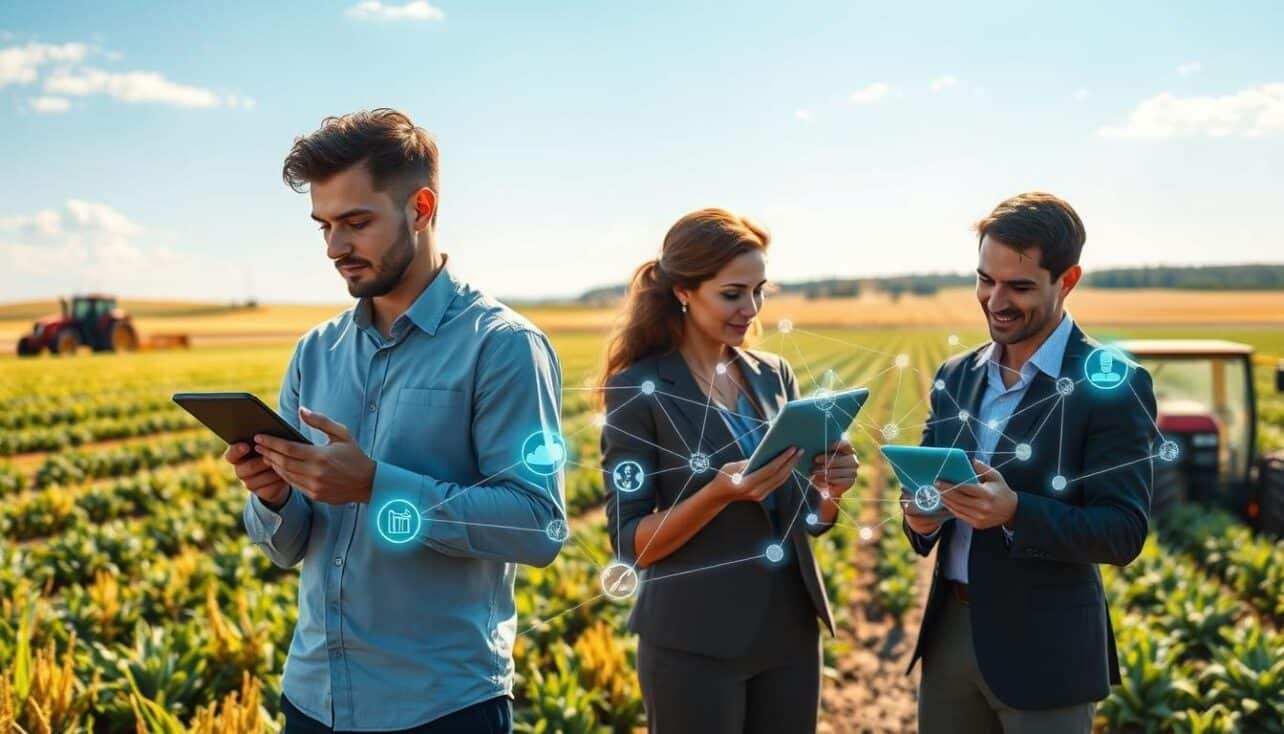
A powerful shift is happening from farm to table. New digital tools are creating a more open and trustworthy system for our food.
People today want to know where their meals come from. They care about safety, ethics, and the planet. This demand is pushing the entire farming sector to adopt innovative solutions.
One key solution acts as a shared digital ledger. It records every step of a product’s journey. This allows for unmatched visibility into a food’s origin and path to the store.
The core benefits are significant. They include stronger quality control, faster payments, and proven sustainability. Ultimately, this builds much deeper consumer confidence in what we eat.
Understanding Blockchain in Agriculture Supply Chain
Imagine a digital ledger that everyone in the food journey can trust, from seed to supermarket. This technology creates a shared, tamper-evident record. It shows exactly who did what, when, and where.
Defining the Concept and Relevance
At its core, this system builds immutable ledgers based on standardized event data. All stakeholders access the same verified information simultaneously. This addresses longstanding challenges like fraud and inefficient recalls.
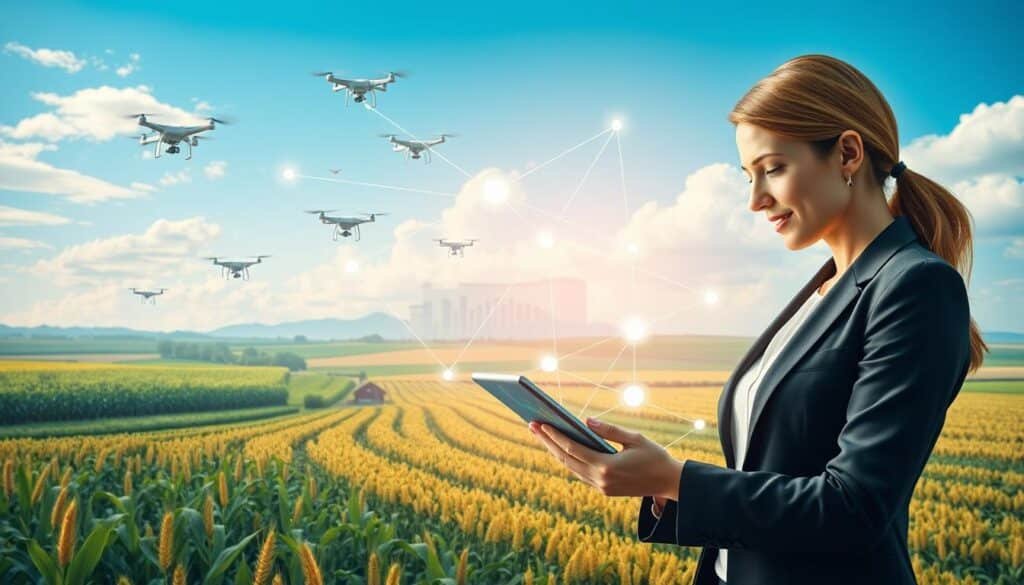
The Evolution of Blockchain Technology in Agriculture
The tool has evolved from an optional add-on to a non-negotiable necessity. Real-world crises exposed weaknesses in paper-based systems. Now, it is vital for business continuity and reducing disputes.
This evolution strengthens accountability across the entire network. It cuts down on manual reconciliations. Many are now adopting these sustainable agriculture initiatives to build a safer, more transparent food future.
The Demand for Transparency in Modern Food Supply Chains
The modern shopper is no longer a passive buyer but an inquisitive participant in the journey of their meals. People want clear answers about what they eat. This demand for openness is reshaping the entire food system.
High-profile safety incidents have eroded public trust. Outbreaks and labeling fraud make headlines. Consumers now seek verifiable proof of a product’s origin and handling.
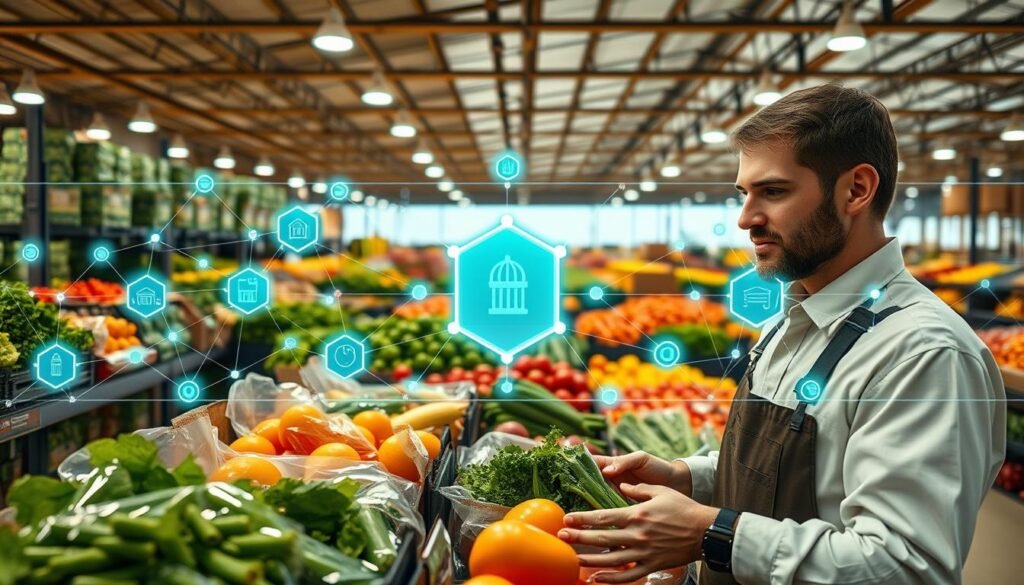
This need goes beyond safety. It includes sustainability and ethical production. Shoppers look for proof of organic methods, fair labor, and animal welfare.
For businesses, traceability is a operational necessity. During a recall, fast tracking saves money and protects brands. Regulators and large retailers now mandate it.
Ultimately, this push for visibility builds deeper consumer confidence. It allows people to support values they believe in, from local economies to responsible farming.
Enhancing Traceability and Quality Control with Blockchain
Retail giants like Walmart have demonstrated the staggering potential of near-instant traceability in our food networks. This capability transforms how we ensure quality and protect public health.
The foundation is an unchangeable digital ledger. Every event is timestamped and cryptographically sealed.
Creating Immutable Digital Ledgers
Each step a product takes is permanently recorded. This creates an unbreakable chain of custody from origin to consumer.
Critical information captured includes:
- Farm location and planting dates
- Real-time growing conditions
- Harvest time and processing steps
- Storage temperatures and transportation routes
Once entered, this data cannot be altered or deleted. It provides a permanent audit trail for complete accountability.
Real-time Data and Recall Efficiency
Internet of Things (IoT) sensors enable continuous monitoring. They track variables like temperature and soil health.
This information feeds directly into the ledger. A famous test by Walmart and IBM traced a mango’s journey in 2.2 seconds. Previously, this took nearly a week.
Such speed turns a widespread recall into a targeted action. Companies can isolate affected batches instead of pulling entire categories. This dramatically cuts waste and economic loss.
Farmers also gain. They analyze historical data to see what conditions improve yields. This leads to better quality control season after season.
Smart Contracts and Automated Transactions in Agriculture
Self-executing digital agreements are transforming how farmers get paid and how food quality is enforced. These programs are coded into a digital ledger. They trigger actions automatically once specific, verifiable terms are met.
Streamlining Payments to Farmers
These smart contracts enable immediate payment upon delivery verification. This cuts the lengthy delays that have historically troubled growers.
The automated system reduces transaction costs. It eliminates middlemen, banks, and payment processors who traditionally take fees.
Payments can even be released in stages. Milestones like planting verification or quality inspection can trigger partial funds.
Ensuring Compliance and Fairness
The same technology enforces agreed-upon standards automatically. It verifies that products meet quality or sustainability specs before releasing payments.
This process can incentivize eco-friendly practices. Farmers receive automatic rewards or premium prices for documenting compliance with environmental protocols.
Platforms like The Marco Polo Network use this for cross-border trade. They guarantee payment once shipment conditions are verified, reducing risk for all parties.
Farmers’ Benefits and Consumer Trust through Blockchain
The relationship between those who grow our food and those who buy it is being fundamentally reshaped. This technology creates a win-win scenario, empowering growers while giving shoppers undeniable proof.
For farmers, the advantages are direct and financial. They can connect straight with buyers, removing costly middlemen. This control over pricing and distribution leads to faster, fairer payments. It also guards against counterfeit seeds or fertilizers with traceable records.
Shoppers gain immense value from this openness. They can access a verified history of their food’s journey. This builds deep confidence in every purchase.
Key consumer benefits include:
- Verified geographic origin and production methods
- Authentic proof of organic or fair-trade certifications
- Immutable records of storage and handling conditions
This transparency creates a powerful cycle. Consumers support values they believe in by paying fair prices. Farmers receive direct economic incentives to maintain high standards and build lasting brand loyalty.
Current Trends Driving Blockchain Adoption in Agriculture
Market forecasts reveal an industry at an inflection point, with billions poised to flow into securing and streamlining the journey of our meals. The conversation has moved past shiny pilots. It now focuses on practical, scalable programs driven by business necessity and regulation.
Market Growth and Investment Forecasts
The numbers are staggering. This sector’s market size was valued at $285.34 million in 2022. It is predicted to reach over $7.3 billion by 2031.
This represents a compound annual growth rate of 43.76%. Such explosive growth signals a shift. The technology is transitioning from experimental projects to essential business tools.
Major investment is flowing in from diverse sources:
- Venture capital firms seeking innovative solutions
- Agricultural cooperatives and large food retailers
- Government-backed innovation programs
Integration of Digital Tools and Sensors
Adoption is accelerated by convergence with other digital systems. The integration of IoT sensors, drones, and AI creates powerful management ecosystems.
Sensors monitor soil health, storage temperatures, and crop conditions in real-time. This stream of data is automatically recorded to an immutable digital ledger. It provides a trusted, single source of truth for all partners.
Regulatory pressures are a key driver. Safety mandates and sustainability reporting make this traceability non-optional. Companies are implementing these systems to meet compliance demands efficiently.
Sustainability and Environmental Impact of Blockchain Initiatives
Environmental stewardship is becoming a measurable, verifiable component of modern farming. This technology provides a clear window into the ecological footprint of our meals.
It creates permanent records of farming methods. This allows for the verification of organic certification and water conservation efforts.
Promoting Eco-friendly Farming Practices
The digital ledger enables precise tracking of resource use. Every drop of water and unit of energy is logged.
This transparent data helps identify waste and promotes optimal utilization. Farmers can prove their commitment to reduced chemical use.
Smart contracts can automatically reward those who meet sustainability benchmarks. This creates direct economic incentives for soil conservation and other responsible methods.
Such systems also support biodiversity by documenting heritage seed varieties. They facilitate knowledge sharing for a healthier ecosystem. Projects like those discussed by the UNDP show how this can drive climate action.
Furthermore, it provides a foundation for carbon credit systems. Verifiable records of emissions allow farmers to monetize sustainable practices.
Reducing Waste Through Precise Traceability
Enhanced traceability directly minimizes food waste. Real-time monitoring from farm to table allows for quicker responses to quality issues.
During a recall, companies can identify and remove only affected products. This avoids disposing of entire batches.
Better monitoring of storage conditions extends shelf life. Optimized inventory management ensures fresher goods reach consumers.
This precise approach protects both the planet and profits. It ensures resources are used efficiently throughout the entire journey.
Innovative Applications Enhancing Food Safety Standards
When a foodborne illness outbreak strikes, every second counts in protecting public health. Innovative applications built on blockchain technology provide that speed. They enable complete traceability from the consumer back to the farm.
This end-to-end visibility is crucial. It allows investigators to pinpoint the origin of contamination rapidly. The spread of illness can be halted much faster.
Consumers now play an active role in safety. By scanning a QR code on packaging, they can instantly verify a product’s authenticity. They can view its full history and check for any recall alerts.
These advanced systems track critical parameters at every stage:
- Cold chain compliance and storage temperatures
- Sanitation records and quality inspections
- Processing conditions and laboratory test results
Such detailed monitoring creates a verifiable chain of custody. This makes it nearly impossible for counterfeit or mislabeled goods to enter the legitimate food supply chain.
Recall efficiency improves dramatically. Companies can execute surgical removals of affected batches only. This minimizes waste, economic loss, and consumer exposure.
Furthermore, these applications support regulatory compliance. They maintain immutable audit trails that prove adherence to HACCP protocols and other standards. All this builds a stronger, more trustworthy system for everyone.
Challenges in Implementing Blockchain in Agriculture
While the potential is immense, the path to widespread adoption is paved with significant hurdles. The fragmented nature of food networks creates coordination challenges. Many long-time growers may resist such fundamental changes to their operations.
Technological Barriers and Limited Infrastructure
Many rural farming areas suffer from inadequate internet connectivity. Smaller operations often lack the computing resources or technical expertise needed.
The requirement for data standardization across diverse stakeholders presents a major technical hurdle. Different partners use various systems and business practices.
High initial investment costs for hardware and software can be prohibitive. This creates a significant financial barrier for small-to-medium-scale farmers.
Resistance and Education Gaps Among Farmers
Traditional communities may view new digital tools with skepticism. Unfamiliarity with the technology breeds fear of complexity or increased surveillance.
Common misconceptions directly link the system to cryptocurrency. This confusion leads to unwarranted privacy or energy consumption concerns.
Targeted education is vital to overcome these gaps. Demonstrating tangible benefits builds the trust necessary for broader acceptance across the sector.
Integrating IoT, Sensors, and Data Security in Supply Chains
Trust in food provenance hinges not just on secure records, but on the accuracy of the information they contain. The seamless integration of physical devices with digital ledgers creates a comprehensive monitoring network.
Real-time Monitoring of Crop Conditions
IoT sensors deployed across fields provide continuous updates. They measure soil moisture, air temperature, humidity, and light levels.
This stream of data flows automatically into an immutable ledger. It creates a trusted, timestamped history of growing conditions.
GPS devices and temperature probes track location and cold chain integrity during transport. This ensures perishable goods maintain quality from farm to store.
Ensuring Robust Data Integrity
A critical challenge is the “oracle problem.” The technology secures records but cannot guarantee the initial data is true.
Robust systems solve this by layering multiple verification sources. These include automated sensor readings, human inspector attestations, and third-party audit reports.
In rural areas with spotty connectivity, edge computing systems capture information locally. They securely store it and synchronize with the main network once an internet connection is restored.
Applications of Blockchain Technology in the Food Supply Chain
Real-world programs prove the tangible value of shared digital records across the entire food ecosystem. These practical applications move beyond theory, showing how every participant benefits.
Case Examples of Successful Implementations
IBM Food Trust serves as a foundational collaborative network. It connects growers, processors, and retailers on one platform.
Major brands have launched successful pilots. Notable case studies include:
- Pietro Coricelli tracking 4 million kilos of olive oil from Italian groves to store shelves.
- Nestlé and Carrefour using the technology to trace the origin of potatoes in their Mousline mashed potato product.
- Walmart slashing mango traceability from days to mere seconds.
These initiatives demonstrate scalable use. They provide consumers with instant, verifiable histories.
Innovative platforms like AgUnity also show promise. They bridge the digital gap for smallholder farmers, connecting communities to markets.
Each successful program shares key elements: stakeholder collaboration, clear data standards, and user-friendly design.
Regulatory Compliance and Standardization in Agricultural Blockchain
Legal frameworks worldwide now demand proof of ethical sourcing, pushing digital ledgers from optional to essential. Due diligence and traceability are becoming mandatory requirements for companies.
Regulations like the EU Deforestation Regulation (EUDR) force businesses to provide plot-level geolocation evidence. This proves agricultural commodities were not sourced from recently cleared land.
Global standards provide the common language for this new era. GS1 EPCIS and the Global Traceability Standard create consistent event data formats.
This standardization enables seamless information transfer between all partners. It ensures different systems can work together without complex custom integration.
The immutable nature of the technology guarantees records cannot be altered after creation. This builds trust for regulators and consumers alike.
Emerging concepts like Digital Product Passports may soon extend to food. They would require comprehensive lifecycle documentation.
Portable digital identities for farms could transform the audit process. Verifiable credentials streamline certification renewals and compliance checks instantly.
Traditional vs. Blockchain-Enabled Supply Chains
Legacy food networks, reliant on paper and spreadsheets, stand in sharp contrast to new, interconnected digital frameworks. Manual logs and isolated databases create major vulnerabilities. They are prone to human error, costly delays, and information gaps.
This old model struggles with scale. It cannot provide the real-time visibility modern markets demand.
Efficiency Gains and Cost Reductions
New digital systems automate routine tasks. They eliminate redundant data entry and speed up transaction settlements.
Smart contracts execute payments and verify compliance automatically. This cuts administrative overhead and reduces intermediary fees.
Streamlined processes lead directly to increased profit margins. They also minimize expenses related to product recalls and disputes.
Enhanced Fraud Prevention and Record Keeping
Unlike manual logs, digital ledgers create permanent, unchangeable records. This makes historical data virtually impossible to alter or falsify.
Such transparency prevents counterfeit goods from entering the legitimate network. It also stops the falsification of certifications.
These comprehensive audit trails support regulatory checks and insurance claims. They provide a trusted foundation for continuous improvement across all partners.
Future Prospects: Predictive Analysis and AI Integration in Agriculture
The convergence of artificial intelligence and secure digital ledgers is unlocking predictive powers previously unseen in farming. This fusion moves beyond simple record-keeping. It enables proactive decision-making for better outcomes.
Verified historical information becomes a powerful training set for machine learning models. These systems can then forecast crop yields, pest risks, and market trends with remarkable accuracy.
Using Blockchain for Advanced Forecasting
Immutable records provide a reliable foundation for AI algorithms. This allows for predictive modeling tailored to specific local conditions. Growers receive actionable insights on optimal planting times and resource use.
A key innovation is asset tokenization. Real-world assets like future harvests can be represented as digital tokens. Smart contracts then automate investment and profit distribution.
This integration creates a closed-loop system. Decisions are informed by trusted data, outcomes are recorded, and practices continuously improve. The future points to highly efficient, sustainable operations.
Real-World Case Studies: Success Stories in Blockchain Agriculture
Concrete examples from leading companies show how digital ledger technology delivers real value across global food networks. These success stories highlight practical benefits for all participants.
IBM Food Trust and Collaborative Networks
IBM Food Trust creates a shared platform connecting growers, processors, and retailers. Pietro Coricelli used this system to track 4 million kilos of olive oil from Italian groves to store shelves.
Nestlé and Carrefour partnered to trace the Mousline mashed potato brand. Customers can scan packaging to see detailed product origins and quality.
Walmart’s collaboration slashed mango traceability from days to seconds. This proves the scalability for leafy greens and other produce.
The Role of the Marco Polo Network and Other Pioneers
The Marco Polo Network modernizes import and export business. It provides a platform for tracking shipments worldwide and guarantees payment once conditions are met.
AgUnity bridges the gap between farming communities and organizations. Its participatory design learns from end-users to support smallholder farmers.
These initiatives demonstrate strong leadership and clear value propositions. User-friendly interfaces and phased implementation ensure success.
Conclusion
Practical value, not just technological promise, now drives the adoption of secure digital ledgers in farming. The shift from pilot projects to essential infrastructure is clear. It is fueled by stricter rules, safety needs, and shopper demand for honesty.
Success hinges on execution. Systems must deliver real benefits to all stakeholders. This means faster payments for growers, safer goods for families, and efficient operations for businesses.
Effective transparency shares verified data while protecting private details. It builds trust without exposing competitive secrets. This balanced approach is key for widespread use.
Challenges like limited internet access or upfront costs remain. Yet, the potential to create fairer, more resilient food networks is immense. Future progress will merge this technology with AI and smart sensors for even smarter ecosystems.
Ultimately, this represents a fundamental reimagining. Our food systems move towards models built on shared value and verified information.
FAQ
How does this technology improve food traceability?
It creates a permanent, unchangeable digital record for every product. This ledger tracks each item from the farm to the store shelf. If a safety issue arises, companies can pinpoint the problem’s source in minutes, not days. This rapid response protects public health and reduces waste from broad recalls.
What are smart contracts, and how do they help farmers?
Smart contracts are self-executing digital agreements. They automatically trigger actions, like payments, when pre-set conditions are met. For instance, a payment can be released instantly once a delivery is verified at a distribution center. This gives producers faster, more reliable income and builds fairness into transactions.
What are the main hurdles for adopting this system in farming?
Key challenges include a lack of reliable digital infrastructure in rural areas and the initial cost of setup. Furthermore, some producers may be hesitant to adopt new processes due to a knowledge gap. Successful implementation requires investment in both technology and training for all participants in the network.
Can this innovation support sustainable farming?
Yes, it promotes eco-friendly practices by providing verifiable proof. Farmers can securely record data on water usage, organic certifications, or reduced pesticide application. Consumers and retailers can then make informed choices, rewarding operations that prioritize environmental stewardship and reducing the ecological footprint.
How does it work with other digital tools like IoT sensors?
Internet of Things (IoT) devices, like soil or temperature sensors, collect real-time information from fields and shipments. This data is then securely logged on the immutable ledger. This integration allows for automatic quality verification, monitors crop conditions, and ensures the integrity of the information throughout the journey.
Are there real-world examples of this being used successfully?
A> Absolutely. Platforms like IBM Food Trust are used by major retailers and brands to track produce and packaged goods. Similarly, networks like Marco Polo facilitate trade finance and logistics. These pioneers demonstrate tangible gains in operational efficiency, safety, and trust among all parties involved.
How does this approach prevent fraud in the food industry?
The decentralized and transparent nature of the digital ledger makes fraud extremely difficult. Records cannot be altered or deleted without consensus from the network. This prevents issues like mislabeling a product’s origin, falsifying organic status, or tampering with safety inspection certificates, ensuring authenticity for buyers.

No comments yet