

The world of athletics is undergoing a powerful digital revolution. Market experts predict adoption of this decentralized technology will grow at a steady 9% each year. This surge is driven by a strong demand for greater transparency and security across the entire sector.
Academic studies have identified numerous practical applications for this innovation. Research analyzing dozens of publications from 2017 to 2023 found managing competitor information to be a primary focus. This comprehensive analysis highlights ten distinct areas where the technology is making a real impact.
The system tackles persistent problems like fake tickets and tampered records. It also creates new, exciting ways for supporters to connect with their favorite teams. Major leagues and global clubs are already implementing these forward-thinking solutions.
This guide will examine the real-world implementations that are changing the game. We will explore how this tech builds a new architecture of trust and creates engaging opportunities for fans, athletes, and organizations alike.
The Evolution of Blockchain Technology in Sports
Microsoft’s 2017 launch of BraveLog marked a pivotal moment for secure data recording in athletics. This first dedicated platform, built on Azure, was designed to protect competitor statistics. It moved beyond theory into a real-world application.
Academic exploration of this decentralized ledger tech grew rapidly afterward. Studies increased from just one in 2018 to a peak of eleven by 2022. The focus shifted from broad reports to concrete technical contributions for deployment.

The scope of these platforms evolved significantly. Early systems simply stored athlete performance data. They soon incorporated smart contracts, NFTs, and decentralized autonomous organizations (DAOs) for governance.
Practical implementations now span a wide range of areas:
- Creating tamper-proof ticketing systems
- Building new fan loyalty programs
- Ensuring anti-doping measure integrity
- Managing copyrights and sponsorships
Research hubs in China and the United States have driven much of this innovation. This geographic concentration highlights the global race to harness this tech’s potential for transparency.
Understanding Blockchain’s Impact on Fan Engagement
Supporters are no longer just spectators. They are becoming active stakeholders in their favorite clubs. This shift is powered by innovative digital assets.
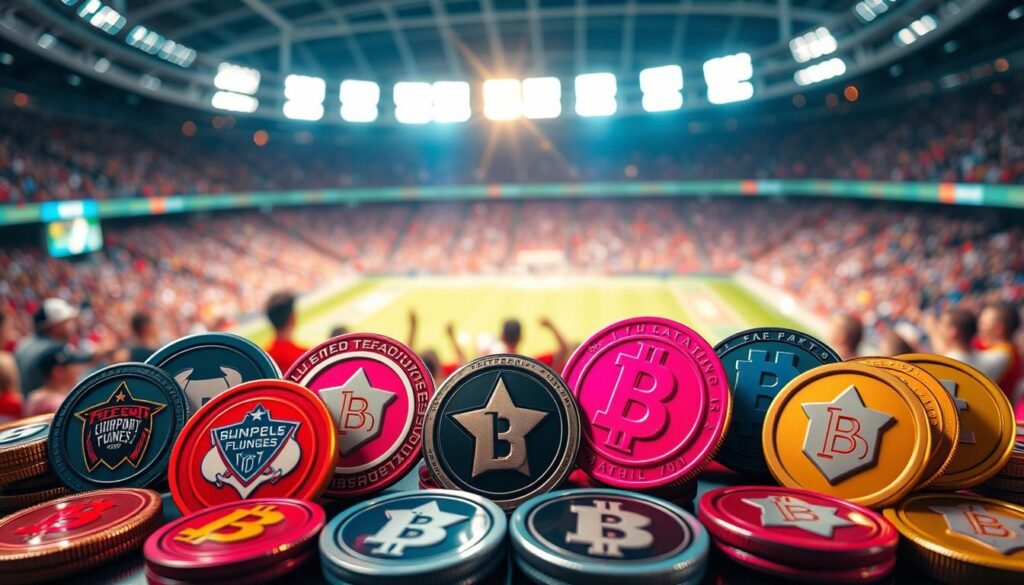
Enhancing Loyalty and Participation
Fan tokens grant holders special privileges. These digital assets create a direct link between organizations and their global fanbase.
Key benefits for supporters include:
- Voting rights on specific team decisions
- Access to exclusive behind-the-scenes content
- Special rewards like merchandise discounts
This system builds a stronger emotional connection. It rewards loyalty with real influence and unique experiences.
Case Studies of Fan Token Success
FC Barcelona launched its fan token offering in June 2020. It raised an impressive $1.3 million in just two hours.
This rapid fundraising shows massive demand. Major football clubs like Juventus have also generated millions.
The revenue supports club operations. More importantly, it fosters a community-driven ecosystem where fans are invested participants.
Exploring “blockchain in sports industry use cases”
A detailed study of 38 research papers uncovers ten primary areas where this innovation is applied. This analysis provides a clear framework for understanding its practical roles.
Managing athlete information emerged as the most prevalent application. It was cited in over half of the reviewed publications.
Other key implementations include transparent financial systems for crowdfunding. Authenticating digital collectibles and memorabilia is another major focus.
Research also highlights this tech’s role in event logistics and deeper fan connections. These areas show its dual capacity for operations and engagement.
The academic work reveals an interesting split. A large majority of studies concentrate on traditional athletics.
Emerging digital competitive environments represent a smaller but growing segment. This indicates significant potential for future development in that sector.
Athlete’s Data Management and Performance Optimization
The integrity of an athlete’s career data is paramount for fair competition and career advancement. This area represents the most researched application of decentralized ledger technology, cited in twenty academic sources.
It tackles critical flaws in traditional centralized systems. These include single points of failure and risks of information tampering.
Decentralized Storage and Security
Platforms like Microsoft’s BraveLog create immutable digital records of competitor statistics. This establishes a verified sports CV.
Tools such as Peerspoint collect metrics during training and games. They provide recruiters with authentic information for assessment.
The decentralized approach offers enhanced security and transparency. It serves as a reliable bank for fitness measurements and health records.
Integration with IoT and AI for Performance Predictions
Internet of Things (IoT) devices capture real-time physiological data. This includes heart rate and biomechanical metrics.
Artificial Intelligence algorithms analyze this information securely stored on the ledger. They optimize training programs and forecast outcomes.
Advanced hybrid models, like Block-Deep, combine this technology with deep learning. They refine methods for injury rehabilitation and fracture detection with high accuracy.
Smart Contracts in Sports: Automation and Transparency
Automated agreements are transforming how professional teams manage their commercial relationships. These self-executing digital protocols bring unprecedented clarity and reliability to dealings between clubs, athletes, and backers.
Streamlining Sponsorships and Player Contracts
Smart contracts revolutionize agreements by automating payment execution. Funds are released automatically when athletes hit predefined performance benchmarks.
This process eliminates manual delays and reduces administrative overhead. It creates a transparent system where all terms are visible and immutable.
Key advantages include:
- Immediate compensation for achieved goals
- Reduced need for intermediaries like agents
- Real-time auditability of all contract terms
- Stronger trust between all parties involved
Performance-based models motivate players and assure sponsors. Investments are tied directly to verifiable results. The automation inherent in this technology minimizes disputes and simplifies rights management.
Organizations can handle complex multi-party agreements with greater efficiency. Resources shift from administrative tasks to strategic growth.
Digital Collectibles and NFTs: Revolutionizing Fan Experience
Platforms like NBA Top Shot demonstrate the massive potential of tokenized fan experiences. This digital marketplace has generated over $700 million by letting supporters buy and sell iconic highlight clips.
These digital collectibles offer exclusive memorabilia options with guaranteed scarcity. They create a new, emotional connection between fans and the games they love.
Authenticity and Ownership in Digital Trading Cards
Proving an item’s genuineness has long been a problem for collectors. Decentralized technology solves this by creating immutable records for each asset.
Advanced management systems use a multi-phase process. Smart contracts trigger at each step to verify origin, issuance, and payment.
This creates a transparent, auditable trail for every transaction. It gives collectors tamper-proof evidence of their ownership rights.
Emerging Trends in Sports Memorabilia
The market is evolving beyond simple digital cards. Tokenized physical items now link a real-world artifact to a unique digital certificate.
Augmented reality experiences connected to these assets are gaining popularity. Fractional ownership models also allow more fans to access high-value pieces.
These innovations are revolutionizing fan engagement by offering provable scarcity and authenticated provenance. They build a trustworthy ecosystem for the modern supporter.
Secure Ticketing Systems: Eliminating Fraud and Scalping
Ticket fraud and scalping have long plagued major sporting events, creating frustration for genuine supporters. Innovative digital solutions are now tackling these issues head-on. For example, UEFA introduced a mobile app powered by decentralized ledger tech for its 2020 tournament.
This platform successfully distributed over one million passes. It enhanced security and transparency while preventing fraud.
Leveraging Blockchain for Immutable Ticket Verification
Tokenizing event passes as non-fungible tokens (NFTs) leverages the immutability of blockchain. Each NFT receives a unique identification code that cannot be duplicated. This eliminates ticket forgery completely.
Smart contracts embedded within these digital assets enable automated conditions. They can set maximum ownership limits per digital wallet. This impedes automated bot operations that dominate secondary markets.
These contracts can also restrict resale prices. They ensure prices do not exceed initial purchase values. This eliminates predatory pricing by scalpers.
Integration with RFID technology creates comprehensive solutions. Spectators receive unique wristbands that trigger smart contracts at gate readers. Instant validity verification speeds up entry.
The transparency provided allows fans to verify authenticity before purchase. They can trace ownership history. This builds trust in secondary markets.
Royalties are seamlessly incorporated through automated agreements. Organizers receive automatic payments for each secondary sale. This creates new revenue streams.
Contactless verification became particularly valuable during the COVID-19 pandemic. It reduced fraud risks and supported public health safety at venues.
Anti-Doping Measures and Integrity in Competitive Sports
State-sponsored doping schemes exposed at the Rio Games shook public confidence in anti-doping systems. These revelations showed that centralized oversight mechanisms are vulnerable to manipulation.
Tackling Centralization Challenges
Current systems like WADA’s ADAMS face significant challenges. Over-centralized data management and insufficient privacy measures have led to security incidents.
This jeopardizes the agency’s efficacy in maintaining fair competition. A new approach is needed to restore trust and integrity.
Decentralized technology offers an innovative platform to combat doping. Its tamper-proof nature and smart contracts provide regulators with powerful tools.
Researchers propose redesigning Therapeutic Use Exemptions using permissioned blockchain. This enhances security and democratization compared to current processes.
Immutable records of test outcomes prevent data manipulation. All stakeholders can then trust the fairness of doping assessments.
Smart contracts automate complex workflows like sample tracking. This reduces administrative burdens while increasing process reliability for athletic organizations.
Blockchain for Sponsorship, Crowdfunding, and Finance
The second most researched application of this tech focuses on revolutionizing how teams and athletes secure funding. Academic analysis identifies financial management as a key area for innovation.
This decentralized approach moves beyond traditional banking. It creates a new architecture for monetary flows across the athletic sector.
Transparent Transaction Records and Smart Funding
Every financial interaction can be recorded on an immutable ledger. All stakeholders gain real-time visibility into sponsorship deals and revenue distribution.
This transparency builds unprecedented trust between backers and organizations. It prevents fund misappropriation and ensures accountability.
Smart contracts automate complex funding mechanisms. Payments trigger automatically when athletes hit performance milestones or tournaments conclude.
This automation eliminates manual delays and reduces administrative costs. It allows sponsors to track contribution utilization effortlessly.
Key advantages of this financial model include:
- Elimination of costly intermediaries from payment processing
- Tamper-proof documentation for regulatory compliance
- Democratized investment through tokenized team shares
- Global accessibility for supporter crowdfunding campaigns
Smaller clubs and individual competitors benefit greatly. They can access micro-transactions and global capital previously unavailable. This system fosters a more equitable and efficient financial ecosystem for all participants.
Enhancing Event Management and Operational Efficiency
Seven academic studies have specifically examined how decentralized ledgers can streamline event operations. Organizing a major tournament requires flawless coordination between many groups.
Venues, sponsors, vendors, and security teams must collaborate. Decentralized platforms simplify this complex process.
They handle ticket sales, sponsorship deals, and merchandise payments. This integration results in significant cost savings.
Transparency is enhanced at every step. Fans and partners gain verifiable records of all transactions.
The technology’s governance rules are built into its architecture. Access controls and incentive structures automate coordination.
This reduces manual oversight for event organizers. All authorized stakeholders follow predetermined protocols.
Real-time data sharing allows for better logistics tracking. It also helps manage crowd flow and emergency responses.
The decentralized nature eliminates single points of failure. Critical information remains accessible even during network issues.
Innovative approaches include community-managed festivals using DAOs. Programmable agreements adjust automatically based on live attendance metrics.
Interplay of IoT, AI, and Blockchain in Sports Data Analytics
The fusion of IoT sensors, artificial intelligence, and secure distributed ledgers is creating a new paradigm for athletic performance analysis. These three technologies work together to collect, protect, and interpret competitor information.
Advanced Performance Prediction Models
Wearable devices capture real-time physiological data. This includes heart rate, movement patterns, and force application.
The information flows to an immutable ledger for secure storage. AI algorithms then analyze this verified data to find trends.
Machine learning models, like Hidden Markov Models, use historical records. They forecast tournament outcomes and optimal training adjustments with high accuracy.
This integrated system also monitors injury rehabilitation. Neural networks assess recovery metrics stored on the ledger.
They identify patterns showing a program’s effectiveness. The result is a closed-loop system for continuous performance improvement.
Coaches and medical staff receive actionable insights. This synergy builds trust through transparency and security for all stakeholders.
Governance and Transparency: Shaping the Future of Sports Organizations
A new “rule of code” is emerging to define how clubs and leagues operate. This model moves power from a central office to a distributed network of participants.
This shift is powered by Decentralized Autonomous Organizations, or DAOs. They enable fans and athletes to vote on key decisions directly.
Decentralized Autonomous Organizations (DAOs)
DAOs distribute decision-making authority among token holders. This creates a more participatory and transparent governance structure.
Key mechanisms include access controls and incentive systems. These rules are embedded directly into the technology’s infrastructure.
This ensures all stakeholders follow the same immutable protocols. It builds greater trust within the community.
Frameworks Integrating Distributed Governance
Researchers propose blending several theoretical models. The Dynamic Capabilities Framework and Collaborative Governance Theory provide a roadmap.
This integrated approach helps sports organizations navigate the digital landscape. It balances innovation with operational needs.
However, implementing these systems faces hurdles. Regulatory uncertainty and technological complexity are significant barriers.
Contemporary governance models must evolve. They need to support decentralized, community-driven organizations effectively.
Traditional vs Digital Sports: Comparative Use Cases
Academic research reveals a striking imbalance in how decentralized technology is applied across different competitive domains. Studies show 81% of papers focus on traditional physical activities. Only 19% explore digital sectors like gambling and esports.
Performance Improvement in Traditional Sports
This technology creates specialized systems for physical athletics. It tracks real-time data for basketball training improvement.
Other applications ensure transparency for taekwondo belt exams. They also predict cricket player outcomes using secure historical data.
Football injury management is another key area. These platforms store health records to generate better rehabilitation plans.
Innovations Driving Digital Sports and eSports
Digital competitions leverage this ledger differently. Transparent betting platforms eliminate outcome manipulation.
Fantasy leagues tokenize player ownership as unique digital assets. This creates more engaging and trustworthy experiences for participants.
Esports tournaments use automated agreements for prize distribution. These models align with the preferences of younger, digital-native fans.
Research Trends, Global Perspectives, and Case Study Insights
A worldwide analysis of scholarly work highlights where theoretical research meets practical implementation. Geographic patterns reveal significant concentration in innovation.
China leads academic productivity with nineteen papers. The United States follows with seven publications. This shows these nations are driving the theoretical development of this technology.
The distribution of publication types indicates a maturing field. Fifty-eight percent are peer-reviewed journal articles. This shift from conference reports to rigorous scrutiny marks important progress.
Studies were systematically coded by type, field, proposed use case, and targeted stakeholder. This framework offers a clear view of the research landscape.
Major case studies provide concrete validation. UEFA’s ticketing application distributed over a million secure passes. FC Barcelona’s fan token offering raised $1.3 million in just two hours.
NBA Top Shot’s generation of $700 million in sales proves the commercial model for digital collectibles. These are powerful applications.
Corporate platforms like Microsoft’s BraveLog and Peerspoint deliver specialized solutions. Practical adoption by football clubs and professional leagues shows this sector’s evolution transcends academic hubs.
Overcoming Challenges and Driving Future Innovations in Blockchain for Sports
For this transformative tech to reach its promise, organizations must first tackle pressing concerns around scalability and knowledge gaps. Several significant hurdles stand in the way of full integration.
Technological literacy among key stakeholders remains a fundamental barrier. Many coaches, administrators, and fans lack understanding of decentralized systems. This knowledge gap slows adoption across the sector.
Governance disputes also arise from shifting to community-driven models. Traditional hierarchies often resist distributed decision-making processes.
A lack of standardization fragments different platforms. Ticketing, fan engagement, and data management solutions cannot communicate seamlessly. This limits the technology’s overall transformative potential.
Regulatory uncertainty creates complex compliance landscapes. Rules for digital assets vary greatly between jurisdictions. Navigating these laws requires specialized legal expertise.
Substantial upfront investment in infrastructure and skilled personnel presents a financial challenge. Smaller entities with limited budgets find this particularly difficult.
Future progress depends on comprehensive education initiatives and user-friendly interfaces. Collaboration with regulators to establish clear frameworks is equally vital. These steps will drive the innovation needed for broader, more efficient adoption.
Conclusion
This exploration confirms that the digital transformation of athletics is not a trend, but a fundamental shift. The study provides crucial theoretical insights and a practical framework for entities.
Real-world applications like secure ticketing and fan tokens generate significant value. They demonstrate the move beyond concepts to scalable solutions.
Challenges around regulation and knowledge remain. Future progress depends on strategic partnerships with specialized software developers.
Ultimately, this technology builds a more transparent and participatory ecosystem for all stakeholders.
FAQ
How does this technology improve interaction for supporters?
It creates direct, transparent channels between clubs and their audience. Tools like fan tokens from platforms such as Socios.com allow supporters to vote on minor club decisions, access exclusive content, and unlock unique rewards. This fosters a stronger sense of community and belonging, moving beyond passive viewership to active participation.
What are smart contracts, and how are they used in athletics?
Smart contracts are self-executing agreements with terms written into code. In athletics, they automate processes like player salary payments upon achieving performance milestones, ensuring timely and transparent transactions. They also streamline sponsorship deals, automatically releasing funds when contractual conditions, like social media posts, are verified.
Can digital collectibles like NFTs benefit fans?
Absolutely. Non-fungible tokens (NFTs) revolutionize memorabilia by providing verifiable proof of authenticity and ownership for digital assets. Fans can collect and trade officially licensed digital trading cards or video highlights from marketplaces like NBA Top Shot. This creates a new economy and a modern way for enthusiasts to connect with their favorite teams and athletes.
How does a distributed ledger system help with ticket sales?
It secures the ticketing process by creating an immutable, verifiable record for each ticket. This makes duplication or forgery nearly impossible, effectively combating fraud and scalping. Companies like GUTS Tickets use this model to ensure tickets are resold at fair prices, guaranteeing authentic entry for every event attendee.
What role can this innovation play in anti-doping efforts?
It can enhance integrity by creating a tamper-proof log of an athlete’s medical data and test results. Authorized bodies like the World Anti-Doping Agency (WADA) could access a secure, immutable history, reducing administrative errors and increasing trust in the fairness of competition. This tackles challenges in current centralized data management systems.
How does it change financial models for clubs and athletes?
It introduces new avenues for revenue and funding. Through tokenized crowdfunding, organizations can raise capital directly from their global fanbase. Furthermore, transparent transaction records for sponsorship deals build trust with partners. Athletes can also leverage it for direct fan funding or through automated royalty payments for licensed merchandise.
Can it help manage athlete performance information?
Yes. It offers a secure, decentralized system for storing sensitive performance and health metrics. When integrated with IoT devices and AI, this data can be used to build advanced prediction models for injury prevention and training optimization, all while giving the athlete full control over who accesses their personal information.
What are the main hurdles for wider adoption in this sector?
Key challenges include the need for significant education among stakeholders, integrating new systems with legacy infrastructure, and navigating evolving regulatory landscapes. Concerns around the energy consumption of some networks and achieving true scalability for mass adoption during live events also need to be addressed for future innovation.

No comments yet