

This guide explains how a distributed ledger can reshape modern logistics and operations. It matters now as U.S. networks face disruptions, higher buyer expectations, and tighter compliance rules.
At a high level, the tech creates a shared record of verified transactions from source to consumer. That shared ledger boosts transparency, trust, and auditability while reducing paperwork and disputes.
Readers will get an end-to-end primer that moves from fundamentals to real-world applications, integration tips, and risks. You will learn key benefits: traceability, stronger security, faster recall readiness, fewer disputes, and smarter automation through smart contracts.
The business case is clear. Market forecasts project growth to about USD 17.15B by 2030, so firms invest now to meet industry expectations and stay competitive.
This is not a magic fix. Success depends on correct labeling, scanning, and reliable data capture. The guide is for supply leaders, operations, compliance, and IT teams seeking practical steps to evaluate a rollout.
Learn more about real implementations at blockchain for supply chain.
What Blockchain Means for Modern Supply Chains
A shared, tamper-evident ledger lets multiple firms record the same transactions with consistent rules and access.
How the ledger works: the system records transactions as linked entries so authorized participants see the same information. That consistent format reduces mismatched records and speeds audits.
Visibility suffers when many handoffs use siloed systems and delayed updates. Multi-party workflows and varying data formats create gaps that weaken trust and spark disputes.

Data integrity matters: if parties can edit records differently, inventory, recalls, and payments become risky. A shared ledger makes tampering evident and helps keep records aligned.
- Permissioned networks: access is controlled and suit enterprise confidentiality.
- Public ledgers: open but less private, often not ideal for enterprise needs.
- Consortium models: a middle ground for industry groups that need shared rules.
As more participants adopt common data rules, the ledger shifts from another silo to a reliable, shared system of record. Understanding these mechanics helps stakeholders judge whether a blockchain supply solution fits their specific supply chains and prepares them for the technical details covered next.
How Blockchain Works Within Supply Chain Processes
Records are grouped into linked blocks with timestamps and one-way hashes, so any tamper attempt becomes obvious. Each block references the prior block, and multiple ledger copies let partners detect any mismatch quickly.
Why that matters: within supply chain processes, multiple partners must agree on event history—packed, loaded, handed off, inspected, and received. A tamper-evident ledger makes those events verifiable without constant reconciliation.
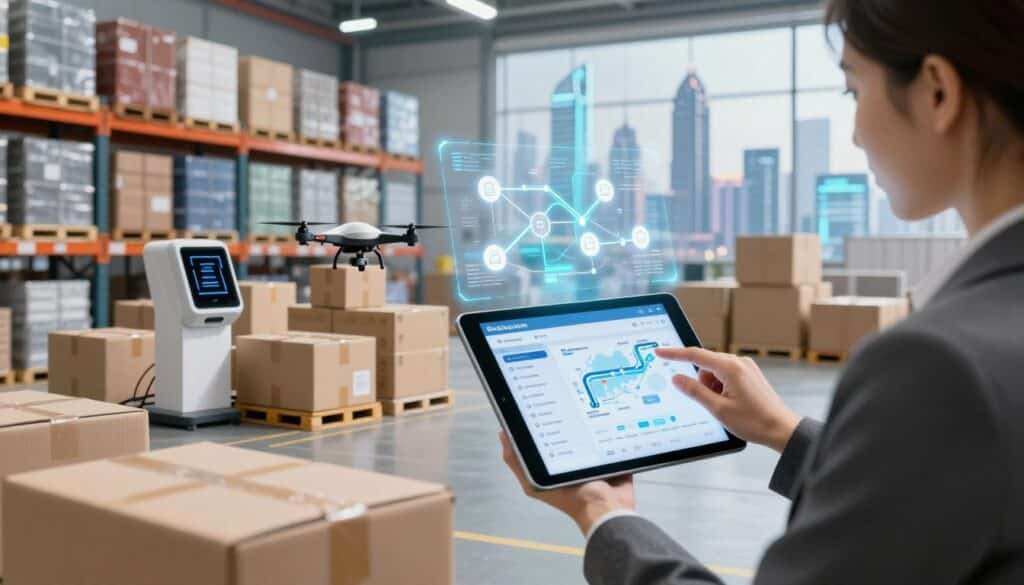
Shared single source of truth
Instead of reconciling spreadsheets and siloed systems, authorized companies read one ledger state for the same product movement. That single source of truth speeds audits and reduces disputes across partners.
What must happen off-chain
The ledger only records what is captured. Reliable labeling, consistent scan events, and data capture standards determine ledger quality. Define required fields and event types before rollout.
Connecting scanners, barcodes, and RFID
Handheld and fixed scanners can write barcode or RFID scan events directly to the ledger rather than to a single-company database. This improves tracking of goods across carriers and warehouses and cuts errors during frequent handoffs.
- Mechanics: blocks, timestamps, one-way hashing, and linked entries.
- Process fit: agreed event history for every product movement.
- Practical steps: standardize labels, map data fields, and set read/write permissions for all partners.
For a deeper look at practical deployments and governance options, read this overview on enterprise use: blockchain supply solutions.
Why Companies Use Blockchain Supply Chain Solutions Today
Many firms now adopt distributed ledgers to stop counterfeits and speed crisis response across complex networks. Pressure from fraud, tighter recall rules, and customer demand for verified sourcing pushes companies to change how they record events.

Reducing fraud and lowering disputes: shared, verifiable records show who did what and when. That clarity cuts reconciliation time and reduces costs tied to paperwork, chargebacks, and delayed payments.
Faster recall readiness: lot-level traceability narrows recalls to affected items. Food, pharma, and consumer goods firms can isolate lots quickly and cut recall costs and risk to consumers.
Building trust among stakeholders: global sourcing and multiple tiers erode confidence. A common ledger helps stakeholders align on the same history, improving security and transparency without relying only on intermediaries.
- Decision criteria: which events to record, which partners must join, and which costs fall (paperwork, reconciliation, delays).
- measurable outcomes: fewer disputes, lower fraud risk, faster recalls, and higher customer trust.
Blockchain in Supply Chain Management Benefits
When every partner records the same events, teams gain clear traceability across every handoff.

End-to-end traceability lets you follow a product from origin to delivery. Consistent event records across all participants improve accuracy and accountability. That clarity speeds recalls and root-cause analysis for damaged goods.
Transparency and real-time visibility
Authorized parties read and write the same ledger updates, reducing blind spots across supply chains. Near real-time visibility cuts delays and shortens dispute resolution.
Stronger security and immutability
Immutability—one-way hashes, timestamps, and multiple ledger copies—makes tampering evident. Shared verification lowers fraud, substitution, and record manipulation.
Operational efficiency and smart contracts
Fewer reconciliation cycles mean less paperwork and faster updates. Smart contracts automate milestone actions, such as releasing payment after proof of delivery and temperature compliance.
Compliance and provenance
Audited transaction records provide provenance proof for regulated goods like pharmaceuticals and food. A shipment’s ledger can show custody changes and condition checks, helping resolve claims and reduce chargebacks.
- Benefits: traceability, transparency, security.
- Applied gains: faster delivery confirmation and fewer disputes.
- Business result: clearer audits and verified provenance for goods.
Core Capabilities That Make Blockchain Technology Valuable in Supply Chains
Practical features of distributed ledgers help firms confirm origin, monitor condition, and prove ownership for high-value goods.
Provenance and authenticity verification for products and materials
Link origins to verifiable events: record sourcing, transformation, and custody updates so each product has an auditable trail. This helps companies spot substitutions and reduce counterfeits.
Condition monitoring for sensitive goods
IoT sensors can log temperature, humidity, and handling events to the ledger. For vaccines, biologics, or refrigerated foods, that recorded data supports quality claims and fewer spoilage disputes.
Tokenized assets for ownership and chain-of-custody validation
Digital tokens act as certificates tied to physical items (gems, high-value parts, or certificates of authenticity). Tokens simplify transfers and make custody history tamper-evident.
Data governance in enterprise blockchain consortia
Clear rules matter: define who writes, who views, and how disputes are resolved. Permissioned networks can identify malicious actors and enforce standards that protect data and access.
- Set event scope: identity, location, condition.
- Define audit rights and penalties for false updates.
- Adopt industry standards to speed partner onboarding.
Outcome: these capabilities yield fewer counterfeits, better compliance reporting, and clearer accountability. Start by scoping the key events and attributes that matter most to your industry and risk profile.
Real-World Applications Across Industries in the United States
Real U.S. projects show how a shared event record helps multiple carriers and vendors resolve exceptions faster.
Logistics and shipping: end-to-end shipment tracking across hubs and carriers improves exception management, reduces disputes, and boosts customer visibility. Major firms like FedEx and UPS are exploring ledger-enabled offerings that let shippers, carriers, and receivers read the same custody events instead of storing data in a single carrier’s system.
Healthcare and pharmaceuticals: validated temperature logs and tamper-evident records support cold chain integrity for vaccines and regulated materials. Consistent traceability helps auditors verify compliance and reduces substitution risk for sensitive products.
Manufacturing: greater supplier visibility and component traceability cut counterfeit risk and ease standards compliance across multi-tier vendors. Companies can link parts and certificates to immutable events so recalls and quality checks run faster.
- Example: Deloitte prototyped a system using Hyperledger Fabric with IoT tracking (Thingstream) and AWS to record real-time locations immutably for all parties.
- Shared pattern: trusted information, consistent event capture, and smooth integration with existing systems power these applications.
High-Impact Blockchain Supply Chain Use Cases
Targeted use cases demonstrate how a tamper-evident record solves recurring problems like counterfeits, recalls, and billing disputes.
Counterfeit prevention for high-risk products
What it fixes: verified provenance and chain-of-custody events make substitutions and fraud visible. For pharmaceuticals, luxury goods, and critical components, this reduces recalls, warranty claims, and legal risk.
Food safety and targeted recalls
Lot-level traceability lets teams isolate affected batches quickly. That precision limits shelf pulls and cuts recall costs while protecting consumers.
ESG and Scope 3 tracking
Why it matters: verified traceability and provenance data back sustainability claims and lower greenwashing risk for stakeholders and auditors.
Streamlined documentation and shared records
Replacing repetitive document exchange with a shared, auditable ledger reduces administrative costs and boosts transparency across participants.
Automated procurement-to-pay workflows
Smart contracts trigger approvals and payments when delivery, inspection, or condition data match agreed rules. That reduces disputes and improves cash flow for suppliers.
- Example: IBM Food Trust shows faster investigations and recall response through ledger-enabled traceability.
- Note: each use case depends on consistent data capture and aligned stakeholders, not only the ledger layer.
Integrating Blockchain With IoT, AI, and Existing Systems
A practical integration layers device telemetry, analytics, and existing enterprise software so teams see trusted events and act faster.
Integration strategy: treat the ledger as a trusted coordination layer while each system keeps its role. Sensors and scanners capture events, AI analyzes patterns, and ERP handles planning and finance.
IoT sensors and real-time condition capture
Sensors on pallets and containers record temperature, humidity, and GPS and write time-stamped events to the shared record. That verified information supports tight tracking for cold chain goods like vaccines and biologics.
AI analytics on trusted records
AI models use the cleaner ledger data to spot anomalies and predict disruptions. Predictive alerts reduce risk and help operations reroute shipments before delays cascade.
ERP and legacy systems as add-on layers
Position the ledger as an add-on solution that syncs via read/write APIs. A simple architecture has data ingestion, validation rules, ledger write, and read endpoints that feed back to ERP and planning systems.
- Governance: define master data owners, identity roles, and exception workflows.
- Architecture: sensors → validation → ledger write → API sync to systems.
- Outcome: faster audits, clearer information, and lower operational risk.
Challenges, Risks, and Standards to Address Before Implementation
Start with a clear map of integrations, governance, and privacy needs. This step exposes the key challenges and helps you choose the right standards and architecture.
Interoperability and cross-platform standards
Why it matters: suppliers, carriers, and buyers use different systems. Cross-network bridges and relayers can connect ledgers but add trade-offs for latency and trust.
Scalability and throughput
Transaction limits vary by network. Enterprises often use permissioned setups for higher throughput or Layer 2/sidechain approaches for public networks.
Security, privacy, and smart contract risk
Core risks: confidentiality, data integrity, consensus failures, and buggy contracts. Require code audits and proven frameworks to reduce vulnerabilities.
Stakeholder adoption and governance
Projects fail when participants lack incentives. Define roles, data requirements, and dispute rules early so stakeholders share timely, accurate updates.
Cost considerations and a quick checklist
Account for implementation effort, node operations, and training. Verify ROI via fewer disputes, faster recalls, and lower fraud.
- Define scope and data model.
- Choose network type and standards.
- Plan integration, audits, and governance.
- Quantify benefits before scaling.
For practical examples and standards guidance, review a primer on transparent networks.
Conclusion
A unified, auditable record makes it easier for companies to trace products and resolve disputes fast.
What it is / how it works / why it matters: a tamper‑evident ledger records verified transactions so partners share the same view. That shared visibility improves traceability, transparency, and security across the supply chain.
The real gains come from pairing the technology with solid processes: consistent labeling, disciplined scanning, and clear governance. Without those steps, system data and outcomes suffer.
Near-term high-value applications include anti‑counterfeit programs, targeted recalls, cold‑chain integrity, shared documentation, and automated procurement‑to‑pay. Start small: pick a high-impact use case, onboard key partners, prove ROI, then scale.
Examples like IBM Food Trust, Hyperledger Fabric prototypes, and Oracle implementations show the model works today. As interoperability and IoT/AI links deepen, expect this approach to expand across the industry and into the future.
FAQ
What does distributed ledger technology mean for modern supply chains?
Distributed ledgers create a shared, tamper-evident record of transactions and events across multiple participants. That shared record improves visibility, reduces reconciliation work, and establishes a common provenance for goods and documents without relying on a single trusted intermediary.
How do permissioned, public, and consortium networks differ for industry use?
Public networks are open to everyone and prioritize decentralization. Permissioned networks restrict participation and are common for enterprise consortia where privacy, governance, and regulatory compliance matter. Consortium models sit between the two, letting a group of vetted organizations jointly run validation and set rules.
Why do many supply chains struggle with visibility, trust, and data integrity?
Fragmented systems, manual paperwork, and siloed databases create gaps and inconsistencies. Multiple parties use different formats and controls, which leads to disputes, slow reconciliations, and unreliable provenance data that hampers rapid decision-making.
How do blocks, hashing, and timestamps make records tamper-evident?
Each entry is hashed and linked to the previous block, so changing one record alters subsequent hashes and triggers detection. Timestamps and cryptographic signatures add an audit trail that shows when data was added and by whom, making unauthorized edits evident.
What data still needs to happen off-chain and why?
Physical labeling, scanning, sensor readouts, and high-volume raw files often remain off-chain for cost and performance reasons. Off-chain systems capture details and then write summarized, verifiable proofs or hashes to the ledger to maintain integrity without overloading it.
How are barcodes, RFID, and scanners connected to the shared ledger for tracking goods?
Scanners and RFID readers capture identifiers at checkpoints; middleware or gateways validate and format that data, then submit a signed transaction to the ledger. That links the physical event to a digital record accessible to authorized participants.
In what ways do solutions reduce fraud, counterfeit risk, and disputes?
Immutable provenance records and certified attestations make it harder to introduce fake items or alter origin data. Shared visibility reduces discrepancies between invoices, shipping documents, and receipts, lowering the incidence and cost of disputes.
How does ledger-based traceability speed up recalls?
Lot-level and batch traceability lets organizations quickly identify affected shipments and downstream recipients. Faster identification reduces recall scope, lowers costs, and supports faster communication to partners and regulators.
What role do smart contracts play in automating supply chain milestones?
Self-executing contracts trigger actions—like payments or release of documents—when predefined conditions are met (proof of delivery, temperature thresholds, arrival timestamps). This reduces manual intervention and accelerates settlement.
How does this technology improve security and verification across networks?
Strong cryptographic controls, consensus rules, and shared validation reduce single-point failures. Combined with role-based access and permissioning, participants can verify data authenticity while protecting sensitive fields.
What core capabilities support provenance and authenticity verification?
Immutable recording of handoffs, digital certificates for suppliers, tokenized asset identifiers, and integration with physical markers (secure labels, tamper-evident seals) provide verifiable provenance and authenticity checks.
How can condition monitoring for temperature or humidity be integrated?
IoT sensors stream telemetry to edge gateways that validate readings and submit hashed proofs or events to the ledger. That creates a trusted timeline of environmental conditions for sensitive products like pharmaceuticals or perishables.
What does tokenization of assets enable for chain-of-custody?
Tokenized representations let ownership, custody, and entitlements be tracked digitally. Tokens can transfer with each handoff, creating a clear, auditable chain-of-custody without repeatedly exchanging physical documents.
Which industries are already using ledger-based tracking in the United States?
Logistics and shipping use case pilots track shipments across carriers. Healthcare and pharmaceuticals use cold-chain monitoring and serialization. Manufacturing applies supplier visibility and component traceability to ensure standards compliance.
How does ledger technology prevent counterfeit drugs and luxury goods fraud?
Combining unique identifiers, secure labeling, and an immutable record of each transaction enables verification at any point in the flow. Retailers and regulators can validate provenance before sale or distribution.
How does this approach help food safety and targeted recalls?
Faster mapping of ingredient and lot movement lets companies pinpoint affected batches and notify partners quickly. That reduces waste, limits consumer risk, and shortens the recall timeline.
How are environmental, social, and governance (ESG) goals supported?
Verified provenance and supplier attestations enable accurate Scope 3 emissions tracking and sustainability claims. Auditable records make ESG reporting more reliable for investors and regulators.
How do IoT and AI enhance the value of shared ledger data?
IoT supplies real-time sensor inputs; AI analyzes verified data to detect anomalies, predict disruptions, and optimize routing. Together they turn trustworthy telemetry into actionable insights.
What are key interoperability and standards challenges before rollout?
Differing data formats, inconsistent identifiers, and a lack of cross-platform protocols hinder multi-network collaboration. Industry standards for schemas, APIs, and identity are crucial to scale solutions.
How should organizations approach scalability and throughput limits?
Use permissioned networks, Layer 2 solutions, or hybrid architectures that keep high-frequency details off-ledger while anchoring proofs on-chain. Pilots help tune performance and cost trade-offs.
What security and privacy risks remain and how are they mitigated?
Risks include smart contract bugs, exposed private data, and compromised endpoints. Mitigations include code audits, access controls, data encryption, secure key management, and clear governance policies.
How do companies align stakeholder incentives and governance?
Define shared rules, data ownership, and dispute resolution mechanisms before launch. Consortium agreements, membership criteria, and economic models help ensure fair participation and long-term viability.
What cost factors should organizations consider before implementation?
Budget for integration with ERP and warehouse systems, IoT hardware, network operations, governance overhead, and ongoing maintenance. Evaluate ROI from reduced disputes, faster recalls, and improved operational efficiency.
How do enterprises integrate ledger systems with existing ERPs and legacy platforms?
Use middleware and APIs to map events between systems, implement data transformation layers, and run pilots to refine mappings. Treat the ledger as an interoperability layer that augments—not replaces—core enterprise systems.
What practical steps should companies take to start a pilot?
Start with a specific use case—serial tracking, cold-chain monitoring, or invoice reconciliation. Gather stakeholders, define measurable KPIs, choose a permissioning model, and validate integrations with real-world data before scaling.

No comments yet