

What you’ll get: a clear, side-by-side review of common scaling approaches used in blockchain technology today. This intro sets expectations and frames the main decision most teams face: upgrade the base chain or offload execution and settle back to the main chain.
The market is large and growing. Analysts project the sector to reach about $1.4 trillion by 2030, and the ecosystem already includes over 1,000 active platforms. Readers will see practical metrics and a simple framework: performance, security, decentralization, cost, interoperability, ecosystem fit, and operational complexity.
This review previews two broad categories — Layer 1 versus Layer 2 — and explains why teams often mix approaches rather than pick a single best option. We use real networks and mechanisms like Ethereum, Bitcoin, Polygon, rollups, sharding, channels, and sidechains so the analysis stays grounded.
Note: performance figures are illustrative ranges from public documentation and ecosystem claims; production results vary by network setup and usage patterns.
Why Blockchain Scalability Matters for Transaction Volumes and Mainstream Adoption
Rising demand for on-chain activity now strains many public ledgers during peak events. That pressure shows up as longer waits to confirm transactions and sudden spikes in fees that push casual users away.
How congestion affects processing transactions and fees: when transaction volumes climb, the network queues more pending actions. Confirmation delays increase and fees spike during short-lived trends, making small transfers uneconomical.
Real user impacts: swaps can time out, NFT mints may fail, and a wallet interface will warn of high gas estimates. These simple failures degrade trust and block everyday use cases like gaming or micro-payments.

Growth snapshot and workload multipliers
Early 2023 estimates show 420 million crypto owners worldwide, a clear signal that more users compete for limited blockspace. DeFi apps and NFT marketplaces multiply load: one interaction can generate many on-chain reads and writes.
Wallets like MetaMask act as gateways for millions, concentrating peaks when trends surge. Persistent congestion nudges projects and users toward alternate networks or L2 overlays, which matters for long-term adoption and ecosystem health.
- Rising transaction volumes create congestion and higher confirmation times.
- User experience suffers: failed swaps, expensive small transactions, and slow UX.
- Main chain pressure grows with mainstream growth; reliability becomes essential for mass use.
Understanding the Scalability Trilemma in Blockchain Technology
Designing a ledger for millions of users forces architects to pick what to prioritize. The well-known trilemma says a network can rarely maximize security, decentralization, and speed at the same time. Real projects balance these goals based on use case and trust assumptions.
Speed in a chain means more than raw TPS; it includes confirmation latency and finality time. Faster confirmation can improve user experience but may push systems toward fewer validators and tighter coordination.

Validator scale and real-world examples
Ethereum runs with a very large validator set (reported near 500,000 validators), which boosts decentralization and raises the cost of coordinated attacks. By contrast, BNB Chain operates with about 21 validators, enabling quicker decisions but easier central control and faster pauses during incidents.
Distributed systems perspective
Think of the CAP-style choice: under network partitions, designers trade availability and consistency. That analogy helps explain finality, reorg risk, and liveness under stress for any ledger architecture.
- Fewer validators can increase throughput but weaken censorship resistance and governance diversity.
- More validators strengthen resilience but add coordination overhead and reduce peak speed.
- Scaling approaches are ways to rebalance these pressures without breaking core trust assumptions; see a concise primer on the trilemma here.
Blockchain Scalability Solutions Comparison: Layer 1 vs Layer 2 at a Glance
At a glance, two paths tackle transaction growth: upgrade the foundation or layer on off-chain execution. Each path shifts who holds data, runs consensus, and executes transactions.
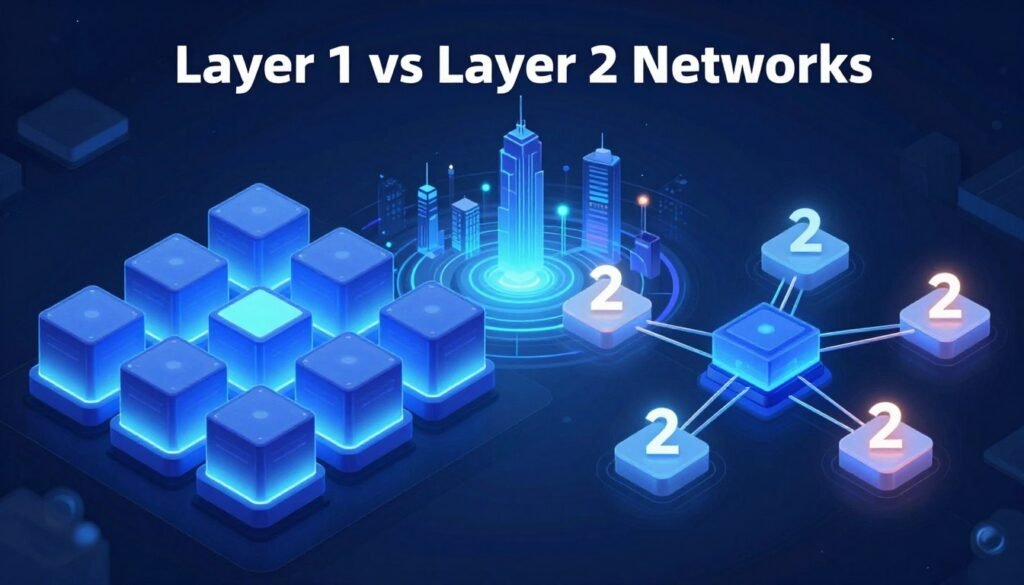
Purpose difference: Layer 1 networks change the base chain itself so the ledger can stand alone. Layer 2 overlays offload execution and then settle results back to the main chain to inherit its security.
- Data availability: L1 stores it natively; many L2s post summaries or proofs to L1 for anchoring.
- Consensus: L1 enforces final agreement; some L2s use their own validators or challenge games.
- Execution: L2s run transactions off-chain to reduce load, then submit compact results for settlement.
Quick mapping for the later table:
- L1: consensus changes, forks, sharding.
- L2: rollups, channels, sidechains, nested chains.
Settlement means finalizing state on the main ledger. Many L2 designs post proofs or transaction data to the base chain so users can recover funds and benefit from the main chain’s security. Different L2 types vary in how and when they post data, and in withdrawal guarantees—details covered in later sections and in this Layer 1 and Layer 2 primer.
Layer 1 Scalability Solutions and How They Process Transactions on the Main Chain
Layer 1 upgrades change how every full node validates and records activity on the main chain. These protocol shifts alter data formats, consensus rules, and how nodes process transactions across the network.

Consensus changes: mining vs stake
Proof-of-work relies on mining and energy to create blocks, while proof-of-stake assigns validation to stakers. Ethereum’s move from PoW to PoS raised throughput and lowered operational cost; many sources cite ~10 TPS under PoW and roughly ~30 TPS after the Merge.
Soft forks that increase capacity
Protocol tweaks can free up space. Bitcoin’s SegWit changed how signatures are stored and pushed per-block capacity from about ~1,600 to ~3,000 transactions in practice.
Sharding basics
Sharding splits state into pieces called shards so validators no longer process every transaction. This parallelizes work, but cross-shard calls require careful design to keep consistency.
Where L1 upgrades still hit limits
Major upgrades demand client coordination, long testing, and slow rollouts. That timeline makes base-layer changes harder to deploy quickly than many off-chain options.
- Pros: unified security and on-chain finality.
- Cons: complex rollout and cross-shard coordination.
- Context: L1 changes help throughput but rarely eliminate peak congestion alone.
Layer 2 Scaling Solutions That Offload Processing from Blockchain Networks
Many projects move heavy execution off the main ledger to keep fees low and speed high. Layer 2 designs run work elsewhere, then commit compact results back to the main chain to reduce congestion and cut costs.
State channels: when repeated, private exchanges fit best
State channels let two or more parties transact off-chain with near-instant finality. They work well for frequent interactions; Lightning often cites up to ~1,000,000 TPS as an illustrative peak for simple payments.
Rollups: bundling many actions for on-chain settlement
Rollups aggregate transactions, execute them off-chain, then post proofs or summaries to the base ledger. This approach greatly reduces on-chain work per user and lowers fees.
ZK rollups vs optimistic rollups
ZK rollups use validity proofs for fast finality. Optimistic rollups accept batches quickly but rely on fraud proofs and a challenge window, which can delay withdrawals.
Nested chains and sidechains
Nested chains (parent/child) delegate execution to boost throughput — Plasma examples suggest ~5,000 TPS in some setups.
Sidechains run parallel consensus with asset locks and bridges; Polygon-style chains report much higher peak TPS (illustrative ~65,000) but carry separate trust and security models.
- UX note: wallets often route users to L2 networks for better speed and cost efficiency while keeping settlement on the main chain.
- Choose channels for private, repeated transfers; pick rollups for broader app compatibility.
Sharding vs Layer 2 Solutions for Scalability: Strengths, Weaknesses, and Best-Fit Use Cases
Two distinct paths let networks process more activity: widen the base with parallel state or bundle work off-chain and settle later.
Sharding scales by creating parallel lanes of state and work coordinated by a beacon or main chain. That design can significantly enhance scalability by letting many validators handle different shards and reducing global replication of every transaction.
Layer 2 overlays give immediate relief. Teams ship rollups, channels, or sidechains to aggregate transactions off the base chain and post compact data for settlement. Deployment is faster because it avoids heavy protocol and client changes.
Implementation differs. Sharding demands wide architectural changes: protocol updates, client logic, cross-shard messaging, and new validation rules. L2 complexity shifts into proofs, sequencers, and bridges that sync with the main chain.
- Cross-shard calls need robust routing and data availability for composable contracts.
- L2 requires trusted bridging, message ordering, and settlement windows to keep funds safe.
Best fit: high-frequency games and trading prefer L2 speed. Long-horizon ecosystems aiming for unified throughput may invest in sharding later. Most projects will combine both approaches: L2 for now, sharding to raise the ceiling over time.
Performance and Throughput Benchmarks Across Solutions and Networks
Measured benchmarks help teams pick the right trade-offs between raw throughput and real-world user speed. Below are illustrative figures to orient teams, not hard guarantees.
Illustrative TPS ranges
- Lightning Network: commonly cited ~1,000,000 TPS (simple payments).
- Polygon sidechains: roughly ~65,000 TPS in some setups.
- ZK rollups: capacity claims up to ~100,000 TPS for batched proofs.
- Plasma / nested chains: around ~5,000 TPS.
- Representative networks: Ethereum ~30 TPS, Polygon 7,000+, Arbitrum ~40,000, Cosmos 10,000+, Avalanche ~4,500, BNB Smart Chain up to ~100 TPS.
Why TPS isn’t everything
Latency, time-to-finality, and failure rate under congestion shape perceived speed more than peak TPS. A system with fast finality gives DeFi users predictable outcomes. Low latency matters most for games and microtransactions.
Matching performance to use cases
High transaction volumes from consumer apps often fit rollups or sidechains. Capital-heavy DeFi projects favor strong settlement guarantees and audited bridges. Teams should benchmark using their own transaction mix — simple transfers yield higher raw TPS than complex contract calls.
Security and Decentralization Trade-Offs in Scaling Mechanisms
When projects push work off the main ledger, new trust points appear. Off-chain components — sequencers, provers, watchers, and bridge validators — introduce operational assumptions that differ from native on-chain security.
On-chain security versus off-chain assumptions
On-chain security relies on the base consensus and global validator set. It gives strong guarantees about finality and data integrity.
Off-chain mechanisms depend on external actors and proofs. Users may trust fraud proofs, validity proofs, or upgrade keys — all new trust boundaries that can fail independently of the main chain.
Validator design and decentralization effects
Validator count and distribution shape censorship resistance. For example, a network with ~500,000 validators creates much higher attack difficulty than one with 21 validators.
Fewer validators lower coordination cost but raise centralization and censorship risk. Broader participation improves resilience but adds coordination overhead during incidents.
Incident signals and bridge risk
High-value attacks and bugs highlight common weak links: the Oct 2022 BNB Chain exploit (~$570M), Polygon whitehat-reported bugs in 2021, and a critical Arbitrum–Ethereum bridge bug.
Bridges often custody assets or escrow data, making them prime targets even when base networks remain secure.
- Evaluation criteria: audit history, time in production, incident response, governance clarity, and upgrade controls.
- Prioritize projects with transparent governance and phased rollback plans.
Cost Efficiency, Interoperability, and Ecosystem Fit for Users and Projects
Projects face tight trade-offs between per-transaction cost and cross-network reach. Layer-2s reduce fee pressure by moving frequent transactions off the main chain while posting aggregated results for settlement. That lowers costs for users who transact often and speeds routine flows.
How the cost stack works
Users pay L2 execution fees and occasional L1 posting fees. Total costs depend on how much data the L2 posts and main chain demand at the time. This two-part stack often beats repeated on-chain transactions for active wallets.
Interoperability and ecosystem fragmentation
Cross-chain bridges enable token movement but add contract and operational risk. Liquidity can split across networks, forcing extra steps in wallets and slowing user journeys.
- Cosmos uses IBC as a native design for cross-chain messaging.
- Ethereum-centric bridges rely more on third-party infrastructure and custodial links.
- Choose an ecosystem based on where users and liquidity already sit, and which developer tooling speeds blockchain development.
As volumes grow, the right choice balances cost, reliability, and composability for the app’s real-world transactions and integrations.
Conclusion
Conclusion
Practical choices now favor approaches that reduce fees and speed user flows while preserving trust. Short-term overlays give immediate performance gains, while base-layer upgrades take time and coordination.
Layer 1 upgrades raise the long-term ceiling, but are slow to deploy. Layer 2 approaches offload work and settle back to the main chain, cutting costs and improving throughput.
Designers still trade off security, decentralization, and speed. Choose rollups or channels for low fees and fast UX, sidechains when specialized throughput matters, and sharding as a future ramp.
Evaluate threat models, expected volumes, interoperability, and upgrade risks. Benchmark costs, test bridges, and pick the least complex path that meets needs. Revisit choices as blockchain networks and blockchain technology evolve—stay pragmatic and consult an expert when planning changes.
FAQ
Why does scalability matter for transaction volumes and mainstream adoption?
As more users, DeFi protocols, NFT marketplaces, and wallets like MetaMask interact with networks, on-chain congestion raises fees and slows confirmation times. That undermines user experience and blocks wider adoption. Scaling lets networks process higher volumes with lower costs and faster finality, which is essential for retail use and real-time apps.
How does network congestion affect processing transactions, fees, and user experience?
When demand exceeds capacity, miners or validators prioritize higher-fee transactions, pushing gas prices up. Users see longer wait times and failed transactions, which damages trust. Congestion also forces dApps to add complex retry logic or poor UX workarounds, increasing development and operational cost.
What does global crypto ownership growth signal for networks?
With roughly 420 million crypto users worldwide, demand for secure, low-cost, and fast transaction processing rises sharply. That growth pressures base chains and drives innovation in both base-layer upgrades and overlay networks to handle diverse use cases at scale.
Why do DeFi, NFT marketplaces, and wallets like MetaMask amplify demand on the main chain?
These services generate frequent, often complex transactions — swaps, auctions, minting, and signature flows. Many rely on main-chain settlement or data availability, so spikes in activity quickly consume blockspace. Wallets make interaction seamless, which increases usage and stress on the chain.
What is the "scalability trilemma" and why do trade-offs appear in real networks?
The trilemma states networks can optimize only two of three properties: security, decentralization, and speed. Improving throughput often requires more trust or fewer validators, while boosting decentralization can slow consensus. Real projects balance these based on target use cases and security needs.
How do Ethereum’s validator scale and BNB Chain’s validator set illustrate decentralization trade-offs?
Ethereum’s large, geographically distributed validator set favors resistance to censorship and strong decentralization, but coordinating many validators complicates upgrades and can limit raw throughput. BNB Chain runs fewer validators, enabling higher transaction rates but raising concerns about centralization and single-point risks.
How do CAP-style distributed systems trade-offs map to blockchain architecture?
Similar to CAP, blockchains balance consistency, availability, and partition tolerance. Protocol choices affect finality and liveness under network splits. For example, some chains favor instant finality with stricter validator assumptions, while others accept longer confirmation windows to remain live under partitions.
What are the core differences between Layer 1 and Layer 2 approaches?
Base-layer upgrades change consensus, sharding, or block parameters to increase native throughput. Layer 2s operate as overlays — rollups, state channels, or sidechains — that move execution off the main chain and use it mainly for settlement or dispute resolution. L1 changes alter global security; L2s trade some assumptions for faster deployment.
How do data availability, consensus, and execution differ between base chains and overlays?
L1 provides global consensus and canonical data availability, so state transitions inherit on-chain security. L2 can execute transactions off-chain and rely on the main chain for periodic data posting or fraud proofs. This reduces on-chain load but means L2 security depends on its specific design and how it anchors to L1.
What are common scaling options at a glance?
Options include L1 changes like sharding or consensus shifts, and L2s like optimistic and zk rollups, state channels, sidechains, and nested chains. Each targets different needs: higher throughput, lower latency, cheaper fees, or specialized trust models.
How does switching consensus (PoW to PoS) affect main-chain processing?
Moving from Proof-of-Work to Proof-of-Stake often reduces energy use and can improve block finality and throughput. Ethereum’s transition lowered resource costs and enabled protocol-level upgrades such as sharding and better validator participation mechanics that support higher processing capacity.
How did chain forks like SegWit improve throughput on Bitcoin?
SegWit restructured transaction data to increase effective block capacity and fix malleability, enabling more efficient use of blockspace. It shows how protocol-level changes can raise usable throughput without altering fundamental consensus rules.
What is sharding and how does it use pieces called shards to process transactions?
Sharding splits the network state into multiple shards, each processing transactions in parallel. That raises aggregate throughput because work spreads across shards. However, cross-shard communication and maintaining consistency add complexity.
Where do L1 scaling efforts still hit practical limits?
L1 upgrades face validator coordination, long rollout timelines, and compatibility challenges. Achieving high throughput while preserving decentralization and strong security often requires phased deployments and careful testing, which slows immediate gains.
When are state channels the best fit?
State channels excel for repeated interactions between known parties, like gaming or micropayments. They offer low latency and privacy by keeping many transactions off-chain and settling the net result on the main chain when the channel closes.
How do rollups work to bundle transactions back to the chain?
Rollups execute transactions off-chain and post compressed transaction data or proofs to the main chain. The main chain verifies or stores minimal data for fraud-proofs or validity proofs, enabling high throughput while retaining a trust-minimized settlement layer.
What practical differences exist between ZK rollups and optimistic rollups?
ZK rollups submit cryptographic validity proofs to the main chain, offering fast finality and strong security but higher prover cost. Optimistic rollups assume transactions are valid and use fraud proofs to challenge bad batches, which lowers immediate cost but introduces challenge windows and longer withdrawal times.
What are nested blockchains and what do they optimize?
Nested chains implement a parent/child relationship where child chains handle execution and periodically settle to the parent chain. This structure optimizes throughput and workload separation while relying on the parent for settlement and security guarantees.
How do sidechains differ from other L2 approaches?
Sidechains are independent parallel networks with their own consensus and security assumptions. They move assets via locking and bridging. Sidechains can scale specific workloads but carry separate risk models compared with rollups that inherit main-chain security more directly.
What are the strengths and weaknesses of sharding versus Layer 2 approaches?
Sharding increases native capacity with strong security if well-implemented, but requires deep protocol changes and complex cross-shard logic. Layer 2s deploy faster, offer immediate cost relief, and suit many apps, yet they introduce varied trust and bridge risks depending on design.
How does implementation complexity compare for shards vs L2s?
Shards demand major architectural work, validator changes, and prolonged testing. L2s often build on existing tooling and can launch quicker, making them attractive for teams needing immediate scalability without altering base-layer consensus.
How do cross-shard communication and bridging compare for synchronization?
Cross-shard messaging needs protocol-level routing and atomicity guarantees, which is technically challenging. Bridges and L2-to-L1 settlements require secure relays and dispute mechanisms; they can work well but increase the attack surface and coordination overhead.
What are typical TPS ranges across solutions like Lightning, Polygon, and rollups?
Lightning Network supports many micropayment hops with high throughput for payments. Polygon sidechains can handle hundreds to thousands of TPS depending on configuration. Modern rollups report thousands of TPS in lab settings, though real-world throughput varies with data availability and sequencer design.
Why isn’t TPS the only metric for performance?
TPS ignores latency, finality time, and user experience. A high TPS system with slow finality or poor UX can still frustrate users. Match performance metrics like latency, cost-per-transaction, and finality guarantees to the target application.
How should projects match performance to use cases like DeFi, gaming, or high-frequency transactions?
DeFi needs strong security and finality, favoring rollups with robust settlement. Gaming benefits from low latency and cheap microtransactions, so sidechains or state channels may fit. High-frequency trading requires low-latency settlement and predictable finality, often pushing hybrid L1/L2 designs.
What changes between on-chain security and off-chain assumptions?
On-chain security depends on base-layer consensus and validator honesty. Off-chain solutions reduce on-chain exposure but introduce assumptions about sequencers, relayers, and bridge integrity. Evaluating threat models is essential before trusting off-chain mechanisms.
How does validator design affect decentralization and resistance to censorship?
More decentralized validator sets increase censorship resistance and raise the cost for coordinated attacks. Fewer validators can give higher throughput but lower resilience. Governance, reward design, and node distribution all shape these trade-offs.
What real incident signals highlight scaling risks?
Bridge exploits, sidechain failures, and sequencer outages have caused high-value losses and downtime. These incidents demonstrate that scaling paths which introduce new trust assumptions require rigorous audits, monitoring, and contingency planning.
How do L2s reduce fee pressure while relying on L1 settlement?
L2s batch many transactions into a single L1 interaction, splitting the base-layer fee across many users. That dramatically lowers per-transaction cost while keeping the main chain as the ultimate source of truth for settlement or dispute resolution.
What are interoperability realities around bridges and cross-chain asset movement?
Bridges enable asset transfers but vary widely in security models: some use multi-sig custodians, others use lock-and-mint or complex fraud-proof schemes. Cross-chain movement increases fragmentation and requires careful trust evaluation and redundancy to minimize risk.

No comments yet