

This guide shows how to use a popular volatility indicator on crypto charts so you can build repeatable entry and exit rules instead of guessing in fast markets.
Expectations: the bands describe context and volatility, not certainties. The focus here is confirmation signals, risk controls, and clear “when not to trade” rules for disciplined traders.
The walkthrough covers setup on common platforms and how to read touches, closes, squeezes, and band walks. You will get a practical playbook for ranging and trending conditions.
These concepts apply across major coins and altcoins, but settings differ by asset volatility and timeframe. Good parameter selection matters for clean signals and reliable price management.
Core workflows you’ll follow: identify market conditions, wait for confirmation like RSI or volume, define invalidation, and plan exits before entry. The article stays informational and process-driven for a US audience, emphasizing disciplined execution and risk management for serious traders.
What Bollinger Bands Are and Why Crypto Traders Use Them
John Bollinger created a volatility-based indicator in the early 1980s that suits 24/7, fast-moving markets. The tool wraps a simple moving average in a standard deviation envelope so users can see when price stretches away from its recent mean.
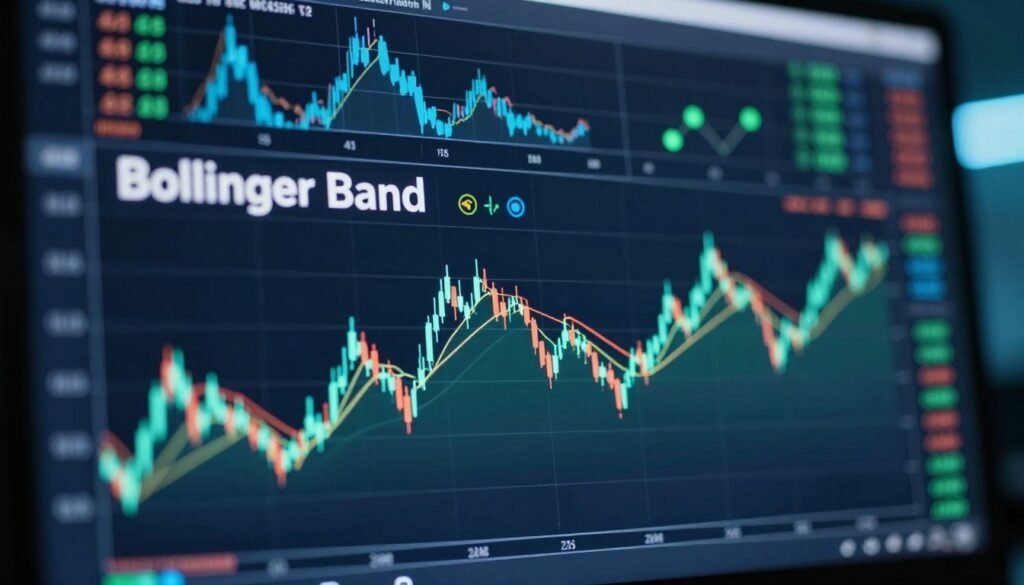
John Bollinger’s volatility-based idea
The indicator reads market volatility by expanding when moves grow stronger and contracting during quiet spells. That visual cue helps traders judge whether volatility is expanding or compressing without complex math.
What the bands reveal
Use the lines to get three quick insights: the volatility state (wide vs narrow), trend context (where price sits relative to the middle line), and price extremes (touches near the outer envelope).
Common misconceptions about touches
Not every outer touch equals an automatic reversal. In a strong trend, repeated interaction can signal strength, not an immediate sell or buy. Rely on confirmation tools and clear rules — like closes back inside the envelope or volume spikes — before acting.
- Assess volatility, not certainties.
- Combine with RSI or volume for reliable signals.
- Reserve fades for well-defined conditions and avoid fading a band walk.
How Bollinger Bands Work: SMA, Standard Deviation, and the Three Bands
Start with the base. The channel is built from a simple moving average (most commonly a 20-period sma) plus and minus a multiple of standard deviation. That creates a center line and two outer lines that adapt to volatility.
Middle band as a dynamic mean. The middle band is the sma of closing prices over the chosen window. Traders treat this moving average as the short-term mean price and use it as dynamic support or resistance during trends.

Upper and lower lines — the math in plain English. First compute the sma. Then calculate standard deviation over the same lookback. Plot the upper band as SMA + (k × SD) and the lower band as SMA − (k × SD). Default settings are N=20 and k=2.
- Higher multipliers widen the channel and reduce false touches.
- Lower multipliers tighten it and increase signal frequency but add noise.
- Widening bands = rising volatility; narrowing bands = compression and possible breakout.
Visual cues and market conditions. A flat middle band with parallel outer lines usually means a range. A sloped middle band with price hugging one side suggests a trend. These mechanics lead directly to squeezes, mean-reversion plays, and trend-continuation signals.
For a concise primer on the indicator math, see this indicator overview. For notes on applying these mechanics to digital assets, review crypto-specific notes.
How to Set Up Bollinger Bands on Crypto Charts and Choose Settings
A clean setup and sensible defaults make it easier to read volatility and avoid false alarms.
Quick setup: open a candlestick chart, open Indicators, search “Bollinger Bands,” and apply it to the active pair. On KuCoin the flow is Indicators → search → select. TradingView and most US-facing platforms use a nearly identical process.
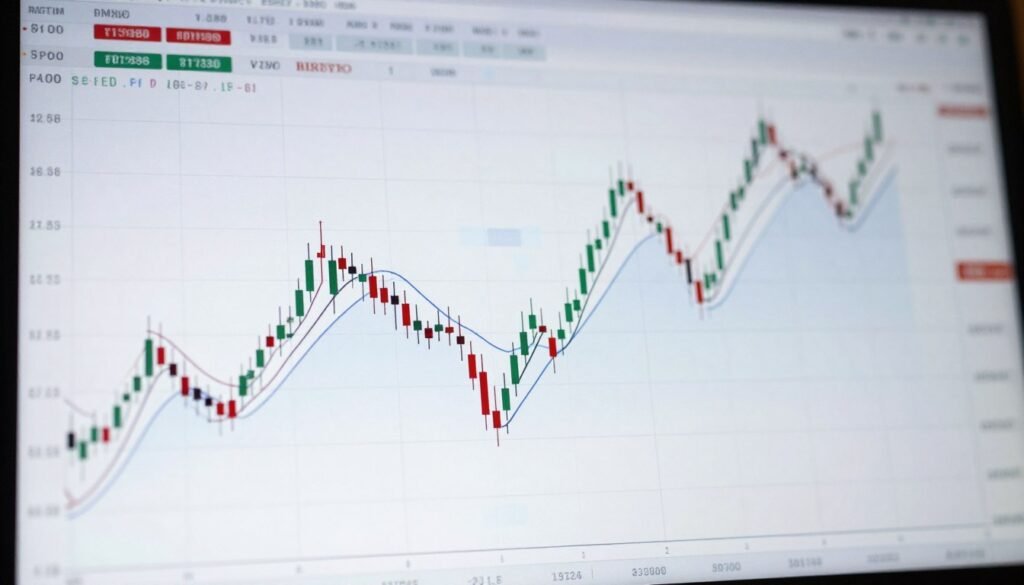
Recommended presets by timeframe
- Day traders: 10-period middle line with ~1.5 SD for faster swings.
- Swing traders: 20 & 2 as a balanced default.
- Position traders: 50-period with ~2.5 SD to cut noise.
Adjusting for asset volatility
Highly volatile altcoins often need a longer lookback or wider deviation to reduce false signals. Large-cap coins may work with the defaults.
Extras to enable: add %B to locate where price sits inside the envelope and Bandwidth to spot low volatility compressions that can precede breakouts.
Always backtest settings on your chosen timeframe. For broader chart reading and execution notes, see the chart analysis guide.
How to Read Signals: Entries, Exits, and Confirmation
Turn visuals into repeatable rules. Use clear entry and exit filters so you react to valid signals and not noise. Define where the idea is wrong before you enter.

Entry rules for ranges vs. trends
In a range, look for price to touch the lower band for potential longs and the upper band for shorts. Wait for proof — many traders use a close outside then a close back inside as the trigger.
Exit frameworks
- Mean target: take partial profit at the middle line.
- Stretch target: aim for the opposite band when volatility supports a full swing.
- Structure target: scale out at prior support or resistance levels.
Reading breakouts and trend strength
A squeeze shows compression; expansion with a strong close beyond the band and rising volume supports a breakout. Use volume analysis and the quality of the candlestick to judge conviction.
When prices repeatedly hug an outer line in a clear uptrend or downtrend, that band walk signals strength. Avoid fading that momentum unless moving average slope or RSI show clear exhaustion.
Confirmation tools
Filter entries with the moving average slope, check RSI for extremes, and confirm with volume analysis. These checks reduce false breakouts and improve repeatability in fast markets.
Bollinger Bands Crypto Trading Strategy Playbook
This playbook presents clear if/then tactics so traders can match an approach to current market context instead of forcing one method on every chart.
Squeeze workflow for low volatility breakouts
If you spot prolonged tight bands and low volatility, set range alerts above and below structure. Then wait for a decisive close outside the envelope as the band begins to expand.
If price closes above the upper band, treat it as a bullish breakout; if it closes below the lower band, treat it as bearish. Confirm with rising volume and place a stop beyond the recent swing.
Bounce rules for ranges
When bands are flat, buy near the lower band and sell near the upper band. Use rejection wicks or a close back inside as the entry trigger.
Exit toward the simple moving mean or prior levels. Do not use bounce rules when price is walking a band — that often signals trend continuation.
Trend, reversals, RSI, and volume
In trends, prefer pullbacks to the middle band as re-entry points with support confirmation. For reversals, watch W-bottoms/M-tops: the first extreme closes outside, the second forms inside the envelope.
Use RSI to confirm overbought oversold readings and volume to filter false moves before committing to a trade.
Conclusion
Keep these concise rules handy. Use the indicator framework to read volatility, structure entries and exits, and avoid guesswork when market context shifts.
Remember the base: a simple moving average plus standard deviation makes adaptive lines that expand when moves strengthen and contract during quiet periods.
Focus on the high-probability setups: squeezes for breakout attempts, mean reversion in flat ranges, and pullbacks or band-walks for trend continuation. Treat outer touches as context, not automatic reversal signals.
Confirm and manage risk: pair signals with RSI and volume, size positions conservatively, use stop-losses, and test rules on specific crypto pairs and timeframes before risking live capital.
FAQ
What is the basic purpose of the Bollinger Bands indicator in crypto markets?
It measures volatility around a simple moving average to show where price sits relative to typical recent movement. Traders use the upper and lower lines as dynamic levels that signal potential reversals, continuations, or breakouts based on changing market volatility.
How does the middle band function compared to the upper and lower lines?
The middle line is a simple moving average that acts as a dynamic support or resistance and a trend reference. The outer lines are calculated by adding and subtracting a multiple of standard deviation from that average, so they expand when volatility rises and contract when it falls.
What settings work best for different timeframes and assets?
Shorter lookbacks (10–20) suit intraday approaches; standard 20-period works well for swing trades; longer periods (50+) help position traders. Adjust the standard deviation multiplier (commonly 2) only when an asset shows persistent volatility differences from typical samples.
How do I set up the indicator on major charting platforms?
Open your chart, select indicators, pick the indicator by name, set the length (often 20) and deviation (often 2). Most platforms like TradingView, Binance, and CoinGecko offer presets and let you add overlays like %B or Bandwidth for extra clarity.
What is a band squeeze and why is it important?
A squeeze occurs when the outer lines tighten, signaling low volatility and a likely upcoming expansion. Traders watch for a directional breakout after the squeeze, using candlestick closes, increased volume, or momentum confirmation before entering.
When should I trade bounces versus breakouts?
Use bounce rules in clear range markets—fade moves that touch an outer line and revert toward the middle SMA. Use breakout tactics after a squeeze or a decisive close beyond an outer line with supporting volume or momentum indicators.
How can I reduce false signals when using the indicator?
Combine it with confirmation tools like RSI for momentum, volume spikes for conviction, or an additional moving average for trend context. Avoid trading single-band touches without supporting evidence of reversal or continuation.
What is the “band walk” and how should traders respond?
A band walk happens when price rides along an outer line during a strong trend. Don’t fade it; consider trend-following entries on pullbacks to the middle SMA or wait for confirmed trend loss before reversing positions.
Can the indicator signal overbought or oversold conditions by itself?
Not reliably. Outer-line touches can indicate extremes, but markets can stay extended for long periods. Use momentum indicators like RSI and look for divergence or weakening volume to validate overbought/oversold readings.
How do %B and Bandwidth enhance signal clarity?
%B normalizes price position between the bands, letting you quantify where price sits. Bandwidth measures the distance between outer lines relative to the middle, making squeezes and expansions easier to spot and compare across assets.
What risk management rules pair well with this method?
Define stop levels using recent structure or a fixed ATR multiple, size positions to risk a small percentage of capital per trade, and use clear exit rules—either target-based, middle-band-based, or on confirmed trend failure.
Which common patterns combine well with the bands for reversals?
W-bottoms and M-tops that form near outer lines, outside-inside bar setups, and engulfing candles near the lower or upper lines offer useful reversal clues when paired with reduced volatility and confirming indicators.
How do I adapt settings for highly volatile altcoins?
Consider increasing the deviation multiplier or lengthening the moving average to smooth erratic price swings. Alternatively, rely more on confirmation from volume and momentum to avoid whipsaws on noisy tickers.
Should I use the indicator differently for intraday versus swing trades?
Yes. For intraday use tighter lookbacks and faster confirmations; for swing trades use standard or longer periods and place greater weight on trend context and daily closes to avoid intraday noise.
Where can I learn more reliable, practical rules for execution?
Study reputable trading education sources, exchange tutorials, and charting-platform public scripts. Backtest rules on historical price data and demo-trade to validate approaches before committing real capital.

No comments yet