
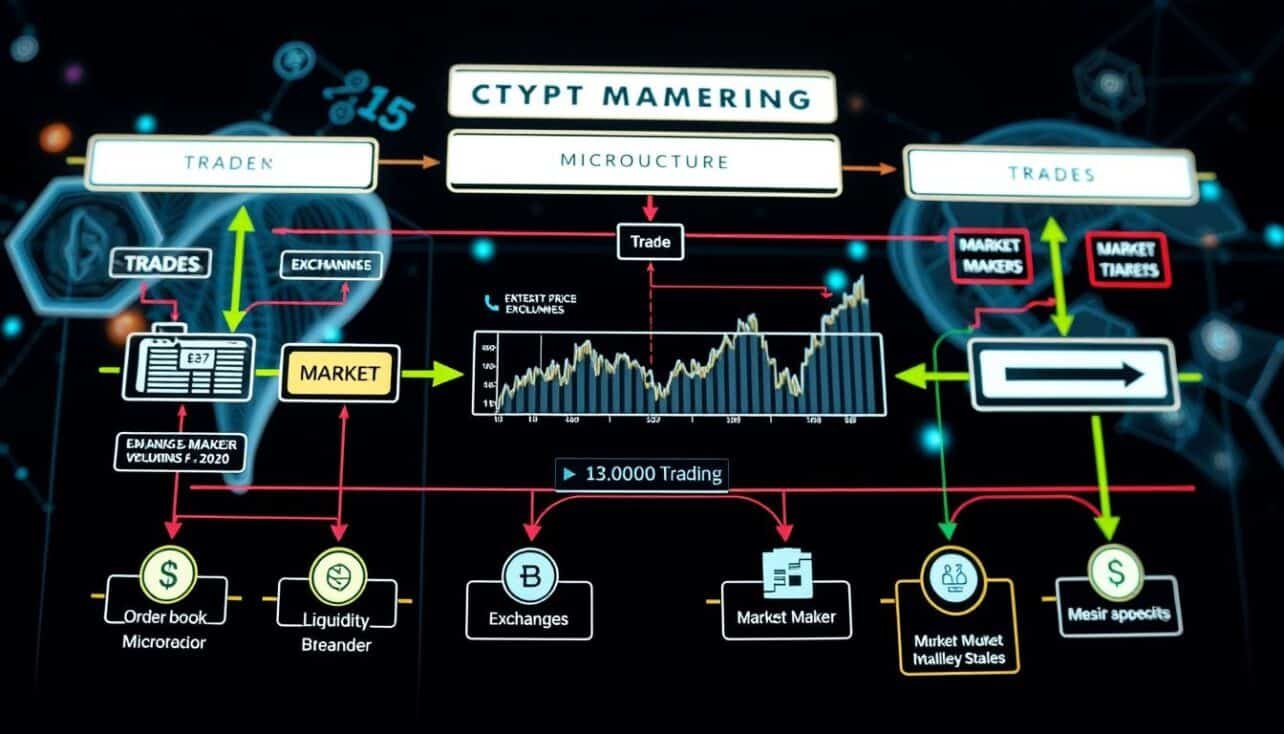
Have you ever wondered what really happens behind the scenes when you buy or sell digital assets? The inner workings of these exchanges are governed by a field known as market microstructure.
This framework determines how trades are executed and prices are set. For anyone involved with digital assets, from casual traders to large institutions, grasping these mechanics is essential for making informed decisions.
The landscape for cryptocurrency is unique. It operates 24 hours a day, with liquidity spread across many different platforms. This creates a dynamic and often complex trading environment.
Our guide breaks down the core components you need to understand. We will explore concepts like order flow, liquidity provision, and price discovery.
You will learn how these elements interact within cryptocurrency markets. We connect established ideas from traditional financial markets to the new world of digital assets.
This resource provides actionable insights grounded in real data. It is designed to help you navigate with greater confidence and strategic clarity.
Introduction to Crypto Market Microstructure Explained
Academic exploration into the mechanics of digital asset exchanges has surged in recent years. A systematic review of 138 studies shows this literature has grown exponentially since 2019.

This field of study, known as market microstructure, examines how orders are placed and matched. It focuses on the processes that ultimately determine an asset’s price.
Grasping these mechanics is fundamental for any investment strategy. It reveals how liquidity and transaction costs directly impact outcomes.
Recent analyses highlight both similarities and differences with traditional financial markets. The digital asset landscape operates continuously, with unique dynamics driven by algorithmic activity.
Key research terms like Bitcoin, efficiency, and volatility dominate the discourse. Collaborative work is the norm, with over 81% of studies co-authored.
Evolution of Cryptocurrency Markets and Trading Dynamics
In just over a decade, the landscape for digital assets has evolved from a fringe experiment to a mainstream financial frontier. This rapid growth is among the fastest observed in any financial sector worldwide.
The transformation reflects deeper changes in infrastructure and participant sophistication.
Historical Development of Crypto Markets
Beginning with Bitcoin’s launch in 2009, early digital asset venues were defined by extreme volatility. Liquidity was scarce, and platforms were fragmented.
This environment posed significant barriers for mainstream investment. Over time, the space matured into a multi-trillion-dollar asset class.
The introduction of derivatives and futures contracts provided new tools for price discovery. This evolution marked a shift from retail-dominated activity to a more professional ecosystem.

Regulatory Milestones and Market Maturation
A key turning point arrived in January 2024 with the SEC’s approval of spot Bitcoin ETFs. This decision legitimized the asset class for a vast pool of traditional investors.
Nearly $70 billion flowed into these new funds within two months. Such inflows testify to the growing appeal of accessible digital asset investment.
Concurrently, research shows the trading process has become more efficient. The introduction of futures, for example, improved informational efficiency in spot markets.
Global regulatory frameworks are emerging, focusing on custody and investor protection. Evidence of maturation includes decreasing price delays and reduced arbitrage opportunities across exchanges.
Fundamental Principles of Market Microstructure
Three interconnected dimensions form the basis of how trading venues function and establish prices. These are liquidity, volatility, and price discovery. Grasping these concepts is essential for evaluating any trading environment.
Liquidity, Volatility, and Price Discovery
Liquidity refers to the ease of executing trades without causing large price moves. High liquidity means tight bid-ask spreads and lower costs for participants.
Volatility measures the degree of price fluctuation over time. Digital asset venues often show higher volatility than traditional markets. This stems from factors like speculative behavior.
Price discovery is the process by which supply and demand converge to set a fair value. Efficiency improves as liquidity increases, as shown by turnover ratio studies.
Information Asymmetry and Trading Costs
Information asymmetry occurs when some participants have private knowledge. This leads to adverse selection, where informed traders profit at others’ expense.
Foundational models like Kyle (1985) and Glosten-Milgrom (1985) explain this dynamic. The bid-ask spread compensates liquidity providers for this risk.
Key measures capture the degree of informed trading. Kyle’s lambda and VPIN indicate “toxic” order flow. The Roll measure estimates effective spreads from price serial correlation.
Trading costs include both explicit fees and implicit impacts like price slippage. This theory provides tools to quantify these factors in the trading process.
Liquidity and Order Flow Analysis in Crypto Trading
To understand short-term price action, one must look at the balance of buying and selling pressure. This order flow analysis examines how instructions interact on digital asset exchanges.
It reveals the mechanisms through which trading pressure moves prices. Liquidity provision adjusts in response to observed activity.
Order imbalance is the difference between buy and sell volume. Research using Binance data shows it is a powerful predictor of directional momentum.
The effect is largely monotone but shows concavity at extremes. This means large imbalances have a diminishing impact as liquidity absorbs the shock.
The limit order book displays all outstanding bids and asks. This transparency offers a unique view of market depth for participants.
Top-of-book metrics, like the best bid and ask, are highly informative. They reflect immediate liquidity and the cost of executing trades.
Trade flow distinguishes aggressive market orders from passive limit orders. The balance between these flows can signal informed activity.
Volume-weighted average price (VWAP) deviations from the mid-price also signal latent pressure. Large deviations suggest one-sided interest that may reverse.
Studies find remarkably similar patterns across assets like Bitcoin and smaller altcoins. This suggests universal mechanics govern short-horizon return dynamics in these venues.
Tools and Techniques in Crypto Microstructure Research
Investigating the inner workings of trading platforms requires specialized tools. These blend classic financial metrics with modern computational analysis.
This dual approach allows researchers to quantify liquidity and detect informed activity. It turns raw data into actionable insights.
Quantitative Indicators and Market Models
Established metrics provide a standardized language for analysis. They measure key aspects like illiquidity and trade toxicity.
- Roll Measure: Captures effective spreads from price serial correlation.
- Kyle’s Lambda: Gauges price impact per unit of volume.
- Amihud Measure: Assesses illiquidity across different assets.
- VPIN: Detects “toxic” order flow and information-based trading.
These indicators form the backbone of empirical research. They enable comparisons across assets and time periods.
Utilizing Machine Learning for Analysis
Advanced machine learning techniques uncover complex, non-linear patterns. Studies use algorithms like random forests and CatBoost.
These models are often trained with a direction-aware GMADL objective. This explicitly rewards correct price movement predictions.
For interpretability, SHAP values decompose a model‘s decisions. They show which features drive predictions, aligning machine learning results with established theory.
Insights from Crypto Winter and Market Regime Shifts
When digital asset prices plunge dramatically, do the underlying rules of trading change? Extended periods of decline, known as “crypto winter,” test this very idea. The 2022-2023 downturn saw Bitcoin drop from nearly $69,000 to below $16,000.
Such severe stress could reshape liquidity provision and trading behavior. A shift from bull to bear conditions often alters participant psychology.
Impact of Market Regime Changes on Price Dynamics
Regime shifts between expansive and contracting periods can fundamentally alter price dynamics. Wider bid-ask spreads and increased volatility are common during downturns.
Yet, a key research study covering January 2021 to July 2023 found remarkable stability. The predictive power of core microstructure measures did not waver.
This suggests the fundamental mechanics of price formation operate consistently. Order flow toxicity and information asymmetry remain key drivers across environments.
Stability and Predictability During Downturns
The research revealed no significant effect from the crypto winter on predictability. Metrics like the Roll measure and VPIN maintained their forecasting strength.
Area Under Curve (AUC) values stayed above 0.55 across all digital assets studied. This indicates economically significant prediction accuracy even in adverse conditions.
These stable, cross-asset relationships have major implications. Trading strategies based on these microstructure variables may not require constant recalibration. The dynamics of these venues prove resilient through time.
Predictability in Crypto Prices: Microstructure Variables
Two powerful metrics reveal hidden predictability within the seemingly random fluctuations of digital asset prices. This challenges the idea that these venues are perfectly efficient. Specific microstructure variables demonstrate consistent forecasting power for short-term returns and volatility shifts.
This predictability offers a potential edge for active participants. It stems from the unique structure of order flow and information diffusion.
Role of Roll Measure and Serial Correlation
The Roll measure captures the serial correlation structure of transaction prices. It estimates effective bid-ask spreads from the sequence of trades.
Higher Roll values indicate greater price reversals and potential illiquidity. Research shows surprisingly high values in digital asset venues compared to traditional equity and futures markets.
This suggests stronger momentum-based trading patterns. Positive returns tend to be followed by additional positive returns, reflecting order flow persistence.
Understanding VPIN and Trade Toxicity
VPIN measures trade toxicity by analyzing buy-sell volume imbalances. Higher VPIN levels indicate a greater likelihood that informed traders are active.
Cryptocurrency venues show elevated VPIN relative to traditional markets. This points to greater information asymmetry and risks for liquidity providers.
Empirical analysis finds both Roll and VPIN are the most important predictive features. Their Area Under Curve (AUC) values range from 0.54 to 0.61, indicating economically significant forecasting power.
Cross-asset effects are also crucial. Bitcoin and Ethereum’s Roll and VPIN measures predict price dynamics across smaller digital assets, showing how shocks propagate.
crypto market microstructure explained
A deep dive into exchange operations reveals the crucial interplay between order types, liquidity, and information flow. This comprehensive study shows how prices form from buyer-seller interaction.
It also details how a venue’s structure affects costs and efficiency. Traders gain insights into the hidden mechanics that drive price movements.
The framework extends beyond simple supply and demand. It includes the institutional details of how orders are matched and how information flows.
Different participant strategies interact to produce observable price patterns. Practical understanding means knowing how bid-ask spreads work.
It also involves seeing how order flow imbalances signal pressure. Measures like VPIN can detect the presence of informed activity.
With this knowledge, participants can better assess execution quality. They can optimize their order placement strategies effectively.
The architecture of these venues shows both similarities and differences from traditional finance. Key traits include 24/7 operation and fragmented liquidity.
High-frequency traders and algorithmic market makers contribute significantly. They aid in price discovery and liquidity provision.
Their activity can also create short-term predictability. Sophisticated participants may exploit these micro-level dynamics for an edge.
Cross-Asset Effects and Advanced Trading Strategies
Research confirms that Bitcoin’s internal trading dynamics powerfully forecast movements in other digital currencies. This creates a connected landscape where major assets lead and smaller ones often follow.
Intra-Market and Cross-Market Implications
Intra-market effects happen within a single digital asset. Order flow imbalances can signal its own near-term price moves.
Cross-market effects are broader. Metrics like Bitcoin’s Roll measure predict volatility for Ethereum, Solana, and others.
This spillover means news or a liquidity shock for a major coin ripples across the ecosystem. Traders must watch these leading indicators.
Algorithmic Trading and High Frequency Strategies
Algorithmic execution is widespread. It ranges from simple trade bots to complex high-frequency strategies.
Sophisticated models use signals like VPIN to adjust speed. They execute faster when predicting adverse selection.
This approach helps minimize costs. Both retail and institutional traders now use systematic methods to navigate these interconnected dynamics.
Order Book Dynamics and Price Impact
The real-time ledger of buy and sell intentions, known as the order book, is the heartbeat of any trading venue. It displays all pending limit orders organized by price level, providing a transparent view of market depth. This continuous ledger reveals how supply and demand are matched as new instructions arrive and old ones cancel.
Studies show the top few levels hold the most predictive power. The best bid and ask prices, along with their volume, are key for forecasting short-term moves. High-frequency data from platforms like Binance Futures confirms this. Deeper order book levels often add noise, so research focuses on the most informative aggregates.
Price impact measures how much a trade moves the price. Larger market orders “walk” through the book, exhausting liquidity at each step. A universal pattern, the “square-root” law, shows this impact scales with the square root of trade size. This reflects fundamental dynamics in order book shape.
Understanding these dynamics is essential for execution. A thick book suggests abundant liquidity, while a thin one means even small trades can cause big swings. Analyzing broader trends alongside real-time book data helps traders choose between aggressive and passive strategies wisely.
Research Methods and Data Analysis in Crypto Studies
Empirical studies into exchange operations rely on high-frequency datasets and sophisticated analytical frameworks. This research combines quantitative econometrics with machine learning to extract patterns from massive records.
The approach transforms raw tick data into actionable insights. It requires meticulous preprocessing and validation.
Leveraging Binance Data for Empirical Research
Many studies use Binance, the world’s largest digital asset exchange. Its perpetual futures contracts provide deep liquidity and transparent order books.
Data spans assets like Bitcoin, Ethereum, and Solana. The sample time often covers both bull and bear periods, from 2021 to 2023.
Researchers construct synchronized time series. They pair sub-second quotes with trade records at consistent intervals, like one-minute bars.
Each bar records the opening and closing price. It also notes the dollar volume traded within that window.
This enables cross-asset analysis. Scholars test if relationships hold across different cryptocurrency sizes and liquidity profiles.
Feature engineering creates key variables from this data. Examples include order flow imbalances and VWAP deviations.
Time-series cross-validation prevents information leakage. Walk-forward validation with rolling windows ensures robust out-of-sample estimates.
The number of observations is immense. Processing millions of data points requires efficient computational methods.
This rigorous analysis forms the backbone of modern research into digital asset market mechanics.
The Role of Machine Learning and Quantitative Models
Modern analysis of exchange dynamics relies heavily on machine intelligence and statistical modeling. These approaches uncover complex, non-linear relationships hidden in vast datasets.
Random Forest, CatBoost and SHAP Techniques
Algorithms like Random Forest and CatBoost are central to this research. They offer robustness and can automatically detect intricate feature interactions that simpler models miss.
This power allows for highly accurate predictions of short-term price movements. The range of quantitative techniques extends from traditional econometrics to advanced deep learning.
Interpretability is crucial. SHAP analysis explains a model‘s decisions, showing which variables drive its forecasts.
This bridges the gap between black-box machine learning and established economic theory. Studies using a GMADL objective further align model training with profitable trading outcomes.
Comparing Crypto and Traditional Financial Market Microstructures
A side-by-side examination reveals where digital asset trading diverges from and converges with established financial systems. Both environments rely on order flow to set values, but their operational frameworks differ dramatically.
Differences in Market Regulation and Efficiency
Traditional financial markets operate under decades of developed rules. They have centralized clearing and safeguards like circuit breakers.
Digital asset venues often face minimal oversight. This creates higher volatility and risks but allows for constant, permissionless access.
Studies on efficiency show mixed conclusions. Some point to inefficiency due to youth and speculation. Others note improvement, especially after Bitcoin futures launched.
Similarities in Price Discovery and Liquidity Measures
The core mechanics of price formation are remarkably alike. Order flow drives short-term moves in both arenas.
Information asymmetry creates predictable patterns. Concepts like adverse selection operate similarly across asset classes.
Liquidity metrics follow the same mathematical relationships. Bid-ask spreads and market depth function identically, though absolute levels vary.
The introduction of regulated ETFs has bridged these worlds. It brings familiar investment vehicles to digital assets, improving price discovery.
Integrative Analysis of Global Research on Crypto Microstructure
A systematic review of 138 academic papers maps the global landscape of research on digital asset trading mechanics. This analysis reveals exponential growth in publications, with 2019 being the peak year.
England leads in total citations, while Ireland shows high productivity per institution. Key centers include Sheffield Hallam University and Dublin City University.
Finance Research Letters published the greatest number of studies. Economics Letters earns the highest impact per paper.
Over 81% of works are co-authored. Interestingly, solo-authored papers tend to receive more citations on average.
The research methodology has evolved. Early theoretical work has given way to machine learning and high-frequency data analysis.
Major themes include efficiency tests and liquidity dynamics. Studies also explore cross-asset links and algorithmic trading effects.
Conclusions across the literature are diverse. Some research finds cryptocurrency markets efficient, while others note inefficiencies.
An emerging consensus points to maturing market structures. Microstructure variables hold predictive power, and major coins like Bitcoin often lead price moves.
Insights for Traders, Investors, and Regulators
The ultimate value of studying exchange mechanics lies in its actionable insights for three key groups: traders, investors, and rule-makers.
For active traders, understanding order flow dynamics is crucial. Knowledge of VPIN signals and Roll measures informs decisions on execution speed and order size. This helps minimize costs and exploit predictable patterns in trading.
Investors should recognize how these mechanics affect investment performance. Execution costs reduce returns, while liquidity risk constrains position sizing. Cross-asset effects, where Bitcoin’s order flow leads smaller digital assets, can inform tactical allocation decisions.
Regulators face the challenge of balancing innovation with protection. Analysis reveals specific risks like manipulation from thin liquidity. Effective oversight should address fragmentation and enhance transparency across venues.
The end goal for all stakeholders benefits from a deeper grasp of how information flows into prices. This understanding fosters better strategies and more resilient cryptocurrency markets.
Conclusion
This exploration reveals that consistent principles govern even the most volatile digital asset arenas. Understanding the microstructure of these trading venues is no longer a niche academic pursuit. It is a practical necessity for anyone seeking an edge.
Key variables like the Roll measure and VPIN show significant predictive power. Their stability across bull and bear periods provides a reliable foundation for analysis. Advanced tools, including machine learning with SHAP analysis, bridge complex models with clear economic insight.
For active participants, this knowledge translates to better execution and risk management. Investors gain clarity on costs and cross-asset dynamics. Regulators can design more effective oversight based on empirical research.
The end result is actionable knowledge. It empowers you to navigate the complex information flows and order processes that define modern cryptocurrency markets with greater confidence.
FAQ
What is the main focus of financial market microstructure research?
This field examines the detailed processes and systems that determine how asset prices are set. It looks at the mechanics of trading, including how buy and sell orders interact on exchanges like Binance and Coinbase. The research analyzes factors such as liquidity, trade execution costs, and the speed of information incorporation into valuations.
How does liquidity affect digital asset trading?
Liquidity determines how easily you can buy or sell an asset without causing a large price swing. In venues with high liquidity, such as major exchanges, the spread between the bid and ask price is typically narrow. This environment allows for larger trade sizes with minimal immediate impact on an asset’s quoted value, reducing costs for participants.
Can quantitative models predict price movements in digital asset venues?
Advanced analytical techniques, including machine learning algorithms like Random Forest, can identify patterns and relationships within trading data. Models often use variables such as order book depth, past trade volume, and volatility metrics. While not foolproof, these tools help assess the probability of future price direction based on current market conditions.
What role do automated strategies play in these electronic venues?
Algorithmic and high-frequency trading systems execute orders based on pre-set rules, reacting to market data in milliseconds. These strategies provide constant buy and sell quotes, adding liquidity. They also engage in arbitrage, helping to align prices across different trading platforms swiftly.
What is the VPIN metric used for?
The Volume-Synchronized Probability of Informed Trading (VPIN) is a quantitative indicator that estimates the level of trading activity likely driven by informed participants. A high VPIN reading suggests a greater presence of “toxic” order flow, which can signal upcoming short-term volatility. Traders monitor this as one gauge of market imbalance.
How did the recent ‘crypto winter’ impact trading dynamics?
During this prolonged downturn, overall trading volume and volatility often decreased. However, research into this period showed that certain microstructure relationships, like the predictive power of order flow, remained surprisingly stable. This suggests core mechanisms of price formation persist even during bear markets.
Why is the order book a critical tool for analysis?
The live order book displays all pending buy and sell limit orders at various price levels. By analyzing its depth and shape, traders can gauge immediate supply and demand. Large buy walls might indicate support, while thin sell walls can suggest potential for rapid price increases if buying pressure arrives.
How do digital asset markets differ from traditional stock exchanges?
Key differences include operating hours—digital asset trading is 24/7—and the current global regulatory landscape, which is less uniform. However, similarities exist in core principles. Both systems rely on order-driven price discovery and are influenced by liquidity measures and information asymmetry among participants.

No comments yet