

Crypto Trading Volume Indicators are core tools for reading market dynamics. This short guide explains what they measure and how traders use them with price action to make smarter choices.
Volume counts the total contracts or shares traded in a period and shows whether a move has backing from real buying or selling. Volatility shows how wildly price swings, and it ties to risk, uncertainty, and opportunity.
You will learn clear definitions, interpretation rules, and a practical workflow. The article previews common tools like OBV, MFI, Chaikin, ATR, Bollinger Bands, CCI, and moving averages for volume.
Remember: volume itself does not predict by magic. It reveals participation and conviction behind price moves. Often, volume acts as the fuel and volatility rises when more liquidity joins a major move.
Why Volume and Volatility Matter in Crypto Trading
Two simple measures—how many units change hands and how wildly prices move—shape smart entry and exit choices.
Trading volume definition and what it measures in today’s crypto markets
Trading volume is the total number of shares or contracts traded in an asset over a defined period. It shows how much of a coin or token changes hands in a given time, which matters in a market that runs 24/7.
Volatility definition and why it creates opportunity and risk
Volatility measures the size and speed of price swings. High volatility can offer big opportunity for gains but also raises the chance that stop-losses get triggered on sudden moves.
How volume, volatility, and liquidity work together during major price moves
When participation rises, liquidity tends to improve and ranges can widen. That chain effect often turns quiet charts into clearer trending conditions.
- More activity usually signals stronger market agreement from traders and investors.
- Low activity often means thin liquidity and uncertain price movements.
- Always map these measures to price over time before acting.

How to Read Crypto Trading Volume Indicators With Price Action
Read how volume pairs with price action to reveal whether a move has real trader participation or is just noise.
Volume acts as the fuel behind price movements: a rising price on expanding activity usually denotes strong interest and conviction. When price climbs on low activity, the move may be a weak rally that lacks follow‑through.
Pair price and volume on the chart to see if a move shows participation. Ask: did volume rise as price broke a level, or did price slip away without orders supporting it?
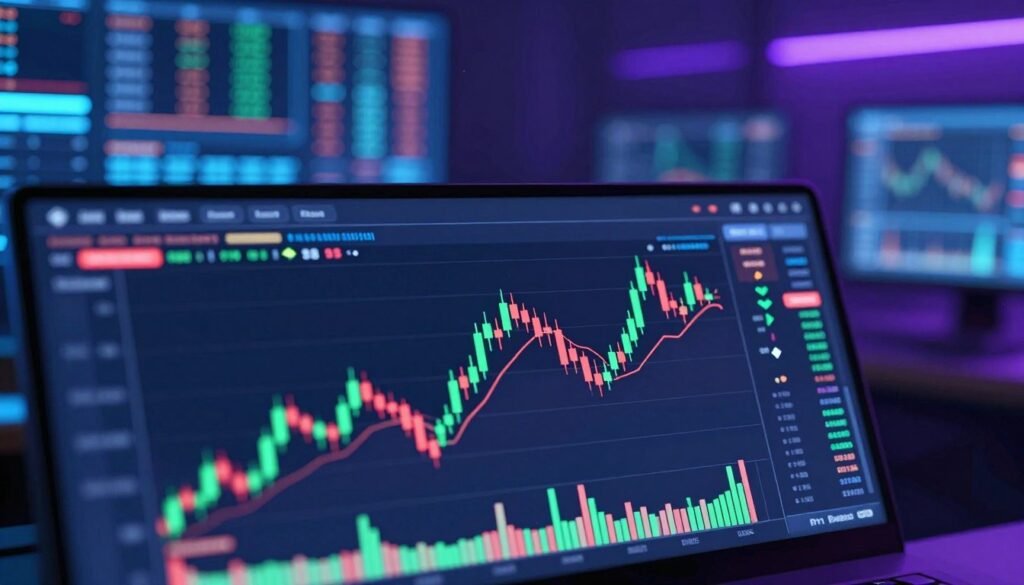
High readings often confirm genuine demand or supply and validate trend direction. Low readings can signal hesitation, choppy ranges, or unreliable continuation.
Volume areas with “memory” act like magnets: past high‑activity levels often become support or resistance when revisited. Mark those levels and watch for renewed activity there.
- When price exits a range, look for a sharp volume spike plus follow‑through to confirm the breakout.
- If a breakout lacks volume, treat it cautiously; false moves are common.
- Use volume context with trend direction and nearby levels to improve odds.
Practical checklist: pair price action with a confirming spike, check memory areas, and always manage risk if the price reverses back into the prior range.
For more on how volume tools work with charts, see a clear primer on volume concepts and a guide to common pattern uses at volume pattern analysis.
Common Volume and Volatility Indicators Traders Use
A practical stack of tools helps traders read market participation and measure risk in real time. Use a mix of participation gauges and range measures, then interpret them against price.

On‑Balance Volume (OBV)
The obv adds volume on days with higher closes and subtracts it on down closes. A rising OBV points to growing buying pressure, while a falling line implies selling pressure.
Traders use OBV to confirm trends or spot early weakness before price follows.
Money Flow Index (MFI)
The money flow index is a volume-weighted momentum index that runs 0–100. Readings above typical highs suggest overbought conditions, and lows hint at oversold setups.
Because it blends price and money flow, MFI can catch shifts faster than a plain momentum index.
Chaikin A/D Oscillator
This oscillator applies EMAs to the Accumulation/Distribution line. Crosses of the zero line signal shifts from accumulation to distribution or vice versa.
Traders watch the slope and crossing to time confirmations of buying or selling pressure.
Volume Moving Average and ATR
A simple moving average smooths raw volume so you can see when participation expands or fades. Compare current readings to that average for context.
Use atr to measure volatility and set smarter stop-loss distances: higher ATR means wider typical swings, so give positions more room.
Bollinger Bands and CCI
Bollinger bands use an SMA midline and standard-deviation bands. Expansion signals rising volatility; contraction warns of compression before a move.
The cci flags deviation from a historical average. Values above +100 often indicate overbought; below −100 can mark oversold turns.
How to Use Volume and Volatility Indicators in a Practical Trading Workflow
Use a clear, repeatable process: start with market structure and price levels, then confirm participation, and finally quantify range for risk sizing.
Confirming trends: align rising participation with upward moves and strong sell participation with declines. If price advances but participation falls, treat the move as suspect.

Spot divergences: watch for new highs in price that lack matching highs in participation or range. Such divergences often warn of weakening momentum and potential reversal.
Find convergences: higher-quality breakouts occur when price exits consolidation and participation plus volatility expand together. That alignment supports continuation.
- Extremes: unusually high readings can mark climaxes; unusually low readings often precede expansion.
- ATR stops: set stops at a multiple of ATR to avoid premature exits—wider in high range, tighter in calm markets.
- Combine tools: use trendlines, patterns (flags, triangles), and candlestick context with participation checks to filter setups.
Execution discipline: use these measures to confirm trades, not to chase every move. The goal is better probabilities and defined risk, not perfect prediction.
Conclusion
Clear signals come when participation and price align. Use volume analysis and volatility measures together to explain why a move has strength or looks fragile.
High activity backing a price rise or fall usually strengthens the signal. Low activity moves often fail without follow‑through, so treat them cautiously and set ATR‑based stops when range widens.
Combine these tools with trend lines, pattern context, and strict risk rules. Apply the workflow on a few liquid markets, keep a trade journal, and refine which indicators best suit your time frame and style.
Remember: indicators improve decision quality but do not remove risk. Discipline, liquidity awareness, and confirmation matter in fast markets.
FAQ
What does trading volume measure in today’s crypto markets?
Trading volume counts the number of units or contracts exchanged in a given period. It shows how much market activity accompanies price moves, helping traders judge whether a rally or decline has real participation or is thin and unreliable.
How does volatility create both opportunity and risk?
Volatility reflects how fast and far prices move. Higher volatility offers bigger profit potential but raises the chance of sharp losses and wider stop-outs, so traders must widen risk controls and position sizes accordingly.
How do volume, volatility, and liquidity interact during major price moves?
Liquidity determines how easily large orders execute without moving price. When liquidity is low, high volatility and rising volume can trigger exaggerated swings. Strong moves with supportive volume and ample liquidity are likelier to sustain.
Why is volume called the “fuel” behind price movements?
Price changes need participation. Volume confirms whether buyers or sellers back a move. High volume strengthens trend validity; low volume often signals a lack of conviction and higher reversal risk.
What’s the difference between high volume and low volume signals?
High volume during a breakout suggests conviction and potential continuation. Low volume on a breakout or rally suggests weak demand and a higher chance of failure or quick pullback.
How can I spot weak rallies when price rises on low volume?
Look for price gains that lack accompanying spikes or steady increases in traded units. Combine this with momentum indicators and shorter time-frame checks; if volume doesn’t confirm, treat the move cautiously.
What are volume areas with “memory” and how do they link to support and resistance?
Zones with historically high traded value tend to act as magnets where buyers or sellers defended positions. These price levels often act as support or resistance because market participants remember previous execution areas.
How do volume spikes validate breakouts and breakdowns?
A spike shows concentrated buying or selling interest at the breakout level, reducing the chance of a false move. Ideally, volume should exceed recent averages as price clears a range or trendline.
What does On-Balance Volume (OBV) tell traders?
OBV accumulates volume on up days and subtracts it on down days to track buying vs. selling pressure. Divergences between OBV and price can warn of weakening trends or hidden strength.
How does the Money Flow Index (MFI) differ from simple volume measures?
MFI weights volume by price to create a momentum oscillator. It highlights overbought or oversold conditions by combining price action with money flow, useful for spotting reversals.
When should I use the Chaikin A/D Oscillator?
Use it to detect shifts between accumulation and distribution. It compares volume flow over short and long windows to flag when smart money is buying or selling ahead of price changes.
Why apply a volume moving average?
A volume moving average smooths noisy data and highlights persistent increases or decreases in activity. Traders use it to set confirmation thresholds for breakouts or trend strength.
How does Average True Range (ATR) help with stop placement?
ATR measures average price movement size. Traders use multiples of ATR to set stops that accommodate normal volatility, reducing premature exits while managing risk.
What do Bollinger Bands reveal about volatility?
Bollinger Bands widen when volatility rises and contract during calm periods. Price touching or breaking bands can signal continuation, exhaustion, or an imminent volatility expansion.
How can the Commodity Channel Index (CCI) assist in timing moves?
CCI flags deviations from a moving average. It helps identify overbought/oversold states and cyclical turning points, useful when combined with volume confirmation.
How do I confirm trends using volume and volatility signals?
Look for alignment: price moving with rising volume and expanding volatility suggests a reliable trend. If volume falls while price continues, treat the trend as suspect and tighten risk controls.
What are divergences and why do they matter?
Divergences occur when price makes new highs or lows but volume or momentum indicators don’t follow. They warn of weakening participation and a higher chance of reversal.
How do convergences support trend continuation after a breakout?
Convergences happen when price, volume, and momentum indicators all align in direction. When a breakout shows higher volume and matching momentum, the odds of a sustained move improve.
How can I identify extremes and regime shifts from indicator readings?
Unusually high volume or volatility readings compared with historical averages signal regime shifts. Persistent extremes often precede new trend phases or rapid mean reversion.
What practical steps help manage risk in volatile markets using ATR?
Use ATR to size positions and set stops beyond normal price noise. Increase margin for larger ATR values, reduce position size when volatility spikes, and reassess stop placement after major events.
How do I combine volume analysis with trendlines and chart patterns?
Use volume to validate pattern breakouts: a true breakout should show volume above the recent average. When trendlines hold with rising volume at bounces, the trend gains credibility.
How often should I monitor these indicators for intraday vs. swing setups?
Intraday traders check volume and volatility on tight timeframes like 1–15 minutes and use faster-moving averages. Swing traders favor daily or 4‑hour charts with longer smoothing to avoid noise.
Can low volume periods be useful?
Yes. Low volume can signal accumulation phases or upcoming volatility compression that often precedes explosive moves. Recognizing quiet periods helps prepare for higher-probability breakouts.

No comments yet