

This short intro explains what the index does for the modern market. It compresses multiple data sources into a single 0–100 score that summarizes crowd mood. Many traders check that score daily as a quick read when prices move fast.
The index is a high-level indicator, not a crystal ball. It blends web trends, volatility, volume, and social signals into one number so you can spot shifts in market sentiment without digging through raw data.
This guide will show how to read the score, how the calculation works, and how traders use it as a supporting tool. Use it to prompt further analysis and to reduce emotional moves, not as the sole basis for decisions.
Who benefits? Newer investors, active traders, and long-term holders can all use the index differently to shape entries, exits, and an overall investment strategy. This content is informational, not financial advice. Consider your risk tolerance before acting.
What the Crypto Fear and Greed Index Measures in Today’s Crypto Market
A compact sentiment score shows how traders feel about the market at any given moment.
What it measures: The score captures crowd psychology, not intrinsic value. It bundles social chatter, price swings, volume, and volatility into a single number so investors can see mood shifts quickly.
How sentiment spreads fast: News, tweets, and headlines travel instantly. Bitcoin often leads, and altcoins follow as liquidity shifts. This means emotion and speculation can move prices before fundamentals update.

- Low values signal panic selling and high perceived risk.
- Mid-range values show cautious accumulation or neutral sentiment.
- High values point to euphoric buying and possible FOMO.
Use the score as a fast temperature check for short-term timing. It helps frame risk: a low reading may hint at value opportunities, while a high reading suggests caution and profit-taking plans.
For more on the data behind the metric, see this data reference and an interpretation overview. Pair sentiment with risk rules before acting.
How to Read the Fear Greed Index Score and Sentiment Zones
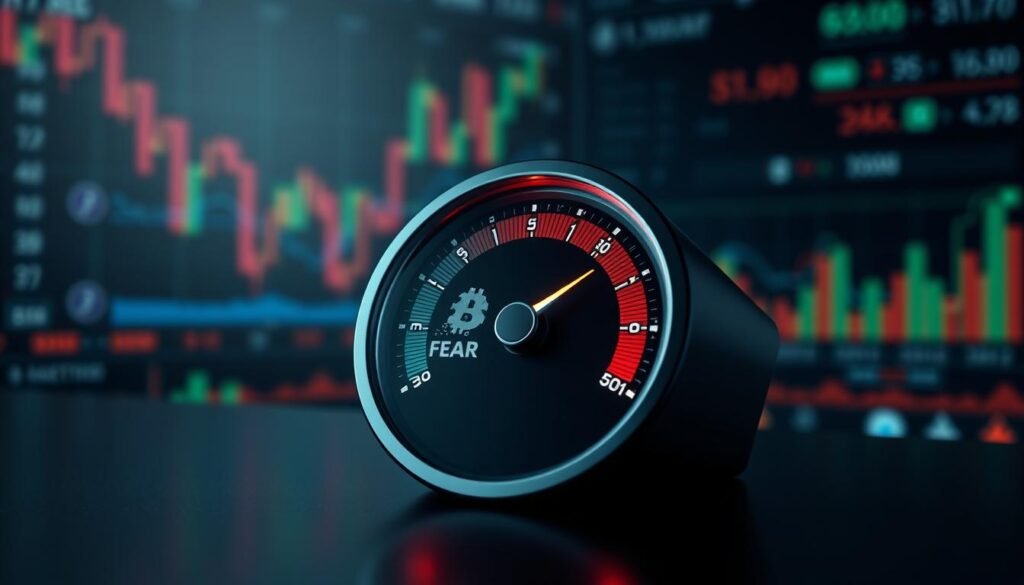
Read the numeric score as a simple map of crowd behavior across five sentiment bands. The scale helps you spot when markets lean cautious or overly eager.
Zone breakdown
Common ranges are: 0–24 = Extreme fear, 25–49 = Fear, 50 = Neutral, 51–74 = Greed, 75–100 = Extreme greed.
What extreme fear can mean
Values ≤24 often show heavy selling pressure and negative headlines. That mood can create oversold conditions and a potential buying opportunity.
What extreme greed can mean
Readings ≥75 point to FOMO-driven moves. Prices can keep rising, but correction risk climbs as positions become crowded.
Using zones as a checklist
- Use low scores to spot value, but confirm with support and volume.
- Use neutral readings to watch for consolidation and clear breakouts.
- Use high scores to tighten stops and plan profit-taking.
Tip: Treat the measure as a behavioral cue that prompts further checks. For background on the methodology visit the fear and greed index.
How the Index Is Calculated Using Multiple Data Sources
Multiple market inputs are combined to produce a single, easy-to-read sentiment number. This is why the measure is called an index: it aggregates diverse data sources so one value reflects broad market mood instead of one metric.

Volatility and drawdowns as fear signals
Volatility spikes and deep drawdowns push the score toward fear. Analysts compare current volatility and max drawdown versus 30- and 90-day averages to spot abnormal stress.
Market momentum and trading volume as greed signals
Strong momentum with rising volume often indicates growing risk appetite. High volume on uptrends is treated as a greed input and raises the sentiment value.
Social media sentiment and engagement spikes
Social media metrics — mentions, hashtags, and interaction rates — act as a proxy for hype. Sudden engagement spikes signal crowded narratives that move the index higher.
Bitcoin dominance and what it implies for risk-on altcoins
Bitcoin dominance is used as a risk gauge. Rising dominance can imply flight-to-safety into BTC. Falling dominance often points to a risk-on rotation into altcoins and higher market breadth.
Google Trends search behavior
Search trends track public interest. Rapid increases for bullish phrases push sentiment up, while searches for crashes or manipulation push it down.
Methodology notes
Alternative.me supplies the vendor data and common weightings: volatility ~25%, momentum/volume ~25%, social media ~15%, dominance ~10%, trends ~10%, with surveys historically cited around 15% but currently paused.
- Why it matters: The index calculated this way is directional, not absolute.
- Limitations: Weights and some components can change, so use it alongside other analysis and risk rules.
Cryptocurrency Fear and Greed Index Guide for Timing Entries and Exits
Treat extreme readings as an alert to run a short checklist before placing an order. Use the score as a prompt, not a command, so your trading stays systematic and repeatable.

Using extreme fear as a potential buy-the-dip opportunity
When extreme fear appears, some investors see a value opportunity. Confirm with price structure first: look for support levels and declining sell volume.
Checklist: confirm trend, identify invalidation levels, set position size, and pick a time horizon.
Using extreme greed to plan profit-taking and manage downside
Extreme greed often signals crowded trades and higher correction risk. Traders tighten stops, reduce leverage, or rebalance position sizing to protect gains.
Avoid panic exits or FOMO entries when volatility spikes.
How traders use the index as a signal to review other indicators
Use the reading to review momentum, volume, and support/resistance indicators. Treat it as a tool that points you to other checks before making investment decisions.
Document why you entered or exited so the index supports a clear strategy over time.
Strategies to Use the Index Without Letting Emotions Control Your Decisions
Use the sentiment score as a signal to spot emotion-driven moves before they turn into costly trades. The behavioral goal is simple: notice emotion in the markets — and in yourself — so you act by rules, not impulse.
Contrarian mindset with clear rules
Contrarian thinking means being cautious when many are euphoric and looking for opportunity when panic appears. Set rules like only adding at defined support levels or after a multi-day confirmation to avoid guessing on vibes.
Dollar-cost averaging to ease timing
DCA reduces timing risk. Keep a steady schedule and consider modestly larger tranches during extreme market stress. This keeps decisions mechanical and lowers emotional pressure.
Diversify and size positions to survive swings
Concentrated bets feel great in greed but hurt during rapid declines. Limit position sizes, use maximum allocation caps, and rebalance to protect capital during volatility.
Pre-commitment rules to block panic and FOMO
Create entry criteria, take-profit targets, and cooling-off periods. Use limit orders, staged buys, and mandatory checklists so you avoid panic selling or all-in moves based on short-term hype.
Short-Term Indicator vs. Long-Term Tool: What the Index Can and Can’t Do
Think of the index as a pulse: it highlights immediate stress or euphoria in the market but does not set long-term direction. Use it as a rapid alert that invites further checks, not as a lone decision-maker.
Why it reacts quickly to news and price moves
The indicator feeds on volatility, momentum, volume, social chatter, and search trends. These inputs update fast, so the reading swings as headlines or sudden moves hit prices.
How long greed or extreme greed can persist
Greed and extreme greed can remain for weeks during strong rallies. That persistence means an extreme reading is a warning to review risk, not an automatic sell rule.
Practical guidance by time horizon
Day traders use the tool for intraday signals. Swing traders pair it with support and momentum analysis. Long-term investors focus more on fundamentals and wider time frames.
Bottom line: treat extremes as a “pay attention” alert. Run deeper analysis and tighten risk controls based on your time frame before acting.
How to Combine Crypto Fear Greed With Other Market Signals
Use the sentiment reading to prompt a quick checklist that centers on price action and risk limits. Start with the score, then confirm with concrete market structure before placing capital.
Pair sentiment with price action and momentum
Stack signals: read the crypto fear greed value, check support and resistance, then inspect momentum indicators for trend direction and rate of change.
If sentiment is extreme but momentum diverges, treat the reading as weaker. If momentum confirms sentiment, the signal gains weight.
Use dominance to gauge rotation
Watch dominance shifts to see if capital moves into Bitcoin or rotates into altcoins. Rising dominance with rising prices hints at risk-off flows into BTC.
Shrinking dominance during rallies suggests a risk-on rotation into altcoins and broader market breadth.
Zoom out with higher timeframes and on-chain data
When the short-term reading is extreme, check longer timeframes and on-chain metrics for context. Higher-timeframe structure often changes how you act on short signals.
- Rule: combine at least two confirming indicators before entering a trade.
- Tip: use reliable market sentiment tools like the market sentiment tools link to broaden data inputs.
Conclusion
A clear numeric reading can act as a traffic light for short-term trading choices. ,
Key takeaway: the index compresses many signals into one score that highlights extreme fear or greed in the crypto market. Use that signal as a prompt to run checks, not as a stop or start command.
Practical steps: identify the zone, confirm with at least two price-based signals, set position size, then follow your written strategy. Treat this tool as one indicator among several to shape sound decisions.
Markets move fast; discipline beats prediction. Stay systematic, document trades, and let rules protect capital while you spot opportunities.
FAQ
What does the crypto Fear and Greed score measure in today’s market?
The score compresses multiple signals — price volatility, market momentum, trading volume, social media sentiment, Bitcoin dominance, and search trends — into a single 0–100 value that reflects short-term investor emotion. Lower values point to worry or selling pressure; higher values show growing confidence and potential FOMO.
Why does market sentiment move Bitcoin and altcoins faster than fundamentals?
Sentiment drives flows. Social chatter, sudden news, and short-term momentum attract traders and liquidity quickly, causing rapid price swings. Fundamentals like network activity or development matter long term, but emotion and positioning often determine immediate market direction.
What does the 0–100 score represent for fear, greed, and investor emotions?
The index maps scores to sentiment zones: very low numbers signal extreme worry and potential capitulation, middle scores indicate neutral or balanced sentiment, and high scores show growing greed and risk-seeking behavior. Traders use these bands to frame risk and opportunity.
How are the sentiment zones defined (extreme fear, fear, neutral, greed, extreme greed)?
Typical ranges split the 0–100 scale into five zones: extreme fear at the bottom, followed by fear, a neutral middle, then greed, and extreme greed at the top. Each zone summarizes the prevailing emotional backdrop and implied risk appetite across the market.
What can “extreme fear” signal about value and oversold conditions?
Extreme fear often indicates heavy selling and pessimism. It can highlight oversold opportunities where prices may be undervalued relative to fundamentals, but it’s not a standalone buy signal — confirm with price structure, volume, or on-chain metrics.
What does “extreme greed” typically signal about FOMO and correction risk?
Extreme greed suggests widespread optimism and speculative excess. That environment increases the chance of sharp pullbacks as late buyers enter. Many traders view extreme greed as a cue to trim positions or tighten risk controls.
Which data sources feed the index calculation?
The index combines metrics from market data (price volatility, drawdowns, volume), social platforms (mentions, engagement, sentiment polarity), Bitcoin dominance measures, and search trends such as Google Trends. Some providers also factor in surveys and vendor-specific methodology notes.
How does volatility and drawdown factor into the fear signal?
Large, fast price swings and deep drawdowns increase the fear component because they indicate unstable markets and forced selling. The index weights recent volatility to capture sudden panic or de-risking events.
How do market momentum and trading volume contribute to the greed signal?
Strong, sustained upward momentum and rising volume point to buying conviction. When momentum and volume align, the greed component grows, reflecting active participation and trend-following behavior that can push prices higher.
How is social media sentiment and engagement measured for the index?
Analysts track volume of posts, sentiment polarity, engagement spikes, and influencer activity on platforms like Twitter and Reddit. Rapid increases in bullish mentions lift the greed score, while negative sentiment and panic replies boost fear.
What does Bitcoin dominance imply for risk-on altcoins?
Rising Bitcoin dominance usually signals rotation into BTC and away from altcoins, suggesting a risk-off tilt. Falling dominance often coincides with capital flowing into smaller tokens, indicating a risk-on environment favorable for altcoin rallies.
How do Google Trends and search behavior inform the index?
Search volume for bullish or bearish keywords tracks retail attention and narrative shifts. Surges in bullish searches can inflate greed readings; spikes in negative queries or “sell” searches increase the fear component.
Are surveys and vendor methodology important for interpreting the score?
Yes. Some providers, like Alternative.me, publish methodology notes explaining weights and data refresh rates. Understanding those details helps users know what drives the index and its limitations.
How can traders use extreme fear as a buy-the-dip opportunity?
Traders treat extreme fear as a potential entry zone but usually combine it with confirmation — support levels, improving volume, or on-chain upticks — to avoid catching falling knives. Position sizing and stop rules remain essential.
How should investors act when the index shows extreme greed?
Extreme greed often prompts profit-taking, rebalancing, or tightening stops. Investors may reduce exposure, take partial profits, or hedge, since crowded trades face higher correction risk.
How do traders use the index alongside other indicators?
Professionals pair the sentiment score with technicals (support/resistance, momentum), on-chain metrics, and macro signals. The index serves as a risk filter — it tells you when to be cautious or opportunistic, not when to execute blind trades.
What does contrarian thinking mean when using the index?
Contrarian use means buying when the crowd panics and trimming when optimism peaks. The index helps identify crowded sentiment extremes where contrarian moves may offer asymmetric returns, but always verify with other data.
How can dollar-cost averaging reduce timing risk with volatile sentiment?
DCA smooths entry prices by investing fixed amounts over time, reducing the impact of short-term swings. In highly emotional markets, DCA avoids single-point timing mistakes and lowers short-term regret.
What role do diversification and position sizing play during fast sentiment shifts?
They limit downside when sentiment reverses. Smaller position sizes, spread exposure across assets, and clear stop-loss rules help manage risk when the index moves sharply between fear and greed.
How do pre-committing rules help avoid panic selling and FOMO buying?
Pre-defined plans — entry/exit levels, rebalancing schedules, and stop-loss sizes — remove emotion from decisions. When the index spikes toward extremes, these rules guide actions instead of instinctive reactions.
Why does the index react quickly to news events and price moves?
The index pulls in real-time social and market data, so headlines, exchange flows, or large orders can immediately shift sentiment metrics. That makes it a short-term barometer rather than a long-term valuation tool.
How long can the index stay in greed or extreme greed?
There’s no fixed duration — periods of speculation can last weeks or months if buying momentum and narratives continue. Sustained greed typically ends when liquidity thins, or negative catalysts trigger reversals.
How should I combine the index with price action and momentum indicators?
Use the index as context: when sentiment is extreme, require stronger confirmation from price patterns and momentum to trade in the same direction. In neutral zones, let technical setups and risk management dictate entries.
How can dominance metrics help gauge rotation between Bitcoin and altcoins?
Watch Bitcoin dominance to spot capital flow shifts. A falling dominance suggests funds rotating into altcoins, signaling broad risk-taking. Rising dominance often precedes altcoin underperformance and flight to perceived safety.
When should I zoom out and use longer time horizons or on-chain data?
Use longer horizons and on-chain metrics when the index shows persistent extremes or when macro fundamentals change. These tools help determine whether sentiment-driven moves align with structural trends or are transient noise.

No comments yet