

Liquidity is simply how easily you can buy or sell an asset without moving its price. In the crypto market this shows up as how fast an order fills and how close the execution price stays to the displayed price.
Think of trading like a busy market stall. Major coins such as Bitcoin and Ethereum usually execute instantly on large US-facing exchanges, while small-cap tokens can shift price with a single order.
This guide focuses on execution quality, not token popularity. You will learn how liquidity works on centralized order books and on decentralized pools, which metrics matter, and what tools help reduce slippage.
Practical impact: liquidity affects entry and exit timing, trading costs (spreads and slippage), and the ability to get out during downturns. Remember: liquidity can vanish fast during crashes or project-specific events, so monitoring it is basic trade hygiene.
What cryptocurrency liquidity means in today’s crypto market</h2>
Picture an order book as a shallow pond: a big stone makes a ripple, a small pebble barely moves the surface. In trading terms, liquidity is the market’s ability to absorb an order without shifting the posted price.
Moving price happens when the displayed rate is only the top of the book. Execution depends on the volume sitting behind that price, whether in an order book or a pool.

High liquidity means many buyers sellers exist at nearby prices. That yields fast fills, fewer partial orders, and steadier price action. Low liquidity produces slow fills, bigger swings, and higher slippage risk.
- Real-world contrast: BTC and ETH trade deep on major exchanges; small-cap tokens on thin venues can move sharply with modest orders.
- Everyday impact: better liquidity equals less frustration when placing trades during news-driven volatility.
- Measurable factors: volume, depth, and spread reveal market liquidity and can be checked before you place an order.
Market depth varies by venue (CEX vs DEX), pair, and time of day. These differences make liquidity the backbone of every trade, powering price discovery and reducing friction across exchanges.
For a deeper look at academic findings on market liquidity, see this market liquidity study.
Why liquidity matters for investors and traders</h2>
When buyers and sellers are active, orders fill quickly and slippage stays low. That simple fact drives how you manage risk and time entries in a fast-moving crypto market.

Efficient trading, faster execution, and more stable prices
Efficient trading happens when depth keeps spreads tight. Faster execution means fewer partial fills and clearer costs for each trade.
Traders use this to place market orders or scale positions without being punished by wide spreads.
How liquidity shapes entry and exit points
Good depth lets you enter on momentum and exit without moving the quoted price. A promising project can still be a poor investment if exits stall or move price sharply.
Long-term holders should plan exits up front and check where real liquidity sits before committing capital.
Liquidity as a signal of market health and confidence
Consistent volume and tight depth often reflect broad participation and higher confidence in a market. Erratic involvement can hint at concentrated ownership or thin venues.
- Stable liquidity reduces volatility and supports reliable price discovery.
- Thin liquidity magnifies moves: small orders can trigger large swings and wider spreads.
- During shocks—regulatory news or outages—liquidity matters most for executing trades.
Core liquidity metrics to watch before you place buy sell orders</h2>
Before you hit buy or sell, scan a few quick metrics that show how the market will handle your order.
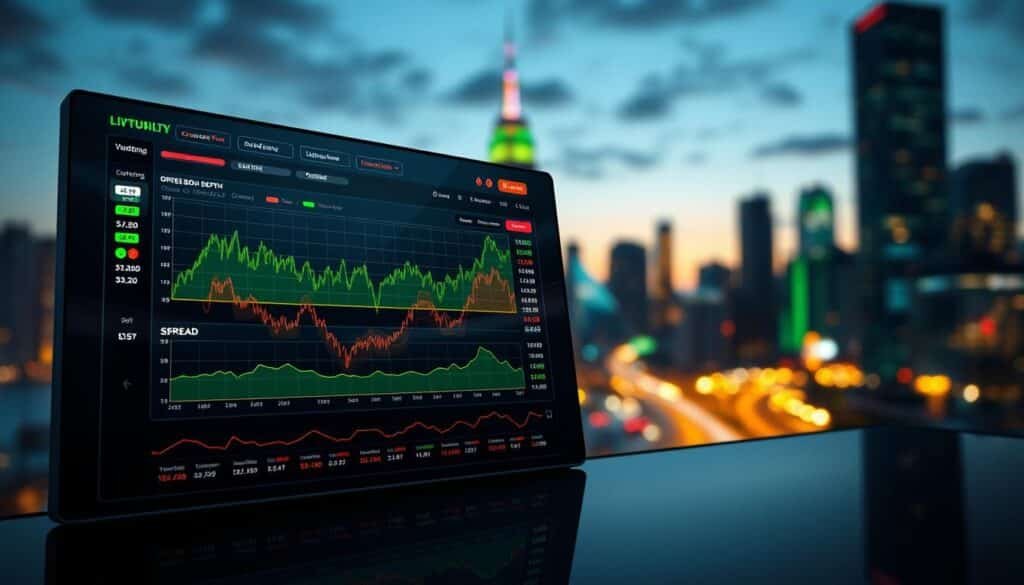
Trading volume and what 24-hour volume really tells you
24-hour trading volume is a starting point. High volume suggests steady two-sided activity, but it does not reveal where bids and asks sit.
Market depth and reading an exchange order book
Look at cumulative bids and asks around the current price. Note where depth drops off — that gap shows how much size will move price.
- Check volume near the mid-price, not just the headline number.
- Scan depth 0.5%–2% away from price to test execution risk.
Bid-ask spreads and the hidden cost inside prices
Spread = ask minus bid. A tight spread might be $0.10 on a $100 asset; a wide spread could be $5. That difference eats gains on entry and exit.
Slippage and why low depth changes execution price
Slippage grows with larger orders, thin depth, or fast moves. For market orders, estimate slippage by matching your size to cumulative depth before you trade.
Pre-trade checklist: check 24-hour volume, top-of-book spread, scan depth 0.5%–2% away, and estimate slippage for your order size. Metrics vary by exchange and pair, so pick the venue where depth concentrates.
How crypto exchanges create market liquidity</h2>
Exchanges act like automated matchmakers, pairing limit orders and market orders in real time. A centralized order book records resting bids and asks so buyers and sellers can meet.
Order books, limit orders, and market orders
Limit orders add depth by resting in the book. They supply quotes that other traders can hit.
Market orders consume that depth and move price when size exceeds nearby bids or asks. How traders place orders shapes execution quality and short-term spreads.
Market makers and their role
Market makers continuously quote two-sided prices. They earn tiny profits from spreads and help keep spreads tight.
By thickening quotes near the mid-price, makers reduce abrupt jumps and cut volatility during normal trading hours.
Cross-platform pricing and fragmentation
Because markets are split across venues, the same token can trade at different levels when supply and demand vary or transfers lag. Compare spread + fees + expected slippage across exchanges before trading.
During stress, fragmentation can worsen as some platforms thin faster than others. For deeper context, see this market structure research.
Decentralized exchanges, automated market makers, and liquidity pools</h2>
Decentralized platforms price swaps using reserves and math rather than a list of orders. Automated market makers (AMMs) read pool balances and produce a live quote for traders.
How automated market makers price assets without an order book
Most AMMs follow the constant-product rule: x * y = k. When a trader swaps, the ratio of tokens shifts and the price moves as the pool rebalances.
Liquidity pools, liquidity providers, and trading fees
Pools hold paired reserves (for example, ETH/USDC). Users called liquidity providers deposit both sides and enable trades.
LPs earn a share of trading fees. Fee income depends on trading volume, pool use, and competition from other routes.
Impermanent loss and trade-offs for providers
Impermanent loss happens if one token’s market value diverges. Even with fees, LPs can have less value than simply holding the two assets.
Why pool size impacts slippage for buy and sell orders
Smaller pools reprice more per swap, so traders face larger slippage and worse execution on buy sell orders. Larger pools absorb bigger trades with lower price impact.
Trader takeaway: before swapping, check pool depth, recent activity, and expected price impact—especially for long-tail crypto pairs on new DEX pools.
Cryptocurrency Liquidity: What Investors Need to Know when assessing a coin</h2>
Gauge a token’s trade health by watching where real buying and selling happens, not hype.
Quick pre-trade checks: confirm 24-hour volume, market cap, and whether the token lists on multiple reputable exchanges. High volume plus a solid market cap usually signals deeper liquidity and easier exits.
Compare prices across venues
Scan several exchanges for consistent prices. Large discrepancies often point to thin markets, wider spreads, or manipulation risk.
Find where real liquidity lives
Use tools like CoinGecko’s Markets tab to see which pairs hold depth. Real liquidity often sits in USD, USDT, or major-asset pairs, not obscure token pairs.
Risk controls for thin markets
If a coin shows low liquidity or one-off volume spikes, size positions smaller and plan exits in advance. Check trading volume quality—sustained activity beats headline spikes when assessing long-term investment risk.
Free tools to track crypto liquidity in real time</h2>
Start with the Markets view and you’ll see where volume and spreads concentrate. That quick check separates healthy pairs from thin listings before you trade.
CoinMarketCap and CoinGecko
Open the Markets tab on each site. Scan 24-hour volume, listed exchanges, and top pairs for the asset.
Look for consistent volume across several exchanges and tight spreads. If one listing shows huge volume but others do not, flag it as suspicious.
DEXTools for DeFi pairs
Use DEXTools to inspect pool size, recent swaps, and price impact estimates. It shows where liquidity providers added or removed capital and how that affects slippage.
DeFi Llama for TVL and macro trends
DeFi Llama tracks liquidity locked across chains. Rising TVL often means more depth for swaps; falling TVL can foreshadow wider spreads and fragile execution.
- Practical tip: compare the same asset across listings and re-check metrics just before placing an order.
- For pool-level details, read guides like analyzing crypto liquidity pools.
What causes liquidity to rise or fall in crypto markets</h2>
Market depth changes fast when headlines shift and traders react. In crypto, depth often tracks attention: more eyes mean tighter spreads and faster fills.
Trading activity cycles and demand shifts
When narratives, listings, or regulatory notes surface, demand moves quickly. Volume spikes tighten quoted prices. When interest cools, depth thins and execution worsens.
Liquidity providers entering or exiting pools
On DeFi pools, depth rises as liquidity providers add capital. If they flee—for higher yields or risk-off sentiment—pools shrink and slippage climbs.
Price shocks, macro sentiment, and rapid volume changes
Macro risk-on or risk-off swings can drain the broader market. Supply limits—locked tokens or low exchange float—amplify moves when demand hits. The May 2022 Terra collapse showed how quickly liquidity can vanish on smaller pairs, making exits painful.
- Monitoring tip: watch rapid volume shifts, widening spreads, and falling depth as early warning signs of deteriorating depth and higher trading risks.
Trading strategies for high-liquidity versus low-liquidity markets</h2>
Match your trading style to market depth: tactics that work in thin books differ from those for deep markets. Use the right approach and you reduce slippage and manage risk more predictably.
Low-liquidity tactics: limit orders, smaller sizes, and timing
In thin crypto markets, use limit orders to control execution and avoid moving the price. Break large buy sell orders into smaller chunks and pace entries across time.
Trade during peak volume windows when spreads tighten. For sell orders in thin books, plan exits early and expect partial fills rather than panic market-sells that cascade price down.
High-liquidity tactics: market orders, active trading, and risk controls
When depth is strong and spreads are tight, market orders become reliable. Active traders can use speed for momentum plays and tighter stop-loss levels.
- Practical rule: adapt order size to book depth.
- Use stop-loss and take-profit orders where the book can absorb them.
- Always assess slippage estimates before placing an order.
Core principle: match strategy to liquidity conditions rather than forcing a high-frequency approach into a thin market.
Risks of low liquidity investors should factor into every trade</h2>
Thin books can turn a calm chart into a storm in minutes. Low depth raises several practical risks for anyone trading crypto or tracking markets.
Price manipulation becomes easier. With few real orders on the book, a single large player can push price up or down and create deceptive breakouts or dumps.
Price manipulation, wash trading, and “fake” liquidity signals
Wash trading shows as inflated volume with little real depth. That fake activity hides true supply and fools participants into chasing false momentum.
Check depth near the mid-price, not just headline volume, and be wary of sudden spikes that lack cross-exchange confirmation.
When liquidity dries up: stalled sell orders and forced exits
In a dry market, sell orders may sit unfilled while bids vanish. Traders can be forced to accept prices far below expectations just to exit a position.
Volatility, widening spreads, and higher slippage in thin markets
Thin books amplify volatility: spreads widen and even modest trades cause big moves. Slippage can quickly erase gains, so correct direction alone may not save a trade.
- Venue risk: small exchanges can show deceptive activity; larger venues and transparent market makers reduce — but do not remove — this risk.
- Mitigations: verify depth and cross-exchange pricing, cut position size, and plan exits before you trade.
- Actionable step: read this guide on risks of investing in cryptocurrencies for broader risk controls and practical checks.
Conclusion</h2>
Conclusion
A quick pre-trade scan separates routine fills from trades that will shift price.
The main takeaway: liquidity determines whether you can buy or sell an asset without moving its price. It drives costs, risk, and outcomes in any market.
Before trading, check 24-hour volume, market depth, bid-ask spreads, and expected slippage. Verify price consistency across exchanges and major pairs.
CEX order books and market makers support depth, while DEX pools and automated pricing create on-chain liquidity. Use a short, repeatable routine: volume, spread, depth, cross-venue price check.
Conditions change fast with news and provider flows. This guide is informational, not financial advice; cryptocurrency is volatile. Do your research and follow local rules.
FAQ
What does liquidity mean in today’s crypto market?
Liquidity describes how easily you can buy or sell a token without moving its price. High liquidity means lots of active buyers and sellers and tight bid-ask spreads; low liquidity means thin order books, larger spreads, and higher risk of price swings when you trade.
How does high liquidity differ from low liquidity?
High-liquidity markets offer fast execution, smaller spreads, and predictable pricing for larger orders. Low-liquidity markets show wide spreads, deep slippage on modest trades, and sudden volatility when sizable orders hit the book.
Why is liquidity important for trading on exchanges?
Liquidity supports efficient trading: it reduces transaction costs, speeds execution, and helps maintain price stability. Without it, entering or exiting positions can become costly or impossible at expected prices.
What core metrics should I watch before placing buy or sell orders?
Monitor 24-hour trading volume, order book depth, bid-ask spreads, and recent slippage on similar trade sizes. These metrics reveal how much demand and supply exist at different price levels on an exchange.
What does 24-hour volume really tell you?
Volume shows recent activity but can be inflated by wash trading. Use volume with market depth and exchange provenance to judge meaningful liquidity rather than relying on a single number.
How do I read an exchange order book for market depth?
Look at cumulative bid and ask sizes at incremental price levels. Thick bids below the price and thick asks above it indicate better depth. Thin clusters mean a single large order can move price sharply.
How do bid-ask spreads affect my cost to trade?
The spread is an immediate cost: buying at the ask and selling at the bid creates an instant gap you must overcome to break even. Wider spreads increase trading costs, especially for short-term strategies.
What is slippage and why does low liquidity increase it?
Slippage is the difference between expected and executed price. Low liquidity lacks resting orders at nearby prices, so market orders consume multiple levels and execute at worse prices, increasing slippage.
How do centralized exchanges create liquidity?
Centralized platforms use order books with limit and market orders and often host professional market makers who post two-sided quotes. These participants reduce spreads and absorb order flow, supporting steady trading.
What role do market makers play in reducing spreads and volatility?
Market makers continuously post buy and sell orders, providing depth. Their activity narrows spreads and cushions price moves by taking the other side of trades, improving execution quality for other users.
How do fragmented markets across exchanges affect liquidity?
When liquidity spreads across many venues, depth on any single exchange can look thin. Arbitrage keeps prices aligned, but fragmented supply raises the risk of localized price moves and larger execution costs.
How do automated market makers (AMMs) price assets without an order book?
AMMs use mathematical formulas (like constant product) to set prices based on token ratios in pools. Trades shift those ratios, changing price and producing slippage proportional to trade size relative to pool liquidity.
What are liquidity pools and how do providers earn fees?
Liquidity pools hold paired tokens that traders swap through smart contracts. Providers deposit assets and earn a share of trading fees proportional to their pool stake, but they assume exposure to price divergence risks.
What is impermanent loss and why does it matter for liquidity providers?
Impermanent loss is the temporary reduction in value a provider experiences compared with holding tokens outright when relative prices change. It’s a key trade-off against fee income when supplying liquidity.
Why does pool size impact slippage for buy and sell orders?
Larger pools absorb bigger trades before prices move much, so slippage falls as pool depth grows. Smaller pools shift token ratios more for the same trade, producing steeper price impact.
How should I assess a coin’s liquidity before trading?
Check trading volume, market cap, and the number and reputation of exchange listings. Compare order book depth across venues and identify which trading pairs hold the most genuine activity.
Why compare prices across exchanges?
Cross-exchange checks reveal thin markets and potential arbitrage. A large price gap on one venue often signals low liquidity or unreliable pricing there, increasing execution risk.
What free tools track liquidity in real time?
Use CoinMarketCap and CoinGecko for volume, market listings, and spread snapshots. DEXTools helps analyze DeFi pairs and pool activity; DeFi Llama shows total value locked and ecosystem liquidity trends.
What causes liquidity to rise or fall?
Liquidity shifts with trading cycles, investor demand, and whether liquidity providers enter or exit pools. News, macro moves, and price shocks can rapidly dry up depth or draw fresh capital in.
How should trading differ in low-liquidity versus high-liquidity markets?
In thin markets, favor limit orders, reduce order size, and time trades when activity picks up. In deep markets, market orders and active strategies work better, but maintain risk controls and position sizing.
What risks of low liquidity should traders always consider?
Risks include price manipulation, wash trading that masks true depth, stalled sell orders during exits, widened spreads, and large slippage. Always verify exchange integrity and use conservative sizing.

No comments yet