
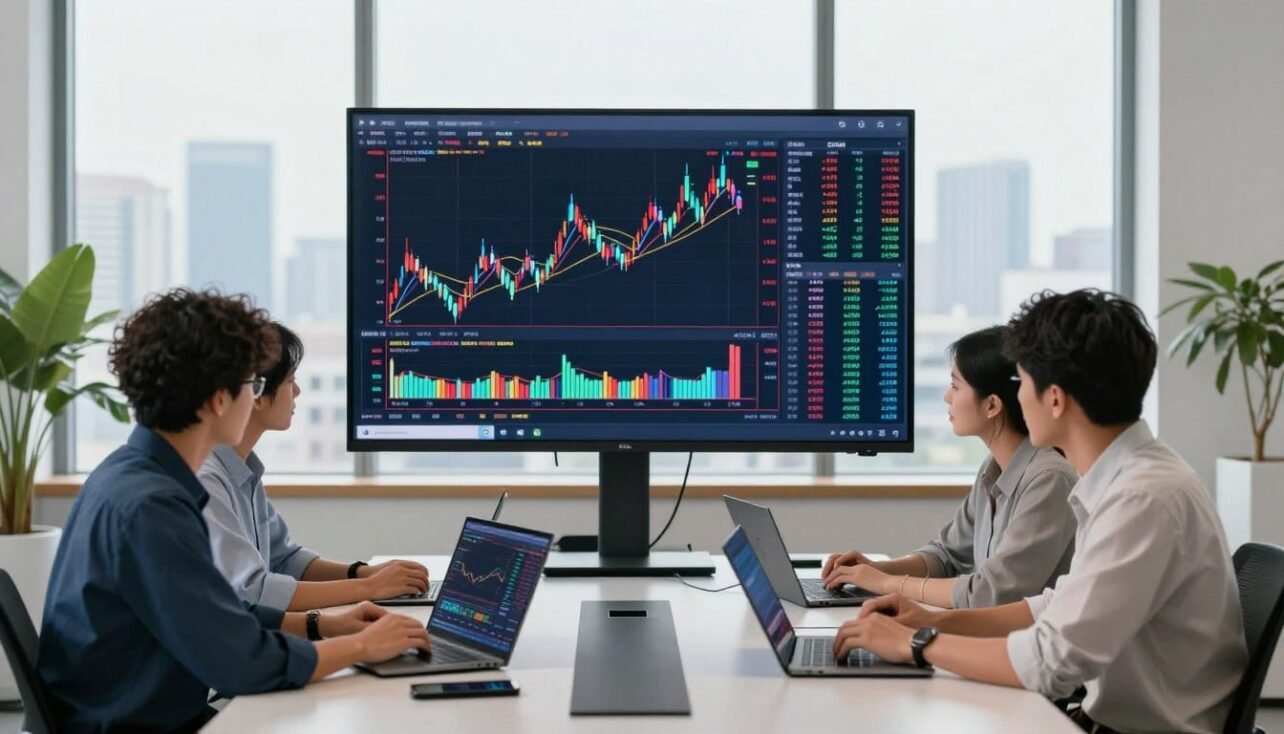
Backtesting tests a trading idea on historical data before risking real capital. Traders use OHLCV market data to simulate entries, exits, and fees across a chosen period. This process helps validate logic and a risk profile rather than promise future returns.
This guide walks through a stepwise approach: define a rules-based trading strategy, choose reliable historical data sources, run tests with realistic assumptions, and read results honestly. Expect a filter, not a guarantee; past performance does not ensure future returns, especially in high-volatility crypto markets.
Readers will learn which tools work best—manual checks, TradingView, no-code platforms, and Python—plus which metrics matter most for returns and risk. The aim is repeatable decision-making. Start with simple tests, then validate across multiple market cycles and exchanges with paper trading or forward testing before committing capital.
What crypto backtesting is and what it can tell you
Replaying a rulebook on past market records gives a trader insight into pattern reliability and risk. Backtesting simulates a written plan on historical market data to estimate how it would have performed. This lets a trader measure signal frequency, average outcomes, and edge across chosen time frames.

Backtesting defined
Backtesting means replaying strategy rules over historical OHLCV candles and recording simulated trades. It answers whether rules create consistent decisions and how often trades trigger.
Why OHLCV and time periods matter
OHLCV data is compact, widely available, and matches chart-based logic. Selecting representative time periods uncovers performance in bull, bear, and range markets.
Backtesting vs. paper vs. live
- Backtesting: historical market data with simulated fills.
- Paper: real-time data with virtual money and more realistic timing.
- Live: real capital, true slippage, and psychological pressure.
What a backtest can’t capture
Backtests often miss emotions, execution delays, and market impact unless you model order books and latency. Clean data and conservative assumptions help bridge the gap.
Why backtest crypto trading strategies before risking capital
A disciplined test turns a trading idea into a trackable performance report instead of a guess. Backtesting converts vague ideas into measurable results using clear rules and historical data.
Rules-based testing forces traders to state entries, exits, and risk management without interpretation. That clarity creates repeatable decisions and removes impulse from execution.
Reviewing results highlights weaknesses: frequent whipsaws, overly tight stops, or poor returns in range markets. Spotting these issues early lets you refine one variable at a time and document each change.
Discipline grows from knowing a system’s worst drawdown and losing streak. During high volatility, a tested plan reduces emotional errors and helps protect capital.
- Fast feedback: tests give measurable results faster than a few live trades.
- Targeted fixes: stats like win rate and drawdown guide sensible tweaks.
- Repeatability: clear rules produce consistent decisions across market cycles.
For a practical walkthrough, read this step-by-step guide that matches venue, fees, and timeframe before risking capital.
How to Backtest Crypto Trading Strategies
Follow a short, practical roadmap that keeps realism at the center of your tests.
Step 1 — Encode clear rules. Write entry, exit, and risk limits so a computer or another trader can act the same way every time. Remove vague phrases and define exact thresholds, time limits, and order types.
Step 2 — Use matching historical data. Collect OHLCV or order-book snapshots that match your exchange and timeframe. Venue-specific pricing and liquidity matter for fills and slippage.
Step 3 — Run tests with realism. Model fees, spreads, slippage, and consistent position sizing. Use conservative fills and next-bar execution to avoid look-ahead bias.
Step 4 — Analyze honestly. Focus on max drawdown, equity curve, and risk-adjusted metrics like Sharpe or Sortino. Stress test and forward test before moving capital.
Use this concise workflow guide as a practical reference for platform selection and data sources.
Write a testable trading strategy with clear entry, exit, and risk management
Start by writing clear, testable rules that state the asset, timeframe, indicator inputs, and exact trigger conditions. Keep each rule short and concrete so it can be coded or logged without ambiguity.

Entry and exit signal examples
- SMA crossover: buy when the 20 SMA crosses above the 50 SMA on BTCUSD 4h; exit on a close below the 50 SMA.
- RSI dip-and-reclaim: enter long when RSI(14) drops below 30 then closes back above 35 on a 1h chart; set a fixed take-profit or trailing exit.
- Breakout confirmation: enter after price closes above the prior 24h high with volume >1.5x average on the 4h chart; stop under the breakout candle low.
Position sizing models
Choose consistent sizing: fixed-fraction (risk 1% of equity per trade) or volatility-based sizing using ATR. For ATR sizing, compute position size so that a 2x ATR stop equals the per-trade risk cap.
Risk guardrails
- Per-trade stop-loss: set in ticks, ATR multiples, or percent of price.
- Take-profit and trailing exits: define a target or a trailing rule like 1 ATR trail after 1R move.
- Max drawdown circuit breaker: halt trading for seven days if equity drops X% (example: 8%).
Timeframe selection
Match timeframe to style: scalping (1m–5m), day trading (5m–1h), swing (4h–daily), trend following (daily–weekly). Lower time frames give more signal frequency but raise costs and slippage.
Cleaner, narrower rules produce cleaner results. Avoid indicator overload; one or two well-defined indicators plus price action is usually more testable and comparable across markets and data sets.
Choose the right historical data for crypto markets
A realistic test starts with the right dataset matched to your exchange and time period. Selecting accurate historical data is the foundation of trustworthy results. A strategy is only as reliable as the records it runs on.
OHLCV versus order book snapshots
OHLCV candles are compact and work well for swing and trend systems where spread and depth have small impact. They keep storage and compute costs low.
Order book snapshots add spread and depth, which improves execution realism for scalping or spread-sensitive methods. They need more storage and stronger compute tools or platform support.
Where to source market data
Free endpoints: Binance kline, Coinbase market data, and CoinGecko. Paid providers: Kaiko, CryptoCompare, and CoinAPI for normalized coverage across exchanges.
Use the same exchange you plan to trade when possible to avoid mismatches in price and liquidity that inflate results.
Cleaning and normalization checklist
- Detect and fill missing candles; flag gaps by time.
- Align timestamps, standardize one timezone, and normalize symbols across venues.
- Log every cleaning decision so the backtesting process stays reproducible and audit-friendly.
Crypto-specific data challenges that can distort backtest results
Crypto market data often hides quirks that can warp simulated outcomes if not handled carefully. That makes realistic tests harder than with equities. Treat historical records as noisy, multi-venue feeds rather than a single truth.
Fragmented pricing across exchanges creates inconsistent price reads and uneven fills. Smaller venues often show thin liquidity that inflates apparent returns if you assume ideal fills at each candle close.
Time matters: there is no official market close in cryptocurrency markets. Pick a timezone standard and define a daily cut-off for your period analysis. Volume cycles shift with global hours and change the best windows for entries.
- Short histories and delistings produce survivorship bias when tests ignore assets that vanished.
- Whale spikes, chain forks, and sudden regulatory moves inject noise and regime shifts into data.
- Test across multiple exchanges and years, use conservative slippage, and log how you handle outliers.
Practical mitigation: run backtesting across venues, document cleaning rules, avoid conclusions from brief samples, and stress results with worst-case fills and cost assumptions.
Pick a backtesting method and tools that match your skill level
Match your method with your goal: learning, fast iteration, or full automation. That choice shapes which platform and data you use.
Manual replay uses chart bar replay plus a spreadsheet trade log. Record entry, exit, reason, size, and notes. It teaches market structure but is slow and bias-prone.
TradingView and Pine Script
Use event-driven scripts that process candles in order and mark entries and exits. The built-in report gives quick performance summaries for a strategy and speeds repeatable testing.
No-code platforms
No-code platforms such as Coinrule, Kryll, and 3Commas let you iterate across many coins and timeframes. They are fast for multi-coin testing but limit low-level execution control.
Python frameworks
For full control, pick Backtrader, Zipline, vectorbt, or backtesting.py. These tools handle custom data ingestion, portfolio rules, and parameter optimization for advanced traders.
- Tip: Start manual, then migrate to code or no-code platforms for repeatability.
- Balance speed against realism by modeling spreads, slippage, and fills.
Make your backtest realistic with fees, slippage, and execution rules
Realistic tests subtract the frictions you will face on an exchange: fees, spreads, and cautious slippage estimates. Add these costs on every simulated fill so results track what money and capital would look like in live market conditions.
Model fees, spreads, and slippage conservatively
Apply exchange fees per trade and widen the spread you assume for fills. For low-liquidity pairs or shorter timeframes, assume larger slippage. This alone can flip a profitable backtest into a losing one.
Avoid look-ahead bias with next-bar execution
Trigger signals on candle close but execute on the next bar or simulate realistic limit fills. OHLCV candles hide intrabar paths; if you lack order-book data, use conservative fill prices.
Keep position sizing and capital realistic
Enforce single-account equity limits, avoid overlapping positions that exceed capital, and ban unlimited leverage. Re-run tests with harsher costs and smaller sizes to see if results hold under stress.
- Tip: Log assumptions for fees and slippage so results remain auditable and comparable.
- Tip: Stress-test with worst-case fills before risking real money.
Analyze backtest results using profitability and risk metrics that matter
Start your results review by pairing profit numbers with clear risk signals so decisions are based on facts, not pretty charts.
Core profitability stats
Total return shows the raw gain for the full period. Annualized return normalizes that figure across years so you can compare against benchmarks. Profit factor divides gross wins by gross losses and tells whether gains outweigh losses.
Trade quality metrics
Win rate is useful but not decisive. Check average win and average loss, then compute expectancy: the average net per trade. That reveals if the system depends on a few big winners or steady, repeatable wins.
Risk and equity curve behavior
Max drawdown measures the worst peak-to-trough loss. Drawdown duration shows how long recovery took. Equity volatility tells you how rough the ride will be for traders and capital allocators.
Risk-adjusted metrics
Sharpe Ratio shows reward per unit of total volatility. Sortino Ratio focuses on downside swings and is often more meaningful for volatile markets. Use both when judging long-term viability.
Sanity checks
Run results across multiple market cycles — bull, bear, and range — and compare performance against a relevant benchmark like buy-and-hold over the same years. This prevents mistaking market beta for genuine edge.
Validate robustness before going live with real money
Robust validation is the step that separates a neat backtest from a plan that can survive real market pressure. Run checks that challenge assumptions and expose weak points before you deploy capital.
Out-of-sample testing and walk-forward analysis
Out-of-sample testing locks your rules and runs them on a different period of data the model never saw. This shows whether the results persist beyond the original fit.
Walk-forward analysis repeats train-then-test windows across changing time frames. It reduces dependence on one regime and flags fragile model behavior.
Stress-test assumptions and limit parameter tweaks
Increase fees, widen spreads, and raise slippage in your tests. Apply parameter restraint so you avoid overfitting noisy data. These conservative adjustments reveal true edge under worse conditions.
Paper trading as the final bridge
Use paper trading to confirm live execution friction: latency, partial fills, and order handling. Treat this as a final verification step.
- Only consider allocating capital if performance holds under tougher costs and across varied market periods.
Conclusion
Use clear rules and clean records so analysis produces actionable, repeatable results. Begin with a concise plan, run realistic tests, and log every assumption. That process helps traders see what works and why.
Backtesting is a filter, not a promise. Run tests on accurate data, apply conservative cost and slippage estimates, and evaluate results with risk-aware metrics. This shows whether a setup can deliver steady returns in volatile markets like crypto.
Prioritize risk management: size positions, set stops, and cap drawdowns before risking capital. Validate with out-of-sample checks, walk‑forward runs, and paper trading. Keep strategies simple, document assumptions, and let disciplined evidence guide deployment.
FAQ
What does backtesting on historical market data show?
Backtesting simulates past trades using historical OHLCV and volume data to estimate how a set of rules would have performed. It reveals returns, drawdowns, win rate, and risk-adjusted metrics across chosen timeframes, helping you judge whether an idea produced repeatable edges under past market conditions.
Which data types matter most for realistic results?
Use candle data (OHLCV) for strategy logic and order book snapshots or trade ticks when execution and liquidity matter. Choose exchange-matched feeds, correct time zones, and consistent symbol mapping to avoid distortion from missing candles or misaligned timestamps.
How far back should historical data go?
Cover multiple market cycles—bull, bear, and sideways—when possible. For major coins a few years can be sufficient; for altcoins you may need the full available history but watch for survivorship bias and delistings. The goal is representative samples, not just the longest timeline.
How do I model fees, slippage, and execution realistically?
Include exchange fees, spreads, and conservative slippage assumptions based on liquidity and order size. Use next-bar execution or simulated fills tied to order book depth to avoid look-ahead bias. Test different slippage scenarios to understand sensitivity.
What common crypto-specific pitfalls distort backtests?
Watch for inconsistent prices across exchanges, liquidity gaps, fork events, and whale-driven spikes. No market close complicates daily definitions, and short histories or survivorship bias in altcoins can overstate performance if not handled.
Which tools suit different skill levels?
Manual chart replay and spreadsheets work for simple validation. TradingView with Pine Script offers quick strategy testing. No-code platforms speed iteration for multi-coin tests. Python frameworks (Backtrader, Zipline variants, custom scripts) give full control for advanced modeling and automation.
How should I size positions in a backtest?
Implement explicit sizing rules: fixed fraction of equity, volatility-based sizing (ATR), or risk-per-trade percentages. Enforce capital constraints and margin rules across simultaneous positions to reflect real portfolio limits and avoid inflated returns.
What metrics matter when analyzing results?
Prioritize total and annualized return, max drawdown, Sharpe and Sortino ratios, profit factor, win rate, average win/loss, and expectancy. Also inspect the equity curve and drawdown duration. Use these together to judge both return and resilience.
How do I avoid overfitting during optimization?
Keep parameter counts low, limit walk-forward or in-sample tuning, and validate on out-of-sample periods. Use cross-validation, penalize complexity, and prefer robust parameter regions rather than single “best” values that only work on past noise.
What validation steps are critical before going live?
Run out-of-sample tests and walk-forward analysis, stress-test costs and slippage, and paper trade with live data to confirm execution behavior. Monitor live performance against backtest expectations and be prepared to pause for re-evaluation if discrepancies appear.
How can I detect look-ahead bias and survivorship bias?
Ensure signals only use data available at decision time (next-bar fills help). Use historical listings and include delisted assets when testing across altcoins. Avoid using future peak values or forward-adjusted series that leak information.
When should I use order book data instead of candles?
Use order book or trade-level data when large order sizes, spread capture, or execution quality materially affect outcomes. For scalping and market-making models, order book simulation is essential; for many swing or trend strategies, cleaned OHLCV often suffices.
How do I account for margin, leverage, and funding rates?
Model margin requirements, position liquidation rules, and periodic funding or borrowing costs. Apply realistic leverage caps, simulate margin calls, and include funding rate volatility for perpetual futures strategies to prevent overstated profits.
Can I rely on paper trading alone after backtesting?
Paper trading is an important final check but not sufficient by itself. It confirms execution flow and latency effects, but real money introduces behavioral differences and platform-specific risks. Use both paper and small-scale live deployment to bridge the gap.
What sanity checks should I run after a backtest?
Verify results across multiple market regimes, rerun with conservative slippage and higher fees, inspect trade-level logs for unrealistic fills, and confirm performance persists after small parameter changes. If results break under modest adjustments, they may not be robust.
Where can I source reliable historical crypto data?
Use exchange APIs (Binance, Coinbase Pro, Kraken) for native feeds, or commercial providers like Kaiko, CoinAPI, CryptoCompare, and Coin Metrics for normalized datasets. Choose providers that offer tick, trade, and OHLCV data with clear provenance for auditability.

No comments yet