

This short guide explains what charts show and why they matter in a fast-moving crypto market.
Charts are visual records of price action over time. They help a beginner swap guesswork for clear information when headlines are noisy.
This article will cover basic chart types, key parts of a chart, candlestick reading, trend lines, support and resistance, volume signals, and a few simple indicators.
Expect practical, platform-agnostic examples that work across most US exchanges. The goal is learning, not promises of profit.
Structure: first we explain why charts matter, then show how to read them, and finally layer in technical analysis and settings like timeframe and log scale.
For a deeper walkthrough on reading live charts, see this step-by-step resource.
Why Crypto Charts Matter in Today’s Volatile Crypto Market
When prices swing wildly, a readable chart is the best tool for separating emotion from facts. Chart literacy helps traders react with a plan, not panic.
How charts turn price data into clearer trading decisions
Charts convert raw price data and trade prints into a visual story of trend, momentum, and key levels. That view makes it easier to spot direction and strength without guessing.
Using charts to spot better entry and exit points
Traders use historical reaction areas to plan buys, sells, stop-losses, and take-profits. Both new and experienced market participants benefit:
- Beginners learn common swings and timing.
- Advanced traders refine entries with tighter rules.

What charts can’t do: limits of patterns and technical indicators
Patterns and technical indicators are probabilistic tools, not guarantees. They often fail during sudden news events or low-liquidity moves.
Balance is key: combine chart analysis with risk management and basic market context rather than relying on a single signal.
How to Read Cryptocurrency Charts for Beginners
Charts compress trading data into a simple picture. A crypto chart shows where price started, where it is now, and how it moved between those points.
What “over time” means: each bar, candle, or point summarizes trades for a chosen interval. Change the interval and the same asset can look very different. This is normal because each period compresses data in a unique way.

Where you will see charts
Charts appear on exchanges, broker apps, and standalone charting platforms. Most include toggles for chart type, timeframe, and indicators that help analysis.
Picking a period time that matches your goal
Match short intervals with active day trading. Use longer periods for swing trades or investing. Start by identifying trend direction, key support and resistance levels, and volume before adding other tools.
- Define the crypto chart view you need (minute, hourly, daily).
- Check direction first, then volume and key levels.
- Adjust the period time and compare views; repeat until the picture is clear.
Crypto Chart Types Explained: Line Charts vs Candlestick Charts and More
Not every chart tells the same story — each type highlights certain data and hides other details. Pick the view that answers your question: trend, momentum, or intraperiod action.

Line charts and closing prices
Line charts connect closing prices into a simple line. That makes overall direction easy to see and lets you compare assets quickly.
They remove intraperiod swings, so small moves inside a period are hidden.
Candlestick charts for short-term movements
Candlestick views show open, high, low and close for each candle. Traders use them to read sentiment and quick price movements.
Bar charts and Heikin-Ashi
Bar charts offer the same OHLC detail with less visual bulk than candles.
Heikin-Ashi smooths movements to highlight trend, but it can hide exact closing price details.
Practical choice
- Use a line view for big-picture direction.
- Switch to candlesticks or bars when you need the full story inside a period.
- Try Heikin-Ashi when trend clarity matters more than exact prices.
Core Parts of Crypto Charts You Must Recognize
A quick tour of a chart’s parts makes spotting meaningful moves much simpler.
Price axis and live updates:
The vertical axis shows current price and recent highs and lows. Live updates matter when the market moves fast. Watch the changing price to guard against slippage and rapid reversals.
Time axis and timeframe:
The horizontal axis shows time. Options range from 1m and 5m up to 1D and 1W. Changing the timeframe changes how many candles appear and how each candle is built.
Note: Switching period is more than zooming. It alters candle construction and can change trend signals.
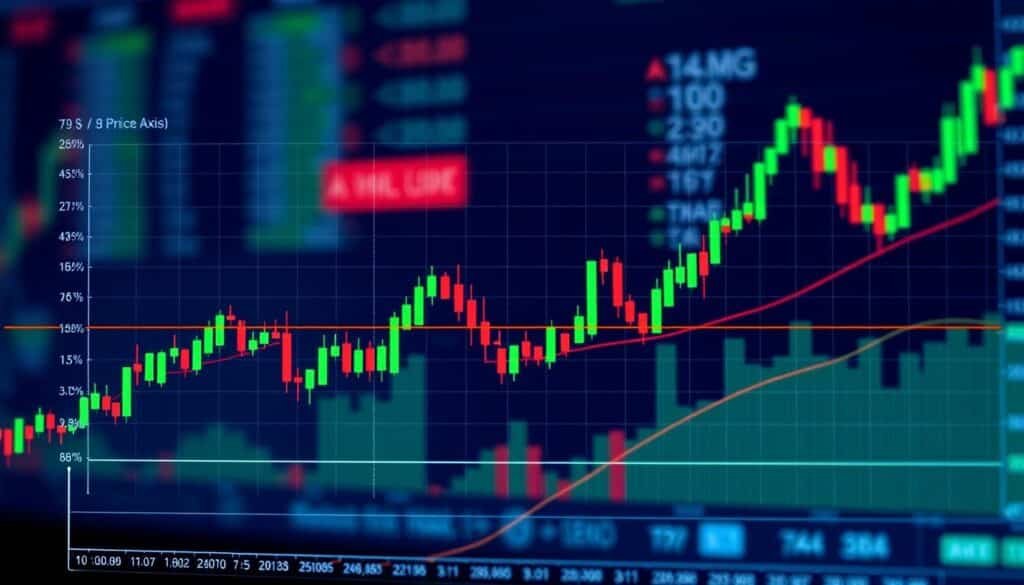
Volume bars at the bottom show how much traded per candle. Tall bars mean heavy interest and lend credibility to price movements. Low volume can signal weak moves or false breakouts.
- Learn the anatomy so any platform looks familiar.
- Use price and time together to mark support and resistance.
- Check volume to see if an asset’s move has real backing.
These elements form the basic data and information traders use in technical analysis. Master them and the rest of the chart tools will make more sense.
Reading Candlestick Charts: Open, High, Low, Close Made Simple
Candlesticks pack four critical prices into a single visual that traders use to narrate short-term market moves.
Understanding the candle body
A candle’s body shows the opening price and the closing price for the period. A long body signals strong movement and conviction. A short body shows indecision and small net change.
Wicks and shadows
Thin lines above and below the body are wicks (shadows). They mark the high and low reached during the period. Long wicks often mean rejection at price extremes.
Color and sentiment
Green (or white) candles close above the opening price and show bullish pressure. Red (or black) candles close below the opening and reflect bearish control.
Body and wick length
Long bodies suggest momentum. Short bodies and long wicks suggest tug-of-war or reversal risk. Always read these signals in the context of nearby candles and short trends.
Simple checklist for each candle
- Identify opening and closing prices first.
- Note wick range (high and low) next.
- Compare this candle with the prior few candles for context.
Practice narrating clusters of candles—that habit reveals real patterns faster than memorizing names. For a deeper walkthrough, see this analyze crypto charts.
Trend, Support, and Resistance: The Foundation of Technical Analysis
Markets move in waves; spotting those waves is the first step in useful technical analysis. A trend is defined by successive peaks and troughs rather than a straight line. Rising highs and higher lows mark an uptrend; falling highs and lower lows mark a downtrend.
Sideways action means price swings stay within a range. Short-, medium-, and long-term trends can exist at once. A brief down move may be a correction inside a longer uptrend, so timeframe matters for any trading plan.
Support and resistance are best seen as zones, not exact points. They form because traders remember areas where price paused or reversed. Repeated reactions at similar price levels create floors and ceilings.
Trend lines and channels
Draw a trend line by connecting higher lows in an uptrend or lower highs in a downtrend. Channels are parallel lines that contain price action and help visualize where a chart has been confined.
Use these tools as guides, not rules. Plan entries near support in an uptrend, consider exits near resistance, and treat decisive breaks as signals to reassess position risk and market bias.
Volume and Market Strength: Confirming Price Movements
Volume is the market’s voice — it shows whether price action has real backing or is just noise. On a crypto chart, volume bars sit under the price plot and measure how much traded in each period.
High volume typically means many participants took part. That suggests stronger conviction and makes a move harder to reverse.
Low volume means fewer trades and weaker backing. Price movements on thin volume often fade or reverse quickly.
High volume vs low volume: strong moves or fragile ones
When price breaks a zone, check whether volume expands. A breakout with rising volume is more credible. A breakdown with higher volume shows stronger selling pressure.
Spotting breakouts and breakdowns with volume confirmation
Use this simple habit:
- If a break happens on high volume, treat it as worth investigating and plan entries carefully.
- If a break occurs on low volume, wait for extra confirmation before acting.
- Remember: a sudden price spike on weak volume can be a false move that fades.
Volume complements technical analysis — it adds context to price movements but should not be the only trigger for trading decisions. Combine volume with support, resistance, and trend checks for clearer points of action.
Beginner-Friendly Technical Indicators: Moving Average and RSI Basics
A few well-chosen indicators can cut through noise and give a clear read on market momentum. Technical indicators are calculations applied to historical price data that help traders view trend and momentum more objectively.
Simple moving average: smoothing data to reveal trend
The Simple Moving Average (SMA) smooths short-term fluctuations so the underlying trend is easier to see. A rising SMA suggests an uptrend; a falling SMA points to a downtrend.
Common SMA signals
When price crosses above the moving average, traders often treat that as a potential bullish shift. When price drops below the SMA, it can signal weakening or a bearish turn.
RSI overview: spotting momentum and stretched moves
The Relative Strength Index (RSI) measures momentum and shows when a move may be overextended. Read it as a momentum check: high readings can stay high during strong trends, and low readings can persist during sharp downtrends.
Indicator overload: less is more
Practical tip: start with one moving average and RSI, then watch how they behave across timeframes before adding more. Too many indicators can conflict and distract from price action.
For a deeper look at using indicators with live charts, see this analysis guide.
Chart Settings That Change What You See: Timeframes and Log Scale
Chart settings can flip the story a price plot tells you, so choose them with a clear goal. Small changes in period or scale alter what stands out. That affects entries, exits, and how you judge momentum.
Picking the right period for day trading versus investing
Shorter timeframes show more noise and offer more entry chances. Day traders often use minutes or hourly views to spot quick moves.
Longer periods smooth noise and reveal structure. Investors and swing traders rely on daily or weekly views for clearer context.
Arithmetic versus logarithmic scale explained
An arithmetic scale treats each dollar change equally. A $10 move looks the same anywhere on the axis.
A logarithmic scale shows equal percentage moves as equal space. That makes long-term charts of volatile cryptocurrency look more meaningful.
Use log when early low-price swings would otherwise appear flat next to later large gains.
Practical workflow: big-picture then detail
Start with simple line charts based on closing prices to set trend and bias. Then switch to candlestick charts for precise entries and stop placement.
- Check a line chart for overall direction and major support/resistance.
- Zoom into a daily or hourly candlestick view for entries, risk, and timing.
- Keep settings consistent when comparing different crypto or cryptocurrency assets so visuals match reality.
Final tip: choose period time with your goal in mind and repeat the same process each session. Consistency cuts false signals and improves your analysis over the long run.
Conclusion
A solid grasp of basic chart skills makes market analysis faster and less stressful.
You now can spot key chart parts, read candlesticks, identify trends, and use support, resistance, and volume for context. That set of skills helps you interpret price moves and market behavior with clearer intent.
Priority: start with price, then trend and key levels, check volume on major moves, and add a small set of indicators only after that. Use a repeatable routine: pick a timeframe that matches your goal, mark zones, and avoid reacting to single candles in isolation.
Technical analysis shows probabilities, not guarantees. This article offers educational information, not investment advice. Practice daily on one major crypto asset, keep notes, and review outcomes to build confidence over time.
FAQ
What basic information does a crypto chart show?
A crypto chart plots price action over time, typically showing opening, closing, high and low prices for each period. It also displays the time axis and price axis, and often includes volume bars underneath. Together these elements let traders track movement, momentum, and participation behind each move.
Which chart type is best for spotting short-term price moves?
Candlestick charts are the most popular for short-term moves because each candle shows open, high, low and close for the period. Candles reveal momentum and reversals more clearly than a simple line chart, which only plots closing prices.
How does volume help confirm a price breakout?
High volume during a breakout indicates strong participation and increases the chance the move will hold. Low volume breakouts are more likely to fail because they lack conviction from traders and investors.
What does a moving average tell me on a crypto chart?
A simple moving average (SMA) smooths price data over a chosen period to reveal trend direction. Traders watch price crossing above or below the SMA for potential trend changes or dynamic support and resistance.
How should I choose a timeframe for my chart?
Match the timeframe to your goal: 1–15 minute charts suit scalping, 1–4 hour charts work for swing trades, and daily or weekly charts are best for long-term investing. Combine a big-picture view with detailed shorter periods for context.
What’s the difference between arithmetic and logarithmic scales?
Arithmetic scale shows equal price increments, while logarithmic scale displays equal percentage changes. Use log scale for long-term charts when price has moved many multiples—this gives a clearer view of percentage-based trends.
Why do some traders use Heikin-Ashi candles?
Heikin-Ashi smooths price action to highlight trend direction and reduce noise. It’s useful for trend-following, but it alters exact open/high/low/close values, so it’s not ideal when precise price points matter.
Can indicators predict exact price tops and bottoms?
No. Indicators like RSI and moving averages provide signals and probability, not certainties. They help identify momentum shifts and potential turning points, but should be used with price action, volume, and risk management.
How do I read a candlestick’s body and wicks?
The candle body shows the difference between the opening and closing price. Wicks (shadows) extend to the session’s high and low. Long bodies indicate stronger momentum; long wicks suggest rejection or indecision at higher or lower prices.
What are support and resistance zones?
Support zones are price areas where buyers historically step in, creating a floor. Resistance zones are levels where sellers tend to appear, forming a ceiling. Traders mark these zones to plan entries, stops, and targets.
How do I avoid indicator overload as a new trader?
Use a small set of complementary tools—one trend indicator (like an SMA) and one momentum tool (like RSI). Focus on price, volume, and clear rules for entries and exits rather than stacking many signals that conflict.
Where can I practice reading crypto charts safely?
Many exchanges and charting platforms offer demo or paper-trading modes—Coinbase Pro, Binance, TradingView, and Kraken are common choices. Start with simulated trades to learn chart interpretation without risking capital.
What role does timeframe alignment play in trading decisions?
Alignment across timeframes—long-term trend, medium-term structure, and short-term execution—gives higher-probability signals. For example, taking short-term longs while the daily trend is up improves the odds of success.
Are line charts useful at all?
Yes. Line charts, which often use closing prices, provide a clean view of direction and are helpful for big-picture trend analysis. They remove intra-period noise and complement detailed candlestick inspection.
How important is closing price compared with intraperiod highs and lows?
Closing price is widely used because it reflects final trader consensus for the period and feeds many indicators. Intraperiod highs and lows show volatility and rejection levels, but clustering analysis of closes often offers clearer trend signals.

No comments yet