
Navigating the digital asset landscape requires more than just price charts. It demands a deep understanding of the blockchain itself. This is where advanced analytics platforms become essential.
These tools transform raw, complex data into clear, actionable insights. They provide a window into the real movements of capital across the crypto market.
One leading solution in this space is Nansen. It is an AI-powered analytics platform that labels hundreds of millions of wallets. This process identifies funds, exchanges, and major traders to give vital context.
This capability offers unprecedented transparency. Investors can observe institutional positioning and major transactions as they happen, a level of visibility rarely seen in traditional finance.
This guide will explore the sophisticated features that set such platforms apart. We will cover wallet labeling, Smart Money tracking, and real-time dashboards for NFTs and DeFi.
Background on On-Chain Analysis and Nansen Tools
Public blockchains offer a radical level of financial transparency unseen in traditional markets. Every transaction is permanently recorded on an open ledger.
This creates a vast, real-time data set for the entire crypto market. Making sense of it requires specialized tools.
Understanding Blockchain Data and Its Value
The blockchain is a public ledger. All transactions are fully transparent and accessible.
This contrasts with traditional finance, where institutional positioning remains private. The raw data, however, is complex.

Linking addresses to real entities and understanding patterns demands expertise. Basic explorers like Etherscan show raw details but lack context.
The Evolution of On-Chain Analytics Platforms
Advanced platforms evolved from these basic explorers. They add vital context through wallet labeling and entity-level insights.
Modern analytics solutions use AI for pattern recognition and tracking. They transform raw numbers into actionable intelligence.
The ecosystem includes players like Dune Analytics, Glassnode, and Arkham Intelligence. Nansen stands out with its AI-powered wallet labeling system.
These platforms aggregate data across multiple chains. Visual dashboards make complex on-chain information accessible to all investors, providing a clearer view of the market.
How to Use Nansen for On-Chain Analysis
The power of on-chain analytics lies in transforming complex transaction data into actionable intelligence. Platforms like Nansen provide the interface to access this power.
Navigating Nansen’s Intuitive Dashboards
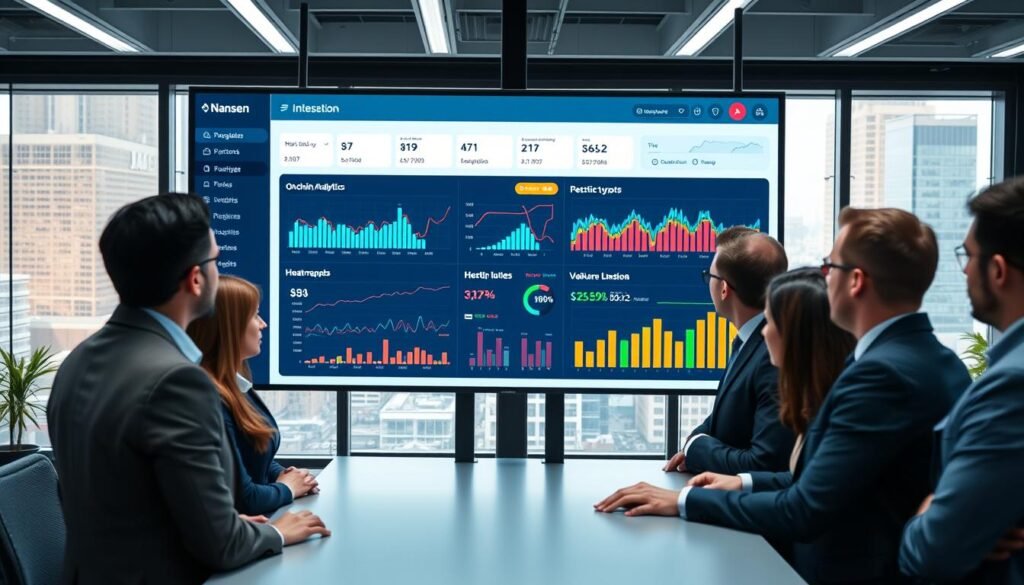
The main interface organizes key tools. Central dashboards offer real-time views.
One highlights fresh wallets with large volume. Another, Token God Mode, gives deep analysis for any token.
It shows holder concentration and exchange flows. This tracking reveals capital movement trends.
Key Features Driving Informed Crypto Decisions
Smart Money identification is a core feature. It follows high-performing wallet strategies across DeFi and NFTs.
Labeling adds context to millions of addresses. This creates clear insights from raw on-chain data.
These features help investors make confident decisions. For a detailed guide, learn how to analyze token flows with.
Deep Dive into Token Flows and Smart Money Insights
Token flows offer a real-time map of market sentiment and potential price shifts. Monitoring these movements reveals hidden supply and demand dynamics before they impact broader market action.
This analysis focuses on two powerful concepts: the movement of tokens and the behavior of smart money.
Tracking Token Movements in Real Time
Token flows describe cryptocurrency transfers between addresses. Watching large token movements, often above $1 million, is crucial.
Whale wallet activity can sway price direction. Sustained transfers to an exchange often signal selling pressure.
Leveraging Smart Money Behavior for Market Edge
Smart money identifies wallets with a history of profitable trading. Platforms classify these actors by their consistent success.
The tracking process involves filtering data dashboards. Observers identify tokens experiencing accumulation or distribution by these elite groups.
This provides a significant informational edge. Divergent behaviors between smart money categories can hint at sector rotation.
Real-World Examples from Recent Market Trends
Following BEAM’s price rise, sophisticated addresses moved large quantities to Binance and MEXC. This flow indicated coordinated profit-taking ahead of a correction.
For Chainlink, analysis of Fresh Wallet balances showed accumulation. Wallets held tokens instead of sending them to exchanges, signaling long-term confidence.
These trends highlight how token flows and smart money tracking turn raw data into actionable market intelligence.
Analyzing Wallet Activity, Exchange Inflows/Outflows, and Stablecoin Movements
The movement of tokens and stablecoins between wallets and exchanges tells a powerful story about investor intent. Tracking these movements provides a direct window into market sentiment and potential price action.
Exploring Exchange and Wallet Metrics
Exchange inflows and outflows are fundamental metrics. Large token transfers into exchanges often signal upcoming selling pressure.
Conversely, sustained outflows suggest accumulation or a move into DeFi protocols. Watching wallet activity adds depth.
This includes transaction frequency and interaction with lending platforms. These metrics distinguish between active trading and long-term holding behavior.
Interpreting Stablecoin Flows as Liquidity Signals
Stablecoin movements are a leading indicator for liquidity. Inflows to exchanges often mean capital is poised for buying.
Outflows can indicate capital exiting the crypto market. Cross-reference these flows with token movements.
High stablecoin inflows plus token outflows suggests bullish absorption. The reverse hints at distribution.
A recent ORBR unlock showed this. Fresh Wallet monitoring revealed $502 million in inflows with $467 million ending balances. This indicated a 7% distribution, with Token God Mode confirming Gate.io as the primary destination.
Practical Implementation Strategies with Nansen Tools
Customizing your analytical approach unlocks deeper market intelligence and a competitive edge. Moving from observation to action requires tailored tools.
Setting Up Custom Alerts and Smart Segments
Create custom Smart Segments by defining wallet groups. Use criteria like token holdings and transaction patterns.
For example, a “Solana Ecosystem Early Adopters” segment tracks addresses in multiple protocol launches. Monitor their capital movements for emerging opportunities.
Configure threshold-based alerts for specific tokens. Set parameters for trading size, like $100,000 transfers to exchanges by smart money addresses.
Integrate notifications with platforms like Telegram. This creates an early warning system for potential market action.
Integrating On-Chain Data with Investment Decisions
Sophisticated analysis combines multiple data streams. Correlate token flows with smart money activity and exchange metrics.
This tracking reveals accumulation or distribution trends. Combine these insights with fundamental and technical analysis.
The result is a holistic investment thesis. Investors gain clarity for confident decisions in the crypto market.
Conclusion
Transforming raw blockchain data into a strategic edge defines modern crypto investing. On-chain tracking offers unparalleled transparency and insight.
Tools like Nansen interpret complex transaction movements. They enable monitoring of token flows, smart money behavior, and exchange metrics.
Successful analysis synthesizes these data streams. This identifies accumulation patterns and sentiment shifts ahead of market action.
Nansen excels with AI-powered analytics across millions of wallets. Begin with core features like Token God Mode.
Frequent asked questions cover platform value and tracking techniques. Investors gain clarity on liquidity movements and protocol engagement.
Start leveraging this intelligence now. Make informed decisions with a comprehensive view. For deeper trends analysis, consult this detailed resource.
FAQ
What makes Nansen different from other blockchain analytics platforms?
Nansen stands out by labeling wallet addresses with real-world entities. This transforms raw transaction data into actionable intelligence. You can see if a wallet belongs to a venture capital fund, a centralized exchange, or a specific protocol. This context is crucial for interpreting market sentiment and smart money movements accurately.
How can I track "smart money" accumulation on specific tokens?
Use the Token God Mode or Smart Money dashboards. These tools filter activity to show trades only from wallets Nansen has identified as high-performing or institutional. You can see their real-time buying and selling patterns, accumulation trends, and which new tokens they are moving into, giving you a significant edge.
Why are exchange inflows and outflows important metrics?
Exchange inflows often signal selling pressure, as users move assets to platforms to trade. Large outflows can indicate accumulation, as investors move tokens to private wallets for long-term holding. Monitoring these flows, especially for major exchanges like Binance or Coinbase, provides a clear window into overall investor sentiment and potential price movements.
Can Nansen help me understand liquidity conditions in the market?
Absolutely. A key feature is tracking stablecoin movements. Large transfers of USDC or USDT onto exchanges can signal incoming liquidity and buying power, often a precursor to market rallies. Conversely, stablecoins moving off exchanges might indicate capital is being withdrawn, which can be a cautionary signal.
How do I set up alerts for specific wallet or token activity?
Nansen’s Alert feature allows you to create custom notifications. You can get alerts for large transactions, when a smart money wallet makes a new trade, or when a specific token experiences unusual volume. This ensures you never miss critical on-chain events and can take action in real time.

No comments yet