

This guide gives a clear, practical view of a five-line system that many traders use to read trend, momentum, and projected support resistance at a glance.
Designed for traders in stocks, forex, and crypto, the tool combines Tenkan-sen, Kijun-sen, Senkou Span A, Senkou Span B, and Chikou Span into a single, forward-looking price map.
The article explains each line, how to read the chart, common signals, and simple rules for stops and exits. You will learn when the method shines — clear trends — and when to add filters to avoid whipsaws in range markets.
By the end, expect practical setups, objective trend filters, and a repeatable checklist to improve timing on entries and exits.
What Is the Ichimoku Cloud and Why Traders Use It Today
Think of it as a compact market dashboard that shows direction, momentum, and likely price reaction zones at a glance.
The ichimoku cloud consolidates multiple reads—trend direction, momentum, and dynamic support and resistance—into one visual framework. That single-pane view helps traders use fewer overlays and cut through chart noise.
Directional logic is simple: price above the cloud favors bullish conditions, below favors bearish bias, and inside suggests consolidation. Signals gain or lose strength depending on where they form relative to the spans.
The forward projection of the spans is a key differentiator. It plots potential future support and resistance, so traders can anticipate likely reaction areas instead of only looking backward.
When combined with basic price filters—such as avoiding trades inside the cloud—this system supports clear, rule-based setups for trend-following and momentum confirmation.
It works best in trending markets and remains compatible across platforms and asset types. Later sections break down each line, show how to read signals, and give execution rules you can test on live charts.
From Goichi Hosoda to Modern Markets: A Brief History

Goichi Hosoda quietly developed his five-line method over decades before releasing it in the 1960s.
Originally, the system was built for Japanese stocks. Its design used both past and forward projections, which set it apart from other indicators of the time.
The forward projection gave traders a way to see likely support and resistance ahead of price. That feature made the method easy to transfer to currencies and commodities.
- Creator: Goichi Hosoda refined the rules across many years.
- Original use: Japanese equities with multi-timeframe logic.
- Adoption: Spread as charting platforms matured and global traders sought unified systems.
Through time, core rules stayed consistent. Modern traders favor the approach for systematic, rules-based setups that combine trend reading and projected zones.
| Era | Primary Focus | Adoption |
|---|---|---|
| 1930s–1960s | Development and refinement for stocks | Limited, Japanese markets |
| 1970s–1990s | Transfer to forex and commodities | Growing among global traders |
| 2000s–present | Standardized on major platforms | Widespread across timeframes and assets |
Components of the Ichimoku Cloud Explained
Each of the five elements gives a distinct view of price action. Together they show momentum, equilibrium, and projected reaction zones. Below are the formulas and practical roles to use on charts.
Conversion Line (fast midpoint)
The conversion line is the 9-period midpoint: (highest high + lowest low)/2. It reacts quickly and often acts as near-term support or resistance in trends.
Base Line (26-period equilibrium)
The base line uses a 26-period midpoint. It reads as a medium-term balance and tends to anchor pullbacks. Traders treat the base line as a stronger guide for continuation versus reversal.

Leading Span A and Leading Span B
Leading span A = average of conversion line and base line, plotted 26 periods ahead. It forms the faster edge of the shaded area.
Leading span B = midpoint of the highest high and lowest low over 52 periods, also plotted 26 periods forward. Its slower move often marks stronger reaction zones.
Lagging Span (confirmation)
The lagging span plots the current close 26 periods back. Above past price it confirms bullish bias; below, bearish. Use it alongside the other lines for higher-probability setups.
- Tip: These five midpoints differ from moving averages because they use highs and lows, which can reduce noise.
- Practical rule: Favor trades when conversion line, base line, the leading spans, and the lagging span align.
How to Read the Ichimoku Cloud on a Price Chart
Begin with price placement on the chart: that single check tells you whether to favor buys, sells, or no trade. Price above the shaded area generally signals an uptrend. Price below suggests a downtrend. Inside the zone often means consolidation and higher risk.
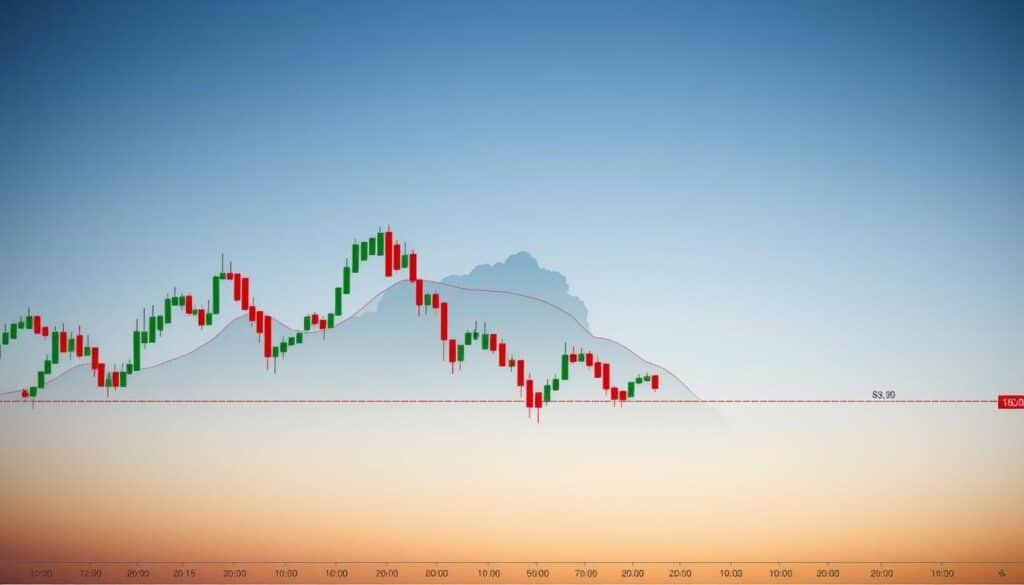
Trend identification
Start with location: define bias by whether price is above, inside, or below the spans. This avoids trading against the dominant condition.
Support and resistance levels
Leading spans form dynamic support and resistance levels. Use those lines and the base line for pullback entries and stop placement.
Cloud thickness and angle
Thicker zones usually provide stronger support and resistance. Thin zones can break more easily. The angle of the shaded area helps gauge momentum—steeper slopes imply stronger price moves.
- Use the conversion line and base line to confirm momentum alignment.
- Avoid entries when price sits inside the zone to reduce whipsaws.
- Reference recent periods’ highs and lows to know why levels shift.
For a deeper, step-by-step walkthrough, see the complete trading guide.
Core Trading Signals with the ichimoku cloud indicator
Trade decisions become simpler when you weigh crossovers, breaks, and the lagging confirmation together.
Conversion line/Base line crossovers act as early momentum triggers. A bullish signal forms when the conversion line crosses above the base line. A bearish signal forms when it crosses below. Crosses carry more weight when they occur above or below the shaded zone in the trend’s direction.
Breakouts through the shaded area mark structural shifts. When price moves cloud boundaries with decisive closes, the market often shifts from neutral to directional. Thicker zones require stronger moves to confirm a valid breakout.
The chikou span (lagging span) is a final filter. If it sits above past price, it supports bullish continuation. If it sits below past price, it confirms a downtrend signal. Use this to avoid marginal or late entries.
- Use crossovers as momentum triggers, but require alignment with cloud bias.
- Validate breakouts with the lagging span and leading span A vs B.
- When signals occur inside the shaded area, wait for a close outside before acting.
| Signal | Confirmation | Quality |
|---|---|---|
| Conversion/Base cross | Above/below shaded area + chikou span alignment | Higher if outside shaded area |
| Price breaks shaded bounds | Decisive close through thick zone + leading span A above B | High if lagging span confirms |
| False/inside-zone signals | Wait for close outside or additional crossover | Lower; use protective rules |
Practical Strategies: From Setups to Execution
Focus your plan on high-probability setups that combine trend direction, pullbacks, and momentum checks.
Trend following with price and span bias
Trade with the wider structure: go long only when Leading Span A sits above Leading Span B and price is above the shaded area. Reverse the logic for shorts.
That alignment preserves momentum and reduces false entries. Keep position size small when spans disagree.
Pullbacks to the base line and cloud edges
Use pullbacks to the base line as first-touch continuation entries. Add tests of the nearer cloud edge for deeper retests.
Place stops just beyond the base line or the opposite cloud edge so risk is defined by price structure, not guesswork.
Creating confluence with RSI divergences
Layer an RSI divergence to spot fading momentum early. When RSI disagrees with price or with span alignment, tighten stops or take partial profits.
Define exits in advance: conservative exits on a Tenkan/Kijun cross against you, aggressive exits on a full opposite-side cloud break.
- Rule of thumb: scale in on clean retests if spans stay supportive.
- Document each trade to refine which setups work best in your market.
For a step-by-step guide to chart analysis that complements these tactics, see how to analyze crypto charts for U.S.
Settings, Timeframes, and Markets
Choose periods with purpose. The common default is Tenkan 9, Kijun 26, Senkou Span B 52, with spans projected 26 periods forward and the lagging line 26 back. These values work as a baseline across many stock and forex timeframes.
Shorter periods increase sensitivity for intraday setups. Longer periods smooth moves for swing and position trades.
When to adjust parameters
Raise or lower the Tenkan/Kijun and Span B based on volatility or session structure. Fast markets often benefit from tighter periods; low-volatility stocks may need longer smoothing.
Across assets and time
The tool is available for stocks, forex, and crypto. Its level logic stays consistent: the leading span (senkou span B) often marks stronger levels across markets.
- Test changes on your instrument before trading live.
- Compare with moving averages: midpoints of highs/lows behave differently than close-based averages.
- Align timeframes — use higher-timeframe bias with lower-timeframe entries for better odds.
| Horizon | Suggested periods | Benefit |
|---|---|---|
| Intraday | Shorter Tenkan/Kijun | More sensitivity |
| Swing | Default 9/26/52 | Balanced signals |
| Position | Longer Span B | Smoother levels |
Ichimoku Cloud vs. Moving Averages
Moving averages give a tidy history of price closes. They smooth noise and make trend direction easy to spot with minimal chart clutter.
By contrast, the ichimoku cloud combines several lines and plots a forward-projected area. The system uses midpoints of highs and lows and plots a leading span 26 periods ahead to show likely future support and resistance.
Backward-looking averages vs. forward-projected spans
Key differences matter for execution:
- Inputs: moving averages use close-based data; the other method uses high/low midpoints for Tenkan, Kijun, and Span B.
- Projection: averages reflect past action; the leading span projects structure ahead of price.
- Complexity: averages are simple and clean; the layered system gives more signals but can clutter charts at first.
- Use case: both support trend analysis, but one is a compact trend check while the other is an integrated trading framework.
| Feature | Moving averages | Ichimoku approach |
|---|---|---|
| Data input | Closing prices | High/low midpoints and closes |
| Lookahead | No forward plot | Leading span plotted 26 periods ahead |
| Chart clarity | Minimal, clean | Denser, multi-signal |
| Best use | Quick trend checks and smoothing | Integrated momentum, levels, confirmation |
Risk Management and Trade Management with Ichimoku
Structure-based stops help you trade without guessing where the market will turn. Place protective stops beyond clear chart structure so losses stay defined. Use the base as a first line of defense and the spans as secondary protection.
Stop placement and practical rules
Use the base line as your primary stop reference. If price closes beyond the base line, the trend’s equilibrium likely shifted and you should reassess the trade.
- Primary stop: just beyond the base line for structure-based risk.
- Wider stop: set beyond the far cloud boundary or the senkou span B to avoid random stop-outs.
- Position sizing: align size with distance to structural stops so risk per trade stays consistent.
Exit strategies: conservative vs aggressive
Choose exits based on your goal: protect gains or capture the full move.
- Conservative exit: take profits or tighten stops on a Tenkan/Kijun cross against you or on a close into the cloud as momentum wanes.
- Aggressive exit: remain in the trade until a full opposite cloud break; accept larger drawdowns for bigger runs.
- Use spans for targets: let support resistance levels and resistance levels from the leading span guide targets and trailing logic.
In a downtrend, rallies into the cloud often act as resistance. Treat those touches as chances to tighten stops or scale out. Monitor the chikou span: declining confirmation can justify partial profit-taking before a final exit.
| Action | Reference | When to use |
|---|---|---|
| Stop tight | Base line | Short-term trades, low volatility |
| Stop wide | Far cloud / senkou span B | Trend trades, high volatility |
| Exit conservative | Tenkan/Kijun cross or close into cloud | Protect gains in choppy markets |
Common Mistakes, Limitations, and How to Avoid Them
Even solid tools fail when traders ignore context and let rules slip during fast moves. The system relies on past prices and can struggle in sideways markets. That makes false signals and whipsaws more likely.
Avoid trading inside indecision. Late entries while price sits inside the cloud often have poor reward-to-risk. Wait for a clean close beyond structure before committing.
Default settings may not fit every market or timeframe. Reassess periods for volatility and session profile to tune the lines and levels to your instrument.
- Don’t treat the span area as infallible—range-bound conditions reduce its effectiveness and increase whipsaws.
- Avoid clutter: hide nonessential lines when testing hypotheses or use separate charts for confirmations.
- Resist counter-trend entries that fight the cloud’s directional read unless you have a tested reversal plan.
- Monitor the lagging span to confirm breaks and filter marginal signals; combine it with RSI divergences for added confirmation.
- Respect leading and senkou span levels for stops and targets; misreading them leads to misplaced stops and missed exits.
Track mistakes and refine rules. Keep a simple trade log of overtrading inside the cloud, ignored levels, or misread chart context. Reviewing real errors helps traders cut bad habits and improve timing.
For a complementary, step-by-step chart walkthrough that pairs well with these avoidance tactics, read how to analyze crypto charts.
Conclusion
End with a routine: define bias, confirm momentum, and protect risk at clear structural levels.
The ichimoku cloud indicator combines lines and forward spans to give directional bias, timing, and support/resistance levels in one view. Use the conversion and base line for momentum timing and the leading span relationships to read likely price reaction zones.
Keep risk at structure: place stops beyond the base or cloud edge and size positions to that distance. Align higher-time spans with lower-time entries to reduce false trading signals across markets like stock and crypto.
Quick checklist: trade with the cloud, use lines for timing, respect support and resistance levels, validate signals with the chikou span or a simple RSI, and log every trade to improve over time.
FAQ
What is the Ichimoku system and why do traders use it?
The Ichimoku system is a multi-line charting method that shows trend, momentum, and dynamic support and resistance in one view. Traders use it to quickly assess whether price action is bullish, bearish, or neutral and to find entry and exit opportunities without adding many separate moving averages or oscillators.
What are the main lines and how do they differ?
The setup uses a short-term conversion line for early momentum, a longer base line for equilibrium and dynamic support, two forward-projected spans that form a shaded zone, and a lagging span offset for confirmation. Each line reflects different lookback periods so you can read immediate momentum, medium-term direction, and projected support/resistance.
How do I identify trend with the shaded zone and price position?
If price trades above the shaded zone, the trend is generally bullish; inside the zone signals congestion or transition; below indicates a downtrend. The zone’s slope and thickness help gauge trend strength and likely volatility of future price moves.
What are reliable entry signals with this system?
Common entries include a conversion/base crossover in the direction of the trend, a breakout above or below the shaded zone confirmed by the lagging span, and pullbacks to the base line or top of the zone that hold as support or resistance.
How should I set stop losses and manage risk?
Place stops beyond the shaded zone, under the base line, or past the relevant span depending on your risk tolerance. Use position sizing and avoid adding to weak setups; exits can be based on opposite line crosses or price re-entering the zone against your trade.
Can I use standard settings across markets and timeframes?
Default periods work well for many traders, but customization often improves results across stocks, forex, and crypto. Shorter timeframes may need tighter settings; longer-term investors can use default or extended lookbacks for smoother signals.
How does this tool compare to simple moving averages?
Unlike traditional moving averages that only reflect past prices, this system includes forward-projected spans that give a view of future support and resistance. It combines momentum and trend context in one package rather than relying solely on lagging averages.
What common mistakes should traders avoid?
Avoid using the system in isolation, ignoring context like volume or higher-timeframe trends, and treating thin shaded zones as strong support. Also, don’t overtrade minor crosses without confirmation from price position and the lagging span.
How can I combine this method with other tools for better signals?
Create confluence by adding momentum tools such as RSI for divergence, volume for breakout strength, or trend filters from higher timeframes. Use these additional inputs to filter false breakouts and improve entry timing.
What does the lagging span tell me and how should I use it?
The lagging span is a price offset used to confirm trend direction and breakout validity. If it sits above past prices during an uptrend, it supports bullish bias; if below past prices in a downtrend, it reinforces bearish bias. Use it as a secondary confirmation before entering.
Are there limitations to this approach I should be aware of?
Yes. Signals can lag in fast reversals, the shaded zone may produce false breakouts in low-volume markets, and the method requires practice to interpret correctly. Always combine it with sound risk management and market context.
Where did this method originate and who developed it?
The method was developed by Goichi Hosoda in the mid-20th century. Traders adopted it because it packages multiple trend and momentum signals into a single, easy-to-read charting system that remains relevant across modern markets.

No comments yet