
Metis Dao Andromeda is an Ethereum Layer-2 rollup built for high throughput, quick finality, and low fees. The platform helps teams move from siloed Web2 systems to usable Web3 apps without sacrificing performance.
Developers and product teams value the stack for its EVM-equivalent VM and IPFS-based storage. These components reduce operational overhead and speed deployment for production-grade dApps.
The guide explains where the platform fits in the broader blockchain landscape, who the primary developers and users are in the United States, and which solutions thrive here.
For a deep technical and token outlook, see this detailed review on the ecosystem: Metis deep dive. This article sets expectations for architecture, governance, and next steps for your project.
Why Metis Andromeda Matters Today for Developers and Users
Scalability that keeps user flows fast and predictable is the core advantage for teams building real products. This Layer-2 platform reduces friction between Web2 expectations and on-chain systems so developers can focus on features, not fragile infra.
For developers, the environment offers familiar Ethereum tooling, faster confirmations, and lower fees that make testing, staging, and production rollouts easier. That predictability shortens time-to-market for US companies and startups targeting mainstream adoption.
From Web2 to Web3: a Layer-2 platform focused on scalability and usability
The system abstracts many blockchain details so teams avoid costly rewrites. It supports governance through a DAC-style framework to speed decisions and maintain accountability.
High-throughput transactions and low fees for dApps in the United States and beyond
Lower fees reduce failed transactions and checkout abandonments. Users see near Web2 responsiveness, while the network preserves Ethereum-derived security and finality.
- Familiar development stack for faster integration.
- Predictable transaction costs for better UX and retention.
- Bridge options and cross-network paths for multichain growth.
| Benefit | Impact for Developers | Impact for Users |
|---|---|---|
| High throughput | Faster deploys, lower latency in dev cycles | Quick confirmations, fewer failed actions |
| Low fees | Predictable costs for product economics | Lower friction for trading and minting |
| Familiar tooling | Easy integration with existing frameworks | Smoother onboarding and consistent UI |
| Governance framework | Faster decisions, clearer roles | More reliable product roadmaps |
What Is metis dao andromeda? Core Concepts, Network, and Platform Vision
This Layer-2 design batches many user actions into single on-chain commitments to cut costs and speed confirmations.
Optimistic rollups are the main scaling approach: they bundle numerous transactions into batches while keeping Ethereum-level security through fraud proofs. The environment runs an EVM-equivalent virtual machine so developers can deploy existing smart contracts with minimal refactor.
Optimistic Rollups and Ethereum compatibility for smart contracts
The rollup model reduces gas spend and confirmation time. That lets teams focus on product features instead of rebuilding core infra. IPFS-backed storage handles off-chain content and data availability, keeping on-chain costs lower.
Andromeda and Hyperion: a two-network strategy for diverse projects
The platform pairs two networks to suit different application needs. One side targets fast experimentation; the other supports scale and physical-asset integrations. A future decentralized sequencer is planned to remove single points of control and improve censorship resistance.
- Modular framework for interoperability and future integrations.
- Developer-friendly tooling lets developers ship Ethereum-compatible dApps faster.
- Batched transactions, IPFS storage, and governance keep the ecosystem flexible for many projects.
How Metis Works: Rollups, Storage, and the Tech Stack
The platform reduces cost and improves speed by grouping many actions into single on‑chain commitments. Optimistic rollups aggregate transactions into batches, then submit concise proofs to Ethereum. This approach lowers on‑chain data footprint and keeps fees predictable for users and apps.
IPFS handles decentralized storage and data availability. Applications reference content‑addressed files so data stays portable and verifiable across the blockchain ecosystem.

Bundling transactions to reduce fees and speed up confirmations
Batching cuts per‑action costs and enables high throughput during demand spikes. That makes the system suitable for microtransactions, marketplaces, and real‑time features.
IPFS-powered decentralized storage and data availability
Off‑chain storage lowers gas needs while keeping data auditable. Developers can anchor state transitions on Ethereum and serve heavy reads from cheaper layers.
EVM-equivalent virtual machine and contract execution
The VM follows Ethereum semantics so smart contracts and tools work without large rewrites. This eases audits and speeds deployment for U.S. teams building production systems.
Toward a decentralized sequencer for stronger security and stability
A planned decentralized sequencer will reduce single‑operator control and improve overall security. That change strengthens sequencing, fault tolerance, and censorship resistance across the network.
For practical rollup use cases and DeFi patterns, see this guide on top rollup applications: rollup use cases for DeFi.
Governance and Token: DAC Framework, Roles, and the METIS Tokenomics
Governance on this Layer‑2 emphasizes expertise and operational roles over pure token-weighted votes. The DAC framework prioritizes subject-matter knowledge so decisions match technical needs and legal realities.
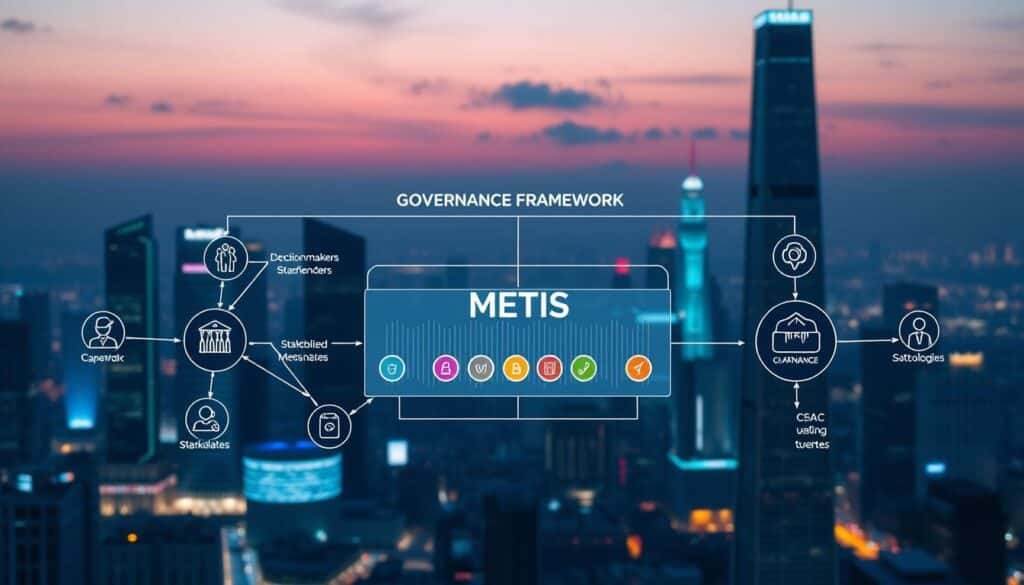
Commons can create and submit proposals by staking the metis token. Staking aligns incentives and filters low‑quality submissions.
EcoNodes are selected for measurable ecosystem contributions. That selection ties reviews to operational realities and strengthens security.
- Token utility: fees, staking, and network security.
- Contracts and on‑chain records boost transparency and auditability.
- Roadmap items include a decentralized sequencer to improve decentralization and stability.
| Area | Mechanism | Impact |
|---|---|---|
| Governance | DAC framework, Commons staking | Expert-driven proposals, reduced capture risk |
| Node selection | EcoNode contributions | Operational checks, improved security |
| Tokenomics | 10,000,000 cap; 49.3% minted 2021; 50.7% for community | Launch support plus long-term incentives for ecosystem growth |
Clear roles, on‑chain processes, and funding align decisions with infrastructure needs. Developers and projects gain faster reviews, better security, and predictable incentives for growth.
Getting Started: Bridge, Swap, and Integrate on the Andromeda Network
Bridging funds and swapping tokens on the network is straightforward when you follow a few practical steps. Start small to validate your wallet setup and fee balances before larger transfers.

Bridging assets to Andromeda with RocketX
Visit RocketX, pick your source network (for example Ethereum) and select Andromeda as the destination. Connect a supported wallet such as MetaMask, Rabby, OKX, or Coinbase Wallet.
Ensure you hold enough balance to cover all fees on both chains. Enter the amount, add the recipient address, confirm the cross-chain swap, and wait for the completion notice.
Swapping tokens on-chain
After bridging, connect your wallet to a swap interface. Choose METIS as the input or output asset, pick the target token like ETH, set the amount, check slippage and routes, then confirm the transaction.
Developer onboarding and integration
Developers deploy contracts with standard Ethereum toolchains. Add RPC endpoints, set chain IDs, and account for IPFS-based storage references in backends.
- Document UX flows and confirmation states for users.
- Log transaction data for support and analytics.
- Use audited libraries and verify addresses to keep security strong.
| Step | Action | Tip |
|---|---|---|
| Bridge | RocketX: select networks, connect wallet | Test with small amount; fund fees |
| Swap | Choose METIS/target token, confirm | Review slippage and routes |
| Integrate | RPC, chain ID, storage refs | Monitor transactions; provide fallbacks |
Ecosystem Insights: Analytics, Security, and Metrics That Matter
Real-time on-chain signals let teams spot liquidity shifts and wallet behavior before problems escalate. That visibility helps product leads and operators make faster, data-driven choices.
Nansen integration for real-time on-chain data and transparency
AI-driven analytics consolidate wallet flows, liquidity movements, and smart-money patterns into actionable dashboards. This integration gives firms a clearer view of dApp adoption and token distribution across the network.
Rethinking success metrics: throughput, cost efficiency, and activity
Measure more than price. Track transactions per second, median transaction cost, and active contract interactions to assess health.
- Throughput: stress-tested TPS under load.
- Cost efficiency: median fees per transaction.
- Activity: daily active contracts and retention.
Centralization risks in Layer-2 sequencers and implications
When a small set of operators controls sequencing, the system faces censorship, downtime, or reordering risks. Decentralization of the sequencer reduces these single points of failure and strengthens security.
| Risk | Impact | Mitigation |
|---|---|---|
| Single operator | Censorship or downtime | Move toward decentralized sequencer |
| Opaque governance | Higher counterparty risk | Transparent on-chain processes |
| Slow response | Business disruption | Real-time analytics and incident playbooks |
Business use cases: payroll, bridges, and cross-network strategies
Companies can use real-time data to run crypto payroll, manage stablecoin payouts, and choose bridge providers. On-chain insights inform treasury timing, counterparty risk, and token incentive design.
Conclusion
This conclusion highlights practical value.
Teams can move quickly from prototype to production on a system that preserves Ethereum compatibility and lowers fees. The metis andromeda platform pairs Optimistic Rollups, IPFS storage, and an EVM-equivalent VM to deliver a clear scaling solution.
Governance, token design, and analytics align incentives across the ecosystem. The DAC framework and metis token support community-driven upgrades while Nansen-style data boosts transparency for companies and users.
Start by bridging funds via RocketX, deploy a minimal contract, instrument observability, and iterate. With a roadmap toward a decentralized sequencer and robust infrastructure, developers gain a reliable environment for production projects and predictable transactions.
FAQ
What is the core purpose of the Explore Metis Dao Andromeda platform?
The platform aims to provide a Layer-2 environment that improves scalability and usability for decentralized apps. It bundles transactions using optimistic rollups and offers Ethereum compatibility so developers can deploy smart contracts with lower fees and faster confirmations.
How do optimistic rollups help smart contracts on this network?
Optimistic rollups aggregate many transactions off-chain, submit compressed data to the main chain, and assume transactions are valid until proven otherwise. This reduces gas costs, increases throughput, and keeps contracts compatible with the Ethereum tooling ecosystem.
What is the two-network strategy involving Andromeda and Hyperion?
The two-network approach separates responsibilities and supports diverse project needs. One network can optimize for high-throughput consumer dApps while the other targets enterprise use cases, storage, or specialized governance models, enabling better performance and modularity.
How does transaction bundling reduce fees and speed confirmations?
Bundling groups many user operations into a single submission to the main chain. This amortizes the base gas cost across many transactions, lowering per-user fees and enabling faster finality for confirmations at scale.
What storage solutions are used for data availability and files?
The platform integrates decentralized storage such as IPFS to host application data, metadata, and large files. Off-chain storage paired with on-chain references keeps costs low while preserving availability and censorship resistance.
Is the execution environment compatible with existing Ethereum tools?
Yes. The execution environment mirrors EVM behavior, so developers can reuse familiar compilers, wallets, and debugging tools. That makes migrating Solidity contracts and existing dApp codebases easier.
What is a sequencer and why is decentralizing it important?
A sequencer orders and batches transactions before submission to the main chain. Decentralizing sequencing reduces single-point-of-failure risks and censorship concerns, improving security and trust for users and companies building on the network.
How do Decentralized Autonomous Companies differ from traditional DAOs?
Decentralized Autonomous Companies (DACs) apply corporate-style structures to on-chain organizations, enabling clearer roles, compensation models, and operational processes. They blend governance with business functions to support sustainable projects and services.
What are EcoNodes and how do they support governance?
EcoNodes provide infrastructure, stake-based incentives, and proposal mechanisms that help run the network and fund ecosystem growth. Participants can stake tokens, submit proposals, and earn rewards for contributing services or security.
What utility does the METIS token provide within the system?
The native token powers governance, staking, fee payments, and incentive programs. It aligns network participants by funding development, rewarding contributors, and securing protocol operations.
How can users bridge assets onto the network and what fees apply?
Users bridge assets using a dedicated bridge service such as RocketX. The process typically involves wallet connection, selecting assets, and paying network and bridge fees. Fees vary by asset and congestion but remain lower than direct mainnet transactions.
Which wallets and swaps are supported for token transfers and exchanges?
Common Ethereum-compatible wallets and decentralized exchanges work with the network. Users can swap native tokens like METIS and ETH as well as supported ERC-20 assets on-chain through integrated swap interfaces and liquidity pools.
What onboarding resources exist for developers integrating contracts?
Developer toolkits include SDKs, documentation, contract templates, and testnets. These resources help teams deploy contracts, verify compatibility, and connect backend services like off-chain storage or analytics platforms.
How is on-chain analytics provided and which partners are involved?
The ecosystem integrates with analytics providers such as Nansen to offer real-time transaction tracking, address labeling, and behavioral metrics. These tools help teams measure throughput, costs, and user activity across dApps and bridges.
What metrics should teams track to measure network success?
Focus on throughput (transactions per second), average fees per transaction, active user count, developer deployment rate, and cross-chain volume. These indicators reveal cost efficiency and ecosystem growth.
What centralization risks exist with Layer-2 sequencers and how can companies mitigate them?
Risks include single sequencer control, censorship, and downtime. Mitigation strategies involve multi-party sequencers, fallback mechanisms, clear SLAs, and phased decentralization plans that distribute sequencing duties among trusted nodes.
What business use cases are well suited to this Layer-2 platform?
Ideal use cases include crypto payroll, cross-border payments, bridges between networks, gaming microtransactions, and enterprise tooling that needs fast settlement and low fees while remaining compatible with Ethereum standards.
How does the network handle security audits and vulnerability management?
Projects are encouraged to run professional audits, use bug bounty programs, and adopt formal verification for critical contracts. The ecosystem supports disclosure channels and continuous monitoring to detect and respond to threats.
What integration pathways help companies connect existing Web2 systems to this blockchain ecosystem?
Integration options include API gateways, middleware for off-chain data, oracle services for trusted inputs, and SDKs to bridge user accounts and payment rails from Web2 platforms into decentralized applications.

No comments yet