

Quick guide: This short introduction explains how simple smoothing lines help traders see trend direction and reduce chart noise.
Why this matters: Crypto markets swing fast. Large price moves can hide the real trend. MA lines smooth those swings so traders spot direction, support, and resistance more clearly.
This guide shows how a moving average line is built from past price data and how it behaves across timeframes. You will learn how traders use MAs for entries and exits and how types like SMA, EMA, WMA and VWMA differ.
We also preview MA strategies such as crossovers, dynamic support and mean reversion, and ways to reduce whipsaws. Remember: these tools support analysis but do not guarantee results in a volatile market.
Why moving averages matter in today’s volatile crypto markets
When markets jump and wick wildly, a smoothing line can show the trend beneath the chaos. Fast crypto swings and news-driven spikes make raw price bars bounce and create false breakouts.

How moving averages smooth price data and reduce chart “noise”
A moving average updates the average price across a fixed window. That softens rapid swings, long wicks, and choppy candles so the chart shows clearer direction.
What moving averages can and can’t do as a lagging indicator
They confirm trends, offer dynamic support and resistance, and filter short-term volatility. They lag, so signals often arrive after a move has begun and can miss tops and bottoms.
- Good for trend context and signal confirmation.
- Poor at predicting reversals during sideways markets.
- Best when paired with other indicators and market context.
What a moving average is and how it’s calculated
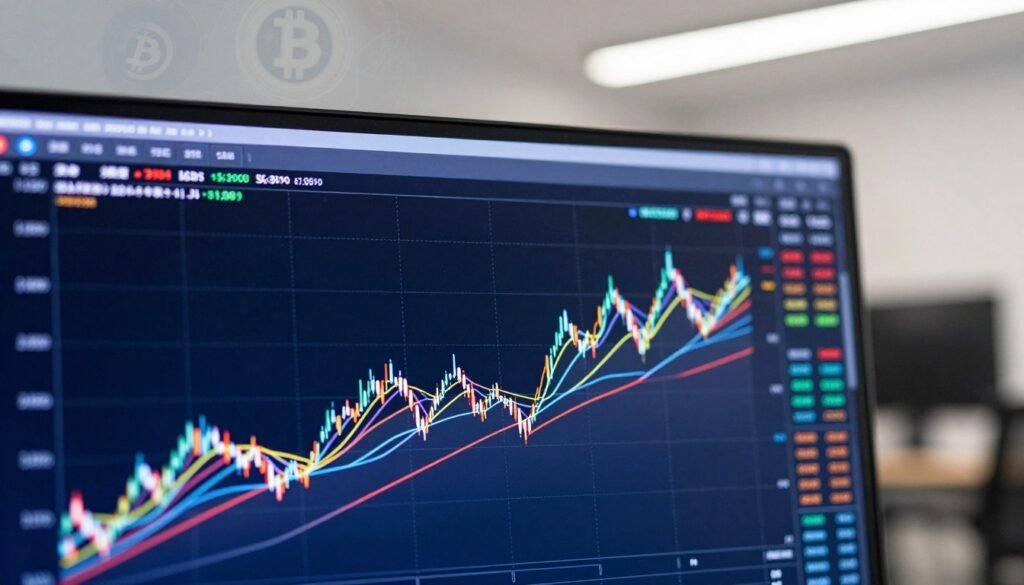
By averaging recent closing prices, the indicator smooths erratic swings and highlights the underlying path. This makes charts easier to read and gives clear context for short- and long-term analysis.
Understanding periods and timeframes
A period equals one candle on a chart — for example, 1-minute, 15-minute, 4-hour, or daily. The same period count covers different real-world time depending on the timeframe.
Example: a 20-period line on a 15-minute chart uses the last 20 fifteen-minute closes. On a daily chart, the same 20 periods reflect 20 days of data.
The core SMA formula using closing prices
An SMA sums recent close values and divides by the number of periods. This rolling calculation updates as new closes arrive and the oldest value drops off — that is why the line “moves.”
- Definition: a rolling average of price over a set number of periods, shown as a line on the chart.
- Simple math: (50 + 45 + 60) / 3 = 51.66 — that is an SMA for three closes.
- Trading note: choosing the right periods and timeframe helps avoid mistaking short-term noise for a trend.
For more detail on how traders apply this concept, see this practical guide and a deeper chart analysis overview.
Types of moving averages traders use in crypto technical analysis
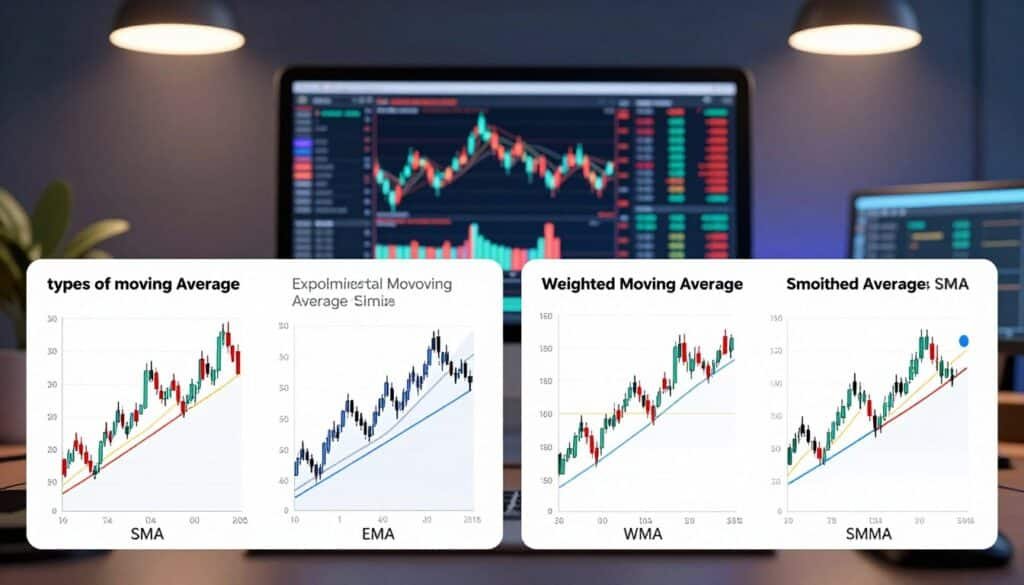
Different average types change how quickly a line reacts to new price action and help traders match tools to style.
Simple moving average as a long-term trend filter
SMA is the plain arithmetic mean of recent closes. It is the smoothest line and suits higher timeframes. Traders often watch 100 and 200 periods: price above a 200 SMA can signal broader strength.
Exponential moving average for faster signals
EMA weights recent price more using a multiplier (2/(periods+1)). That makes the line react faster and helps short-term traders catch moves sooner with fewer delays.
Weighted moving average for balanced responsiveness
WMA applies linearly increasing weights to recent bars. It sits between SMA and EMA for sensitivity, giving quicker feedback without the full volatility of an EMA.
Volume weighted moving average to spot volume-driven breakouts
VWMA factors traded volume so the line shifts toward high-volume price during spikes. That helps identify breakouts that are backed by participation rather than thin moves.
- Practical choice: prefer SMA to reduce false signals on long-term charts.
- Speed-first: use EMA if you need fast reaction for short setups.
- Balanced: choose WMA for midground responsiveness.
- Volume focus: use VWMA when confirmation from participation matters.
Note: the best type depends on your timeframe, strategy, and tolerance for lag versus whipsaw. For deeper setup ideas, see this practical guide.
Best moving average settings for crypto trading by timeframe and goal
Select period settings based on your holding horizon and how quickly you need signals. Start by deciding if you want speed or smooth context. That choice guides timeframe and line type.

Common period benchmarks and what they mean
Short-term: 9 or 20 periods offer fast feedback for quick entries and exits.
Medium-term: 50 periods show swing rhythm and help filter small reversals.
Long-term: 100 and 200 periods reveal broader trend and long-term trend context on daily charts.
Match settings to style and holding time
Scalpers favor 9/20 and reactive types like EMA or WMA to catch brief momentum. Swing traders anchor to 20/50 and mix SMA and EMA. Investors track 100/200 SMA for steady long-term trend signals.
Why higher timeframes and longer periods matter
Longer lengths smooth noise but lag more. Shorter lengths trigger more signals but raise false positives. Higher timeframe charts give stronger signals because each candle holds more price data and fewer random swings occur.
- Method: define holding time, pick timeframe, choose MA type and periods to match lag tolerance.
- Benchmark note: these are starting points—test on your preferred pairs and market conditions.
How to add moving averages to your crypto chart and read the signals
A layered set of averages on one chart makes it easy to read short-, mid-, and long-term market bias.
Step-by-step: open your chart, choose Indicators, pick an MA type (SMA, EMA, VWMA) and set the length or period. Confirm and repeat the indicator to add multiple lines.
Plot a clear short‑mid‑long view
Add a fast line (example: 9), a mid line (50) and a slow line (200). That trio gives quick context for short, swing, and long trends on the same chart.
- Price above a key line = bullish context; below = bearish context.
- Flattening lines suggest indecision or range-bound action.
- Wide spacing between price and lines shows momentum or possible over-extension and hints at mean reversion setups.
Practical tips: color-code and name each MA (e.g., 9 EMA – green). Confirm a lower-timeframe signal against 4H or daily charts before you act. Pair these lines with volume and other indicators for cleaner analysis.
Moving Averages in Cryptocurrency Trading strategies for entries and exits
Use the average as a zone rather than a single trigger. Many traders watch slope, price structure, and volume before entering so they avoid noisy cross signals.
Trend confirmation with rising and falling lines
Enter with bias when the line tilts up and price makes higher highs. A falling line and lower lows favor shorts.
Support and resistance using dynamic zones
Key lines act as live support resistance levels. Traders look for clean bounces, holds, or decisive breaks near widely watched periods like the 100 or 200.
Golden cross and death cross for major trend shifts
Golden cross: the 50 crossing above the 200 marks a bullish regime. Bitcoin’s April 2020 golden cross preceded a rally from about $7,000 to roughly $64,000 within a year.
Death cross: the opposite crossover confirmed the March 2018 bear move from ~ $9,000 to under $4,000. These events signal major trend shifts and attract long-term attention.
Crossovers for buy/sell timing
Faster pairs (9/21, 20/50) help time entries but need extra confirmation to avoid false alarms. Use a higher timeframe or volume read before acting.
Mean reversion and volume confirmation
When price stretches far from the average, expect a reversion. Watch for slowing momentum and declining volume before fading extremes.
Conversely, high volume during a break or reclaim of a key line improves confidence the move is real.
- Practical rule: align any setup with the broader trend and set a clear invalidation point.
- Extra reading: see a detailed chart analysis overview at how to analyze crypto charts.
Reducing false signals, whipsaws, and lag in sideways crypto markets
In sideways action, rapid back-and-forth candles create the false alarms that traders call whipsaws.
How whipsaws form on low timeframes and short periods
Whipsaws appear when price repeatedly crosses a short moving average on small timeframes. That creates frequent false crossovers and fake support or resistance.
Short period lines hug price tightly, so they get “flirted with” during ranges. That raises the number of low-quality signals and costs time and capital.
Multi-timeframe checks to validate a crossover or break
Before acting, confirm the direction on a higher timeframe such as 4H or daily. Check that the line has a clear slope and is not flat.
Require a clean close beyond the line and alignment with the larger trend. This reduces lag-related mistakes and improves signal quality.
When to combine with MACD or Bollinger Bands
Pair the moving average with MACD for momentum confirmation and with Bollinger Bands to spot volatility and over-extension.
If MACD shows rising momentum and price breaks a band with volume, the signal is stronger. If indicators disagree, treat the setup as higher risk.
- Quick checklist: higher-timeframe confirmation, sloping line, clean close, supporting MACD or band read.
- Practical rule: prioritize confirmation over trying to catch exact tops or bottoms.
Risk management when you use moving averages to trade crypto
Risk control keeps a good setup from turning into a portfolio disaster. Use the lines on your chart as guides, not guarantees. Stops, targets, and size rules let you trade without risking the account.
Placing stop-loss and take-profit around dynamic support and resistance
Place stops beyond a reclaimed zone for longs or above a rejected zone for shorts. Prefer stops that sit outside normal noise, not right on the line.
Take-profit options include scaling out as price extends away from the line, or exiting when price closes back through a key zone.
Position sizing and limiting downside during fast moves
Design your stop so a full loss equals roughly 1%–2% of portfolio value. Use that loss amount to size positions. Smaller sizes survive volatile spikes.
Avoid heavy leverage and plan for slippage. Fast gaps can invalidate clean levels, so keep capital per trade modest.
- Translate analysis to rules: never treat signals as certain—define entry, stop, and target before you trade.
- Stop logic: for longs, stop below a held zone; for shorts, stop above a rejected zone.
- Take-profit: partial exits into strength or full exit on a confirmed close through the zone.
- Sizing: set position so a stop hit costs ~1%–2% of your account.
- Fast-move caution: expect slippage and limit leverage to survive spikes.
Conclusion
Use a simple protocol: choose periods, check higher timeframes, then act with defined risk. This approach turns chart data into a clear trend road map and reduces noise when price swings.
Key tradeoff: a moving average helps confirm momentum and shows dynamic support or resistance, but it lags and can mislead in choppy conditions. Better outcomes come from confirmation, not prediction.
SMA and the simple moving average often anchor long-term context, while exponential moving and exponential moving average settings suit faster decisions. Pick periods that match your time horizon and test them.
Action step: plot three averages, set entry/exit rules, then stress-test the rules across market conditions before you scale size.
FAQ
What are moving averages and how are they calculated?
A moving average is a line that smooths price action by averaging a series of closing prices over a chosen period. The simple method sums the closing prices for the period and divides by the number of periods. Exponential and weighted variants give more weight to recent prices to react faster to new data.
Why do these indicators matter in volatile crypto markets?
They reduce chart noise and reveal the prevailing trend, helping traders avoid false moves caused by erratic candles. In fast markets, they act as a dynamic reference for trend direction, momentum and potential support or resistance zones.
What can these averages not do?
They lag price because they rely on historical data, so they cannot predict sudden news-driven reversals. They also produce false crossovers in sideways markets and should not be used alone without confirmation from price action or other tools.
How do I choose periods and timeframes for crypto charts?
Match the period to your style: short periods (e.g., 9 or 20) suit scalping and intraday signals; mid-periods like 50 are common for swing trading; long periods such as 100 or 200 filter long-term trends. Always compare the average on higher timeframes to avoid trading against the dominant trend.
Which types of averages do traders use and when?
Simple averages (SMA) are stable trend filters for longer horizons. Exponential (EMA) reacts faster, favored by short-term traders. Weighted (WMA) balances reactivity and smoothing. Volume-weighted (VWMA) incorporates volume to highlight price moves backed by trading activity.
How many lines should I plot on a chart for context?
A common approach uses three lines: a short-term, a mid-term, and a long-term period (for example 9, 50, 200). That gives context for immediate momentum, trend shifts, and the broader market bias without overcrowding the chart.
What trading signals do moving averages provide?
Key signals include crossovers (short crossing above long = bullish, below = bearish), slope changes (rising averages confirm uptrends), and price bounces off an average acting as dynamic support or resistance. Golden cross and death cross describe major long-term crossovers.
How can I reduce false signals and whipsaws?
Use multi-timeframe confirmation, require volume or momentum confirmation (like MACD), widen periods on low timeframes, and avoid trading crossovers alone. Filtering signals with trend direction on a higher timeframe reduces whipsaws.
How do volume-based averages help spot breakouts?
VWMA weights price by traded volume, so when price crosses a volume-weighted line it suggests the move has participation. Breakouts with rising VWMA support tend to be more reliable than those on low volume.
How should I place stops and manage risk using moving averages?
Place stop-losses beyond the average when it serves as dynamic support/resistance, and size positions so a stop loss equals an acceptable percentage of account risk. Use longer-period lines for wider, trend-based stops and shorter lines for tighter intraday management.
When are golden cross and death cross signals reliable?
They are more reliable on daily or higher timeframes and when supported by improving volume and macro trend context. On intraday charts they produce many false signals due to noise.
Can I use these indicators for mean reversion strategies?
Yes. When price stretches far from a long-term average, traders may trade pullbacks toward that line. Combine with volatility measures and clear reversal signals to avoid catching a trending move.
Should I combine these averages with other indicators?
Yes. Combining with momentum tools like MACD, RSI, or volatility bands improves signal quality. Volume indicators and support/resistance levels also add confirmation before taking a trade.
How do I choose between SMA, EMA, WMA, and VWMA for my strategy?
Choose EMA or WMA for responsiveness if you need faster signals; pick SMA when you want a smoother, less reactive trend filter. Use VWMA when volume participation is a core part of your edge. Test selections against your timeframe and instrument.
What are practical period benchmarks traders commonly use?
Common benchmarks include 9, 20, 50, 100, and 200. These serve as short-, medium-, and long-term references and are widely recognized by the trading community, which can make their support/resistance zones self-reinforcing.

No comments yet