
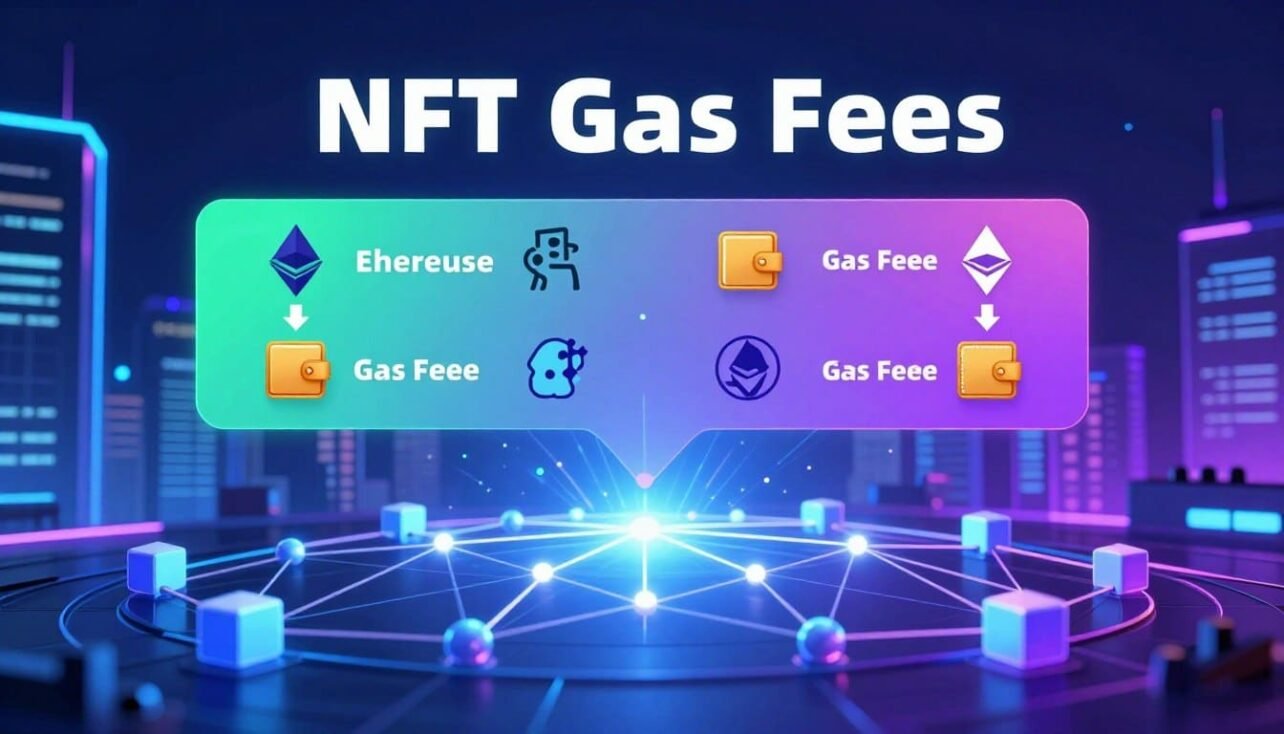
Gas fees are the payments needed to process transactions and run smart contracts on Ethereum and similar chains. They reward validators and help keep the network secure. When demand rises, prices often jump fast.
This beginner’s guide will show what gas is, why gas fees exist, and why actions with tokens can be costly. Expect clear examples like the 21,000 unit rate used for simple transfers and a major case study of Yuga Labs’ Otherside mint.
We’ll explain how fees work, what makes prices spike, and smart ways to cut costs without breaking a transaction. This is not a marketplace surcharge — it’s a network-level mechanism tied to blockchain processing and security.
Focus is on NFTs on Ethereum and comparable networks, plus Layer 2 and alternative platforms. By the end, buyers, sellers, creators, and developers will have the knowledge to plan budgets, avoid failed transactions, and make smarter market moves.
What NFT Gas Fees Are in Plain English
Think of gas as the computing work the blockchain must do when you mint, buy, or transfer an item. Gas represents the power needed to run those steps, and gas fees are the small ETH payments users send to cover that work.

The computing power behind every action
Every on-chain operation uses processing cycles. Simple transfers use less work. Complex smart contracts use far more. That means a single mint can cost more than a basic move.
Why fees feel like surge pricing
When many people try to act at once, blocks fill up. Think of it as rush-hour pricing: higher demand pushes prices up and makes some transactions costly or slower.
Who gets paid and why it matters
Today validators receive the ETH from gas fees under Proof of Stake. This payment incentivizes honest validation and strengthens network security. It also raises the cost of attacking the chain.
- Network fees pay for processing, not marketplace commissions.
- Higher fees reflect limited block space at peak demand.
- Major drops or mints can spike congestion and raise prices across many transactions.
| Action | Typical Gas Use | Why It Varies |
|---|---|---|
| Simple transfer | Low | Minimal computation and storage |
| Marketplace purchase | Medium | Contract checks, approvals |
| Mint / complex contract | High | Multiple function calls and data writes |
Quick tip: Learn strategies to reduce network costs and options to buy without gas costs. Later sections will show why smart contracts need more work than simple transfers.
Why NFT Transactions Require Gas (and Why It’s Not Just a “Marketplace Fee”)
Blockchain networks attach a small monetary cost to each on-chain action to keep bad actors from flooding the system.
Anti-spam and fair access: Charging gas forces a real expense for every request. That simple rule reduces spam and keeps the ledger usable for legitimate users.
What you’re actually paying for
Those payments cover distributed processing and data storage across many nodes. You are not paying a single company; you fund the work the network does to record and secure a transaction.
How prioritization works
When demand rises, validators favor higher-fee submissions. Offering more makes your transaction move up the queue and confirm sooner.
- Marketplaces can waive platform charges but cannot remove on-chain fees for approvals or transfers.
- Older texts mention miners; today validators order and confirm work under Proof of Stake.
- If you bid too low, your transaction may stall or fail, wasting time and possible extra costs.
| Reason | How it helps | Operational effect |
|---|---|---|
| Anti-spam | Deters mass abuse | Cleaner network for users |
| Distributed processing | Pays node work and storage | Durable, decentralized records |
| Prioritization | Markets limited block space | Faster confirms for higher offers |
NFT Gas Fees Explained: The Mechanics Behind the Cost
The cost you see is the result of two measurable parts: how much work your request needs and how much you bid for priority.

Gas units: what you’re buying
Gas units are simply units of work the network measures for each step of a transaction. Simple transfers use few units; smart contract actions for an nft mint use many more.
Gas limit: the safety cap
The gas limit sets the maximum work your transaction can consume. Set it too low and the call can fail but still consume some units. Wallets often set a safe limit automatically.
Gas price: bidding in gwei
The gas price is what you offer per unit, measured in gwei. Prices rise with demand during drops or congestion. Higher bids speed confirmation; lower bids may delay it.
The core formula and a beginner example
Gas Fee = Gas Limit × Gas Price. For a basic transfer the network often uses 21,000 units. At 50 gwei that equals 21,000 × 50 gwei = 0.00105 ETH.
Wallets and tracking tools estimate these amounts so you can trade off speed versus cost. This market-driven price reflects real demand for block space at the time.
What Makes Gas Fees Spike When Minting, Buying, or Selling NFTs
A crowded ledger during popular launches forces users to outbid each other for confirmation. That competition raises the cost per unit of work on the network, so identical actions can cost much more during a drop.
Network congestion during drops, mints, and major on-chain events
When many people try the same action at once, blocks fill quickly. Validators process the highest bids first, so users raise their offers to get in faster.
Transaction complexity: why smart contracts cost more than simple transfers
Simple token transfers use little processing. By contrast, smart contracts run multiple checks and write data, which increases computation and the gas used.
Common minting functions, marketplace buys, and approvals often trigger extra steps. Each added call increases overall complexity and pushes the cost up for that transaction.
Time sensitivity: paying extra to speed up confirmation
If a mint might sell out, buyers intentionally pay higher offers for faster inclusion. That desire for speed raises market competition and the final prices during peak moments.

| Cause | Effect on Cost | Typical Scenario |
|---|---|---|
| High demand / congestion | Costs multiply vs. off-peak | Popular drops and auctions |
| Smart contract complexity | Higher gas per transaction | Mint functions, approvals, batch mints |
| Time-sensitive bidding | Users overpay for speed | Sell-outs and limited releases |
Real-world impact: Spikes are common on mainnet and can affect budgets for creators and buyers. Learn how to plan and when possible try to mint without extra network costs.
Where Gas Fees Show Up Across the NFT Lifecycle
Across an NFT’s life, certain actions always trigger on-chain costs you should expect. Knowing which steps write to the ledger helps plan budgets and avoid surprises.
Minting
Minting creates the token via a smart contract. That contract can run many functions and write data, so minting often uses more gas than a simple transfer.
Listing and selling
Many marketplaces require an approval transaction that permits their contract to move your asset. That approval is a separate transaction with its own fee.
Buying and transferring
Buying on-chain and transferring ownership both create transactions that validators process. Off-chain listings or metadata updates usually don’t incur network charges.
Common extra steps that add cost
- Approvals: A permissioning call before a sale.
- Batch actions: Multiple mints or transfers in one go increase processing work.
- Multiple contract calls: Each call adds computation and raises total cost.
Practical tip: Always review your wallet confirmation to see which contract and action you approve before you pay a fee.
Real-World Costs and a Notable NFT Gas Fee Case Study
Timing and demand shape the true out-of-pocket cost when you interact on-chain. Typical ETH transfers today can be roughly $1–$5 in low-traffic windows, near $10 in normal conditions, and may exceed $50 during busy periods.
Transactions that call smart contracts usually cost more than basic transfers. More function calls and data writes mean higher gas use and higher final fees. Competition for block space also pushes price bids up during drops.
Otherside case study: scale and extremes
During the Yuga Labs Otherside mint, collectors reportedly spent over $150M in total gas. Some single mints hit ~2.6 ETH, roughly $7K at the referenced ETH price.
Lessons and practical insights
- When demand spikes, single transactions can become extreme due to bidding wars.
- Plan timing: off-peak launches lower the amount users pay and help participation.
- Consider Layer 2s, efficient contracts, and clear UX to reduce buyer friction and overall costs.
| Scenario | Typical Cost | Why |
|---|---|---|
| Low traffic transfer | $1–$5 | Low demand, simple computation |
| Normal mint or sale | ~$10 | Moderate demand, contract calls |
| Peak drop (extreme) | $50+ (single tx can reach thousands) | Bidding competition, complex contract logic |
Bottom line: Cost volatility is a core mainnet feature and can change launch outcomes. Use these insights to shape timing, technical design, and buyer expectations.
How to Reduce NFT Gas Fees Without Breaking Your Transaction
Smart timing and small technical choices can cut on‑chain costs without risking a failed transfer.
Timing matters: Try off-peak hours and weekends when network demand often falls. Lower demand usually brings lower gas fees, but real‑time load can still vary. Check a live tracker before you send a transaction.
Use real-time tools before you act
Rely on gas fee calculators and trackers to estimate costs and expected confirmation times. These tools help you pick a price that balances cost and speed.
Choose wallet gas settings wisely
Lowering your gas setting can save money, but setting it too low risks a stalled or failed transaction. Aim for a middle option that keeps the process reliable while trimming costs.
Batch actions: pros and cons
Batch minting or grouped transfers can smooth total costs when a contract supports it. But batching adds complexity and may delay finalization if the contract processes each item sequentially.
- Off-peak hours: try late nights or weekends for lower demand.
- Tools: check live trackers and calculators before committing.
- Balance: don’t underbid so much that a transaction stalls.
- Batching: can reduce per-item cost but adds timing and UX trade-offs.
| Strategy | When to Use | Trade-off |
|---|---|---|
| Off-peak timing | Low network load, weekends | Lower costs, less urgency |
| Real-time tools | Before any transaction | Better estimates, small delay to check |
| Moderate gas setting | Standard buys or mints | Reliable confirms, moderate cost |
| Batch minting | When contract supports batching | Lower per-item fee, increased complexity |
Tip: Match your approach to your needs: choose speed when urgency matters and cost savings when you can wait. For more on planning mint budgets, see minting and cost insights.
Layer 2 and Scaling Options to Lower NFT Transaction Costs
Layer 2 rollups move many actions off Ethereum and then settle bundles back on mainnet. That design trims per-action processing and cuts the gas and gas fees buyers face for common NFT moves.
How these solutions work in simple terms
Layer 2 platforms process transactions off the main chain and publish compressed proofs later. Batching reduces work per transaction, which lowers costs for minting, buying, and transfers.
Today’s popular options
Optimism and Arbitrum are widely used rollups. They offer cheaper execution for many nft actions while keeping compatibility with Ethereum tooling and wallets.
What to watch for
Bridging assets can add steps and small residual fees. UX friction, wallet support, and delayed withdrawals affect total cost and time.
| Consideration | Effect | What to check |
|---|---|---|
| Bridging | Extra steps & small fees | Bridge reputation and delays |
| Platform support | Where you can mint or list | Marketplace compatibility |
| Security | Trust and custody risks | Use known bridges and wallets |
Mental checklist: total costs, UX friction, platform support, and how often you’ll transact. For developers, pick a layer that matches your tools and target platforms to launch smoothly.
Alternatives to Ethereum for Lower-Fee NFTs
As transaction prices climb, people look for platforms that cut repeated on-chain costs without sacrificing speed.
Solana: low cost, high speed
Solana uses a parallelized architecture to process many transactions fast. That design keeps per-transaction gas and fees very low, which helps collectors who move tokens often.
Polygon: familiar, cheaper Ethereum layer
Polygon is Ethereum-compatible, so developers and users can reuse tools and wallets. It offers lower costs and faster confirms while keeping a similar developer workflow.
Avalanche: throughput and customization
Avalanche emphasizes high throughput and low latency. Its customizable subnets let teams tune performance, making it a good solution for specialized token markets.
Trade-offs: ecosystem maturity, marketplace support, wallet compatibility, and security practices vary across networks. Compare total costs — including bridging and onboarding — not just the raw per-transaction price.
| Platform | Strength | Consideration |
|---|---|---|
| Solana | Very low cost, fast | Different tooling, growing marketplaces |
| Polygon | Ethereum‑compatible, cheaper | Depends on bridge steps |
| Avalanche | High throughput, customizable | Developer setup varies by subnet |
Conclusion
Understanding what powers a transaction helps you predict costs and avoid surprises.
Gas is the computing power that measures work on the blockchain. The final fee equals work × price, and network demand drives the market price.
Key takeaway: fees are dynamic. Smart contracts and complex contract calls use more processing and raise the total cost for an nft mint, buy, or transfer.
Quick checklist: use trusted tools to estimate fees, double-check approvals before you confirm a contract, and favor reputable wallets for security.
Remember trends: Layer 2 rollups and alternative chains aim to lower costs and improve experience. In the U.S., transactions may have tax implications, so keep records.
With timing, the right tools, and basic precautions, users can reduce friction and transact with more confidence.
FAQ
What are NFT gas charges in plain English?
These are the payments users make to compensate validators or sequencers for the computing work needed to record a token action on a blockchain. The cost covers execution, storage, and network security rather than a marketplace commission. Think of it like a toll for using decentralized processing power.
How is “gas” different from the fees I pay?
The term refers to two linked ideas: the units of computation a transaction consumes and the monetary amount you pay for those units. You choose a maximum units amount (the work limit) and a per-unit price; multiplying them yields the final payment that miners or validators receive.
Why do prices spike during busy moments?
When the network sees lots of activity—mint drops, popular marketplace listings, or major contract calls—demand for block space rises. Users bid higher per-unit prices to get prioritized. That supply-and-demand bidding is why costs can resemble surge pricing.
Who receives the payments and why are they important?
On proof-of-stake chains, validators (or sequencers on Layer 2s) collect the payments. These rewards fund node operation and secure the network by making attacks costly, which keeps the ledger honest and transactions reliable.
Why do token transfers and smart contract actions both cost money?
Every on-chain change requires nodes to run code and store or update data. Simple transfers use less computation than complex smart contract interactions, so they cost less; more logic means more work and a higher bill.
How do fees prevent spam and misuse?
Charging for computation forces senders to internalize the cost of every operation. Attackers would need to fund massive numbers of transactions, making large-scale spam economically unviable and protecting network health.
What are gas units and what do I buy when I submit a transaction?
Gas units measure the computation your transaction requires. When you submit, you’re buying the ability for nodes to run that work up to a set limit. If your transaction needs more units than you allowed, it fails but still consumes the paid portion.
What is a gas limit and why does it matter?
The limit is the maximum work you authorize the network to perform for your transaction. Set it too low and the transaction will run out of budget and revert. Set it higher than needed and unused units are refunded, but you risk overestimating unnecessarily.
How does the per-unit price change with demand?
The per-unit price—often expressed in gwei on Ethereum—floats with congestion. During high demand, users raise bids to get included sooner. Tools and wallets often suggest a price based on recent blocks to help you choose.
What’s the simple formula to compute the total charge?
Total cost equals the units limit multiplied by the per-unit price. Wallets usually show an estimate in ETH or another native token before you confirm, so you see the expected cost up front.
Can you show a basic example for a beginner?
A common baseline for a simple transfer uses about 21,000 units. If the per-unit price is 50 gwei, multiplying gives the unit cost and that converts to native currency (ETH) at current rates. Wallets calculate the conversion automatically for you.
Why do minting events often lead to extreme spikes?
Drops and mints concentrate many users on a single contract at once. Each wallet competes to get included in early blocks, driving unit prices way up and sometimes producing single transactions that cost hundreds or thousands of dollars.
How does transaction complexity affect the cost?
Interacting with multi-step contracts, calling metadata storage, or executing on-chain logic demands more computation and storage. Those actions consume more units than a simple transfer and therefore raise the total payout.
When should I consider paying more to speed confirmation?
If timing matters—during a limited-drop sale or to beat a competing bidder—increasing the per-unit price raises priority. For non-urgent actions, waiting for lower network load can save money.
Where in the token lifecycle do charges appear?
Costs appear when you mint a token, when you approve contracts for marketplaces, when you list or sell through on-chain workflows, and when you transfer ownership. Some wallet or marketplace off-chain steps avoid charges, but on-chain confirmations always cost.
What extra actions commonly add to the total cost?
Approvals, batch operations, and custom contract calls often add steps that each consume units. Approving a contract once can be expensive; doing repeated approvals multiplies the expense, so batching or single approvals can help.
What are typical cost ranges in today’s market?
Costs vary widely. During low traffic, simple transfers can be inexpensive; during heavy times, even basic operations can jump significantly. Market trackers and historical charts show ranges so you can set expectations before acting.
Can you summarize a real case where costs soared?
Large public launches have produced massive spending across many wallets, with reports of total network spending in the millions during a single mint. Those events illustrate how peak demand concentrates activity and drives prices up sharply.
How can I reduce charges without risking my transaction?
Use off-peak hours, rely on live fee trackers, and choose conservative per-unit bids. Batch actions when appropriate, and avoid unnecessary approvals. Wallets like MetaMask and services with gas estimators help balance cost and speed.
Do calculators and trackers really help?
Yes. Real-time tools show current bid levels and estimated confirmation times. They let you choose economical bids and avoid overpaying when the network is calm.
What trade-offs come with batch minting?
Batch mints can lower average cost per token by grouping operations, but they increase complexity and may fail if one item in the batch errors. Timing and contract design affect the effectiveness of batching.
How do Layer 2 solutions lower transaction costs?
Layer 2s process collections of transactions off the main chain and post summaries back to the mainnet. That reduces per-transaction computation and spreads base-chain costs across many users, lowering individual spending.
Which Layer 2 networks are common today?
Networks such as Optimism and Arbitrum have broad adoption for cheaper execution. They keep Ethereum compatibility while delivering lower per-transaction costs and faster finality for users and developers.
What should I watch for when using Layer 2s?
Consider bridging time and fees, wallet support, and how marketplaces handle cross-chain listings. Some residual costs remain, and user experience varies between platforms.
What are alternative chains for lower transaction charges?
Other chains like Solana, Polygon, and Avalanche offer lower per-transaction costs through different consensus designs and scaling choices. Each has trade-offs in decentralization, tooling, and ecosystem support.
How do I choose the best chain or layer for my needs?
Balance cost, security, audience, and tooling. If you need low fees and high throughput, Solana or Polygon may suit you. If you want Ethereum compatibility with cheaper execution, consider Arbitrum or Optimism. Match the technical fit to your project goals.

No comments yet