
This short guide explains what creator payouts look like today and what creators in the United States must know to protect future sales. It defines how on-chain rules and marketplace policy work together, and it previews the practical steps you will learn.
Expect clear, actionable advice: you will see how to pick a royalty percentage, choose the right contract standard when minting, select marketplaces, and monitor payments over time. The guide notes that “automatic” payouts depend on smart contract setup and each platform’s enforcement.
This matters now because creator payouts remain a core promise of web3, yet enforcement has shifted on some major platforms. The section sets up outcomes: understand primary vs. secondary sales, how fees are calculated on sale, and steps to reduce the risk of bypassed payouts.
For a deeper walkthrough and examples using OpenSea, MagicEden, LooksRare, and MetaShield, follow the full guide.
What NFT royalties are and why they matter for creators</h2>
When a tokenized asset resells, a small cut can flow back to the original creator automatically. This system defines nft royalties as creator payouts that trigger on secondary sales, not just at mint.

Roles are simple: the creator mints and sets the fee, the collector buys or resells, and the marketplace facilitates the trade. Marketplaces may also charge separate platform fees and gas, which are distinct from a creator’s royalty.
Because a portion of each resale is routed to the original creator, a single work can produce ongoing returns if it stays active in the market. That recurring stream can reduce reliance on intermediaries and extend a creator’s financial runway.
Provenance and value
On-chain provenance makes ownership and origin visible. Collectors use that trace to verify authenticity, which can boost perceived value and lower forgery risk.
- Definition: creator payout on secondary sales.
- Control: creators must embed terms before minting.
- Distinction: different from marketplace fees and gas.
How NFT royalties work on the blockchain</h2>
Blockchain records and contract code combine to make creator fee logic visible and auditable. A smart contract stores the fee percentage and the payout address. When a resale transaction occurs, the contract’s rule defines the split from the sale price.
Practical flow:
- Listing → buyer purchases → funds distribution.
- Marketplace processes the transaction and sends the creator payment when it honors the rule.
- On-chain events record transfers so creators can verify payments via explorers or dashboards.
Primary sale vs. secondary sale is simple. The first market sale usually pays the creator from mint proceeds. Royalties work on subsequent sales; that is when the smart contract often applies the preset fee.
Typical ranges sit near 5–10%. Some platforms batch payouts, while others post instant payments to dashboards. Note that a contract alone does not force every marketplace to pay unless the platform enforces the rule.

| Item | Where set | Typical range | Payout timing |
|---|---|---|---|
| Creator fee | Smart contract | 5–10% | Instant or batched |
| Tracking | On-chain explorer | n/a | Real-time visibility |
| Enforcement | Marketplace policy | Varies | Depends on platform |
NFT Royalties: How Artists Earn Passive Income with the right royalty percentage</h2>
Setting a fair royalty percentage balances funding your work and keeping resales active.
Decision framework: pick a rate that supports creator revenue without deterring trades. Start by comparing similar collections in your market. Consider category: fine art may sustain 7–10%, while memberships or gaming assets often use 2.5–5% to favor liquidity.
Common benchmarks and why they matter
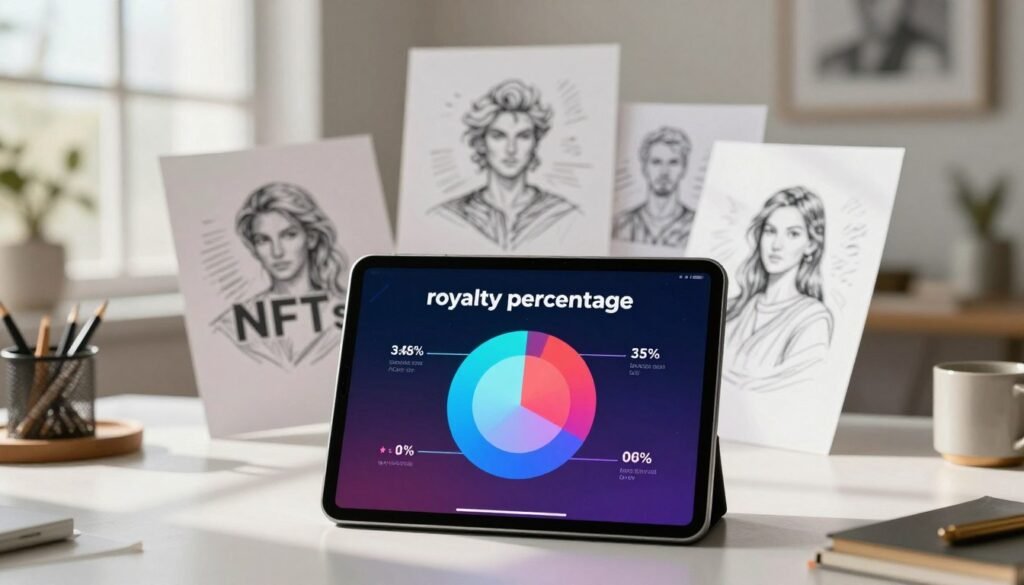
Most projects land near 5–10%, and many use a wider 2.5%–10% range in practice. Lower rates can boost resale volume. Higher rates increase per-sale revenue but can slow trading.
Pricing, market dynamics, and buyer math
If platform fees and creator fees stack, the all-in price rises. That can reduce demand and pressure floor price.
- Match rates to comparable projects to avoid backlash.
- Use royalties with utilities—access, perks, or memberships—to show value.
- Track resale frequency: frequent trades can outpace a lower rate over time.
| Category | Common range | Primary trade-off |
|---|---|---|
| Fine art | 5–10% | Higher per-sale revenue, lower liquidity |
| Memberships / access | 2.5–7.5% | Encourages trading while funding benefits |
| Gaming assets | 2.5–5% | Prioritizes active market and usability |
Final note: choose a royalty percentage that aligns with your community and adds clear value. The rate shapes long-term revenue potential as much as resale frequency.
How to set up NFT royalties during minting</h2>
Plan the mint carefully. Decide the asset type first. That choice shapes resale behavior and buyer expectations.
Decide what you’re tokenizing
Pick visual art, music tracks, gated content, membership passes, or access to experiences. Each option affects demand for secondary trades and associated payments.
Consider bundling extras: exclusive downloads, event access, or layered digital assets to boost long-term value.
Select a smart contract standard
Choose ERC-721 for one-of-one pieces and ERC-1155 for editions or semi-fungible tokens. That choice influences marketplace compatibility and tooling.
Tip: test compatibility with the target platforms you expect collectors to use.
Embed creator fees and confirm payout flow
Set the fee percentage in the smart contract before any mint. If the contract lacks this, the fee may not exist for those tokens.
- Specify the creator fee recipient and wallet.
- Use a dedicated treasury wallet and document custody.
- Run a small test mint, list it, and simulate a resale to confirm payments move as expected.
| Step | Why it matters | Quick action |
|---|---|---|
| Asset choice | Shapes resale demand | Define utility and files |
| Standard | Controls compatibility | Pick ERC-721 or ERC-1155 |
| Payout test | Prevents misrouted payments | Run a low-stakes trial |
For a practical checklist and minting tips, see the minting checklist.
How to choose NFT marketplaces that honor royalties</h2>
Marketplace policy and technical flow determine if creator payments actually reach the payout address.
Marketplace enforcement means the platform reads a token’s fee settings and routes payments during each sale automatically. When a venue enforces fees, the payout follows the contract logic at listing and checkout.
Marketplace enforcement basics
Enforcement involves policy and code. Platforms must support the token standard and call the payout path during transfer.
If the platform lacks support or chooses not to enforce, the creator’s on-chain settings may not trigger a payment.
Where enforcement can break down
- Cross-listing across multiple marketplaces or an aggregator that ignores creator fees.
- Different blockchains or a bridge that strips fee metadata.
- Automated AMM-style venues that settle trades off the usual payout path.
Checklist for evaluating nft marketplaces:
| Criteria | Why it matters | What to check |
|---|---|---|
| Policy on creator fees | Defines enforcement | Read terms and recent announcements |
| Technical support | Ensures compatibility | Confirm standards (ERC, chain support) |
| Reporting dashboards | Shows payments | Test visibility after a sale |
Smart contracts give creators some control, but platform execution often decides real-world payments and future sales outcomes. Research current policies before launch, as platforms change rules often.
Next: if enforcement is optional in parts of the market, tracking tools and protective tooling become essential to monitor and recover expected payouts.
How to track, manage, and optimize royalty payments over time</h2>
Consistent tracking turns irregular resale activity into usable revenue insight for your collection.
Monitoring on-chain transactions and marketplace dashboards
Use on-chain explorers and platform dashboards to watch sale events in real time. Look at sale price, fee breakdown, and the recipient wallet on each transaction.
Tip: record the tx hash, date, and USD value at the time of receipt for clear records.
Planning for irregular cash flow
Resale frequency swings with market cycles and collector interest. That means royalty cash can be lumpy and unpredictable over time.
Separate primary sale proceeds from secondary payouts in your books so you see which part of revenue is recurring.
Operational best practices for US creators
Keep clean records of every sale, payout, and wallet transfer. Track dates, USD equivalents, and note the nft collection and item IDs for tax reporting.
Maintain a simple routine: weekly checks, reconcile monthly, and consult a tax adviser about reporting small, frequent transactions.
| Focus | What to record | Why it matters | Action |
|---|---|---|---|
| On-chain events | Tx hash, wallet, amount | Verifies payments | Export CSV monthly |
| Marketplace sales | Sale price, fees | Separates primary vs secondary | Screenshot receipts |
| Financials | USD value, date | Tax and accounting | Use accounting software |
Royalties in the current NFT market: optional fees, workarounds, and protection tools</h2>
B. Some venues now make creator fees optional to lure price-sensitive traders and increase volume.
Economic driver: marketplaces drop enforced fees because lower all-in price can boost trading and attract buyers. That competition reduces the cost of swap and can change resale dynamics.
Policy shifts and concrete examples
MagicEden introduced MetaShield to find listings that evade payouts and to take actions like blurring images, updating metadata, or flagging items. Shortly after, it made royalties optional and promoted fee waivers.
LooksRare added a checkout checkbox for royalty payment and reports distributing over $65 million while sharing fees with collection owners. These rapid changes show how platform choices move fast.
Technical vulnerability and creator responses
Even when a contract encodes a fee, collectors can route trades through venues or bridges that don’t honor it. That leaves the original creator without the expected cut.
Creators push back with updated terms, community pressure, and tools like MetaShield. Some advocate on-chain enforced creator fees to shift enforcement from platform policy to blockchain-level execution.
| Issue | Cause | Creator options |
|---|---|---|
| Optional fees | Platform competition on price | Policy advocacy, community rules |
| Evasion | Cross-market routing or bridges | Monitoring tools, flagging |
| Partial fixes | Marketplace toolsets (e.g., MetaShield) | Metadata updates, image blurring |
Conclusion</h2>
Smart contract terms define creator cuts at mint, yet platform execution decides if those cuts arrive.
Recap: a royalty rule is embedded during minting on the blockchain and is meant to route payments on secondary sales.
In practice, marketplaces and platforms vary in enforcement, so projected revenue is variable, not guaranteed.
Do this next: pick a fair royalty rate, mint with compatible smart contracts, list on venues that honor payouts, and track payments regularly.
Combine strong content, music, or community utility to boost trade and long-term returns for your collection.
Looking ahead, on-chain enforced creator fees for new EVM collections aim to reduce bypass risk and stabilize creator revenue models as the market evolves.
FAQ
What are creator payouts on secondary sales and why do they matter?
Creator payouts are automatic fees paid to the original maker whenever an item is resold. They matter because they provide ongoing revenue after the first sale, help reward creators for future value increases, and strengthen provenance so buyers can verify authenticity and origin on the blockchain.
How do smart contracts automate royalty payments?
Smart contracts contain the payment rules written into token code. When a resale occurs on a platform that honors those rules, the contract triggers a percentage to the creator’s wallet address. This removes manual billing, speeds payouts, and reduces disputes when marketplaces follow on-chain logic.
Do royalties apply to primary sales or only secondary sales?
Royalties normally apply to secondary sales only. The primary sale is the first transfer from creator to buyer and typically sends proceeds to the seller directly. Secondary market fees are the mechanism used to compensate the original creator after resale.
What percentage should creators choose for creator fees?
Common benchmarks fall between 5% and 10%, with many collections using a 2.5%–10% range. Choose a rate that balances fair long-term revenue with marketability; higher fees can deter resales while lower fees may undercut lifetime earnings.
How does a royalty rate affect the buyer’s total cost?
The royalty adds to the resale price buyers pay, raising the effective cost of ownership when items change hands. Some marketplaces display the fee separately; others roll it into the transaction. Creators should consider market sensitivity when setting fees to avoid pricing out potential buyers.
What steps do I follow to include creator fees when minting?
Decide what you’re tokenizing—art, music, content, memberships, or access. Pick a smart contract standard (ERC‑721 or ERC‑1155) that supports fees. Embed the creator fee into the contract before minting, confirm the payout wallet address, and run a test transaction to verify the flow.
Which smart contract standard should I use for creator payouts?
ERC‑721 is ideal for unique items, while ERC‑1155 suits semi-fungible drops and collections that mix editions. Both can support creator fees, but compatibility with marketplace tooling varies, so check platform support when choosing the standard.
How do I confirm my payout wallet and test royalties?
Set the creator wallet during contract deployment, then perform a small test mint and resale on a supported marketplace or testnet. Verify the payout appears on the recipient address and confirm the marketplace displays the fee information correctly.
Which marketplaces reliably honor creator fees?
Marketplaces that enforce on-chain standards or integrate creator-fee logic—such as OpenSea (with fee settings), Rarible, and other platforms that implement creator protocol—tend to honor payouts. Always review current policy pages because enforcement can change across services and chains.
Why do some platforms stop enforcing creator fees?
Some marketplaces prioritize lower buyer fees or different business models and may adopt off-chain sales flows that don’t trigger on‑chain payouts. Policy shifts, technical constraints, or community governance can also lead platforms to move away from mandatory fee enforcement.
How can creators track and manage incoming royalty payments?
Monitor on‑chain transactions via block explorers and marketplace dashboards. Use portfolio tools and accounting software to aggregate receipts. Keep clear records for tax reporting and reconcile marketplace statements with on‑chain deposits.
How should creators plan for irregular cash flow from royalties?
Expect variability based on resale frequency, collection momentum, and market cycles. Build cash reserves, diversify revenue streams (commissions, drops, memberships), and avoid relying solely on resale payouts for regular expenses.
What tax and accounting practices should US creators follow for royalty receipts?
Treat royalty receipts as taxable income. Maintain detailed records of sale dates, amounts, fees, and wallet addresses. Consult a US tax professional about reporting rules, capital gains implications for crypto proceeds, and deductible expenses.
How can collectors and sellers bypass creator fees and what risk does that pose?
Workarounds include off‑platform transfers, proxy listings, or bridges between chains that strip fee metadata. These practices reduce creator revenue and can undermine market trust. Creators should document provenance and educate their communities about supporting enforced fee models.
What responses do creators use when facing platforms that drop fee enforcement?
Creators update collection terms, rally community support, migrate projects to marketplaces that honor fees, or adopt tools that aim for on‑chain enforcement. Some projects add gated benefits, memberships, or legal notices to protect long‑term value.
What are on-chain enforced creator fees and why do they matter for new EVM collections?
On‑chain enforced fees embed payout rules directly in the token standard so compliant marketplaces must execute them. For new EVM collections, this approach increases reliability of payouts and reduces reliance on marketplace goodwill, helping creators secure lasting revenue streams.
Are there tools that help protect creator revenue across marketplaces?
Yes. Tools and services focus on provenance verification, fee enforcement, and community governance. Look for metadata integrity services and marketplace integrations designed to reduce fee bypasses and improve transparency for collectors and creators alike.

No comments yet