
The gaming landscape is undergoing a massive shift. A new model allows participants to gain tangible value from their time and skill. This approach merges entertainment with genuine economic opportunity.
Blockchain technology is the engine behind this change. It grants people true ownership of their in-game items, known as digital assets. Unlike traditional titles, these virtual worlds have sustainable economies built on player interaction.
Mainstream adoption is growing rapidly. Millions of active users now participate in these vibrant virtual economies worldwide. This guide will explore the mechanics of popular titles and strategies for maximizing returns.
We will cover everything from basic principles to advanced tactics. Whether you are new to this space or an experienced player, this resource offers valuable insights. The goal is to help you navigate this exciting frontier effectively.
Key Takeaways
- A new gaming model offers both entertainment and financial benefits.
- Blockchain technology enables true ownership of in-game items.
- Player-driven economies create sustainable earning potential.
- This guide provides a comprehensive overview for beginners and experts.
- Learn practical strategies to optimize your participation and rewards.
- Understand the key differences from traditional video game structures.
Introduction to the World of NFT Games
Unlike traditional models, this innovative approach centers on player-owned assets secured by distributed ledger technology. These interactive titles are fundamentally different because you truly own your in-game items.
These items are called non-fungible tokens. Each token is a unique digital certificate stored on the blockchain. This proves you are the sole owner of that specific asset.
The types of assets you can own are incredibly diverse. They range from characters and virtual land to vehicles, wearable items, and even pets. Your collection is entirely unique to you.
To start participating, you must own at least one of these digital assets. Some experiences offer free starter items to begin your journey. Others require an initial purchase to enter their world.
The cost of these items is not fixed. It depends on several key factors. Rarity, in-game utility, and the overall demand within the community all influence the price.
| Entry Model | Requirement | Best For | Potential Initial Cost |
|---|---|---|---|
| Free-to-Start | Use provided starter assets | Newcomers testing the concept | Zero |
| Purchase-to-Play | Buy an entry-level asset | Committed participants seeking deeper engagement | Variable (Low to High) |
| Scholarship/Guild | Borrow assets from a guild | Players seeking access without upfront investment | Typically a share of earnings |
This shift to user ownership is a monumental change in interactive entertainment. It empowers individuals with control over their digital possessions. This creates a new layer of strategy and potential value.
Understanding play to earn NFT games with real rewards
Digital worlds are now merging entertainment with tangible financial incentives for participants. This represents a fundamental shift in how people interact with virtual environments. Unlike traditional titles where purchases remain trapped within closed systems, these new experiences grant true ownership.
Players can actually generate income through their gameplay efforts and strategic decisions. The assets they acquire—characters, land, items—become their personal property. This ownership extends beyond the game’s boundaries into the real economy.
The sector has matured significantly by 2025, moving beyond experimental phases. Sustainable economies now reward skilled participants based on their performance and time investment. This creates genuine value rather than just temporary entertainment.
These experiences combine engaging mechanics with tokenized systems where people compete and prosper. The dual proposition of enjoyment and financial gain distinguishes this model from conventional approaches. For those interested in exploring the rise of crypto gaming, the opportunities continue to expand.
Strategic gameplay directly translates to measurable rewards in these virtual economies. This transformation empowers individuals with control over their digital possessions and potential earnings.
The Rise and Evolution of NFT Gaming
Initially celebrated as novel digital art, non-fungible tokens have rapidly found a powerful application in interactive entertainment. Their role has evolved far beyond the initial hype cycles focused on speculation.
The underlying technology matured, leading to more utility-driven ecosystems. One of the most compelling shifts occurred within the gaming industry.
Blockchain-based titles are no longer niche experiments. They have become fully developed, user-centric platforms. These virtual worlds offer a new paradigm for digital interaction.
Modern iterations provide genuine ownership of in-game assets. This is a fundamental change from traditional models. Players truly control their digital possessions.
Key features of these advanced platforms include:
- Interoperable assets that can function across multiple games and metaverses.
- Sophisticated digital economies powered by player activity and smart contracts.
- A global community of millions participating in these new virtual marketplaces.
This transformation empowers individuals, giving them control over their gaming experience and assets. The concept of digital ownership is now widely understood, driving mainstream attention. The evolution from simple collectibles to complex gaming components marks a significant chapter in technology’s history.
Benefits of True Ownership through NFT Assets
The concept of genuine asset ownership transforms the traditional gaming experience completely. Unlike conventional models where companies control all digital items, blockchain technology grants participants real authority over their acquisitions.

Control Over Digital Assets
Previously, gaming companies maintained ultimate control over all in-game items. Players could not truly claim ownership of their earned possessions. This limitation restricted creative expression and economic potential.
Now, participants enjoy complete freedom with their digital collections. They can use, modify, or dispose of assets according to personal preferences. This empowerment creates deeper engagement with virtual worlds.
Smooth Asset Transfer and Trading
Interoperability represents another significant advantage. Users can transfer items across different platforms seamlessly. This capability was impossible in traditional gaming ecosystems.
Blockchain technology enables quick peer-to-peer transactions without intermediaries. Participants can monetize their efforts through cryptocurrency or real currency exchanges. The system ensures secure, direct transfers between users.
This new paradigm eliminates unnecessary fees and third-party interference. It creates a transparent environment where value flows directly to content creators and active participants.
How Tokenization and Blockchain Revolutionize Gaming
The integration of cryptographic protocols into interactive entertainment creates unprecedented levels of transparency and user control. This technological foundation enables a complete reimagining of digital ownership and economic participation.
Blockchain Fundamentals
Blockchain technology establishes a trustless environment where every transaction becomes permanently recorded. This creates absolute clarity between developers and participants in any interactive experience.
The process of tokenization converts virtual items into unique digital certificates. Characters, equipment, and virtual properties transform into distinct tokens on the distributed ledger.
These digital assets reside securely in personal cryptocurrency wallets. This arrangement provides undeniable proof of ownership that extends beyond individual platforms.
Tokenized items gain utility across multiple virtual environments. Players can utilize their collections in different ecosystems, creating interconnected digital economies.
Decentralized exchanges facilitate direct peer-to-peer trading without intermediaries. This system empowers participants with complete control over their digital possessions and economic activities.
The immutable nature of blockchain records ensures permanent ownership history. Every transaction remains transparent and verifiable by all network participants.
Comparing Free-to-Play and Play-to-Earn Models
The choice between accessible entry and potential financial returns represents a critical decision for newcomers to blockchain-based entertainment. These two approaches cater to different user preferences and investment levels.
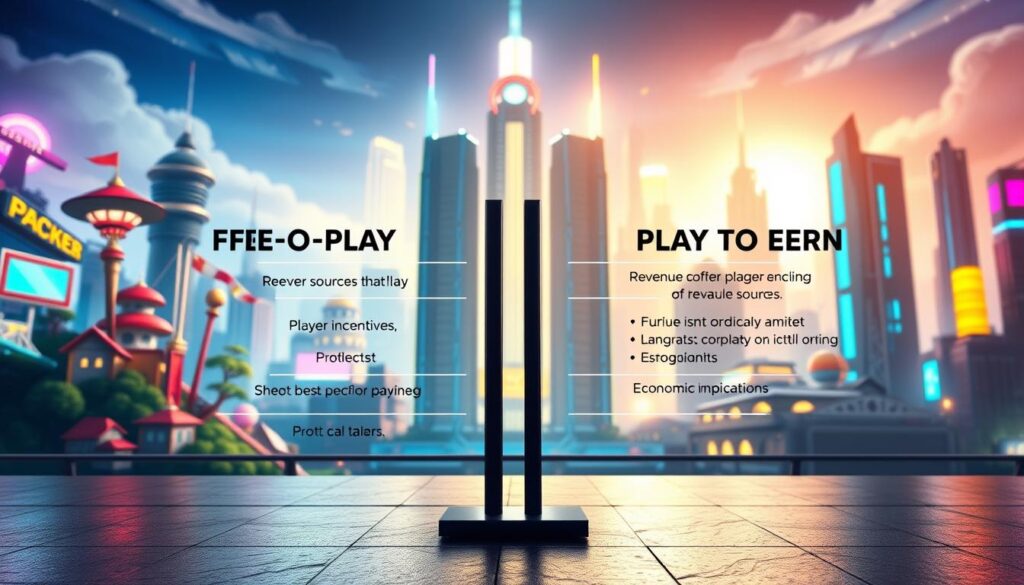
Key Differences in Reward Systems
Free-to-play titles offer immediate access without financial commitment. These experiences focus primarily on entertainment value rather than monetary gains.
In contrast, play-to-earn models provide cryptocurrency tokens as compensation for user participation. This creates a direct link between gameplay effort and financial returns.
The fundamental distinction lies in their economic objectives. One prioritizes accessibility while the other emphasizes earning potential through active engagement.
User Entry Requirements
Entry barriers vary significantly between these models. Free options require no initial investment, making them ideal for casual exploration.
Earning-focused experiences typically demand ownership of digital assets before participation. This upfront cost serves as an investment in the ecosystem.
Many platforms now offer hybrid approaches. These combine elements from both models to accommodate diverse user preferences and financial capabilities.
Earning Mechanisms: From Quests to Passive Income
Active participation and strategic asset management create numerous income opportunities in digital ecosystems. These platforms offer diverse pathways for dedicated users to generate value.
Active Gameplay Rewards
Engaging in various activities generates direct compensation for participants. Completing missions and overcoming challenges contributes to ecosystem growth.
Tournaments and competitive events offer higher compensation for skilled individuals. Victory in these contests often yields substantial returns. The revenue from in-game transactions funds these reward systems.
NFT Trading and Renting Strategies
Strategic asset acquisition and resale presents another income stream. Users purchase digital items at lower prices and enhance their value.
Improved assets can be sold for profit in marketplace environments. Renting valuable items to other users creates passive income opportunities.
This approach allows asset owners to earn without active participation. It provides access to premium items for budget-conscious participants.
Exploring the Best Play-to-Earn Crypto Games
Three prominent examples showcase different approaches to integrating digital ownership with engaging gameplay mechanics. Each platform offers unique economic models and participant experiences.
Featured Titles: Axie Infinity, The Sandbox, Illuvium
Axie Infinity stands as the benchmark title with over one million active participants. Its ecosystem revolves around collecting, breeding, and battling digital creatures.
Participants receive Smooth Love Potion through daily activities. Competitive gameplay yields Axie Infinity Shards for governance participation. The Ronin blockchain enables affordable transactions.
The Sandbox focuses on virtual property ownership through LAND assets. The SAND token facilitates governance, staking, and marketplace activities. Income comes from land value growth and rental opportunities.
Illuvium delivers premium open world exploration with creature collection mechanics. This role-playing experience rewards participants with ILV tokens for various activities. Built on Immutable X, it offers gas-free transactions.
| Platform | Primary Focus | Token System | Blockchain | Key Feature |
|---|---|---|---|---|
| Axie Infinity | Creature Battling | SLP & AXS | Ronin | Free Starter Assets |
| The Sandbox | Virtual Real Estate | SAND | Ethereum | LAND Development |
| Illuvium | Open World RPG | ILV | Immutable X | AAA Quality |
Blockchain Platforms Powering NFT Game Economies
The technical foundation supporting today’s most innovative gaming experiences consists of multiple blockchain solutions. Each platform offers distinct advantages for different types of interactive entertainment.
Ethereum, Polygon, and Beyond
Ethereum remains the most established platform for digital asset gaming. High transaction costs often require Layer 2 solutions for practical implementation.
Polygon provides a popular alternative with low fees and high throughput. This makes it ideal for titles requiring frequent player interactions.
Immutable X has emerged as the preferred choice for premium gaming experiences. It offers instant, gas-free trading through advanced rollup technology.
Solana excels in supporting real-time applications through high-speed processing. The Ronin blockchain demonstrates how specialized infrastructure optimizes user experiences.
Cross-chain compatibility has become increasingly important. Leading titles now support multiple networks to reach broader audiences.
The Role of Governance Tokens in Game Economies
At the heart of decentralized gaming ecosystems lies a powerful tool for community participation: governance tokens. These specialized digital assets give holders voting rights on important platform decisions.
Governance tokens embody the decentralized nature of blockchain-based entertainment. They distribute decision-making power among users rather than concentrating it with developers. This creates truly community-driven development.
Many platforms use a dual-token system. One token fuels the in-game economy while governance tokens provide voting authority. Holders can influence feature implementations, economic adjustments, and resource allocation.
Distribution methods vary by platform. Some award tokens based on investment levels or participation metrics. Others use staking mechanisms or achievement-based rewards.
This participation model creates deeper engagement for players. It fosters long-term commitment to the ecosystem’s success. Governance tokens represent tools for collaborative development rather than purely financial instruments.
In-Game Currencies and Asset Trading Explained
The financial infrastructure of modern gaming ecosystems centers around two key components: in-game currencies and dynamic marketplaces. These specialized tokens serve multiple functions within virtual worlds.
Digital currencies enable activities like character upgrades and item purchases. Their utility extends beyond the game environment through external exchanges.
Trading Strategies
Successful participants develop careful approaches to asset acquisition and disposal. Identifying undervalued items requires understanding rarity mechanics and utility.
Market timing plays a crucial role in maximizing returns. Long-term strategies consider development roadmaps and community growth.
Marketplace Dynamics
Peer-to-peer platforms and decentralized exchanges create fluid trading environments. Supply and demand directly influence asset prices.
Player activity drives valuation through collective sentiment. Scarcity and functionality determine an item’s worth in the marketplace.
| Strategy Type | Focus Area | Time Horizon | Risk Level |
|---|---|---|---|
| Value Investing | Undervalued assets with strong utility | Long-term | Medium |
| Market Timing | Price cycles and sentiment shifts | Short-term | High |
| Arbitrage | Price differences across platforms | Immediate | Low |
Enhancing the Gaming Experience with Digital Asset Verification
Trust and security form the foundation of any successful digital ecosystem, especially when valuable assets are involved. Traditional interactive platforms often lacked proper verification systems, leading to fraudulent transactions where participants purchased incorrect items from unverified sellers.
The introduction of non-fungible tokens provides reliable verification methods for participants to interact with genuine users during asset transactions. This technology greatly increases security and reduces risks of unauthorized duplication or theft.
Security Through Smart Contracts
When initiating on-chain transaction processes, the blockchain’s self-executing smart contracts verify every detail automatically. These contracts examine ownership records, item authenticity, and asset values with precision.
Once all verification criteria are met, smart contracts immediately execute transactions without manual intervention. This eliminates potential manipulation and ensures legitimate ownership transfers.
The transparency of blockchain technology allows participants to verify complete transaction histories and ownership chains. This builds trust throughout the ecosystem and enhances the overall experience for all users. The same verification principles apply to NFT-based rewards for online shopping, ensuring secure digital ownership across various platforms.
The Impact of NFT Gaming on the Global Economy
A new economic paradigm emerges as digital gaming intersects with global financial systems. This fusion creates unprecedented opportunities for participants worldwide.
Players can now transform their gaming skills into tangible income streams. This represents a significant shift in how people approach interactive entertainment.
Strong communities form around these innovative platforms. Participants collaborate, share strategies, and contribute to collective decision-making processes.
Developers benefit from sustainable business models powered by blockchain technology. These systems generate revenue through active user engagement rather than traditional monetization methods.
The global reach of these platforms enables financial inclusion in underserved regions. People gain access to digital economies regardless of their local banking infrastructure.
Virtual economies now connect directly with real-world financial systems. This integration creates new pathways for wealth generation across international markets.
Millions of active participants contribute to substantial transaction volumes worldwide. The economic impact continues to grow as more people join these digital ecosystems.
Future Trends in Play-to-Earn NFT Game Development
Next-generation interactive platforms are embracing innovative approaches that prioritize user empowerment. Several key developments are shaping the direction of this evolving space.
Mobile accessibility represents a significant growth area. More titles are becoming available on smartphones, expanding the player base dramatically. This shift makes blockchain experiences available to wider audiences.
Innovation in Game Mechanics
Augmented reality integration could transform how people interact with digital assets. Players might unlock immersive experiences blending physical and virtual worlds. Cross-platform functionality allows seamless asset movement between different games.
Developers are combining free access models with earning opportunities. This hybrid approach accommodates various commitment levels. It provides flexibility for different types of participants.
Evolving Digital Economies
Player-centered economic models continue to gain traction. Users increasingly influence how virtual worlds generate revenue. Enhanced digital asset functionality enables richer experiences over time.
Blockchain transparency supports ethical development practices. This technology can ensure fair treatment and sustainable operations. The focus shifts toward creating balanced, long-term ecosystems.
Tips and Strategies to Maximize Your Earnings in NFT Gaming
Optimizing returns in blockchain-based entertainment requires strategic thinking and market awareness. Experienced participants develop comprehensive approaches to enhance their virtual economy participation.
Advanced Earning Techniques
Seasoned enthusiasts employ sophisticated methods to boost their digital economy returns. Market timing skills help identify undervalued assets before demand increases.
Passive income streams complement active engagement. Holding native tokens often yields additional rewards through staking mechanisms.
Understanding economic cycles allows participants to sell assets at optimal times. This maximizes value from their efforts and investments.
Community Engagement and Guild Participation
Collaborative approaches significantly multiply individual earning potential. Guilds provide resource sharing and collective purchasing power.
Active community involvement offers exclusive opportunities and early feature access. This correlation often leads to greater success for dedicated participants.
Diversification across multiple platforms reduces risk while maintaining exposure to various earning mechanisms. Time management ensures focus on highest-return activities.
Conclusion
Modern gaming experiences are redefining value creation through decentralized economic models. This represents a fundamental shift where entertainment merges with genuine financial potential.
Blockchain technology empowers participants with true ownership of their digital assets. Every character, weapon, and item functions as tradable property that rewards time and skill investment.
The diverse opportunities span competitive battles, creative development, and strategic asset management. Success requires understanding both gameplay mechanics and economic systems.
Newcomers should begin with accessible titles matching their interests. Gradually expand your portfolio as experience grows within this evolving ecosystem.
The future looks bright for this innovative space. Mainstream adoption continues to grow, promising continuous innovation and expanding potential for all participants.
FAQ
What are play-to-earn NFT games?
These are blockchain-based games where players can earn real rewards. By owning digital assets like characters or land, users gain value through gameplay, trading, and community events.
How do I start playing an NFT game like Axie Infinity?
To begin, you typically need to acquire starter assets, such as creatures in Axie Infinity. This initial investment allows you to participate in battles and quests to generate income.
Can I really make passive income from these games?
Yes, certain strategies can generate passive income. Players can earn by renting out their NFTs, staking governance tokens, or participating in the game’s economy without constant active play.
What is the role of a blockchain platform in these games?
Blockchain technology, like Ethereum or Polygon, provides the foundation. It ensures true ownership of items, enables secure trading on a marketplace, and powers the token economy through smart contracts.
How does asset ownership work in these digital worlds?
When you acquire an in-game item, it becomes a unique digital asset you truly own. You can freely trade, sell, or use it across supported platforms, giving you full control.
What are the main differences between free-to-play and play-to-earn models?
Free-to-play games often monetize through ads or microtransactions where users don’t own assets. Play-to-earn models focus on player ownership, where time and skill can translate into tangible rewards and assets.
Are there risks involved with the price volatility of in-game tokens?
Absolutely. The value of game tokens and digital assets can fluctuate significantly based on market demand, game updates, and broader cryptocurrency events, presenting both opportunities and risks.
What future trends are shaping the development of these games?
Innovation is focusing on deeper gameplay mechanics, more complex digital economies, and improved user experiences. Expect better graphics, more engaging PvP battles, and stronger community governance tools.

No comments yet