

This comparison looks at three major privacy-focused cryptocurrencies used in the United States today. It sets clear expectations: we focus on what each network actually hides—sender, receiver, or amounts—rather than marketing claims.
Readers will learn the difference between privacy and anonymity, plus the core tech each project uses. Monero relies on always-on techniques, Zcash offers optional shielded transactions, and Dash uses a mixing approach aimed at payments and usability.
Why this matters: default settings shape risk. When privacy is optional, everyday users can accidentally expose addresses or amounts. This intro previews tradeoffs like wallet UX, exchange support, and real-world compliance issues without giving legal advice.
What privacy coins are and why they exist on today’s blockchain
Some digital currencies are built to keep who pays whom and how much out of public view. These projects use cryptography to limit what outside observers can learn from a public ledger.

Privacy vs. anonymity on crypto networks
Privacy lets users control what information they reveal. Anonymity tries to remove links between a person and on-chain activity. In practice, privacy can be selective while anonymity aims for full unlinkability.
What “private” means for sender, receiver, addresses, and transaction amounts
- Hiding the sender: obscures which inputs funded a transfer.
- Hiding the receiver: masks the destination address or uses one-time addresses.
- Hiding amounts: encrypts values so outsiders cannot read transferred sums.
Why transparent ledgers create traceability risks for users
Open blockchains let addresses and histories be clustered and tied to real identities via exchange withdrawals or merchant payments. That can expose salaries, invoices, and donation patterns even when names are absent.
Tradeoff: stronger concealment can reduce auditability and raise compliance pressure, affecting exchange listings and daily usability in the United States. Learn more in this privacy coins explained guide.
Privacy Coins: Monero vs Zcash vs Dash at a glance
Think of these networks as different toolkits: one enforces always-on concealment, another lets users opt into shielded transfers, and a third prioritizes payment convenience with optional mixing.
Core positioning and typical users
- Monero: chosen by users who want maximum default secrecy for all transactions.
- Zcash: attracts users who want a choice between transparent and shielded transfers.
- Dash: appeals to payment-focused users who want fast, usable digital cash and optional PrivateSend mixing.
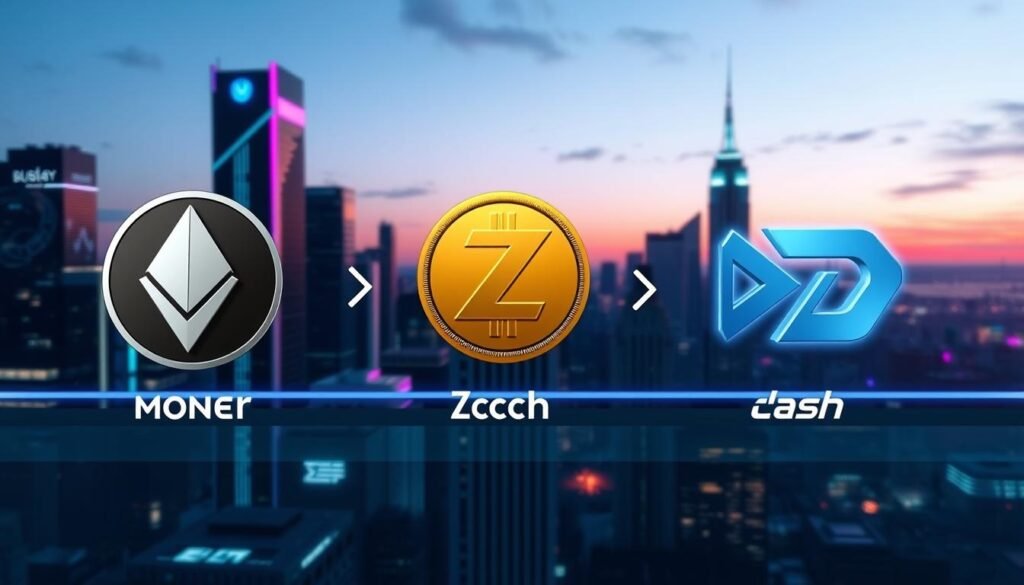
Mandatory protection means most on-chain activity is concealed by default. Optional modes give flexibility but can shrink the anonymity set when many users choose transparent addresses.
Quick summary of main features
- Ring signatures obscure which input funded a transfer, boosting sender unlinkability.
- zk-SNARKs provide mathematical proofs that validate transactions without revealing amounts or addresses.
- PrivateSend mixes outputs through masternodes to reduce direct tracing for payment flows.
Practical note for U.S. users: some exchanges prefer optional privacy models over always-on designs, which can affect how easily you buy or sell different coins. The next sections unpack how each technical component maps to sender, receiver, and amount hiding.
How Monero achieves always-on privacy (XMR)
The protocol bundles multiple obfuscation methods so no single transaction reveals its full story. That design means privacy is automatic for every transfer on the network.

Ring signatures and how they obfuscate the sender
Ring signatures mix a real input with decoy inputs. An observer sees a group of possible spenders, not the true sender, which strengthens sender protection at the input level.
Stealth addresses for receiver protection
Stealth addresses create one-time destinations for each payment. This prevents outsiders from linking multiple receipts to a single public address and helps protect the receiver.
RingCT for hiding transaction amounts
RingCT (Ring Confidential Transactions) conceals values while still proving no new funds were created. The network validates transfers without seeing transaction amounts.
Protocol and consensus basics
The underlying protocol is CryptoNote and the network runs on Proof of Work. That shapes miner incentives and affects decentralization and pool dynamics.
Practical implications
Always-on concealment improves fungibility and reduces traceability. However, strong protections have led some exchanges to be cautious, and public discussion flags mining pool concentration as a risk. Choose a reputable wallet and consider peer-to-peer options if exchange support is limited.
How Zcash enables shielded transactions (ZEC)
Zcash implements selective concealment so users can decide when a transfer hides details on-chain. That design separates verification from data disclosure and makes privacy optional for each transfer.

zk-SNARKs and validating transfers without revealing details
zk-SNARKs are zero-knowledge proofs that let someone prove a transaction is valid without revealing sender, receiver, or amount. The network checks a compact proof instead of reading sensitive fields.
Transparent versus shielded addresses and real user choices
There are two address types: transparent addresses act like Bitcoin and are fully visible on-chain.
Shielded addresses encrypt data so onlookers cannot link activity. What many users choose affects overall anonymity: if most use transparent addresses, shielded benefits shrink.
Protocol, consensus, and practical tradeoffs
The system builds on the Zerocash protocol and runs on Proof of Work, similar in consensus to other PoW networks. Optional concealment eases exchange support and compliance messaging in the United States.
That convenience has tradeoffs: easier listings and audits but more ways for users to accidentally expose transaction history. For more on legal and operational context, see this anonymous transactions guide.
How Dash approaches privacy with PrivateSend
dash offers an opt-in mixing option designed for fast, payment-friendly use. PrivateSend is built to make simple tracing harder without changing every field on the ledger.
PrivateSend mixing and what it does—and doesn’t—hide
PrivateSend mixes outputs across multiple participants so direct links between a spend and its origin become less clear. This improves practical privacy for routine transactions.
It does not cryptographically hide amounts or create shielded addresses at the protocol level. Observers can still infer patterns when mixing use is low or rounds are limited.
Masternodes and the two-tier network model
The design splits duties: miners secure the chain while a second tier of masternode operators coordinate services like mixing. Masternodes help route and aggregate inputs for PrivateSend sessions.
This two-tier model trades some decentralization for convenience and speed in payment flows. That can be useful for merchant-facing use cases in the United States.
Protocol and consensus basics: X11, Proof of Work, and masternode support
The underlying protocol uses X11 hashing and runs on proof of work. Masternode incentives run alongside miner rewards to support optional features and governance.
Bottom line: dash provides usable, optional privacy that suits payments-first users. It is generally considered weaker than always-on or shielded systems, but it remains a practical feature set for everyday use.
Privacy strength comparison: what each coin hides in real transactions
Not all protections are equal in practice. This section compares what type of data an on-chain observer can read and what stays concealed in real transactions.
Sender and input privacy
Monero hides the sender by default using input obfuscation, so tracing inputs is hard. Zcash can hide sender details when shielded transactions are used, but transparent transfers remain visible. Dash uses mixing to obscure origins, which helps but is less cryptographically complete.
Receiver and address protection
Stealth one-time addresses prevent reuse analysis on networks with that feature. Shielded addresses conceal destinations when used. Mixing reduces direct linkage, but outcomes depend on how users spend mixed outputs and on follow-up patterns.
Amount confidentiality
Some networks encrypt transaction amounts at the protocol level so outsiders cannot read values. Others leave amounts visible or only hide them when users opt into special flows. This makes a big difference for fungibility and auditability.
Default settings and common foot-guns for everyday users
Default, mandatory protection reduces accidental exposure for most users. Optional tools create user choices that can break anonymity if spent across transparent pools, reused addresses, or mixed inadequately.
- Send to transparent addresses.
- Reuse the same address.
- Move funds between private and public pools in predictable ways.
In short, strength is both technical and behavioral. Real-world research often shows metadata and patterns remain key risks despite strong on-chain technology.
Usability and adoption in the United States: wallets, exchanges, and everyday use
Real-world use depends less on cryptography and more on how simple it feels to send money at checkout. Good usability means a quick wallet setup, clear default behavior, and obvious fee controls.
Wallet experience and learning curve: A user should open a wallet, back up keys, and send funds with minimal steps. When privacy is enabled by default, there are fewer decisions to make.
Some networks require users to choose address types or run mixing tools. That adds cognitive load and increases error risk for new users.
Exchange availability and delisting pressure
Exchanges in the United States may limit listings when features complicate compliance. Platforms tend to prefer optional transparency because it eases audits.
That means access and liquidity can shift fast. Many users buy on supported exchanges and withdraw to self-custody wallets for control.
Merchant acceptance and digital cash positioning
Everyday payments favor coins that are fast and simple at checkout. Some projects focus on merchant integrations, while others find niche use cases like donations or confidential transfers.
In short, usability drives safety: the harder it is to use private features correctly, the greater the chance a user will leak transaction details despite choosing a privacy-focused cryptocurrency.
Security, risks, and compliance realities shaping privacy coins today
Audit teams and compliance officers flag limited on-chain visibility when assessing transaction trails. That attention often comes from law enforcement reviewing suspicious activities and asking how records can support investigations.
Regulatory tension: strong concealment protects user privacy, but it can hinder compliance and make tracing certain activities harder for regulators and law enforcement.
Optional transparency or selectively revealable data helps with audits and reporting. When users choose transparent flows, businesses can meet accounting and tax requirements with clearer records.
For U.S. users this shows up as exchange restrictions, KYC friction, and periodic delistings rather than a single sweeping law. Firms balance access and compliance before listing a token.
Public research also highlights network risks: proof systems and protocol complexity can introduce implementation bugs. PoW networks may face hash-rate concentration and other centralization pressures.
Finally, separate on-chain concealment from operational security. Wallet hygiene, device safety, and careful handling of information determine real-world protection more than any single technology.
Conclusion
This guide makes the tradeoffs clear: default protection, optional shielding, or payments-first mixing each solve different needs.
, choose wisely depending on your priorities. Monero favors strong default concealment. Zcash gives selectable shielded transfers. Dash focuses on fast payments with optional mixing.
In real transactions, what matters is whether sender links, receiver destinations, and amounts are hidden by default or only when a user opts in.
For U.S. users, consider exchange access and compliance. Self-custody, wallet choice, and knowing on-chain modes help maintain control. These features protect legitimate financial privacy, but regulatory attention and listing decisions can change access over time.
FAQ
What are privacy-focused cryptocurrencies and why do they exist?
These digital cash systems aim to limit on-chain linkability between senders, receivers, and amounts. They emerged because public ledgers like Bitcoin expose transaction flows that can reveal user behavior, holdings, and spending. Developers built tools—mixing, cryptographic proofs, stealth addresses—to reduce tracing risks and offer stronger financial confidentiality.
How do privacy and anonymity differ on blockchain networks?
Privacy refers to protecting transaction details such as who paid whom and how much. Anonymity is the broader inability to link transactions to real-world identities. A network can improve privacy without guaranteeing full anonymity, especially when users reuse addresses or interact with regulated exchanges that collect identity information.
What does it mean to hide sender, receiver, address, and amount information?
Hiding the sender obscures which wallet originated funds; hiding the receiver prevents linking incoming funds to a specific address; hiding addresses prevents chain-based address reuse tracking; hiding amounts means transaction values are not publicly visible. Different technologies focus on one or more of these goals, with tradeoffs in performance and usability.
Why are transparent ledgers considered a traceability risk?
Public transaction histories let analysts and third parties reconstruct chains of custody, trace funds between services, and infer user behavior. That visibility can expose financial privacy, enable targeted crime, or reveal confidential business relationships, which is why some users value enhanced confidentiality features.
How do the three major protocols differ in target users and positioning?
One project emphasizes always-on confidentiality for individuals and privacy-conscious users. Another offers optional shielded transactions aimed at selective confidentiality for institutions and consumers. The third focuses on fast, consumer-friendly payments with an optional mixing feature to reduce traceability. Each targets different tradeoffs between privacy, convenience, and regulatory friendliness.
What is mandatory privacy versus optional privacy in practice?
Mandatory privacy means every transaction is protected by default, reducing on-chain linkability but complicating compliance. Optional privacy lets users choose shielded or mixed transfers when needed, improving interoperability with services that require transparent records but leaving user behavior dependent on correct choices.
What are ring signatures, zk-SNARKs, and coin-mixing, and how do they compare?
Ring signatures mix multiple possible senders so an observer cannot easily identify the true origin. zk-SNARKs are zero-knowledge proofs that let a node validate a transaction without revealing sender, receiver, or amount. Coin-mixing combines outputs from several users through a coordinator to break simple tracking. Each method balances privacy strength, computational cost, and user complexity differently.
How does an always-on confidential protocol obfuscate senders?
It typically uses ring signatures, which aggregate decoy inputs with the true input so onlookers cannot tell which output funded the transfer. Combined with other measures, this reduces the chance analysts can reconstruct sender histories even when large datasets are available.
What role do stealth addresses play in protecting receivers?
Stealth addresses let senders create one-time destination addresses derived from a recipient’s public key. That prevents public address reuse and stops observers from grouping incoming payments to the same wallet, strengthening receiver confidentiality.
How are transaction amounts kept confidential on certain networks?
Dedicated range-proof and commitment schemes, such as RingCT or zero-knowledge techniques, hide amounts while still allowing validators to confirm no new coins were created. These cryptographic proofs ensure integrity without exposing values to the public.
What basic protocol elements and consensus mechanisms support these features?
Many projects build on Proof of Work variants and protocol designs like CryptoNote or Zerocash concepts. Consensus secures the ledger while the transaction layer implements obfuscation techniques. Network design choices, such as two-tier models with masternodes, can add services like coordinated mixing or governance.
Do on-chain privacy features affect traceability and exchange handling?
Yes. Strong default confidentiality reduces on-chain traceability, which can complicate compliance for exchanges and custodians. Some trading platforms restrict or delist coins with hard-to-audit transactions; others accept optional shielded transfers with enhanced KYC procedures.
How do shielded transactions work without revealing details?
Shielded transfers use zero-knowledge proofs to demonstrate that inputs equal outputs and that the signer controls spent funds, all without revealing linked addresses or amounts. That enables validation of correctness while keeping sensitive fields private from the public ledger.
What’s the difference between transparent and shielded addresses for users?
Transparent addresses behave like typical blockchain addresses, publicly exposing transaction flows. Shielded addresses conceal details using advanced cryptography. Users often pick transparent addresses for ease and liquidity, and shielded ones for confidentiality—though crossing between them can reintroduce linkability.
What tradeoffs come with optional shielding in terms of adoption and compliance?
Optional shielding improves interoperability with services that require transparency, which can boost adoption. However, it puts the burden on users to select protective modes correctly, and inconsistent use can weaken overall privacy guarantees. Regulators may favor optional approaches because they allow auditing when required.
How effective is coin-mixing at hiding transaction origins?
Coordinated mixing obscures links by shuffling outputs among participants, but it provides probabilistic anonymity rather than cryptographic guarantees. Its effectiveness depends on participant numbers, implementation quality, and whether mixing rounds are repeated or linked.
What is a masternode and how does a two-tier network help with private transfers?
Masternodes are specialized servers that provide services like instant payments, governance, and mixing on a second layer. They can coordinate PrivateSend-style mixing to improve user convenience, but they introduce centralization points and differing threat models compared with pure peer-to-peer privacy schemes.
How do sender, receiver, and amount protections compare across protocols in real transactions?
Some protocols hide all three elements by default, offering the strongest on-chain confidentiality. Others hide only amounts or offer optional concealment. Real-world privacy depends on defaults, user choices, wallet support, and whether users move funds through services that require identity verification.
What are common usability pitfalls that reduce real-world confidentiality?
Reusing addresses, sending shielded funds to transparent services, or mixing insufficiently can expose links. Wallet interfaces that make private modes hard to use or exchanges that strip privacy during deposits and withdrawals also undermine protection for everyday users.
How easy is it for U.S. users to handle private transfers—wallets and exchanges?
Wallet experiences vary: some offer seamless private transactions, others require technical steps. Exchange support is mixed; regulatory scrutiny has led several U.S. platforms to limit or delist certain confidential transaction types. Users should verify exchange policies and wallet defaults before transacting.
Are merchants accepting shielded or mixed payments for everyday purchases?
Merchant acceptance remains limited compared with mainstream payment rails. Payment processors favor transparent, auditable rails. Some merchants and peer-to-peer vendors do accept confidential transfers, especially where cash-like privacy is valued, but broader adoption needs simpler UX and regulatory clarity.
What regulatory and law enforcement concerns surround strong on-chain confidentiality?
Authorities worry that untraceable transfers can enable illicit activity. This has prompted guidance, delistings, and enhanced compliance expectations. At the same time, advocates argue for lawful uses like financial privacy, witness protection, and sensitive business transactions. Balancing these interests shapes policy and market access.
Why might optional transparency matter for audits and reporting?
Optional transparency allows users or institutions to produce auditable records without exposing all transactions on-chain. That capability supports tax reporting, corporate audits, and compliance while preserving selective confidentiality when legally appropriate.
What technical and network risks should users know from public research?
Research highlights risks such as implementation bugs, deanonymization via metadata, timing analysis, and centralization points like masternodes. Protocol upgrades and independent audits mitigate many risks, but no system is immune to evolving attack techniques or operational mistakes.

No comments yet