
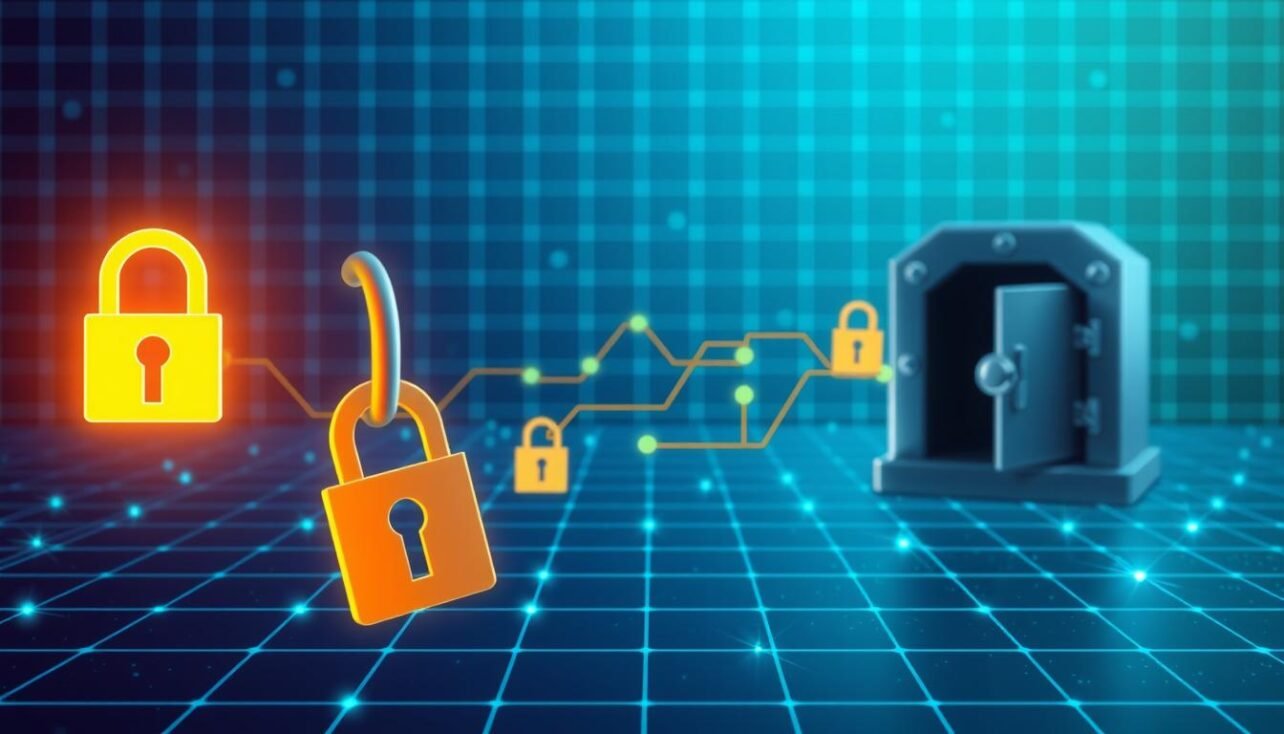
Imagine a mathematical lock and key that secures your digital money. This is the core idea behind the cryptographic system powering modern digital assets. These two pieces, known as a key pair, are the bedrock of secure ownership and transfers on decentralized networks.
This framework, called public-key cryptography, lets you interact safely without a middleman. One part of the pair is meant to be shared openly. The other must be guarded with absolute secrecy. Together, they enable you to send and receive cryptocurrency directly.
If someone gets hold of your secret piece, they gain full access to your funds. That’s why understanding this technology is essential for anyone in the crypto space. It grants you complete control over your holdings.
This guide will break down how these cryptographic keys work. We’ll cover their practical use, vital security practices, and the math that keeps everything safe. You’ll gain the knowledge to navigate the ecosystem with confidence.
Introduction to Blockchain and Cryptographic Keys
The integrity of digital assets relies on a sophisticated system of cryptographic codes and distributed ledgers. This foundation allows for direct peer-to-peer exchanges without intermediaries.
What is Blockchain?
This distributed ledger records transactions across many computers. Its design makes the system transparent and nearly impossible to alter. Every participant maintains a copy, ensuring no single point of failure.
This technology eliminates the need for centralized authorities like banks. Instead, a network of users validates and secures each transfer. You can learn more about different network types in our guide on private vs public blockchains.

- Immutable record-keeping
- Decentralized verification
- Transparent exchange history
The Role of Cryptography in Secure Transactions
Cryptographic methods serve as the mathematical backbone of this ecosystem. They ensure that only authorized individuals can access and transfer digital holdings. This field transforms a simple database into a trustless system.
Public-key cryptography (PKC) is the specific method used to encrypt and decrypt data. Without it, the entire framework supporting digital currencies would be impractical. PKC validates authenticity through digital signatures.
This method provides two primary functions: encrypting sensitive information and proving transfer authenticity. For a deeper dive into how these codes work, explore private and public keys in blockchain.
Understanding these principles is essential for anyone in cryptocurrency markets. They enable the decentralized architecture that makes this innovation revolutionary.
How Public-Key Cryptography Works in Blockchain
At the heart of every secure digital transaction lies a powerful mathematical duo. This system, known as public-key cryptography (PKC), enables trustless exchanges of information on decentralized networks.
Understanding Asymmetric Encryption
Unlike older methods that use a single secret, asymmetric encryption employs two separate but linked codes. One encrypts data, while the other decrypts it.
This approach allows you to safely share one part of the pair. The other remains secret, creating a secure channel for any message.
The Importance of One-Way Mathematical Functions
The security relies on special one-way mathematical functions. These are easy to compute in one way but nearly impossible to reverse.
A prime example is prime factorization. Multiplying two large primes is simple, but factoring the product back would take millennia.
This process forms a “trapdoor.” It lets a public code be derived from a secret one, but not the other way around.
Generating a key pair starts with a random number. Complex one-way functions then transform it into its public counterpart. This mathematical elegance makes peer-to-peer transactions possible without a central authority.
Understanding Private Key vs Public Key Blockchain Explained
Every cryptocurrency transaction depends on a unique mathematical partnership. This partnership is the key pair inside your digital wallet.
One half is your secret code, known as the private key. The other half is your public address, which you can share freely. They are mathematically linked, with each public key having a corresponding private one.
You can always generate the public address if you possess the secret code. The reverse calculation is computationally impossible. This one-way function is the bedrock of security.
Think of your secret code as a treasure map only you should see. Your public address is like the marked location where anyone can send treasure. Sharing the location is safe, but never share the map.
Both keys in the pair are essential. The secret code proves ownership and authorizes transfers. The public address lets others verify and send funds. They work together to enable secure, trustless exchanges.
The Functionality of Public Keys in Cryptocurrency Transactions
Think of your public key as a digital mailbox where anyone can drop off crypto funds. This cryptographic code is your public-facing identifier on the network.
It enables you to receive digital currency from any sender. The process is secure because sharing this code poses no risk to your holdings.
How Public Keys Are Generated
A public key is created from its secret counterpart using a one-way mathematical function. This process applies a cryptographic hash to produce a unique public identifier.
You can always derive the public code if you have the original secret. The reverse calculation is effectively impossible, ensuring security.
Using Public Keys to Receive Funds
In practice, this public code functions as your receiving address. You share it like a bank account number or a PO box.
Many content creators and charities display their crypto addresses online for donations. Anyone can send funds to that address.
Only the holder of the corresponding secret code can access and spend those received cryptocurrencies. This makes your public key safe to share anywhere.
Your digital wallet uses this address to show incoming transactions. It is the public component that makes peer-to-peer transfers possible.
Exploring the Role of Private Keys in Ensuring Security
The ultimate authority over your crypto holdings is not a username or password, but a cryptographic secret. This confidential number represents true ownership of your digital assets.
Whoever possesses this secret has exclusive control. It is the single most important element for your account’s safety.
Private Key Generation Methods
This secret code can appear in several formats for user convenience. Common representations include:
- A 64-digit hexadecimal string
- A 256-character binary code
- A mnemonic phrase of 12-24 words
Regardless of its form, it is an astronomically large, random number. Specialized software uses secure random number generators to create each unique value. This massive size makes guessing it statistically impossible.
Private Keys as Digital Signatures
This secret is used to create a digital signature for every transaction. The signature mathematically proves you are the legitimate owner authorizing the transfer.
It cryptographically confirms the sender’s authenticity. This process ensures that only you can spend the funds associated with your public address.
If anyone else gains access to this secret, they gain full control of your account. This is why the mantra “not your keys, not your crypto” defines true ownership in this space.
Public and Private Key Pair Dynamics in Cryptography
A mathematically linked pair of codes forms the backbone of trustless verification. This system enables secure transactions without intermediaries.
Each half of this duo performs a distinct but complementary role. Together, they create a complete cryptographic framework.
Relationship Between the Key Pair
The connection is fundamentally asymmetric. One code is for sealing and proving, while the other is for opening and verifying.
This bond allows for powerful security functions. Key aspects of their relationship include:
- Mathematical generation from a single secret source
- Distinct and non-interchangeable roles
- One-way derivation ensuring security
Asymmetric Encryption and Digital Signatures
While the framework supports encryption, crypto networks primarily use it for signing. This focuses on proving authenticity rather than hiding data.
A digital signature is created using your secret code. It acts as a unique fingerprint for a specific message or transaction.
Network validators then use the public code to check this signature. This verification confirms the corresponding private key holder authorized the action.
This process guarantees that funds come from the legitimate owner. It prevents forgery and tampering effectively.
The entire dynamic builds a trustless environment. Participants rely on mathematical certainty, not personal trust.
Practical Applications of Key Pairs in Wallet Security
Managing crypto assets requires a practical tool that handles complex cryptographic operations behind the scenes. This tool is your cryptocurrency wallet.
Wallets are software or hardware applications that securely store your secret codes. These codes are never stored on the blockchain network itself.
There are two main approaches to wallet custody. Keeping funds on an exchange means the platform holds your keys, similar to a bank holding gold in its vault.
Transferring crypto to a personal wallet puts you in full control. This is known as self-custody.
Modern wallet interfaces simplify everything for users. You likely never see the long cryptographic strings.
The software manages the keys automatically. You interact using simple buttons to send and receive funds.
A single wallet can generate and manage multiple key pairs. This lets you handle several accounts and addresses from one application.
For backup, wallets provide a seed phrase. This human-readable list of words encodes your secret information.
It allows you to recover all your assets if you lose access to the original device.
Custodial solutions offer convenience but require trust in a third party. Non-custodial wallets give you complete control but demand personal responsibility.
Understanding this helps you choose the right wallet for your security needs and comfort level.
Securing Your Digital Assets with Proper Key Management
True ownership of your digital wealth hinges on one critical practice: secure key management. This involves selecting the right tools and following strict protocols to protect your holdings.
Hardware Wallets vs. Software Wallets
Your choice of storage defines your security level. A software wallet is an application on your phone or computer. It’s convenient but connected to the internet.
A hardware wallet is a physical device. It keeps your secret codes in an isolated, offline environment. This offers superior protection for significant assets.
Best Practices for Storing Your Private Key
Never rely on a single, fragile backup. Traditional paper can tear or burn. Modern metal plates, like stainless steel cards, provide fire and water resistance.
Essential storage rules include:
- Create multiple backup copies of your recovery phrase.
- Store them in separate, secure geographical locations.
- Never digitize your private key in cloud storage or email.
- Absolutely never share this secret with anyone.
Loss of this code is permanent. There is no recovery option in decentralized crypto. For large funds, a hardware wallet is strongly advised. You can also choose a reputable custodial exchange if you prefer not to self-manage.
Case Studies and Real-World Examples in Blockchain Transactions
Concrete examples from major networks make abstract security concepts tangible. Observing how cryptographic principles work in practice provides the best lessons.
Bitcoin and Ethereum: How Keys Secure Transactions
Imagine sending 1 ETH to a friend. You need their public receiving identifier. Your wallet creates a transfer request with this address and amount.
You then authorize this transaction using your secret code. This creates a unique digital signature from the data.
Network validators check that this signature matches your public identifier. This proves you own the funds. Once confirmed, the ETH moves.
Both Bitcoin and Ethereum rely on this identical signing process. It secures all peer-to-peer transactions.
Examples of Key Management Failures and Successes
Real-world stories highlight the stakes. Many have lost access to fortunes by forgetting passwords or discarding old hardware.
One famous failure involved storing a seed phrase in cloud storage. Hackers accessed it and stole the cryptocurrencies.
Success stories show the value of robust backups. Individuals using metal plates recovered their funds after a house fire.
These examples teach a clear lesson. Proper management protects your digital wealth. Carelessness can lead to permanent loss.
Conclusion
Ultimately, protecting your crypto comes down to securing a single piece of information. True ownership means controlling your private key, not just seeing a balance on an exchange.
Your public key lets others send funds and verify transactions. Your secret code proves you are the legitimate owner who can spend them. This partnership is the core technology behind the blockchain.
Guarding this secret is your most important security task. Use a hardware wallet for significant holdings. Follow strict backup procedures.
Understanding this process transforms you from a passive user into an informed owner. You gain complete control over your cryptocurrency and financial future.
FAQ
What is the main difference between a public and private key in cryptocurrency?
Think of your public key as your account number; you share it to receive digital currency. Your private key is like your secure PIN or signature. It proves you own the assets and authorizes sending them. Never share this secret code.
How does a public key receive cryptocurrency?
A public key is used to create a receiving address on the blockchain, like an email address for funds. When someone sends you crypto, they direct it to this public address. Only the holder of the linked private key can then access and move those assets.
What happens if I lose my private key?
Losing your private key typically means permanent loss of access to your funds. Blockchain networks are decentralized, so no central authority can recover it. This is why secure storage in a hardware wallet or on a paper backup is a critical security practice.
Can someone steal my crypto if they only have my public key?
No. A public key and its derived address are designed to be shared safely. They allow people to send you assets but offer no ability to spend them. Theft requires the private key, which is why its secrecy is paramount for wallet security.
What is a digital signature in blockchain?
A digital signature is created using your private key to mathematically sign a transaction. It proves the transaction came from the legitimate owner without revealing the secret key. The network verifies this signature against the corresponding public key to confirm its authenticity.
Are hardware wallets safer than software wallets?
Generally, yes. Hardware wallets like those from Ledger or Trezor store your private key offline on a physical device, isolating it from internet threats. Software wallets are convenient but are on internet-connected devices, presenting a higher potential security risk if compromised.
How do Bitcoin and Ethereum use these keys?
A> Both Bitcoin and Ethereum use asymmetric encryption. Your private key generates a public key, which then creates your public address. To send BTC or ETH, you sign the transaction with your private key. The network nodes use your public key to verify the digital signature before approving the transfer.

No comments yet