

This article aims to give a clear, side-by-side look at the two leading ways decentralized networks reach agreement.
A consensus mechanism is the set of rules that lets a distributed network agree on the shared record. It matters because it solves trust and security for any blockchain.
At the core, proof work secures a chain by asking miners to spend computing power and energy. In contrast, proof stake secures a chain by putting capital at risk—validators lock funds to earn the right to add blocks.
We will compare security assumptions, energy use, participation needs, decentralization trade-offs, speed and governance patterns. Expect practical notes on Bitcoin as the flagship proof work system and Ethereum after its move to proof stake in 2022.
For U.S. readers, energy use and policy are central. Both approaches work, but each shapes incentives, costs, and network outcomes differently.
Blockchain Consensus Mechanisms: Why Networks Need a Way to Agree
When many independent computers keep the same ledger, they must follow shared rules to stay in sync. A consensus mechanism gives a decentralized network a clear way to decide which transactions are real and which block becomes the official next record.

How decentralized nodes stay in sync
Nodes validate and forward transactions. Each node checks signatures and balances, then shares valid transactions with neighbors. Over time, the network converges on one history so everyone records the same blocks.
How consensus prevents fake transactions and double-spending
Double-spend means trying to spend the same funds twice. Consensus stops this by ensuring only one version of a transaction history wins acceptance. Nodes reject conflicting chains and accept the agreed chain.
- No single administrator: shared rules replace any central database operator.
- Chain selection matters: when multiple block proposals appear, consensus picks the valid chain.
- Built-in trust: participants need not trust each other because the system enforces verification.
- Security filter: consensus forces attackers to spend scarce resources, reducing fraud and spam.
Later sections show two common ways to choose who adds a block and how the rest of the network verifies that choice. For a practical guide to building these systems, see how to build a blockchain.
Proof of Work: How PoW Mining Creates New Blocks
Proof of work turns raw electrical energy and hardware into a verifiable right to add a new block. Miners bundle transactions, then race by running hashes until one finds a solution that meets the network target.

Miners, computing power, and the cryptographic puzzle
Miners build a candidate block and try many nonces in a trial-and-error hashing loop. This process is slow and costly for the solver but instant for others to check — the classic “hard to find, easy to check” idea.
Difficulty adjustments and consistent block time
Bitcoin tweaks puzzle difficulty as total computing power changes. The goal is a steady block interval—about ten minutes—so the chain issues blocks at a predictable rate even when hashpower rises or falls.
Mining rewards: subsidy and transaction fees
The miner who finds a valid solution claims protocol rewards plus the block’s transaction fees. Today many individuals join mining pools to pool computing power and steady their chance to earn rewards.
Proof of Stake: How PoS Validators Confirm Transactions
Validators earn the chance to add blocks by locking a specified amount of tokens into the protocol. That process, called staking, replaces energy-heavy mining with financial commitment.

Selection is usually pseudo-random and weighted by how much stake a validator or delegator holds. The higher the locked amount, the greater the odds a validator will propose or attest to a block.
Staking and validator role
Staking means committing tokens to secure the network. A validator runs software, checks transactions, and signs blocks when chosen. Correct participation earns an ongoing reward tied to issuance and fees.
Slashing and incentives
Misbehavior — like signing conflicting transaction histories, making fraudulent proposals, or long downtime — can trigger slashing. Slashing cuts the staked amount to deter attacks and keep validators honest.
Common PoS variants
- DPoS: token holders vote for a smaller validator set (EOS).
- NPoS: nominators back validators to spread responsibility (Polkadot).
- Liquid PoS: delegation without losing custody of funds (Tezos).
Trade-off: PoS lowers energy use and hardware barriers but can concentrate influence if large holders control most stake. Proper design balances security, rewards, and decentralization.
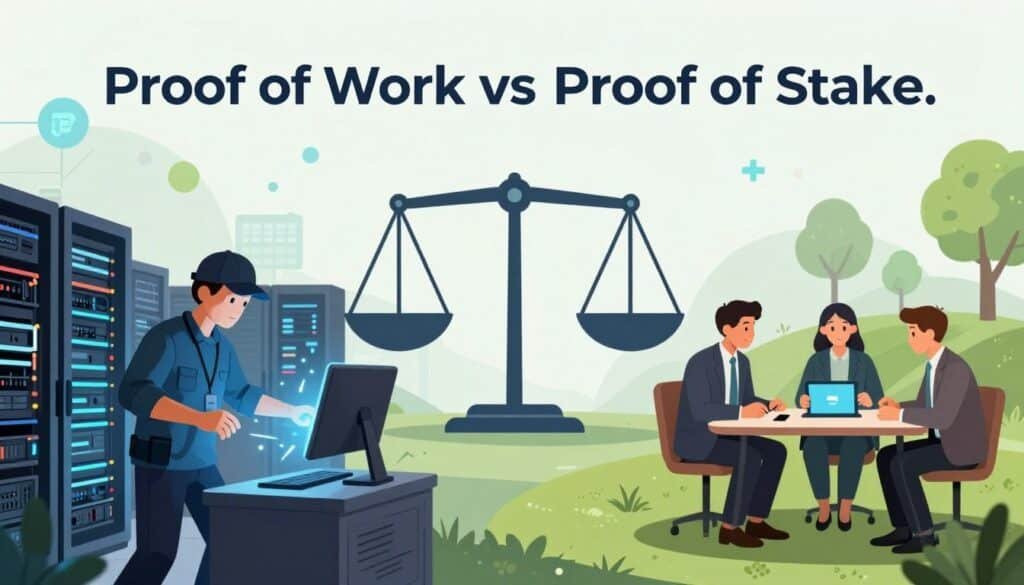
Proof of Work vs Proof of Stake Explained: Side-by-Side Differences That Matter
Compare the two mechanisms across practical categories to see what really changes for users, miners, and validators. The trade-offs show up in energy use, hardware needs, security thresholds, and how quickly a chain settles transactions.
Energy and environmental impact
Energy: one model drives continuous electricity consumption and specialized rigs; the other runs on ordinary servers with far lower consumption.
Carbon and e-waste: electricity mix determines emissions, while custom mining devices create a steady stream of hardware waste as chips age.
Security, speed, and participation
Security: attacks hinge on majority hashrate in one system and majority stake in the other; the economic costs to seize control differ because one requires sustained power and the other needs capital or risks slashing.
Throughput and finality: many staking designs offer faster block times and stronger finality, while longest-chain rules rely on confirmations that grow safer over time.
- Hardware barrier: mining rewards favor specialized equipment and cheap electricity.
- Capital barrier: staking lowers hardware needs but raises the entry cost to secure influence.
- Decentralization risk: mining pools and large stakers (exchanges, whales) can both concentrate power.
For a focused technical comparison and implementation notes, see this short guide on pow pos trade-offs.
Security in Practice: What It Takes to Attack PoW and PoS Systems
Real-world attacks on blockchain networks demand heavy logistics—either warehouses of rigs and steady energy or large blocks of market capital. Practical security is about what an attacker must acquire and sustain, not just theoretical weakness.
Why large-scale attacks need massive hardware and ongoing power
For systems that rely on energy-driven competition, an attacker must buy or rent many units and secure long-term power contracts. That creates two cost layers: a big up-front hardware spend and ongoing electricity bills to keep rigs competitive.
Operating at majority hashrate means sourcing machines, renting space, and managing cooling and logistics. These operational demands raise the real economic costs and slow any sustained assault.
Why attacks in stake-based models require capital and face slashing
In token-weighted networks, an adversary must control a large share of stake to sway consensus. Acquiring that capital is costly and often visible on markets, which raises barriers and detection risk.
Slashing changes incentives by destroying funds for misbehavior. That rule turns an attack into a potentially self-destructive gamble and pushes rational participants toward honest validation.
Takeaway: security depends on distribution of participants, implementation quality, and incentives—not just the chosen consensus process.
Energy, Sustainability, and U.S. Policy Attention
Local grid stress and emissions put mining front and center in U.S. sustainability debates. Large facilities can change electricity pricing, create local demand spikes, and raise questions about emissions and permitting.
Core criticism: mining can drive high levels of energy consumption to secure a network. That consumption is often the focal point for regulators and community groups when new sites appear.
Context matters. The same amount of energy use produces very different emissions depending on the local mix—hydro, wind, gas, or coal. Regions with seasonal or surplus generation sometimes use mining to monetize “trapped energy” that would otherwise be curtailed.
- After China’s mining ban, many operators moved to areas with cheap power, including the U.S. and Kazakhstan.
- Policy watchers should track disclosure rules, local permitting, grid-demand responses, and sustainability standards for mining operations.
- Remember that staking-based designs cut energy concerns dramatically, which is why many newer projects prefer them for consumer-facing chains.
For practical steps toward lower-impact chains, see this guide on sustainable blockchain.
Real-World Examples: Bitcoin’s PoW vs Ethereum’s Move to PoS
Looking at Bitcoin and Ethereum shows how different consensus choices play out in practice. Bitcoin continues to run on proof of work. Ethereum completed a major upgrade in 2022 and now runs on proof of stake.
The Merge and what actually changed
Ethereum’s 2022 Merge ended energy-intensive mining. Miners stopped competing with hashes and validators took over by locking stake (commonly 32 ETH per validator) to secure blocks.
Reportedly, this cut Ethereum’s energy use by more than 99%. That shift reshaped public discussion about sustainability for blockchain projects.
What stayed the same — and why it matters
Users still send transactions. Blocks still form and the network enforces consensus rules. Only the method for selecting who proposes blocks changed.
- Developer impact: Proof of stake enables designs for faster finality and smoother scalability upgrades.
- Security trade-off: Ethereum’s model uses economic penalties on validators, while Bitcoin relies on external resource costs tied to proof of work.
- Decision criteria: choose based on goals like immutability, decentralization dynamics, cost, and environmental limits.
Emerging and Hybrid Consensus Models Beyond PoW vs PoS
New consensus patterns let projects pick which resource—energy, stake, storage, or identity—secures a chain. The industry is moving past a strict debate because different applications need different trust models, performance targets, and governance rules.
Hybrid PoW/PoS designs
Hybrid systems split responsibilities so miners propose blocks while stakers confirm or veto them. That dual approach reduces single-group dominance and blends external resource costs with token-based checks.
Example: Decred pairs mining with on-chain voting so both miners and locked-stake holders share control and governance.
Identity-based validators (Proof of Authority)
Proof of Authority uses known validators to speed consensus. It fits enterprise or consortium systems where verified identities and legal accountability matter more than full decentralization.
- High throughput and low latency.
- Trade-off: efficiency for less distributed control.
- Notable uses: VeChain and some Polygon sidechains.
Storage and other resource alternatives
Proof of Space asks participants to allocate hard drive space rather than compute power or funds. Chia is a leading example that treats storage as the scarce resource.
Other experiments swap the proven resource entirely—identity, succinct cryptographic proofs, or novel hybrid checks. Each changes attack costs, hardware needs, and finality expectations.
Bottom line: when evaluating any mechanism, check incentives for miners and validators, the real-world costs to attack, hardware and storage demands, and how finality is achieved.
Conclusion
Choosing a consensus mechanism sets the rules for who secures a chain and what they must risk to do it.
In short, both approaches solve the same consensus problem. One uses energy and compute to win block rights; the other uses locked capital and penalties to align incentives.
Use proof of work when you value long-proven security and simple rules. Use proof of stake when you want lower energy use, wider access without special rigs, and faster finality.
Focus on three comparison points: security thresholds (51% control), decentralization dynamics (mining pools vs stake concentration), and economic incentives. Ask who can validate, what it costs to join, how penalties work, and how soon transactions become final.
Expect hybrids and new models to keep evolving. The best systems keep incentives clear, verification robust, and participation resilient.
FAQ
What are the main differences between mining-based and staking-based consensus?
Mining-based networks rely on specialized hardware and continuous electricity to solve cryptographic puzzles and earn block rewards. Staking-based systems select validators based on held coin balance and stake, where participants lock capital to earn rewards and can lose a portion if they act maliciously. The two approaches differ in energy use, entry barriers, and how security incentives align.
How do decentralized nodes reach agreement without a central authority?
Networks use consensus protocols that define how validators or miners propose, verify, and accept blocks. Nodes follow rules about block format, transaction validity, and chain selection. When a block meets protocol criteria and a sufficient share of participants accept it, the network adds it to the ledger, keeping all nodes synchronized.
How does consensus prevent fake transactions and double-spending?
Consensus requires that new blocks include only valid transactions verified by many participants. Cryptographic signatures and transaction ordering stop duplicates. In mining systems, the longest valid chain rule makes reversing history costly. In staking systems, penalties like slashing disincentivize validators from approving conflicting blocks.
How does the mining process create new blocks?
Miners collect pending transactions into candidate blocks and run intensive hash calculations to find a nonce that satisfies a network difficulty target. The first miner to find a valid solution broadcasts the block, which other nodes validate and add to their chains if correct. Successful miners receive newly issued coins and fees.
Why does Bitcoin adjust difficulty and target a consistent block time?
Bitcoin recalibrates mining difficulty roughly every two weeks to keep block production near a ten-minute target. Adjustments offset changes in total computing power so that blocks arrive predictably, which stabilizes issuance and helps maintain network security assumptions.
What rewards do miners receive?
Miners earn a block reward (newly minted coins) plus transaction fees included in the block. Over time, many networks reduce block subsidies while relying more on fees. That mix influences miner economics and long-term security funding.
How do validators confirm transactions in staking-based systems?
Validators lock cryptocurrency as collateral and take turns proposing and attesting to blocks according to protocol rules. Other validators add attestations; when enough support accumulates, the block achieves finality. Validators earn rewards proportional to stake and participation.
What are slashing penalties and why do they matter?
Slashing removes a portion of a validator’s stake for severe misbehavior, such as signing conflicting blocks or prolonged downtime. These penalties align financial incentives with honest operation and strengthen the protocol by raising the cost of attacks.
What are common staking model variants?
Variants include Delegated Proof of Stake, where token holders elect delegates to validate; Nominated Proof of Stake, which pairs nominators with validators; and Liquid staking, which issues transferable tokens representing staked assets. Each balances decentralization, liquidity, and usability differently.
How do the two systems compare on energy use?
Mining-based networks consume substantial electricity because of continuous hashing. Staking systems use far less power since validators run regular servers without energy-heavy computation. That difference drives much of the sustainability debate and regulatory attention.
What about environmental effects like e-waste and carbon footprint?
Mining creates hardware turnover and can contribute to electronic waste, especially when ASICs become obsolete. Energy source matters: mining powered by renewables lowers carbon intensity, while fossil-fueled operations raise it. Staking avoids most of these hardware-driven impacts.
How do security models differ: 51% hashrate versus 51% stake?
In mining, an attacker needs majority hashpower to control block creation, requiring huge hardware investment and energy. In staking, an attacker must accumulate a large share of tokens, tying attack cost to market capital. Both face trade-offs: hashrate attacks incur operational costs, stake attacks risk financial losses and slashing.
Which model offers faster transaction finality and higher throughput?
Staking designs often achieve faster finality and higher throughput because they avoid slow PoW mining cycles and can adopt committee-based or instant-finality algorithms. PoW networks can scale with layer-2 solutions but typically have longer confirmation times per block.
What hardware is required and who can participate?
Mining often requires specialized ASICs or powerful GPUs and access to low-cost electricity, raising entry barriers. Staking usually needs less specialized hardware—standard validators run on servers—though capital to stake can still limit participation for small holders.
How do decentralization trade-offs play out with mining pools and stake concentration?
Mining pools consolidate hashing power, which can centralize influence even in PoW. In staking, large holders or exchanges can centralize voting power. Both systems must manage incentives and protocol design to prevent excessive concentration and to encourage broad participation.
What is the risk of chain reorganization and how does finality differ?
PoW typically relies on the longest-chain rule; reorgs are possible until many confirmations accumulate. Some PoS protocols implement faster finality through unanimous or supermajority attestations, reducing reorg risk and making transactions irreversible sooner.
How do governance patterns differ between these models?
PoW communities often coordinate off-chain via miners, developers, and stakeholders. PoS systems can embed on-chain voting tied to stake, letting validators influence upgrades directly. Each approach shapes how protocol changes get proposed and enacted.
What does it take to attack a mining network in practice?
Attacking PoW requires purchasing or controlling vast hardware fleets, securing physical site capacity, and sustaining huge electricity costs. The logistical and capital demands make large-scale attacks difficult and expensive.
How does attacking a staking network differ?
A staking attack needs acquiring a large share of tokens or compromising many validators. Capital costs are central, and protocol features like slashing and coordinated defense increase attack risks and potential financial losses for attackers.
Why is U.S. policy focused on mining’s energy footprint?
Regulators and policymakers examine electricity consumption, local grid impacts, and emissions. High-energy operations raise concerns about grid stability and climate goals, prompting scrutiny, taxation, or regional regulation of mining activity.
How do mining location and energy mix affect the sustainability debate?
Mining near renewable sources or using stranded energy can lower environmental impact. Conversely, concentration in regions reliant on fossil fuels raises carbon concerns. Location choices influence public perception and regulatory responses.
What did Ethereum’s 2022 Merge demonstrate about energy savings?
Ethereum’s transition from mining to staking dramatically reduced energy consumption—studies reported over 99% lower electricity use—highlighting how consensus changes can cut operating power while preserving network functionality.
What hybrid or alternative consensus models exist beyond mining and staking?
Hybrid systems combine mining and staking roles to share security responsibilities. Alternatives include Proof of Authority, which uses identity-based validators for permissioned networks, and Proof of Space, which leverages storage resources. These models trade different balances of performance and trust assumptions.
When does Proof of Authority make sense?
Authority-based models suit private or consortium blockchains where known entities require fast finality and clear accountability. They reduce resource needs but depend on trusted validator identities rather than open-market incentives.
How do resource-based alternatives like Proof of Space compare?
Proof of Space uses disk storage rather than compute or stake to secure consensus. It lowers energy intensity but introduces different hardware dynamics and potential centralization pressures if storage providers dominate.

No comments yet