

This practical, step-by-step resource shows how to use the rsi to read momentum and spot potential overbought or oversold price zones in today’s crypto market.
What you will learn: how the rsi indicator works, how to read common values, and how to apply those signals in real scenarios without treating them as sole decision drivers.
Expect clear sections on calculation basics, adding the rsi to charts, using the 50 line to spot trend direction, overbought/oversold interpretation, and spotting divergence.
Key focus: use the tool as part of technical analysis, wait for confirmation, and manage risk instead of reacting to single signals. Examples will reference KuCoin and TradingView-style charts and common market conventions.
What the Relative Strength Index Really Measures in Crypto Markets
The relative strength index is a momentum tool that summarizes how quickly price is moving and whether recent gains exceed recent losses. It converts short-term price swings into a single value on a 0–100 scale, giving traders a snapshot of current momentum.

What it is and what it is not: this strength index is an oscillator, not a crystal ball. Use the value as context, not a direct predictor of future moves. Fast markets push the value to extremes more often, so confirmations matter.
Why traders still use this tool
The tool is simple, standardized, and easy to compare across timeframes and assets. That makes it popular in technical analysis when you need a concise measure of momentum and short-term price changes.
- Summarizes whether recent gains dominate recent losses.
- Flags potential overbought oversold conditions using the 0–100 scale.
- Supports both mean-reversion and trend-following ideas depending on market structure.
Practical note: treat extreme values as conditions, not automatic entries. Rapid movements can keep readings extreme for longer, so pair the reading with price confirmation and other analysis. For a clear primer on the math and history, read more on Investopedia.
How RSI Is Calculated and Why Average Gain vs. Average Loss Matters
Here we explain how average gains and average losses combine into a single strength value over a chosen period. The core math is easy to follow and reveals what the reading is actually measuring.
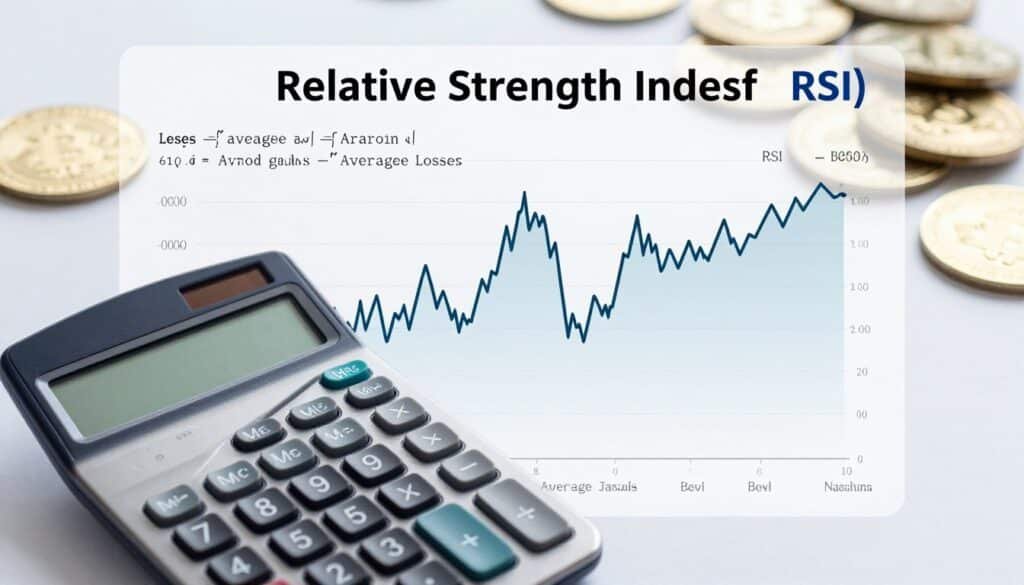
Formula: RSI = 100 − (100 / (1 + RS)), where RS = Average Gain / Average Loss. The result is a single value between 0 and 100 that shows momentum.
The role of relative strength
Relative strength (RS) is a ratio that compares average gain to average loss over X periods. When gains exceed losses, RS rises and the index moves higher.
Average gain vs. average loss
Average gain is the mean of up-closes across the period; average loss is the mean of down-closes. Big, frequent drops inflate the loss term and keep the value lower even after spikes.
What a 14-period setting means
Default X = 14 is a practical baseline. On a daily chart that’s 14 days; on a 1-hour chart it’s 14 hourly candles. Shorter periods increase sensitivity; longer periods smooth the reading.
- Practical note: platforms calculate this automatically, but knowing the math helps you spot noisy signals and adjust the period for your timeframe.
How to Add the RSI Indicator to Your Crypto Charting Platform
Adding the momentum tool to your chart is quick once you know where platforms hide oscillators.
Finding it on common platforms
Look in the chart’s Indicators or Indicators → Momentum menu. Most platforms group oscillators together, so the strength tool is usually listed under momentum or oscillators.
Step-by-step on KuCoin
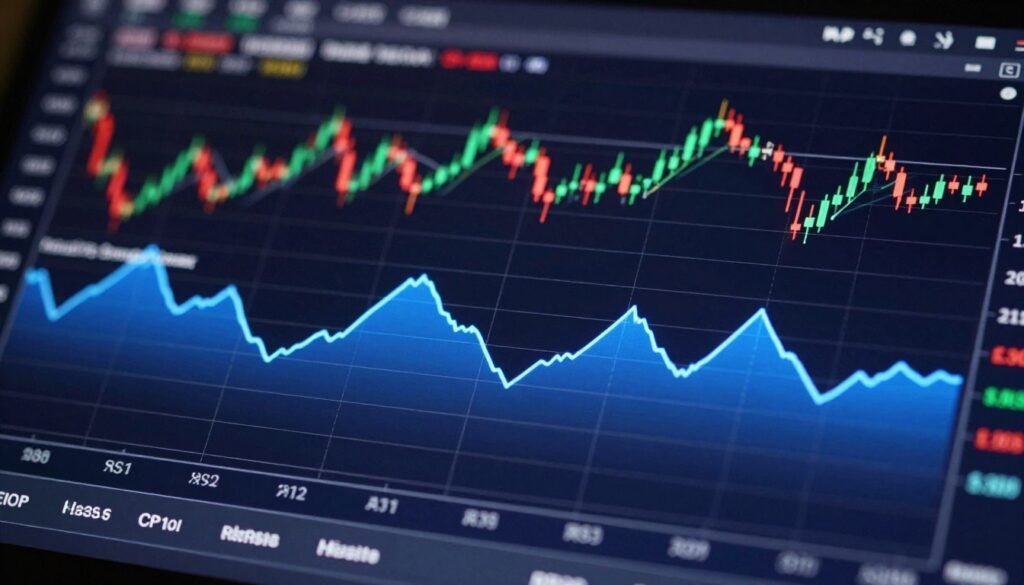
Open the Trading page, choose Indicators, then search “Relative Strength Index.” Select the entry under momentum indicators and apply it to the chart pane below price.
For a quick KuCoin walkthrough, see this practical platform tutorial.
What to confirm after adding it
Check the default period (often 14). Changing the period makes the tool more or less sensitive, so match it to your timeframe.
- Ensure the pane shows the 0–100 scale and reference lines (30/50/70).
- Confirm common levels (70/30) and adjust bands if markets are more volatile.
- Save a template or preset so your settings stay consistent across coins and charts.
Also verify visibility and layout so the oscillator pane doesn’t crowd your price view. For more on reading charts and platform setup, this chart analysis resource is useful.
How to Read RSI Values for Overbought and Oversold Levels
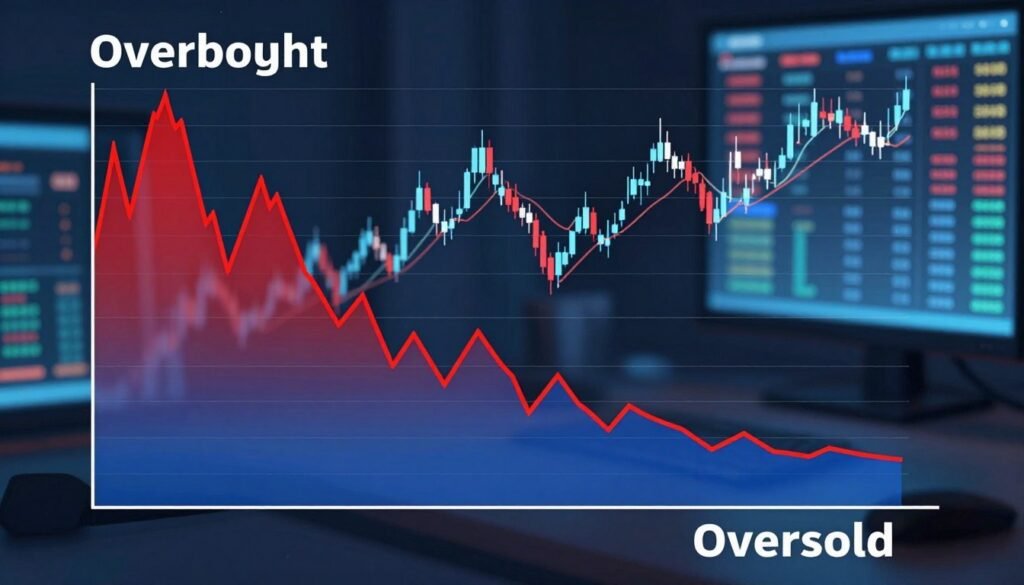
Knowing what extreme values mean helps you avoid reflex moves. Knowing when the tool reads above 70 or below 30 gives context about recent momentum, but it is not an automatic entry or exit rule.
What a value above 70 can signal
An reading above 70 often signals the market has strong recent gains relative to losses. That suggests a possible overbought condition, meaning momentum favors buyers now.
It does not guarantee an immediate reversal; prices can stay elevated in strong trends. Treat the reading as a warning to watch for reversal signals, not as a lone sell command.
What a value below 30 can signal
A value below 30 points to recent losses dominating gains and flags potential oversold levels. That can highlight opportunity, but falls can continue during sharp down moves.
Why waiting for the value to exit the zone helps
Many traders wait for the reading to cross back out (for example, back under 70 or above 30) before acting. This filter reduces premature entries when price keeps trending while the tool stays extreme.
- Context matters: use support, resistance, and market structure together.
- Volatility note: frequent touches happen; require confirmation to avoid false signals.
- Log trades to learn how zone behavior varies by coin and timeframe.
Using RSI Levels Beyond 70 and 30 in Volatile Crypto Conditions
Volatile sessions often make common bands too sensitive to short bursts of momentum. Fixed 70/30 thresholds can trigger repeated reversal calls while a strong move keeps running.
When to consider 75/25 or 80/20
Raise bands during clear trend phases, hype-driven rallies, or when a coin routinely overshoots standard levels. Many traders move to 75/25 or 80/20 to reduce false signals and increase selectivity.
Match bands to volatility and risk tolerance
Wider bands mean fewer entries but often stronger, cleaner signals. That tradeoff suits conservative traders who prefer fewer, higher-quality setups.
- Review several weeks of recent price action to see how often the rsi exceeds 70 without reversing.
- Change one setting at a time and treat it as a controlled experiment.
- Always pair adjusted bands with confirmation tools like volume, moving averages, and support/resistance to manage risk in fast conditions.
Using the RSI 50 Centerline to Identify Trend Direction
The 50 balance point acts as a simple filter to avoid fighting the prevailing market momentum. It marks where gains and losses sit roughly even and gives a fast read on trend direction.
How values above 50 support bullish momentum
When the rsi holds above 50, it shows recent strength: gains tend to outpace losses. Traders use that as a cue to favor long setups and to follow the trend instead of fading moves.
How values below 50 support bearish momentum
Readings below 50 indicate losses outweigh gains and signal bearish bias. Staying below this line can help traders avoid trying to catch falling price and reduce risky countertrend entries.
Practical rules:
- Use 50 as a filter: prefer longs only when above, prefer shorts or defensive plans when below.
- Check higher timeframes first to align the short-term signal with the broader trend.
- The centerline is context, not a guarantee—combine it with price structure for better analysis.
Trend Reading with RSI Ranges in Strong Uptrends and Downtrends
Knowing typical range behavior in strong moves makes the index far more useful than fixed thresholds. Read the pane as a range that shifts with market context, not a single rule set.
Uptrend behavior: in strong uptrends the rsi often sits between about 40 and 90. Dips into the 40–50 band will often act like support and mark healthy pullbacks before price resumes higher.
Downtrend behavior: in strong downtrends the rsi tends to range roughly 10–60. Rallies that stall in the 50–60 band commonly act like resistance and signal the trend may continue lower.
Drawing trendlines on the RSI pane
Connect swing lows (for uptrends) or swing highs (for downtrends) on the pane to form a trendline. A clean break of that line gives an early momentum clue.
- Use breaks as alerts to re-check price structure and risk, not as standalone trade signals.
- Confirm breaks with the chart and higher-timeframe range to avoid false alarms.
- Respect the dominant trend; fighting it often increases losses in fast markets.
RSI Indicator: Crypto Trading Guide for Choosing the Right Settings
Choosing the right lookback window shapes how sensitive momentum reads will be and how many signals you see.
What the period changes: the period is the lookback window used to compute average gains and losses. Shorter windows weight recent moves more. Longer windows smooth out noise.
Shorter periods (7 or 9)
Pros: faster signals for quick entries and exits. Good for active sessions.
Cons: more whipsaws and false signals, so require tight risk control.
Longer periods (14 or 21)
Longer settings reduce false triggers and favor higher-quality setups. They fit swing horizons and reduce trade frequency.
Match settings to your time horizon
- Day traders often use faster periods to capture intraday swings.
- Swing traders prefer smoother periods to avoid noise across days.
- Keep settings consistent and test changes over weeks on one market and timeframe.
Practical rule: treat settings as tools, not rules. Always confirm signals with price structure and other analysis before committing capital.
How Timeframe Impacts RSI Signal Quality in Crypto Trading Today
Timeframe selection shapes how clean and reliable momentum reads appear across charts. Higher blocks such as 1H, 4H, or daily reduce noise and reflect broader market participation. That makes rsi signals there more robust for swing moves.
Short windows like 15 minutes often produce many extremes and apparent reversals. These can fail when a larger timeframe trend stays dominant. Fast charts show more whipsaws and false alerts.
Simple alignment method
- Define the higher-timeframe bias first — for example, rsi above or below 50.
- Use a lower timeframe to find entry timing that matches that bias.
- If they conflict (15m oversold but 4H bearish), treat a bounce as countertrend and size accordingly.
Practical notes for traders: stick to consistent pairs (15m/1h or 1h/4h), tie timeframe choice to risk, and always confirm any signal with price action and wider technical analysis.
How to Spot Bullish Divergence and Bearish Divergence with RSI
Divergence is a simple mismatch between price action and momentum where the oscillator fails to confirm a price extreme. It flags a possible shift in strength but does not guarantee a turn.
Bullish divergence: lower low on price, higher low on RSI
Identify two swing lows on the chart. If the second low in price is lower but the RSI prints a higher low, that is bullish divergence.
Step-by-step: mark the price lows, compare the corresponding RSI swings, then wait for confirmation such as a break of local resistance or an RSI trendline break.
Bearish divergence: higher high on price, lower high on RSI
Find two swing highs. If price makes a higher high while RSI makes a lower high, that is bearish divergence. It shows weakening momentum despite rising price.
Why divergence often clusters near trend exhaustion — and how to time confirmation
Momentum tends to fade before price reverses, so divergence often appears near the end of a trend. Still, it can show up early while price keeps moving.
- Use confirmation: a structure break, RSI exiting an extreme zone, or candle confirmation.
- Mark divergence near key support or resistance and check higher timeframes for stronger signals.
- Manage risk: treat divergence as a setup, not a guaranteed entry, and size positions accordingly.
RSI Trading Strategies for Crypto Traders That Go Beyond Basic Signals
High-probability methods combine momentum readings with price context to reduce false entries and improve outcomes. Below are practical setups you can test and adapt to your timeframes.
Classic mean reversion in ranges
Use mean reversion when the market moves sideways and price bounces between clear boundaries. Take entries near oversold and overbought turns, target the range midpoint, and set stops beyond recent swing highs or lows.
Support and resistance upgrade
Only trade extremes that occur at clear support or resistance. This raises probability and cuts false signals that appear in the middle of a move.
Trend filter and 50-level momentum breakout
In an uptrend, focus on pullbacks rather than selling highs. A reclaim of the 50 line can confirm continuation when price structure aligns with the trend.
Divergence near key levels
Prioritize divergence on higher timeframes and near major price levels. Require confirmation such as a breakout candle or structure shift before risking capital.
- Risk framing: define invalidation points at nearby swings and size small during high volatility.
- Practice one strategy: backtest visually and track results instead of mixing rules.
How to Confirm RSI Signals with Other Indicators and Price Action
A single momentum reading rarely tells the full story; confirmations add context. Use a short checklist of tools so you treat each signal as a hypothesis, not a promise. Confirmation reduces false entries and improves trade quality.
MACD confirmation for momentum shifts
MACD helps verify that a momentum move has broader support. For example, when the rsi recovers and the MACD histogram climbs, the momentum shift gains credibility. Look for MACD crossovers that match the direction of the signal.
Volume as proof of conviction
Rises in volume during breakouts or reversals often show real participation. A low-volume bounce is suspect. Require higher volume to support price moves tied to a momentum reading.
Moving averages as a trend filter
Only take long signals when price sits above key moving averages, and avoid longs below them. MAs clarify trend bias and prevent countertrend entries.
Bollinger Bands for overextension
Outer bands reveal when price stretches beyond normal range. An extreme reading near the band plus a momentum reading suggests overextension that needs extra confirmation.
Candlestick confirmations with divergence
Use clear patterns—engulfing candles, hammer, shooting star, or doji—to time entries after a divergence. These candles improve entry timing and help set tighter stops.
- Quick checklist: matching MACD, rising volume, trend above/below MAs, band context, and a validating candle.
- Apply the same routine across charts and market conditions to stay consistent.
Common RSI Mistakes in Crypto Trading and How to Avoid Them
Strong trends tend to break simple rules. Many traders treat an extreme reading as an automatic entry or exit. That misunderstanding is the root of repeated losses when the market stays stretched for long periods.
Why extremes can persist during trends
When a trend dominates, momentum often stays pinned near extremes. In that case, calling a reversal at the first overbought or oversold reading is risky.
Fix: prefer fading only when price structure supports it. Use a trend filter like the 50 centerline or a moving average before placing countertrend trades.
How lag affects entries in fast markets
The strength index is based on past price moves, so it can trail sharp pumps and dumps. By the time the signal appears, price may have already moved far.
Fix: wait for the reading to exit and for price confirmation—breaks of structure, volume spikes, or a validating candle—before committing size.
Why using this tool alone increases false alarms
Relying only on a single momentum reading creates noise, especially on short timeframes. False signals multiply when other context is ignored.
Fixes: combine a trend filter, require RSI to leave the zone, set clear invalidation points, and size positions conservatively. Journal each mistake type—trend fade, early divergence, no confirmation—to learn faster and refine your market analysis.
- Define entry rules and an invalidation price before you trade.
- Use small sizes in fast markets and scale only after confirmation.
- Log the exact error type and outcome to improve decisions over time.
Conclusion
, The takeaway: treat the rsi as a short, practical read of momentum that helps show which side—buyers or sellers—has recent control.
Use relative strength to add context: watch the 50 centerline, adjust bands for trend ranges, and avoid acting on a single extreme value alone.
Make these rules part of your plan: confirm settings and timeframe, skip instant entries at 70/30, and require price confirmation with structure or volume before you trade.
Use divergence near key levels and on higher timeframes for cleaner signals, then wait for validation. Standardize a workflow: higher-timeframe bias → rsi read → price-level check → confirmation → risk plan → execution.
Final note: consistent process and risk control beat chasing signals in a fast market. Keep testing and logging to improve over time.
FAQ
What does the relative strength index measure in crypto markets?
The relative strength index measures momentum by comparing average gains to average losses over a set period. It plots a value on a 0–100 scale that helps traders spot speeding price moves and potential overvalued or undervalued conditions.
Why is the relative strength index a widely used tool in technical analysis?
Traders rely on it because it’s simple, visual, and effective for spotting momentum shifts, overbought/oversold zones, and divergence. It pairs well with price action and other indicators to improve decision-making.
How does the 0–100 scale help identify overbought and oversold conditions?
Values near the top (commonly above 70) suggest overbought pressure, while values near the bottom (commonly below 30) suggest oversold pressure. Those zones flag potential reversals or pullbacks, though confirmation is required.
What is the formula and the role of relative strength in the calculation?
The calculation uses average gain divided by average loss to produce relative strength, then converts that into the oscillator value. This comparison of up-moves to down-moves defines the indicator’s reading.
How do average gain and average loss affect the indicator’s readings?
Higher average gains raise the value, and higher average losses lower it. The smoothing method (usually Wilder’s) makes recent price action influence the reading while preserving continuity across periods.
What does the default 14-period setting mean on different charts?
A 14-period setting looks at the last 14 bars on whatever timeframe you use. On a daily chart it covers 14 days; on a 1-hour chart it covers 14 hours. Shorter charts make it more responsive, longer charts make it smoother.
Where can I find the indicator on major charting platforms?
Look under “momentum” or “oscillators” menus on platforms like TradingView, Coinigy, Binance, and KuCoin. It’s a standard built-in tool available across most charting services.
How do I add it to KuCoin charts step-by-step?
Open the advanced chart, click indicators, search for the tool name, select it, then confirm default settings. Verify the period, visibility, and horizontal levels are active after adding it.
What should I confirm after adding the tool to a chart?
Check the period setting (default 14), whether horizontal lines (30/70 or your custom bands) are visible, and that the pane is readable with your chart colors and scale.
What does a reading above 70 typically signal in crypto markets?
Readings above 70 often indicate overbought conditions and increasing upside momentum. In strong rallies the value can stay elevated, so use price confirmation or a trend filter before selling.
What does a reading below 30 generally mean?
Values below 30 suggest oversold conditions and strong downside momentum. Like overbought readings, they can persist in downtrends, so wait for signs of reversal before buying.
Why wait for the value to exit overbought or oversold zones?
Waiting reduces entry on false signals. An exit or crossover often shows momentum loss or a shift, improving timing and lowering the risk of entering too early during an extended move.
When should traders use 80/20 or 75/25 bands instead of 70/30?
In highly volatile markets, wider bands reduce false signals by requiring stronger momentum to trigger overextended conditions. Choose tighter or wider bands based on volatility and risk tolerance.
How do volatility and risk tolerance influence band selection?
Higher volatility or lower risk appetite favors wider bands (80/20). Lower volatility or active traders seeking more signals may prefer 70/30 or 75/25 for more frequent entries.
How does the 50 centerline help identify trend direction?
Readings above 50 suggest bullish bias and support for long setups; readings below 50 imply bearish bias and favor short setups. Using the centerline helps filter signals in trending markets.
How does the tool typically behave during strong uptrends?
In strong uptrends it often stays above 40–50 and pulls back to those levels before resuming upward moves. Those mid-range readings can act like dynamic support for momentum.
How does it behave during strong downtrends?
During downtrends it often stays below 50–60 and rallies to those levels before resuming lower. Those mid-range rallies act like resistance for momentum-based setups.
Can you draw trendlines on the indicator pane?
Yes. Drawing trendlines on the pane can highlight momentum shifts or hidden divergence and offer early warning of potential reversals or continuation breaks.
When should traders use shorter periods for the tool?
Shorter periods (e.g., 7 or 9) give faster signals ideal for intraday traders but increase noise and false entries. Use them when you need responsiveness and accept higher trade frequency.
When are longer periods recommended?
Longer periods (e.g., 21 or 30) smooth readings, lower whipsaws, and suit swing traders or position traders who prefer fewer, more reliable signals.
How do you match settings to day trading versus swing trading?
Day traders use shorter periods on low-timeframe charts for quick signals; swing traders use default or longer periods on 4H or daily charts to capture larger moves with fewer false signals.
Why do higher timeframes produce stronger signals?
Higher timeframes filter noise and reflect broader market consensus, so signals tend to have higher reliability and align with major trend context.
How do you avoid conflicts between low- and high-timeframe readings?
Use the higher-timeframe reading as a trend filter and take low-timeframe signals only when they align with that bias. This reduces contradictory signals and improves trade odds.
What is bullish divergence and how do I spot it?
Bullish divergence occurs when price makes a lower low while the oscillator makes a higher low. It suggests momentum is weakening to the downside and a reversal may follow.
What is bearish divergence and how do I spot it?
Bearish divergence occurs when price makes a higher high while the oscillator makes a lower high. It indicates waning upside momentum and a potential top or pullback.
Why does divergence often show up near trend endings?
Divergence signals that price moves lack momentum support. At trend extremes, momentum divergence commonly appears before a structural reversal or significant correction.
Can divergence arrive early and how should I time confirmation?
Yes, divergence can precede price action by some time. Wait for price confirmation—such as a break of structure, a key level, or a centerline cross—before acting.
What classic mean reversion strategies use this tool?
Traders buy near oversold levels and sell near overbought levels inside clear ranges. Combining zone thresholds with support/resistance improves success rates.
How does combining it with support and resistance improve setups?
When oversold/overbought readings occur at known support or resistance, the confluence increases probability, providing clearer entry and stop placement.
How does a trend filter help avoid fading strong moves?
Using a trend filter such as moving averages or higher timeframe bias prevents taking countertrend entries against momentum that can keep reading extreme for long periods.
How can the centerline be used for momentum breakouts?
A clear cross above 50 suggests continuation to the upside; a cross below 50 suggests continuation to the downside. Traders use these crossovers as momentum-confirmation signals.
How do you apply a divergence strategy on higher timeframes?
Identify divergence on daily or 4H charts, mark key levels, and look for price confirmation. Higher-timeframe divergence tends to carry more weight and leads to larger moves.
Which indicators confirm signals effectively?
MACD can confirm momentum shifts, volume validates conviction, moving averages filter trend direction, and Bollinger Bands highlight overextension alongside the oscillator.
How does volume act as proof during reversals and breakouts?
Rising volume on a breakout or reversal supports the move’s legitimacy. Low volume increases the chance of a false breakout despite strong readings on the oscillator.
How do moving averages serve as a trend filter for entries?
Use moving averages to define market bias—only take long signals above the average and short signals below. This reduces countertrend risk when the oscillator gives a trade cue.
How do Bollinger Bands work with the oscillator to spot overextension?
When price hits a band and the oscillator reaches extreme levels, it signals a potential overstretch. The combination helps identify high-probability mean-reversion opportunities.
What candlestick confirmations pair well with divergence?
Reversal patterns like pin bars, engulfing bars, or bullish/bearish rejection candles at key levels add confirmation when divergence appears on the oscillator.
Why can the tool remain overbought or oversold for long in trends?
Strong trends sustain momentum, keeping readings extreme for extended periods. Traders need trend-aware rules to avoid premature countertrend trades.
How does the lagging nature affect entries in fast markets?
The smoothing makes the reading reactive rather than predictive. In rapid moves, signals can lag price, so add faster confirmation methods or tighten risk controls.
Why is using the oscillator alone risky?
Alone it produces many false alarms because it doesn’t account for trend context, volume, or structural price levels. Combining it with other tools improves reliability.
What additional keywords should I consider when researching further?
Consider searching for momentum, overbought oversold, divergence, average gain, average loss, bearish divergence, bullish divergence, trend filter, confirmation, volatility, timeframes, moving averages, MACD, volume, Bollinger Bands, candlestick, support, resistance, and period settings.

No comments yet