

Public networks face a major hurdle: scaling. As more people use them, transaction fees rise and processing slows down. This creates a bottleneck for widespread adoption.
State channels offer a powerful fix. They let two or more participants move their activity off the main chain. This means they can exchange value or information privately and instantly.
All the heavy security of the underlying system remains in place. Funds are locked with a smart contract or multi-signature setup to start. Then, users can conduct countless updates between themselves.
Only the final outcome is broadcast back to the public ledger. This approach slashes costs and boosts speed dramatically. It preserves the core principles of decentralization and security.
Understanding this technology is key for developers and users alike. It powers fast payments, complex gaming logic, and efficient DeFi trades. For a deeper look at the mechanics, explore this resource on state channels.
This guide will walk you through the entire process. You’ll learn how a channel opens, how parties interact off-chain, and how they settle conclusively. We’ll also compare this method to other scaling solutions.
Introduction: state channels blockchain explained
Off-chain scaling techniques unlock new possibilities for speed and cost-efficiency. They allow participants to interact directly, bypassing the public ledger for most steps.
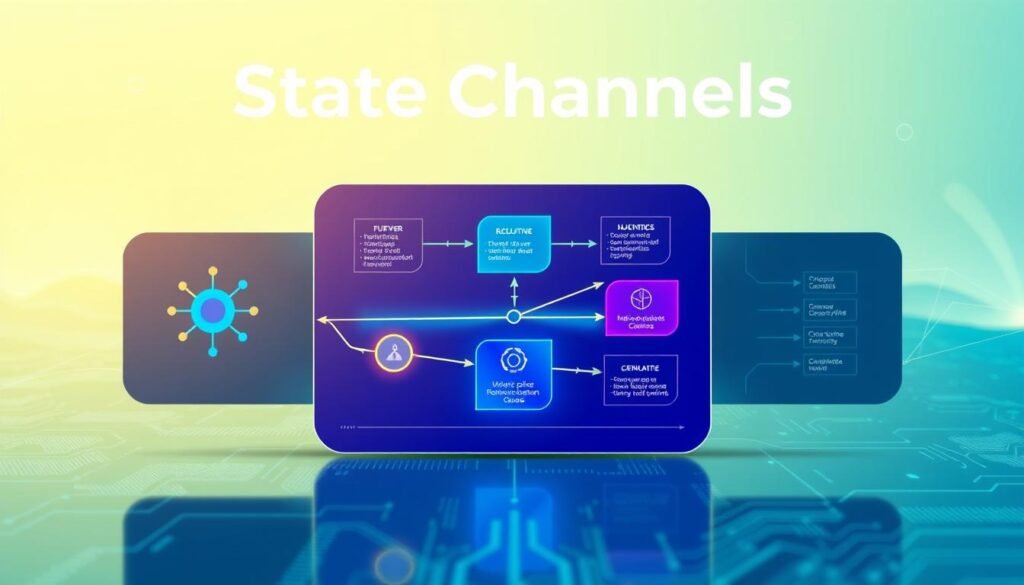
Overview of State Channels in Blockchain
This foundational method lets two or more parties open a shared ledger with one on-chain transaction. They then exchange signed messages to update their shared condition off-chain.
Only the opening and final settlement require network consensus. The shared condition can represent many things:
- Simple payment balances
- In-game asset ownership
- Complex smart contract conditions
This dramatically reduces fees and wait times for repeated actions. It’s a core mechanism for building scalable applications.
The Relevance of Off-Chain Interactions
Public ledgers have limited throughput. Every on-chain action consumes resources and incurs costs.
Moving frequent updates off-chain solves this. Users enjoy near-instant finality and minimal costs. Intermediate details stay private between participants.
This is vital for use cases like streaming micropayments, real-time gaming, and rapid trading. It complements other layer 2 scaling solutions.
Understanding the Mechanics of State Channels
To grasp how this scaling solution operates, one must understand the critical roles of fund locking and off-chain communication. This two-phase process enables fast, cheap interactions between a defined group.
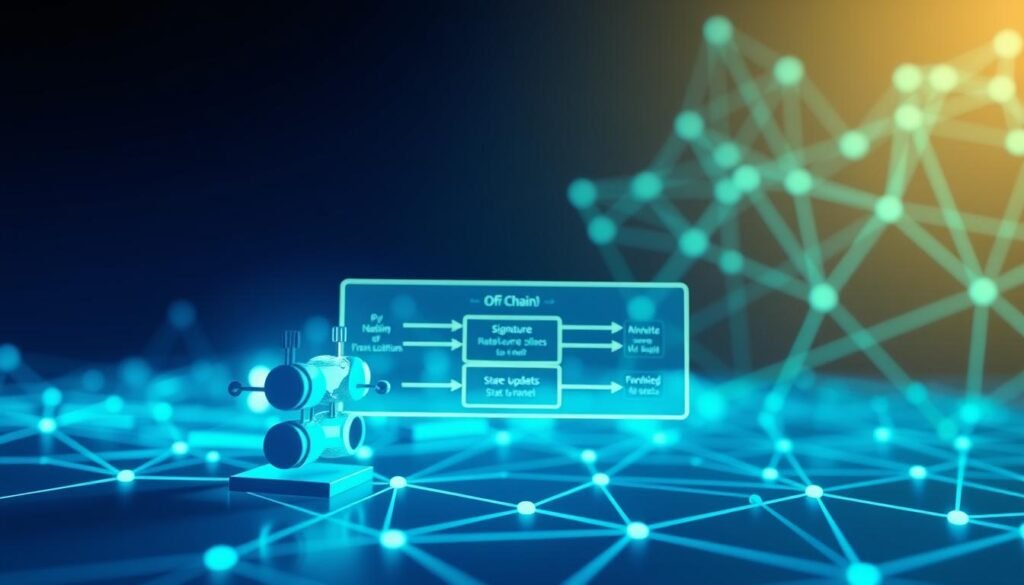
Locking Funds with Multisig Contracts
The first step requires participants to lock assets into a secure contract on the main network. This multi-signature setup creates a shared deposit that defines the starting point.
The locked value can be diverse. It often includes:
- Cryptocurrencies like Ether
- Popular ERC20 tokens
- Unique non-fungible assets (NFTs)
- ENS domain names
This smart contract acts as a vault. All involved parties must sign to alter its contents, preventing unilateral action.
Off-Chain Messaging and State Updates
Once funded, the real activity begins off-chain. Participants exchange cryptographically signed messages. These are valid transactions either party could submit to the chain.
They are kept private to avoid fees and delays. Each new signed message updates balances or conditions. It completely replaces the prior agreement.
In systems like Bitcoin’s Lightning Network, a 2-of-2 multisig secures the pathway. On Ethereum, a channel manager contract holds funds and encodes rules. This ensures only the latest, mutually-signed state is valid for final settlement.
Benefits of State Channels in Blockchain Applications
Adopting this scaling method brings concrete benefits that directly impact user experience and cost. It transforms how participants interact by moving the bulk of activity away from the public ledger.
Near-Instant Finality and Reduced Fees
Once both parties sign an update, it becomes final immediately. There’s no waiting for network confirmations. This enables real-time experiences like point-of-sale payment systems.
Transaction costs plummet because only opening and closing require on-chain fees. Countless intermediate actions happen off-chain at virtually no cost. This makes microtransactions economically viable.
Enhanced Privacy and Security
All intermediate details remain private between participants. Only the initial and final settlements appear on the public blockchain record. This contrasts with typical on-chain transactions where everything is visible.
Security stays strong because either party can enforce the latest signed state on-chain if needed. The underlying network’s consensus mechanism backs this guarantee.
Challenges and Limitations in Implementing State Channels
Despite their speed and cost benefits, these systems introduce unique challenges around availability and liquidity. Teams must carefully weigh these practical hurdles before deployment.
Participant Availability and Monitoring
A core requirement is the constant availability of all participants. They must monitor the network to guard against fraud.
If someone goes offline during a dispute window, they risk losing funds. A counterparty could try to close the channel with old data.
Third-party watchtowers offer a solution. However, they introduce new trust risks and potential attack vectors.
Managing Channel Modifications
These systems work best with a fixed group. Changing the participants requires an on-chain contract update each time.
This process adds cost and complexity. It makes fluid user bases difficult to manage.
Capital is locked for the channel’s entire life. This reduces liquidity and requires careful balance management.
Finally, the opening and final settlement depend on the base networks. When those are congested, fees can spike dramatically.
Comparing State Channels with Other Layer 2 Solutions
Understanding how state channels stack up against other layer 2 methods reveals their ideal use cases. Different scaling tools solve different problems.
Differences Between State Channels and Sidechains
Sidechains are separate blockchain networks with their own validators. Every transaction is public to all sidechain participants.
In contrast, state channels are private agreements between specific users. They keep all intermediate activity off the public ledger.
You don’t need constant availability for a sidechain. But channels require monitoring to prevent fraud during dispute periods.
Critically, channels inherit the full security of the main chain. Sidechains have independent, and often weaker, security models.
Setting up a sidechain needs major investment in validators. A channel simply requires a smart contract on the main network.
Insights into Rollups and Payment Channels
Rollups post compressed data on-chain and use proofs for correctness. This ensures global data availability.
Payment channels keep all intermediate details completely off-chain. They rely on cryptographic signatures.
This makes channels perfect for repeated, private interactions between known parties. Think streaming micropayments or gaming sessions.
Rollups are better for applications needing open participation and a simple user experience. They are complementary tools in the scaling toolkit.
Real-World Applications and Use Cases
Beyond theoretical benefits, payment channels are actively solving practical problems today. They enable applications that were previously impossible on public ledgers.
Gaming, Micropayments, and Financial Transactions
Interactive experiences benefit enormously from this technology. Every move in a chess game could update off-chain with zero fees.
Only the final result requires on-chain settlement. This enables truly decentralized, fast-paced multiplayer experiences.
Micropayments become economically viable. Users can stream tiny payments for content or services. High-frequency trading updates also work efficiently off-chain.
Case Studies: Lightning and Raiden Networks
The Lightning Network represents Bitcoin’s mature implementation. It establishes bidirectional payment channels for instant transfers.
Users conduct unlimited transactions before settling the final balance. The Raiden Network serves as Ethereum’s equivalent solution.
It creates a mesh of off-chain pathways for ERC-20 tokens. Both networks demonstrate practical viability for scaling real-world applications.
Merchants now use Lightning Network for point-of-sale Bitcoin payments. This example shows growing adoption beyond theory.
Dispute Resolution and Managing Channel Discrepancies
Ensuring the final settled outcome reflects the true, latest agreement is a critical security challenge. Since every signed off-chain update is technically valid, a clear mechanism is needed to decide which one gets enforced.
Dispute Windows and Enforcement Mechanisms
If one party tries to unilaterally initiate a closing, they submit a state to the main chain. This starts a timed dispute window.
Other participants can now monitor the chain. If they see an old, favorable state was submitted, they present a newer signed update as proof of fraud.
The smart contract then activates its enforcement mechanism. It typically punishes the dishonest party by slashing their locked funds.
Longer dispute windows allow more response time but delay final closing. Shorter windows need constant monitoring.
Protocols to Prevent Fraudulent Updates
Systems use cryptography to make old updates invalid. A common method is a revocation secret.
When both parties sign a new agreement, they exchange secrets that can prove the prior one is stale. Attempting to publish an old state lets the honest party claim all funds.
This design makes fraud economically irrational. The risk of total loss outweighs any potential gain. The contract impartially enforces these rules.
For this security model to work, someone must be watching when a closing transaction is submitted. This requirement supports watchtower services.
Conclusion
Concluding our exploration, state channels stand out as a practical layer-2 scaling solution. They enable countless off-chain updates between participants. This slashes fees and boosts speed dramatically.
Only the opening and final settlement require on-chain transactions. This mechanism supports real-world applications from instant payments to complex gaming. Networks like Lightning and Raiden prove its viability.
While operational factors like monitoring exist, the trade-offs are often worthwhile. These channels complement other scaling approaches. They excel for repeated interactions between known parties.
For users, managing these interactions starts with secure tools like the best crypto wallets for beginners. Looking ahead, continued development in software and systems will expand their use.
FAQ
How do state channels reduce costs for users?
They slash costs by moving most activity off the main ledger. Only two on-chain transactions are needed: to open and close the conduit. This means you avoid paying a network fee for every single interaction, making micro-transactions and frequent trades economically viable.
What is the role of a smart contract in this system?
A smart contract acts as the secure, impartial referee. It holds the initial funds in escrow using a multi-signature setup, enforces the rules, and processes the final settlement. It only intervenes on-chain if the involved parties have a disagreement.
Is my money safe if the other participant goes offline?
A>Yes, security is maintained. The system is designed with a dispute period. If your counterparty disappears or acts dishonestly, you can submit the last agreed-upon signed update to the on-chain contract during this window. The referee will then fairly settle the transaction based on that proof.
How does this technology differ from a sidechain?
While both are scaling tools, they operate differently. A sidechain is a separate, independent network with its own validators and security model. In contrast, a state channel is a direct, private line between participants that leverages the underlying blockchain’s security for final enforcement and settlement.
What are some real-world projects using this?
The Lightning Network for Bitcoin and the Raiden Network for Ethereum are prominent examples. They function as payment channel networks, enabling fast and cheap transfers. Beyond payments, this tech is ideal for online gaming, decentralized exchanges, and any application requiring high-speed, low-cost state updates.
Can I add a third person to an existing two-party channel?
Directly modifying an active, two-party conduit is complex. Typically, you would close the existing one and open a new channel with the updated set of participants. Some advanced protocols are exploring more flexible, multi-party setups, but the foundational model is for a fixed group.

No comments yet