

Quick guide: This short primer explains how support and resistance form on a chart and why they matter. Traders use these areas to spot likely pauses or reversals in a trend. When price meets a level, it may bounce or break through toward the next area.
Practical focus: You will learn to read timeframes, spot round numbers that attract clustered orders, and combine volume with context to judge strength. A broken level often flips roles, which helps with entries, stops, and targets.
This guide aims to be an actionable reference for building a structured approach to the stock market and beyond. For a deeper explainer on mapped areas, see our support and resistance trading resource.
What Are Support and Resistance? Foundations in Technical Analysis
Price action often clusters where buyers or sellers repeatedly enter the market. These clusters create areas that act like temporary floors or ceilings on a chart.
Support: Where demand halts declines and creates a price floor
A support area appears when buyers step in to absorb selling and stop a decline. Repeated tests at that region make the area more meaningful. Higher volume on those tests and a longer timeframe increase the level’s significance.
Resistance: Where supply caps rallies and forms a price ceiling
A resistance area forms where sellers cap advances. When a stock fails to clear a region several times, it signals an overhead ceiling that may persist. Sharp rejection wicks or pause zones are common at these points.
Levels versus zones: Why precision is rare in real price action
- The market rarely reverses at a single tick; slippage and volatility make zones more realistic.
- More touches, stronger volume, and multi-timeframe alignment improve reliability.
- Behavioral anchors, like round numbers, attract clustered orders that reinforce these areas.
Practical note: Treat these points as areas for scenario planning. Later sections show how to identify and validate each zone with rules and confirmations.
How to Identify Support Resistance Levels on a Chart
Begin by mapping past pivots—those pauses and turns reveal the most useful price boundaries.
Reading swing highs, lows and rejection wicks
Start with obvious swing highs and lows where price reversed. Draw horizontal lines at those points to anchor the level.
Use rejection wicks and tails as evidence that buyers or sellers acted strongly at a point. Short, decisive wicks often mark meaningful price action.
Static levels with horizontal lines and market structure
Mark static lines across the chart where multiple pivots align. Clean, flat boundaries are easier to trade than messy consolidations.
Prioritize levels that match larger timeframe structure. Weekly or monthly zones often dominate intraday moves in a stock or other market.
Confirming significance: touches, volume, and time
Count tests: a level that rejects price at least twice gains credibility. Recent touches usually carry more weight than distant ones.
Look at volume near each level. High turnover near a boundary means many participants acted there, which strengthens that area.
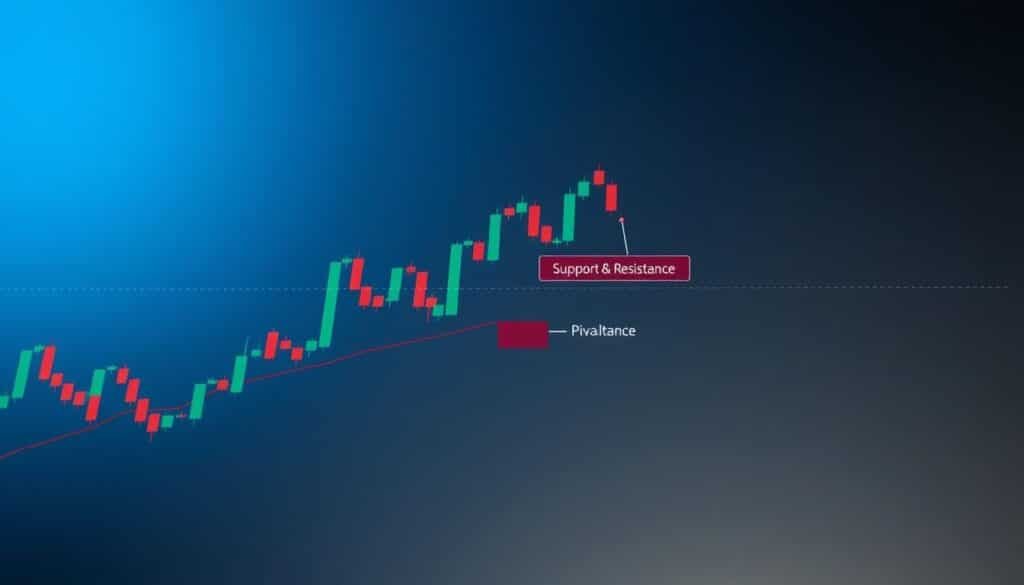
- Map pivots: anchor swing highs and lows with horizontal lines.
- Count tests: require multiple rejections before planning an entry.
- Use volume: confirm a level with high activity at that price.
- Favor higher timeframes: weekly/monthly levels usually matter more.
- Keep a living map: remove invalidated lines as new data prints.
Static vs. Dynamic Levels: Trendlines, Moving Averages, and VWAP
Static price markers stay fixed from past turns, while dynamic indicators move as fresh data arrives.
Trendlines as rising guides
Draw trendlines by connecting at least three clear swing points. A clean rising line can act as a moving guide for entry or a test point during uptrends.
Moving averages as moving barriers
Common moving averages like the 50-day and 200-day are watched by institutions. Price often finds support above a rising average or meets resistance beneath a declining one.
VWAP and channels for intraday context
VWAP shows the average price paid during a session and helps spot control shifts. Add Bollinger or Keltner channels to view volatility envelopes and likely stall points.

- Static levels: horizontal boundaries from past highs/lows that do not move.
- Dynamic levels: indicators that update with each bar, such as moving averages and VWAP.
- Confluence: when a horizontal level lines up with a moving average or trendline, the area gains relevance.
| Feature | Static | Dynamic |
|---|---|---|
| Definition | Fixed horizontal price points from past reactions | Indicators that shift as new data prints |
| Examples | Prior highs, lows, round numbers | 50-day MA, 200-day MA, VWAP, channels |
| Use | Reference for stops and targets | Real-time guidance for entries and mean reversion |
| Validation | Multiple tests at the same points | Alignment across timeframes and trend direction |
Psychology, Round Numbers, and Why Price Levels Matter
Human behavior often pins importance to round figures, which shapes how price moves near whole-number marks.
Anchoring bias makes many traders fixate on neat numbers like $50 or $100. When large groups place stops or targets at the same price point, that clustering creates visible friction on a chart.

Anchoring at round numbers
People treat round figures as natural reference points. Institutions and retail accounts often stack orders at these thresholds, which raises the chance of meaningful action there.
- Orders cluster near whole numbers, forming a recognizable area on the chart.
- Buyers tend to enter near perceived bargains; sellers defend perceived ceilings.
- Repeated hesitation around a single price can form a well-watched band.
Why expectations can create movement
When many expect a reaction at a price level, their orders can produce that reaction. This self-fulfilling effect makes some numbers act like real barriers.
An example: repeated pauses near a round point turn that price into a de facto resistance level, drawing attention across timeframes from intraday scalps to multi-week swings.
Practical tip: Document psychological levels before acting. Combine these anchors with trend direction and recent volatility in your analysis so you respond calmly, not impulsively.
support and resistance trading
Price often bounces inside tight bands until a clear breakout decides the next trend. When levels hold, the market tends to trade between a visible floor and ceiling. These bounces form a range that short-term traders watch for repeatable entries.
Range behavior: price will often move back and forth between defined points. Clean rejections near a floor can spark reversals, especially when the larger trend lines up with the move.

When levels break
A sustained close beyond a boundary signals a regime change. Often the price returns to retest the broken line before continuing the move. This role reversal means a broken floor can act as a cap on rallies while a broken ceiling may become a new base.
- Watch momentum and volume to separate strong breaks from fleeting spikes.
- Predefine invalidation points and maximum risk before entering on a break.
- Beware false moves; require follow-through or a successful retest as confirmation.
- Example: a range top breaks, price pulls back to the former ceiling, then resumes upward.
Practical tip: decide whether to buy weakness or sell strength before the test. If evidence shows the level failed, shift your bias and adapt to the new structure.
For a concise primer on fundamentals, see this support and resistance basics.
Core How-To Strategies: Range, Breakout, and Trendline Trading
Practical rules reduce guesswork when price meets key horizontal or angled lines.
Range setups work by buying near a mapped floor and selling near an overhead cap. Define the band after multiple touches on a higher timeframe. Enter only after signs of stabilization, such as tight consolidation or rejection wicks. Place stops a sensible distance beyond the opposite boundary to allow normal volatility while protecting capital.
Breakout approach
Wait for a clean close beyond the level with rising volume. Favor pullbacks to the broken line for better risk/reward. Use a measured target: the range height or the next nearby resistance level.
Trendline method
Draw lines through clear swing highs or lows. Trade with the trend—buy pullbacks in an uptrend, sell rallies in a downtrend. Confluence between a trendline and a horizontal level or moving average raises the odds.
- Do not chase initial spikes; let price show acceptance.
- Track price action cues: inside bars, higher lows, or lower highs near a level.
- Predefine entry, stop, and targets; take partial profits and trail stops as momentum builds.
Tools That Help: Fibonacci Retracements, Pivot Points, and Price Levels
Reliable tools help turn raw price moves into clear, actionable levels on your chart. Use a small set of proven indicators to frame targets, stops, and intraday bias. These tools give context to price action and highlight where participants may act.
Fibonacci retracements and extensions
Fibonacci ratios such as 38.2%, 50%, and 61.8% help locate likely pullback zones within a trend. Extensions project profit-taking points beyond the swing high or low.
Practical tip: treat these outputs as guides. When a 61.8% retracement aligns with a prior high, the level often draws notable order flow.
Pivot Points for intraday structure
Pivot Points use the prior session’s high, low, and close to project R1/R2 and S1/S2. Active traders apply these points to set short-term bias and anticipate quick reactions.
- Combine static levels with a moving average to spot dynamic barriers.
- Map price levels across timeframes; alignment raises the zone’s influence.
- Backtest settings for your stock or market, then standardize the approach.
Final note: keep charts clean. Seek confluence—when Fibonacci, a pivot, and a prior swing meet, the area becomes a high-probability zone for entries and exits.
Planning Entries, Exits, and Risk Management Around Levels
Define how you will act at a level so trading decisions are rules-based, not emotional. A clear plan reduces guesswork when price nears a known band.
Entry tactics: choose between passive limit orders at the boundary or active entries after a short consolidation breaks higher or lower. Buying near support or selling near resistance can work, but waiting for a micro-structure confirmation raises the odds.
Stops and targets: place stop-losses a sensible distance beyond the level to allow noise while containing risk. Set initial targets just ahead of the next logical boundary to improve fill probability and lock gains.
Wiggle room: treat each level as a zone, not an exact price point. Price may dip below a floor (for example, from $5.00 to $4.90) then snap back. Plan tolerances so you are not stopped out by common volatility.
- Size positions by distance to stop and your max account risk for consistent risk per trade.
- Use confirmations such as a higher low near support or a break above a small base.
- Note if a moving average lines up with the level—this adds weight to the setup.
- Pre-write scenarios: if the area holds, add on a pullback; if it fails, wait for a failed retest before flipping bias.
| Plan Item | Action | Why it matters |
|---|---|---|
| Entry method | Limit at zone or entry after consolidation | Controls slippage and improves risk/reward |
| Stop placement | Beyond zone by preset ticks or percent | Allows for noise while defining max loss |
| Targeting | Near next boundary or measured move | Improves fill odds and secures profits |
| Position sizing | Risk per trade based on stop distance | Keeps drawdowns manageable |
Multi-Timeframe Analysis and Relevance by Market and Time
Begin your analysis by mapping the longest timeframe levels first; these shapes tend to steer price over weeks and months.
Top-down work means mark monthly and weekly zones, then drill into daily and intraday charts. Give priority to higher timeframe boundaries, since they often override short-term signals when prices approach them.
Daily, weekly, monthly charts versus intraday timeframes
Higher timeframe zones usually matter more to institutional activity. Use them to set bias and larger targets.
Intraday charts can show a contrary pattern inside a longer uptrend. Reconcile these by asking which timeframe you will follow for entries.
Stock, forex, and crypto nuances
Stocks react to events and liquidity limits, so major corporate dates can distort technical reads.
Forex and crypto run nearly continuously. That changes how session VWAPs and moving averages align across charts.
- Top-down workflow: monthly → weekly → daily → intraday.
- Priority: higher timeframe levels can overpower short-term moves.
- Confluence: overlapping ticks from several charts often draw strong reactions.
- Practical rule: pick the timeframe that produces your edge and follow it to avoid paralysis.
| Timeframe | Typical relevance | Best use | Watch for |
|---|---|---|---|
| Monthly/Weekly | High — major trend anchors | Set directional bias, major targets | Long retests, big breakouts |
| Daily | Medium — swing setups | Entry planning, stop placement | Context for intraday moves |
| Intraday (5m–60m) | Low for large moves, high for execution | Tactical entries and exits | Noise, session-specific volatility |
| All markets | Varies by liquidity | Adjust rules per asset class | Event risk, session hours |
Common Mistakes, False Breakouts, and How to Troubleshoot
Mistakes around key lines often cost more than a missed opportunity.
Technical analysis is not exact. Price can reverse before or after a prior zone. False breakouts trap late entries and inflate losses.
One frequent error is overfitting charts with too many horizontal marks. Clutter hides the few lines most traders watch. Keep a clean map of weekly and daily levels for clarity.
Another error is ignoring volume. Thin moves lack conviction; strong participation at a point gives the move real weight.
- Seek confirmation: wait for follow-through or a clean retest before committing capital.
- Define invalidation: exit if prices re-enter a broken range or fail the retest.
- Use higher timeframe context to avoid counter-trend entries against major weekly or monthly zones.
- Don’t chase first ticks; let a clear pattern form and set risk with a written checklist.
Practical tip: learn from failed moves with short reviews. Note volume, time of day, spreads, and what triggered the action so you refine rules and protect capital.
Conclusion
Mapping where price pauses or flips turns random moves into actionable scenarios. Use prior pivots to mark clear zones on your chart, then treat each zone as a plan for entries, stops, and targets.
Combine static lines with moving averages or VWAP to build confluence. Note round numbers and behavioral anchors; they often shape reactions at a visible price point.
Require confirmations and retests before you commit capital. Expect role reversal when a ceiling breaks and becomes a new floor — these second‑chance setups often offer better risk/reward.
Finally, codify rules, review past trades, and practice across timeframes. A disciplined, methodical approach to support resistance levels can turn chaotic markets into consistent opportunities for the focused trader.
FAQ
What are support and resistance in technical analysis?
These are price levels where buyers or sellers historically step in. A support level acts like a floor that limits declines, while a resistance level forms a ceiling that caps rallies. Traders watch both to anticipate possible bounces, reversals, or breakouts.
How do I identify reliable price levels on a chart?
Look for multiple touches or rejections at the same area, clear swing highs and lows, and confirmation from volume. The more times price reacts at a level and the longer it holds, the stronger it becomes as a reference for entry and exit planning.
What’s the difference between a level and a zone?
Markets rarely respect an exact number. A level is a single price point, while a zone is a small range where buying or selling interest clusters. Treating marks as zones reduces false signals and gives trades wiggle room.
How do trendlines and moving averages act as dynamic levels?
Trendlines slope with price, providing rising support or falling resistance. Moving averages smooth price action and often act as dynamic barriers — commonly used lengths include the 50- and 200-period averages. Both change with time, unlike horizontal static lines.
When should I trust a breakout versus a false break?
Wait for confirmation: a close beyond the level on higher-than-normal volume, follow-through price action, or a successful retest that turns the broken level into support or resistance. Avoid entering solely on the first impulsive move.
How do round numbers and psychology influence price behavior?
Round numbers like or 0 attract attention and orders, creating clustering that often slows or reverses price. Traders’ expectations and anchoring can turn these points into self-fulfilling barriers that matter in decision-making.
What tools help refine targets and stops around levels?
Use Fibonacci retracements and extensions for logical targets, pivot points for intraday structure, and volatility-based techniques to set stop distance. Combine these with volume and price action for better precision.
How should I place entries and stop-losses near a level?
Consider limit orders near the zone for better risk-reward, or wait for a confirmation candle before entering. Place stop-losses beyond the zone’s edge or a structural invalidation point, and size positions so a stop loss represents acceptable risk.
Do levels on higher timeframes matter more than intraday marks?
Higher timeframe levels (daily, weekly, monthly) carry more weight because they reflect broader sentiment and larger order flow. Intraday marks can still be useful for entries and short-term trades, especially when they align with major timeframe levels.
How can I avoid common mistakes like overfitting and chasing breaks?
Use a clear rule set: limit the number of manually-drawn lines, require volume or retest confirmation for breakouts, and avoid adding lines after a move to justify a position. Backtest simple setups and follow risk management consistently.
Are moving averages better than horizontal lines for all markets?
No. Moving averages work well in trending environments as dynamic barriers. Horizontal levels excel in ranges and at psychological price points. Best practice is to combine both so they corroborate rather than conflict.
How do I apply these concepts across stocks, forex, and crypto?
Fundamentals differ by market — forex often moves on macro news, stocks on earnings, crypto on liquidity shifts — but price-level principles remain. Align multi-timeframe signals, watch volume and market hours, and adapt position size to each market’s volatility.

No comments yet