

Volume Analysis in Cryptocurrency Trading is a simple way to measure how much of a coin changes hands over time. It shows the total units or fiat value traded and helps you read true market participation.
Why it matters: Crypto markets run 24/7 and shift fast. Traders use volume to confirm moves, spot strong interest, and judge whether a price swing is real or short lived.
Think of volume as the fuel for price action. It does not create buy or sell rules by itself, but it strengthens or weakens signals when paired with trend and volatility tools.
In this guide you will learn where volume data appears on exchange dashboards and chart platforms, how to read it beside price, and a step-by-step workflow. Later sections cover indicators, patterns, cross-checks, and how data quality can vary across exchanges.
What Trading Volume Means in Cryptocurrency Markets
Trading volume measures how much is bought and sold over a chosen period. It appears either as the count of coins traded (e.g., BTC) or as the USD value those trades represent.

How the time window shapes the picture: Short periods (1-minute, 1-hour) show bursts of activity. Daily bars smooth spikes and reveal broader trends. Always compare like-for-like periods to avoid misleading reads.
Where traders see this data
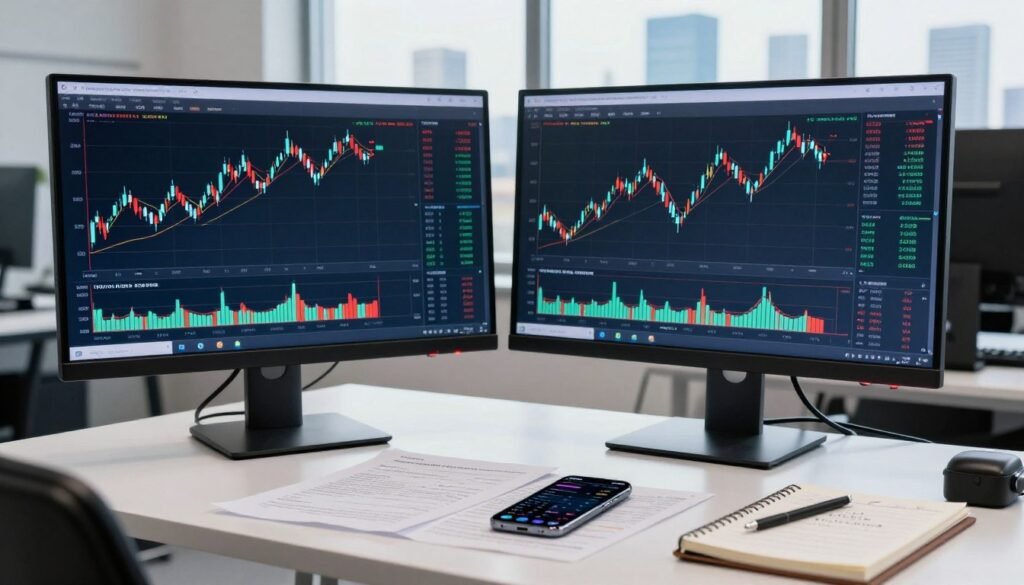
On exchange pages — spot and derivatives — the metric is listed per pair or market. Chart platforms show it as histogram bars under candles, overlays, or separate indicator panels.
- Coins vs USD: coin-denominated reads show token flow; USD reads show dollar exposure.
- Cross-check across exchanges to spot outliers or inflated figures.
- Remember that the number of transactions affects the reading, but it doesn’t count unique participants.
When prices swing fast, switch views carefully: coin totals may stay high while USD value jumps or falls. Use both displays to get a full sense of activity and make cleaner decisions.
Why Volume Matters for Crypto Traders
Active trade counts reveal how much backing a move has. High activity usually means a healthy market with plenty of participants. Low activity often points to hesitation or stagnation.

Liquidity: enter and exit without big slippage
When many trades execute, spreads tighten and orders fill without pushing prices far. That makes entries and exits cleaner and reduces the chance of large slippage for both retail and institutional investors.
Market sentiment and participation
Rising activity often signals growing interest and stronger participation by buyers or sellers. When activity fades, sentiment may be cooling and a move can lose momentum.
Trend strength and sustainability
Price moves backed by solid activity show greater strength and are likelier to hold. Weak activity during a rally or sell-off suggests the trend may fail soon.
Note: High activity often comes with higher volatility, creating opportunity but higher stop-loss risk. For traders, the best use of this metric is to read it alongside price action rather than alone.
How to Read Volume With Price Action
A simple rule helps: read activity next to price candle-by-candle, then check the next two or three bars for confirmation. That combo shows whether a move has real backing or is likely to fizzle.

High activity with rising price: validating bullish momentum
When price climbs on strong activity, buyers are committing and the trend has force. Traders look for sustained activity over several candles, not just one spike, to trust continuation.
High activity with falling price: identifying strong selling pressure
Sharp drops with heavy activity often mark panic selling or capitulation. These candles can signal broad selling pressure and a likely acceleration of the down move.
Low activity moves: fragile rallies or fading selloffs
Low activity rallies tend to lack conviction and often reverse without follow-through. Low activity selloffs, however, may show seller exhaustion and possible stabilization. Wait for confirming signals before acting.
Activity spikes: breakouts and breakdowns
Sudden spikes usually follow headlines or tests of key levels. Use a quick checklist: confirm a price break, check follow-up activity, and avoid treating activity as a lone predictive signal.
- Read candle-by-candle, then across 2–3 bars for confirmation.
- Prefer sustained activity over single prints.
- Combine with trend and volatility checks before entry.
For a practical primer on using these reads with charts, see how to use volume in crypto.
Volume Analysis in Cryptocurrency Trading: A Step-by-Step Workflow
Start by choosing a chart timeframe that matches your style—fast frames for intraday work, longer frames for swing moves. Match the candle period to your horizon so reads are relevant.
Confirm the trend first. Identify structure and direction with price action, then use volume to validate whether participants back the move.
Mark volume areas: highlight zones where activity repeatedly peaks. Those zones often align with support and resistance and act like magnets when price returns.
Use a volume moving average to compare current activity to typical levels for that chart. That helps separate true surges from normal noise.
Translate reads into a plan: enter on confirmed follow-through, stage exits near high-activity zones, and place stops wider when volatility threatens early stop-outs.
- Match period to horizon.
- Confirm trend, then validate with activity.
- Use moving averages to set context.
- Combine volume indicators with other technical indicators for better decisions.
Risk note: spikes create opportunity but raise stop-run risk, so size positions to survive bursts of volatility.
Core Volume Indicators That Help Interpret Market Momentum
Technical indicators help turn raw trade counts into readable momentum signals. They visualize buying and selling pressure so traders see whether moves carry weight or are weak.
On‑Balance Volume (OBV) adds volume on up days and subtracts it on down days. This cumulative method flags accumulation versus distribution. When OBV diverges from prices, traders watch for potential trend shifts.
Chaikin Oscillator (A/D Oscillator) blends price and activity to gauge buying versus selling pressure. Crosses above or below the zero line suggest shifts in net accumulation and can confirm breakouts or warn of fades.
Chaikin Money Flow (CMF) is often run on ~21 days. Positive CMF signals money flowing into an asset; negative values point to outflows. It’s useful for spotting sustained buying or selling dominance.
Money Flow Index (MFI) is a volume‑weighted momentum indicator like RSI but more sensitive because it weights by traded activity. It flags overbought or oversold conditions and short-term momentum shifts.
Ease of Movement (EMV) links price change to activity. High EMV shows prices moved easily on low activity; low EMV means moves required heavy activity. That distinction helps judge the quality of any rally or drop.
Tip: Use these indicators to support signals, not as lone buy sell commands. Always confirm with price structure and apply risk controls.
Using Volume to Validate Signals and Patterns
Use traded activity to separate real breakouts from false alarms on charts. This short checklist helps you treat patterns and signals as evidence-based moves rather than guesses.
Breakouts: look for confirmation before trusting the move
Traders want expanding activity that exceeds recent averages. A clean close beyond the level plus follow-through bars reduces false breakouts.
Reversals: spot fading interest when price rises on declining volume
If price keeps climbing while activity falls, that often signals weakening strength under the surface. Such divergence warns that the pattern may fail.
Trend continuation: confirm sustained buying or selling activity
Steady or rising activity across several bars supports persistence. That makes a pattern-based entry more credible and helps size risk appropriately.
- Pattern — identify the formation.
- Level break — wait for a decisive close.
- Volume confirmation — demand higher activity than the recent average.
- Risk plan — set stops and targets before entry.
Advanced Volume Techniques for Deeper Market Insight
Advanced tools matter because crypto markets move fast and levels can be defended hard. These methods show where participants put real capital, not just momentary noise.
Volume Profile: mapping activity across price
Volume Profile is best described as volume over price rather than over time. It plots how much traded at each price level during a set period.
High‑volume nodes often mark key acceptance areas where the market paused and agreed on value. Traders use those nodes as clear support or resistance zones when price returns.
Order book reading: depth, buy walls and sell walls
Order books show real‑time buy and sell orders across exchanges. Big buy walls suggest possible support; large sell walls hint at resistance.
Watch how depth shifts: if a wall is pulled or sliced, the apparent support can vanish. That movement offers immediate sentiment clues for short‑term strategies.
- How to apply: align Profile levels with price structure, then monitor book depth near those zones.
- Signal check: expect stronger moves when high nodes and visible walls line up.
- Limitations: order book data can change rapidly and can be spoofed, so treat it as context—not certainty.
For a deeper workflow on combining these methods with chart reads, see this practical guide.
Real-World Crypto Examples: What Volume Signaled in Past Market Moves
Examining major crypto episodes helps traders learn how activity backed or unraveled big moves.
The 2021 Bitcoin bull run: strong backing for the uptrend
From about $29,000 to $64,000 in Q1 2021, Bitcoin saw heavy activity across major exchanges like Binance and Coinbase. Large inflows via Grayscale Bitcoin Trust added institutional demand.
Traders watching this could spot higher highs with supportive activity, and pullbacks that held on lower sell pressure — a pattern that confirmed continuation.
The May 2021 crash: heavy selling and fast price discovery
In May 2021, BTC plunged roughly from $58,000 to $30,000 on massive activity after regulatory moves in China and high‑profile tweets. Heavy down activity signaled panic selling and widened spreads.
Risk lesson: heavy selling accelerates moves, so conservative stops and smaller positions help manage sudden losses.
Ethereum’s rise in early 2023: sustained buying, not a one-day spike
ETH rallied from about $1,200 to over $2,000 with steady trade participation tied to DeFi growth and the proof‑of‑stake upgrade narrative. Continued buying across sessions suggested real demand rather than a single‑day spike.
Repeatable rule: pair price action with activity to read trend strength, sentiment, and whether a move has genuine backing.
Conclusion
Strong trade activity helps you separate meaningful moves from short-lived noise. Use volume as context for liquidity, sentiment, and trend durability rather than a lone signal.
Practical steps: pick a timeframe, confirm trend, compare current volume to typical levels, mark high-activity areas, then plan entries, exits, and stops around those zones.
Cross-check reads across reputable exchanges and stay alert for manipulation such as wash trading. That protects your work in volatile crypto markets.
Next steps: add OBV, CMF, and MFI to charts, apply a volume moving average, review past examples, and paper-test strategies before risking capital. Make disciplined decisions that align price structure, risk controls, and market context.
FAQ
What does trading volume mean in crypto markets?
Trading volume measures the number of coins or the USD value exchanged over a set period. Exchanges often report both coin count and dollar value so traders can compare raw activity versus capital flow when assessing interest in a token.
How is volume measured across a time period—coins traded vs. USD value?
Some charts show units traded (like BTC), while others convert that activity into USD or stablecoin value. Units reveal token movement; USD value reveals capital intensity. Use both to understand whether large transactions or many small trades drive a move.
Where can traders view reliable volume data on exchanges and charts?
Major platforms such as Binance, Coinbase Pro, and Kraken display exchange-reported volume. Charting tools like TradingView aggregate exchange feeds and add depth indicators. Check multiple sources to spot reporting differences or wash trading distortions.
Why does liquidity matter for entering and exiting crypto positions?
Higher liquidity lets you buy or sell larger sizes without big price slippage. Thin markets force wider spreads and make stop losses unreliable. Always match order size to typical daily activity to avoid moving the market against yourself.
How does volume reveal market sentiment and participation?
Rising activity usually signals growing interest—more buyers or sellers joining the trade. Declining activity suggests fading participation and increases the risk a trend will reverse or stall. Use volume shifts to read whether momentum is broad-based or narrow.
How does volume confirm trend strength and sustainability?
Strong trends often show rising activity on directional moves and lower volume on pullbacks. If price climbs on falling activity, the trend may lack conviction. Combine trend direction with volume patterns to judge durability.
What does high volume with a price increase indicate?
When price rises on heavy activity, it typically validates bullish momentum—buyers are aggressive and liquidity supports the move. Look for follow-through candles and sustained activity to trust the breakout.
What does high volume with a price decrease signal?
Large volume during declines points to strong selling pressure and possible panic exits. It can mark capitulation or the start of a new downtrend. Pay attention to whether selling volume clusters at key support levels.
How should traders treat low-volume price moves?
Low-volume rallies or drops often lack conviction and can reverse quickly. They may be noise, thin liquidity events, or manipulative runs on smaller exchanges. Use caution and wait for confirming signals before scaling into positions.
What do sudden volume spikes tell you about breakouts or breakdowns?
A spike commonly precedes or accompanies a true breakout or breakdown. It shows new participants and capital committing to the direction. Verify the spike across timeframes and exchanges to avoid false signals.
How do I pick the right timeframe and period for volume reading?
Match the chart period to your style: minutes to hours for intraday, daily to weekly for swing trades. Longer periods filter noise; shorter periods capture real-time shifts. Use a period that aligns with your trade horizon and risk plan.
Why should I confirm the trend before using volume to validate a move?
Trend context prevents misreading isolated spikes. Volume that supports the established direction signals continuation, while volume against the trend can warn of reversal or countertrend strength. Always assess trend first, then volume.
How do I mark “volume areas” that matter for support and resistance?
Look for price bands where activity repeatedly concentrates—these show where buyers and sellers found agreement. Mark those zones on the chart; future approaches often trigger reactions as liquidity sits there.
How can I compare current activity to typical levels using a moving average?
Add a volume moving average (for example, 20 periods) to the chart. Read current bars relative to that baseline: bars above it indicate stronger-than-normal participation; below suggests weaker interest.
How do I translate a volume read into a practical trade plan?
Use volume to set entries, exits, and stops. Buy breakouts with rising activity, place stops below low-volume pullbacks, and scale in when volume confirms direction. Adjust position size by liquidity to limit slippage.
What are the main indicators that use volume to show accumulation or distribution?
On-Balance Volume (OBV) helps identify accumulation versus distribution. Chaikin Oscillator and Chaikin Money Flow track buying and selling pressure over time. Money Flow Index blends volume with price momentum for overbought/oversold signals.
How does Ease of Movement help interpret price moves relative to activity?
Ease of Movement gauges how effortlessly price moves given volume and range. High EMV suggests price shifts with little resistance; low EMV means heavy volume is needed to move price. It helps spot efficient trends.
When should I require volume confirmation for breakouts?
Demand a clear increase above average activity when price crosses a key level. Without it, breakouts often fail. Confirmation reduces false entries and improves risk-reward when combined with stop placement.
How can volume warn me of potential reversals?
Watch for price gains on declining activity or price losses on decreasing volume—both indicate momentum loss. Divergences between indicator readings (like OBV) and price often precede reversals.
How does volume support trend continuation signals?
Sustained or rising activity on successive trend-day moves shows commitment and increases the odds of continuation. If volume tails off, expect consolidation or a stronger pullback.
What is Volume Profile and how does it add insight?
Volume Profile plots traded activity by price level instead of time. It reveals value areas, high-volume nodes, and low-volume gaps that act as magnets or barriers for future price action.
How can order book analysis help alongside volume readings?
Watching buy and sell walls, depth, and recent fills gives a real-time view of pending pressure. It complements volume bars by showing nearby liquidity and potential barriers or supports.
Can you give real-world examples where activity confirmed big crypto moves?
During Bitcoin’s 2021 rally, heavy participation across exchanges validated the uptrend. The May 2021 crash showed large selling volumes and quick liquidations. Ethereum’s 2023 advance featured steady buying volume that sustained the move.
How do exchange reporting differences and wash trading affect volume readings?
Some venues report inflated figures or include internal transfers. Cross-check volume across reputable exchanges and use adjusted metrics from analytic firms to avoid misleading signals caused by wash trading.
What practical risk controls should I use when volume is low or volatile?
Reduce size, widen stops to account for spread, and prefer limit orders. When activity is thin, avoid market exposure at key levels and wait for clearer confirmation on higher-volume venues.

No comments yet