

The digital asset market moves on capital flows. Large holders, often controlling millions in crypto, can significantly impact global price action. Firms like Kenson Investments specialize in tracking this wallet activity to anticipate liquidity shifts.
When these major players quietly increase their stakes, it’s called accumulation. This often hints at bullish sentiment. Conversely, distribution occurs when they sell, which can precede market downturns.
In 2025, sophisticated on-chain transparency tools have matured. Reading these signals is now more reliable, offering a window into where smart money is positioning itself.
This guide will help traders and investors spot early warning signs. You’ll learn to align decisions with actual capital flows. For a deeper dive into monitoring large holders, explore this introduction to crypto whale tracking.
Decoding Whale Accumulation and Distribution Basics
The power to sway entire markets rests with a select group of massive investors in the cryptocurrency space. Their strategic moves form the core of two critical concepts every trader should understand.
Key Definitions and Concepts
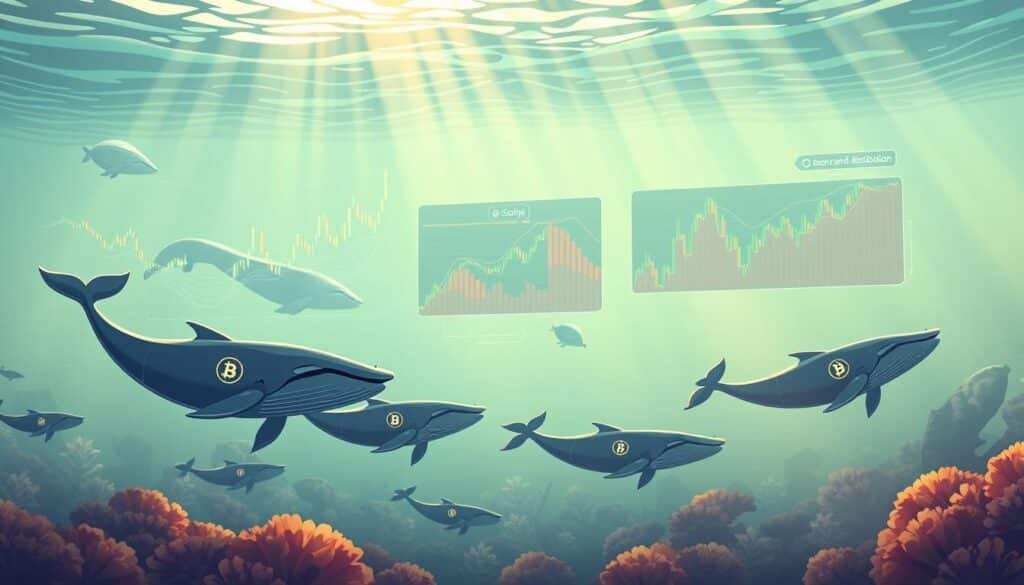
A crypto whale is any entity holding enough digital asset to impact its global price. The term comes from casino culture, describing high-stakes players.
Accumulation describes these large holders quietly increasing their stakes. Distribution is the opposite, where they strategically reduce positions.
It’s vital to know that not every big wallet movement signals a trade. Major players often control thousands of addresses. Transfers between them are usually routine safekeeping or security measures.
Market Impact of Whale Movements
When these big players move crypto off exchanges into cold storage, it reduces circulating supply. This often creates upward pressure on price.
Conversely, moving significant amounts to exchanges increases available sell-side liquidity. This can signal potential selling, even before trades happen.
This behavior influences overall investor sentiment. It can serve as a leading indicator that institutional capital is repositioning. For instance, analysts track recent accumulation activity to gauge market sentiment shifts.
Identifying whale accumulation vs distribution signals
Traders can gain a significant edge by learning to interpret the digital footprints left by the market’s largest participants. It involves spotting specific clusters of on-chain data that reveal intent.
Recognizing On-Chain Indicators
Exchange outflows are a primary signal. Large transfers from trading platforms into private storage suggest a long-term hold strategy.
Conversely, sustained inflows to exchanges often mean assets are being positioned for potential selling. Another strong indicator is a rising number of addresses holding very large balances.
This shows coordinated buying. These phases also typically see low sell-side volume, strengthening the bullish signal.
Interpreting Wallet Activity Patterns
The key is to look for trends, not single transactions. Meaningful patterns involve consistent directional flow from multiple large wallets over time.
This helps filter out routine operational moves. Isolated transfers are often just internal reorganizations by sophisticated investors.
On-Chain Analytics and Tracking Tools for Whale Movements
The evolution of on-chain analytics has given traders unprecedented access to real-time capital movement data. Specialized platforms now turn blockchain activity into actionable intelligence.
This transforms market observation from guesswork into a precise science.
Utilizing Real-Time Data Tools
Immediate notification tools are crucial. They scan multiple blockchains around the clock.
Services like Whale Alert broadcast large transactions instantly via social media and apps. This provides a first alert for major wallets moving assets.
The key advantage is real-time information. You see moves as they happen, not days later.
Comparing Popular Analytics Platforms
Different platforms serve unique purposes. Some focus on identifying who is behind a wallet.
Others track the historical performance of successful large holders. A third category offers deep macro-level analysis.
Here is a quick comparison of leading tools:
- Arkham Intelligence: Uses AI to deanonymize wallet addresses, providing context.
- Nansen: Tracks “smart money” wallets with proven profitable records.
- Glassnode: Focuses on market cycle indicators and cohort behavior.
- Dune Analytics: Allows for custom queries across 100+ chains for tailored data.
Combining these platforms gives a complete picture for informed trading decisions.
Real-World Examples and Case Studies of Whale Activity
Real-world examples illustrate how the actions of the biggest players shape price trajectories. Concrete case studies move beyond theory to show capital flow in action.
Bitcoin’s Recent Accumulation Case Study
In late 2025, a critical event unfolded. Over 30 days, $7.5 billion in large holder inflows hit Binance.
Social media warned of a repeat crash. Yet, Glassnode’s Accumulation Trend Score hit 0.99. This showed aggressive buying, not selling.
The same dollar amount of inflows had preceded a 30% price drop in March. This time, Bitcoin stabilized between $89,000 and $94,000.
Key lessons from this event:
- Exchange inflows do not automatically mean selling pressure.
- Context is everything. The data revealed OTC settlements, not panic dumping.
- Large holders bought 53,000 BTC in a week. This halted a selloff and pushed the price up.
This buying wave reversed months of net selling. It occurred during extreme market fear, while small retail wallets were capitulating.
Tracking Distribution Trends with Historical Data
History shows a repeating pattern. When euphoria grips the retail market, major players often begin distribution.
Conversely, accumulation frequently happens during periods of fear. The 2025 case confirmed this.
Mid-tier wallets increased their holdings by 0.47% in two weeks. Ninety-one new large entities entered the crypto space.
This divergence between smart money behavior and public sentiment creates powerful trading signals. Tracking these trends offers a strategic edge.
Risk Management Techniques When Following Whale Activity
Implementing a systematic risk framework is the critical bridge between observing large holder activity and executing profitable trades. These patterns are helpful indicators, not guarantees.
Several precautions are vital for capital preservation. Your approach must account for false signals and execution hurdles.
Mitigating False Accumulation Signals
A primary risk is false accumulation. Some wallets aggregate tokens only to distribute them later for coordinated sales.
Pump-and-dump schemes can disguise themselves as legitimate buying. Monitoring exit patterns is as crucial as tracking entries.
Always confirm intentions over several days. This helps filter out operational moves from genuine conviction.
Establishing Sound Trading Strategies
Sound trading decisions require disciplined protocols. Even accurate signals can lead to losses without proper controls.
Key tactics for traders include:
- Use Scaled Entries: Commit partial capital initially. Add to positions only as the pattern confirms.
- Set Stop-Losses: Place stops below recent support zones identified by large holders.
- Cap Position Size: Limit any single trade to a fixed portfolio percentage, regardless of signal strength.
- Assess Market Context: These signals work best in trending markets. Avoid forcing trades during choppy periods.
This structured approach manages liquidity and sell pressure risks. It turns probabilistic data into a robust edge.
Advanced Market Analysis: Liquidity, Volume, and Price Patterns
Advanced traders separate market noise from genuine trends by integrating exchange flow data with volume analysis. This multi-dimensional approach provides the clearest signals.
It turns raw blockchain numbers into a coherent narrative of capital intention.
Analyzing Exchange Inflows and Outflows
This analysis forms the foundation. Consistent large outflows from trading platforms to private wallets reduce liquid supply.
It signals a long-term hold strategy. For example, major holders have pulled millions in tokens like LINK from exchange balances.
This action directly shrinks the float available to other participants.
These flow patterns are leading indicators. They show assets being removed from immediate selling availability.
Assessing Volume Trends during Accumulation Phases
Genuine accumulation creates a telltale volume signature. You see strong buying activity but minimal corresponding sell-side volume.
Fewer tokens move back to exchanges. This creates a buying imbalance.
Overall market volume often declines during these phases. Large players absorb supply through patient, layered orders.
They avoid aggressive buys that would spike volume metrics.
Identifying Support Zones and Price Stabilization
When big buyers consistently add positions at a specific price, that level becomes firm support. Whales defend their average entry points.
A classic example was DOGE holding support near $0.25. This occurred while mid-tier accumulation accelerated.
As buying increases, price volatility typically drops. The asset enters a tighter trading range.
This price stabilization confirms the analysis. For sustained rallies, broader market participation is still needed. Tools for comprehensive whale watching can help identify these critical support zones early.
Leveraging whale accumulation vs distribution signals: A How-To Guide for Traders
Turning on-chain data into profitable trades requires a structured plan. Your success depends on choosing a systematic approach that fits your style and available time.
Three primary tracking playbooks offer different paths:
- The Reactive Playbook: Catches breaking moves using real-time alerts, then cross-checks wallet identity and broader market patterns.
- The Smart Money Follower Playbook: Focuses on monitoring specific, proven entities to get ahead of public awareness.
- The Macro-Driven Playbook: Prioritizes understanding the overall market cycle context before reacting to any single transaction.
Step-by-Step Methods to Act on Whale Data
When signals align, use scaled entries. Start with a partial position, adding more as the pattern confirms over days. This reduces timing risk.
Set objective thresholds using on-chain metrics. Create rules like “enter when net buying exceeds 5% of supply in 48 hours.” This removes emotion from your decisions.
Integrating Alerts and Tools into Trading Routines
Configure multiple notification layers. Set alerts for large transactions, specific exchange addresses, and known institutional wallets.
Advanced traders combine data sources in real time. They only act when several independent platforms confirm the same directional insight. This filters out noise and isolates high-probability moves.
Conclusion
For astute market participants, the most reliable signals frequently emerge from the divergence between large-scale capital movements and prevailing public sentiment.
Mastering this flow analysis provides a systematic framework for proactive investment. Success requires combining multiple analytical methods and understanding market context.
Firms like Kenson Investments exemplify this institutional-grade approach. They overlay on-chain patterns with macroeconomic research.
The competitive edge in modern crypto finance now stems from information, not just capital size. Disciplined investors can position alongside smart money.
Looking ahead, sustainable success demands patience for high-probability setups. It requires building positions through scaled orders over days.
Remember, even the best data offers no absolute certainty. Disciplined execution and continuous learning remain the ultimate keys.
FAQ
What is the core difference between accumulation and distribution?
The core difference lies in the intent of large-scale investors. Accumulation refers to the strategic buying and holding of an asset, often signaling long-term confidence and reducing available supply. Distribution is the process of selling off holdings, which can increase sell pressure and available tokens on the market.
How can I spot these activities using on-chain data?
You can look for specific on-chain indicators. Large transfers to custodial exchanges often precede selling, while withdrawals to private wallets suggest holding. Tracking the net flow of assets to and from exchanges, along with changes in the number of large holders, provides strong clues about market sentiment.
Are tools like Nansen and Glassnode useful for this analysis?
Yes, platforms like Nansen and Glassnode are essential. They provide real-time dashboards that track wallet activity, exchange inflows and outflows, and concentration metrics. These analytics platforms transform raw blockchain information into actionable insights about capital movement.
What is a common risk when following these signals?
A major risk is acting on false or lagging indicators. Not every large wallet move is a strategic trade; it could be an internal transfer or collateral movement. Successful traders use this data as one part of a broader strategy, confirming signals with price action and volume trends before making decisions.
How do liquidity and volume interact with these patterns?
Liquidity and trading volume are critical confirmations. Genuine accumulation often occurs on low-volume dips, showing stealthy buying. Conversely, distribution during high volume can indicate strong selling pressure. Monitoring these trends helps identify true support zones versus temporary price stabilization.
How should a trader integrate this data into their routine?
Start by setting up alerts for large transactions on assets you follow. Integrate this with your chart analysis to see if whale moves align with key technical levels. Use the data to gauge overall market sentiment, but always pair it with your own risk management rules to protect your capital.

No comments yet