
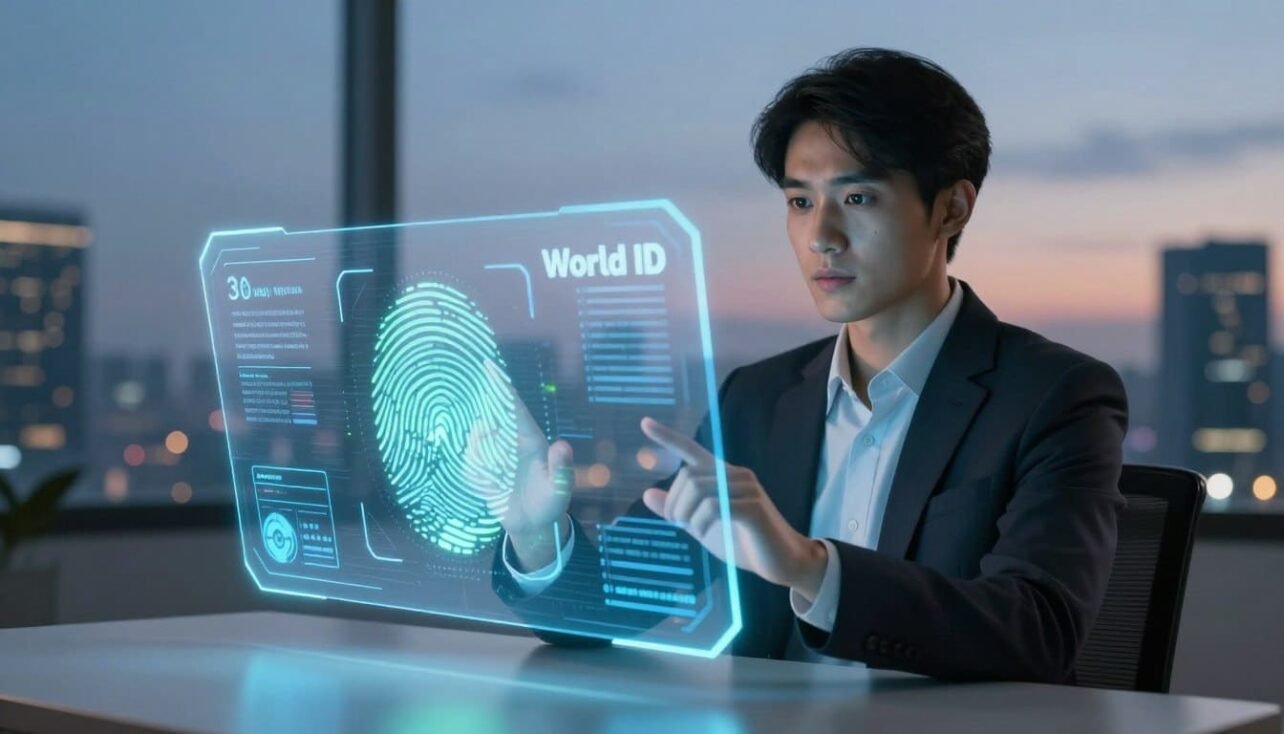
What people mean when they search “Worldcoin: AI Biometric Crypto Explained” is a quick guide to a combined identity-and-token system that launched in 2023 and rebranded in 2024. The project uses an Orb to verify a person’s proof of personhood and issues a World ID. This aims to keep bots off platforms and confirm real humans online.
This US-focused how-to will first explain core concepts, then walk through setup, verification, token basics, and security choices. It clarifies two parts up front: World ID for human verification and WLD as the token, so readers don’t confuse the identity layer with the cryptocurrency layer.
At a high level, the system says it uses hashing and zero-knowledge techniques to protect data. Yet critics worry that iris-based checks raise lasting privacy and surveillance issues. After reading, you should grasp IrisCode/IrisHash, ZK proofs, and options for safer storage, plus what matters most for the United States: availability, token access, and regulatory uncertainty.
What Worldcoin Is and Why It Exists in an AI-Heavy Internet
In today’s internet, confirming real people matters as automated accounts and synthetic media grow. The project aims to create a way to verify unique humans online and reduce fake participation in logins, polls, airdrops, and communities.
The digital identity crisis: bots, deepfakes, and proof of personhood
US users face a practical problem: automated bot farms and deepfake videos make it hard to trust who interacts online. This harms elections, marketplaces, and community moderation.
Proof of personhood means proving someone is a real, unique human, not merely an account or a government ID. It’s about stopping duplicate sign-ups and automated abuse rather than issuing a credential.
How this approach differs from traditional identity tools
Unlike many DID-style credentials that focus on who controls an ID, this system stresses uniqueness. The goal is to ensure one verified person equals one verified identity for specific actions.
World vs. World Network and who built it
The project rebranded in 2024 to cover World ID, the World App, and the WLD token under the World or World Network name. It is developed by Tools for Humanity, a private company founded in 2019.
- Founders include sam altman (co-founder/chairman) and alex blania (CEO).
- Tools for Humanity operates from San Francisco and Munich and says the aim is broader inclusion in a global digital economy.
The initiative promises easier onboarding without prior crypto experience, often via token distribution where available. Still, critics raise measured concerns about consent, incentives for enrollment, and a private company acting as an identity gatekeeper.
Worldcoin: AI Biometric Crypto Explained
This section breaks down how iris scans, blockchain ledgers, and modern automation tools work together to prove someone is a unique human online.

How the three-part stack connects
Biometric data supplies uniqueness: an iris pattern yields a math-based code or identifier that is hard to copy.
Blockchain adds a tamper-resistant layer so services can record verification claims without central alteration.
AI and related automation create the need for these checks and can help flag fraud or deepfake attempts in verification flows.
What World ID proves — and what it doesn’t
The system is designed to show that one real human sits behind an action. That helps prevent duplicate sign-ups, airdrop abuse, or “bot” accounts in community voting and gaming.
It does not reveal your legal name, address, citizenship, credit history, or a trust score. The goal is uniqueness and humanness, not a full identity dossier.
Typical applications include bot-resistant communities, voting-style access, fintech onboarding trials, and human-only game modes. Verification is privacy-focused: apps receive proof of a unique user without seeing raw biometric records.
In practice, users obtain this credential through the World App plus an in-person Orb verification at a supported location. For more on the broader ecosystem and practical steps, see the Worldcoin overview on Ledger.
How to Get Started: World App Setup and Orb Verification
To begin, download the World App and follow the guided steps to create an account. The app separates the wallet features from the World ID flow, so review prompts before you continue.
Download and account setup
The start is simple: install the official world app from your device store, open it, and make an account. Read consent screens carefully and choose whether to use the wallet features without completing verification.
Finding an Orb and the in-person scan
An orb is a device called the Orb that captures an iris image in person. Locate a nearby Orb site, book a short slot, and follow operator instructions for a quick scan.
The appointment usually takes minutes. Operators show consent screens and explain what is — and isn’t — stored.
How verification prevents duplicates
During verification, the system derives a unique identifier from your iris scan. That identifier is checked against existing records to stop duplicate sign-ups or token farming.
Post-scan results and token eligibility
After a successful verification you receive World ID credentials inside the world app and can use them in supported apps for proof of human status. Token eligibility varies by region; in the United States access and claims have changed over time.
- Start here: download the app, create an account, follow verification prompts.
- Safety checklist: use the official app, guard recovery phrases, avoid offers promising guaranteed tokens.
- Next: the following section covers the cryptographic plumbing behind iris hashing and ZK proofs.
How the Technology Works Under the Hood (IrisCode, ZK Proofs, and MPC)
The technical flow converts a captured iris pattern into a privacy-focused template and a proof you are unique. A device captures your iris and creates a compact, repeatable representation called an IrisCode or IrisHash-style template.

From scan to template
The scan is processed into a numeric template — not a photo — so systems can match you later. That template is hashed: scrambled into a fixed string the network can compare without storing raw images.
Zero-knowledge proofs in practice
Zero-knowledge proofs let a service get a yes/no answer about uniqueness without seeing your template or identity. Common uses include logging in, joining human-only groups, or enforcing one-per-person claims.
Why multi-party computation matters
In May 2024 the project moved stored templates into secure multi-party computation to split encrypted fragments across parties. This multi-party computation approach reduces the risk that a single server can reconstruct biometric data and helps with regulatory protection, though critics still voice concerns about whether derived codes count as personal data.
Device, operator risks, and practical takeaways
Hardware and operator practices matter. A 2023 incident where attackers stole operator credentials shows operational security gaps even when user data is not accessible via the operator app.
- Verify at reputable locations and check permissions.
- Keep your phone and recovery phrases secure like any financial account.
- Expect the system to use templates and cryptography, but watch operator and device security.
Using WLD: Token Basics, Wallet Options, and Storage Security
Here we outline what WLD does, where to keep it, and how to buy it safely from a U.S. perspective.
What WLD is and why people hold it
WLD is an ERC-20 token on Ethereum. It is tradable and separate from any identity system, even when marketed together.
People hold tokens for participation in applications, transfers, or as an investment. Remember that prices can swing and holdings are not risk-free.
Wallet choices: convenience vs. control
The World App wallet is convenient for identity-linked flows and simple token use. It suits beginners who want integrated features.
Self-custodial wallets like MetaMask give you direct control of private keys and broad dApp access. If you control the seed phrase, you control the funds; if you lose it, you usually cannot recover assets.
Hardware protection and buying WLD
For meaningful balances, use hardware for protection. A Ledger device keeps private keys offline and lowers exposure to phishing and malware.
- Confirm the correct Ethereum address before sending tokens.
- Test with a small transfer first.
- Store recovery phrases offline in a secure location.
Ledger Live may offer a Buy/Sell flow for WLD depending on region and provider. The typical steps are: go to Buy/Sell, select Worldcoin (WLD), choose fiat, pick a provider, and complete identity/checkout prompts.
For a broader look at wallet tradeoffs and recommended tools, see our guide to the best wallet options.
Privacy Concerns and Regulatory Pressure to Know Before You Scan
Before you book a scan, it helps to understand the privacy and legal risks tied to permanent biometric identifiers.
Biometric data permanence: why iris privacy is different from passwords
Your iris pattern is fixed. Unlike a password, you cannot reset or rotate it after a breach.
That permanence raises unique privacy and security risks if templates or derived codes are exposed.
Data deletion and consent concerns raised by privacy advocates
“Data” can mean raw images, hashed templates, or linked records. Regulators may treat encoded templates as personal data if they can be linked to a person.
Critics say incentives such as tokens can pressure users into consent before they fully grasp long-term risks.
Regulators’ actions worldwide: investigations, suspensions, and deletion orders
Authorities have opened probes and issued orders in several places: investigations in France and the UK, reported probes in Germany and South Korea, and stops in Spain and Portugal.
Kenya ordered deletion in 2025; Hong Kong and Indonesia took enforcement steps. The project says it migrated templates to SMPC in 2024 and deleted older codes, but regulators still press for stronger safeguards.
United States considerations: verification availability vs. token access and compliance uncertainty
For US users, availability can change quickly. An app in a store does not guarantee token access or long-term stability.
Expect differential rollout and evolving compliance rules that may limit the ability to claim, trade, or use tokens in some regions.
- Before you scan: read the latest privacy disclosures and deletion policies.
- Understand what data you consent to share and whether deletion is practical.
- Weigh the benefits against the permanence of iris templates and regulatory uncertainty.
Conclusion
A clear takeaway: the project links in-person orb checks to a cryptographic World ID and optional token use, aiming to make online interactions more trustworthy.
Remember who leads the effort: sam altman and Tools for Humanity shape vision and incentives, which draws extra scrutiny on power and governance. That matters for people choosing to enroll.
Practical steps are simple: install the world app, decide if you want verification at an orb, and pick a wallet strategy for any tokens. Treat the app like a financial account and lock down recovery methods.
If your priority is bot resistance, verification may help. If you worry about permanent identifiers and regulatory risk, waiting is reasonable. Looking ahead, proof-of-personhood systems will matter more, but broad adoption depends on clear consent, strong security, and compliant operations for the near future.
FAQ
What is the project and why was it created?
The initiative was built to solve the growing problem of fake accounts, bots, and fraud online by offering a portable digital identity that ties a human presence to services. Founders including Sam Altman and Alex Blania aimed to create a global “proof of personhood” system that can be used by apps, platforms, and financial services to reduce abuse and improve trust.
How does the verification process work?
Users download the World App, locate a scanning device called an Orb, and complete an iris scan. That scan is converted into a protected identifier and processed with cryptographic tools so the system can detect duplicates without revealing raw biometric images. The verification issues a credential that apps can use to confirm a person is unique.
What is World ID and what can it prove?
World ID is a credential that proves a user has completed a human verification check. It is not a global identity card and does not automatically reveal your name, address, or sensitive personal details. Instead, it signals “this is a verified human” to services that accept the credential.
What happens to my iris scan data after verification?
The raw images are not intended to be stored with identifying metadata. The project converts the scan into a compact code and uses cryptographic methods to avoid keeping reusable biometric files. Still, privacy advocates have raised questions about retention policies, and the project has iterated on storage and deletion practices to respond to regulatory pressure.
How does the system prevent duplicate sign-ups or fraud?
The verification uses a unique biometric-derived identifier and cryptographic checks to detect if the same person attempts to register multiple times. Techniques such as zero-knowledge proofs and secure multi-party computation (MPC) let the network confirm uniqueness without exposing the underlying biometric information.
What cryptography protects my information?
The ecosystem relies on hashing of the iris-derived code, zero-knowledge proofs, and MPC. These tools are meant to allow verification while keeping biometric inputs private. The team has migrated storage and hardened processes over time to reduce risks from centralized data holders.
Where can I get an Orb scan and how safe is the hardware?
Orb locations vary by city and change as operators deploy devices. Scans occur in-person at staffed booths. Device security depends on operator practices; past incidents involving device handling prompted updates to operator training and firmware to limit exposure of sensitive data.
What do I receive after I verify my identity?
After verification you receive a World ID credential usable in the World App and by third-party services that accept it. In some rollouts, verified users became eligible for the native token, WLD, subject to distribution rules and regional availability.
What is WLD and how is it stored?
WLD is the native ERC-20 token used for incentives and governance in the ecosystem. You can keep tokens in the World App wallet or move them to self-custody solutions such as MetaMask. For added security, hardware wallets like Ledger provide offline key storage and are recommended for long-term holdings.
Can I buy the token with Ledger Live?
Availability to buy and manage tokens through Ledger Live depends on regional listings and exchange integrations. If supported in your country, Ledger Live can be used to purchase and manage ERC-20 tokens like WLD while keeping private keys on the device.
What privacy risks should I consider before scanning?
Biometric traits are permanent and cannot be changed like passwords. Consider how your data could be stored, shared, or subpoenaed. Activists and regulators have flagged consent procedures, retention, and potential centralized exposures as core concerns before agreeing to a scan.
How have regulators reacted globally?
Authorities in multiple countries have opened investigations, issued suspension orders, or requested deletions of data where rules on biometric handling were unclear. The project adjusted operations and documentation to comply with evolving privacy and consumer-protection rules.
Is the service available in the United States and what are limits there?
Availability varies by state and by service integration. In the U.S., verification access and token eligibility have been rolled out carefully to meet compliance expectations. Users should check current regional availability and any terms that affect token distribution.
Can the system be used to block bots or improve online voting, airdrops, or reputation systems?
Yes. The core aim is to give applications a way to gate interactions to verified humans, which can reduce bot-driven abuse, secure token airdrops, and underpin reputation systems. Implementations must balance privacy, consent, and the specific application needs.
What are the main controversies and how has the team responded?
Critics point to biometric permanence, data-minimization concerns, and rapid global deployment. The team responded by improving transparency, updating storage and cryptographic practices, and engaging with regulators and privacy researchers to refine operations and compliance.
How does rebranding from World Network affect users?
Rebranding mainly reflects organizational and product evolution. Core functionality—identity verification, the app, and token mechanics—remains focused on proving personhood and enabling integrations. Users should follow official channels for accurate updates on naming or product changes.
Who can I contact for more information or to report a security concern?
For account issues, verification help, or security reports, use support channels in the World App or the project’s official website. Security researchers often use a disclosed vulnerability disclosure process; check official statements for the current contact and bug-bounty details.

No comments yet