

Zero-knowledge proof systems are a foundational idea in modern cryptography. They let one party prove a fact to another without sharing extra information, so privacy stays intact.
This introduction sets expectations for an ultimate guide that explains what a proof is, how interactive and noninteractive methods work, and where this approach adds real value.
We will use simple examples like the Ali Baba cave and two colored balls to build intuition before moving to formal parts. You will learn why this way of validating a statement matters for blockchains, identity, and compliance.
The guide ties history and research — including the seminal 1985 MIT paper — to practical solutions in private transactions, verifiable credentials, and passwordless flows.
Key idea: the verifier learns the truth of a statement, not the secret itself. Over the next sections, expect clear steps from basics to advanced protocols and real-world deployments.
What are zero-knowledge proofs and why they matter today
C modern cryptography uses an elegant method to verify facts about data without exposing sensitive details. Zero-knowledge proofs let a prover convince a verifier that a statement is true while revealing no extra information beyond that fact.
The idea began in the 1985 MIT paper by Shafi Goldwasser and Silvio Micali. Researchers moved the concept from theory into practical systems over time.
Today organizations use this protocol to validate compliance, run selective disclosure in identity networks, and enable private transactions on public blockchains. An easy example: prove you are over a required age without sharing your birth date.
- Interactive vs non-interactive: choose the process that fits performance and deployment needs.
- Practical benefits: proofs verify quickly, scale to real applications, and can support passwordless authentication flows.
- Why it matters: this way minimizes exposure of private data while keeping systems transparent and auditable.
Zero knowledge proofs
The core idea: a zero-knowledge proof lets a prover convince a verifier that a statement is true without revealing the secret behind it.
One party holds the secret solution; the other wants assurance the claim is correct. The protocol shares only the validity of the statement, not the underlying information.
The exchange must prevent the verifier from reconstructing the secret or using the interaction to convince others later. Even a stored transcript should be useless to third parties.
For example, a prover can show they know a password or secret key without revealing it. Cryptographic constructions make guessing nearly impossible, so the verifier accepts the result while learning nothing more.
- Roles: one party proves, the other checks.
- Scope: applies to set membership, computation correctness, and many real systems.
- Outcome: a reliable proof that preserves private information and supports practical uses like identity checks and private transactions.
History and origins: Shafi Goldwasser, Silvio Micali, and knowledge complexity
The story begins with a landmark 1985 MIT paper that reframed how interaction can limit what a verifier learns.
Shafi Goldwasser and Silvio Micali introduced the concept of knowledge complexity in that paper. They formalized interactive proof systems and asked: how much information leaks during a proof exchange?
Their work showed it is possible for a prover to convince a verifier without revealing extra information. The paper analyzed message rounds, randomness, and the tradeoffs in complexity and time.
The 1985 MIT paper and the rise of interactive proof systems
The paper defined interactive rounds where a prover and verifier exchange queries. It measured the amount of information a verifier gains and called that measure knowledge complexity interactive.
Researchers used these models to build rigorous examples and extend theory into systems used in modern cryptography.
From academic foundations to practical protocols
Over time, the theory moved into practical protocol families. Designers built schemes for identity, private payments, and verifiable computation.
Advances in hardware and software cut prover time and made deployment feasible at scale.
- Origin: 1985 MIT paper by Goldwasser and Micali
- Core idea: bound revealed information with complexity measures
- Impact: protocols that balance security and efficiency for real systems
| Milestone | Main Contribution | Practical Impact |
|---|---|---|
| 1985 MIT paper | Introduced knowledge complexity and interactive proofs | Framework for private verification methods |
| Theoretical extensions | Models of prover/verifier interaction and simulators | Rich literature and refined examples |
| Engineering advances | Optimized protocols and lower prover time | Production systems for identity and payments |
The next section will examine the three defining properties every valid demonstration must meet: completeness, soundness, and the zero-knowledge condition.
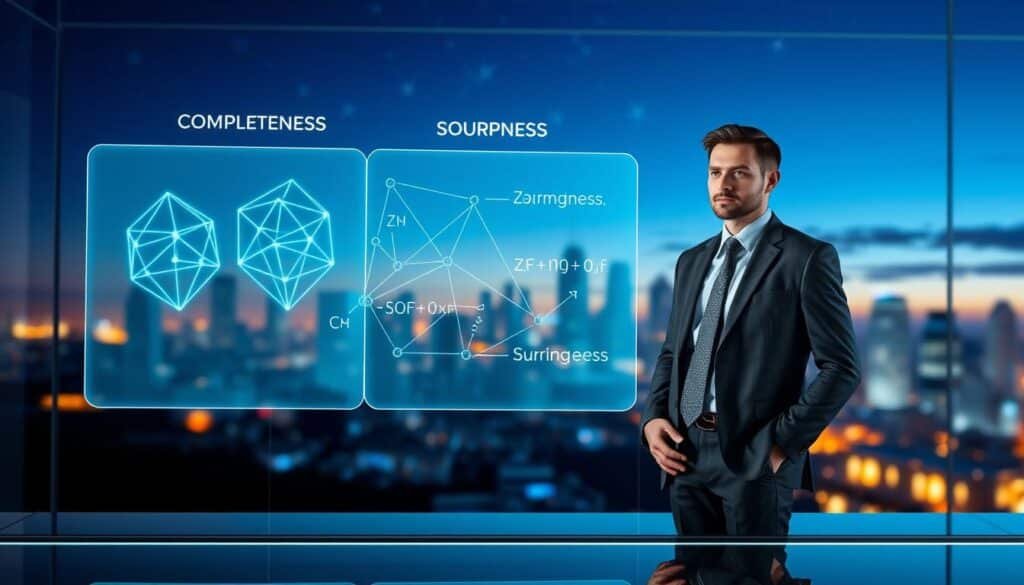
The three properties: completeness, soundness, and zero-knowledge
Every practical proof system depends on three core guarantees that set its security and privacy limits. These properties explain why a verifier can trust a claim while the prover keeps a secret solution hidden.
Completeness
Completeness means: if the statement is true and both parties follow the protocol, the verifier accepts the proof. A correct solution leads to acceptance in honest runs, so the system is useful in practice.
Soundness
Soundness bounds cheating. If the statement is false, no malicious prover can convince the verifier except with tiny probability. Repeating rounds or using stronger primitives reduces that probability to negligible levels.
Zero-knowledge
Zero-knowledge says the verifier learns nothing beyond the truth of the statement. Formally, a simulator can generate transcripts indistinguishable from real interactions. This demonstrates no extra information or knowledge leaks.
- Why these must satisfy together: completeness gives correctness, soundness prevents fraud, and the privacy condition preserves secrets.
- Designs measure probability of cheating and test against defined adversary models and assumptions.
- Implementations scale these guarantees from toy examples to complex computations while keeping proofs convincing and information hidden.
Intuitive examples that build understanding
Simple stories help translate theory into practice. The following short examples show how a prover can convince a verifier while keeping secrets private.
The Ali Baba cave
A prover picks a path (A or B) and reaches a locked door. The verifier issues a random challenge asking which path to exit.
Repeating this process lowers the chance a cheater succeeds. Each extra round reduces the probability that a false claim holds up.
Red card proof
Here the prover reveals every black card as a piece of evidence. That act shows the hidden card must be red while keeping its identity secret.
Where’s Wally / puffin board
A cut-out window shows Wally but hides his coordinates. This selective disclosure proves presence without revealing location or other page details.
Two colored balls
A color-blind verifier watches the prover swap or present balls after a random challenge. Repeating the game proves the balls differ without revealing which is which.
- Why it matters: each example encodes a random challenge and a verifiable response.
- Properties: they illustrate completeness, soundness, and map to formal messages for real protocols.
Interactive vs non-interactive zero-knowledge
A key design choice asks whether a proof needs an active verifier or can stand alone for later checking.
Interactive protocols use rounds: the verifier sends a challenge and the prover replies. This back-and-forth keeps the exchange simple to design and to argue about soundness and probability of deception.
Protocols, messages, and the role of a verifier
The verifier steers challenges and checks responses. That live role can reduce proof size and keep prover time low.
Interactive flows map well to the path-and-challenge example where the prover chooses a path and answers random queries.
Common reference strings, random oracles, and the Fiat-Shamir heuristic
Non-interactive zero-knowledge works when everyone trusts a common random setup or when a hash is modeled as a random oracle.
The Fiat-Shamir heuristic, described in the original paper, replaces verifier challenges with hash outputs. This turns an interactive exchange into a single, verifiable artifact.
- Trade-offs: interactive schemes need round trips; non-interactive proofs improve auditability and distribution.
- Both models preserve completeness and soundness when assumptions match the implementation.
- Practical systems often favor non-interactive and succinct non-interactive constructions for scale and public verification.
| Mode | Verifier role | When to use |
|---|---|---|
| Interactive | Active challenger; checks responses in real time | Live attestations, low prover time, tight soundness control |
| Non-interactive (CRS) | Anyone can verify a single proof | Distributed verification, audit trails, offline checking |
| Fiat-Shamir (hash-based) | No live verifier; hash replaces challenge | Convert protocols to compact proofs for public chains and timestamps |
For further reading on the non-interactive model see this summary, and for applied crypto uses read a practical article on the topic here.
Formal definition and knowledge complexity
A formal model frames interactions as algorithms so we can reason precisely about what a verifier learns.
Model: systems use probabilistic polynomial time (PPT) verifiers and a prover defined as Turing machines. For any PPT verifier, the definition requires a PPT simulator that can reproduce the verifier’s view using only the public statement and possible auxiliary input.
PPT verifiers, simulators, and views of interaction
The simulator approach shows no extra information leaks. If simulated transcripts are indistinguishable from real runs, the interaction reveals nothing beyond the statement.
Perfect, statistical, and computational tiers
Perfect means identical transcripts. Statistical permits tiny distance. Computational allows only infeasible distinguishing by efficient adversaries. These tiers set the strength of the privacy claim.
- Completeness: honest runs must accept with high probability and the formalism captures what protocols must satisfy.
- Soundness: cheating success is bounded by a negligible probability, acceptable in practice.
- Non-interactive zero-knowledge has analogous definitions under chosen models and random oracles.
| Aspect | Formal meaning | Practical effect |
|---|---|---|
| Simulator existence | Reproduces verifier view from statement | Proves no extra information leaks |
| Indistinguishability type | Perfect / Statistical / Computational | Sets deployment trust and assumptions |
| Soundness bound | Negligible probability of cheat | Repeated runs or hardness assumptions reduce risk |
Link to the paper: these formal definitions grew from foundational work that measured knowledge complexity and the amount of information revealed in an interactive setting. Rigorous models enable confident use in high-stakes systems.
Protocol toolkit: commitments, challenges, and transcripts
The essentials of a secure exchange are commitments, random challenges, and an auditable transcript.

Commitment schemes for binding and hiding
Commitments act like cryptographic envelopes: the prover locks a value so it cannot change it later (binding) while keeping the content secret (hiding).
Hash-based commitments are common and efficient. They support many protocols where pieces of information must stay concealed until the right reveal step.
Challenge-response flows and reducing soundness error over time
In a challenge-response protocol the verifier issues random challenges and the prover answers to demonstrate valid knowledge.
Repetition reduces the soundness error: each independent challenge lowers cheating probability exponentially in the number of rounds.
Transcripts record commitments, challenges, and responses so a third party can later validate the exchange without extra data leaks.
- The prover prepares commitments; the verifier supplies randomness; both contribute to a verifiable transcript.
- Pieces of evidence are revealed only at specific steps to preserve hiding while enabling validation.
- Careful selection of parameters balances performance and tight soundness guarantees.
These primitives underpin many modern protocols and lead to scalable families that reuse the same patterns. For a practical primer on applied systems, see this practical article.
Types of zero-knowledge proofs used in practice
Practical deployments favor a small set of proof families that balance size, speed, and trust assumptions. The right choice depends on whether you need low verification cost, transparent setup, or broad programmability.
zk-SNARKs
zk-SNARKs deliver succinct non-interactive arguments with very small outputs and fast verification. They are ideal for on-chain checks and many applications that require compact proofs and cheap verification.
zk-STARKs
zk-STARKs emphasize scalability and transparency. They avoid a trusted setup and rely on hash-based constructions, giving strong resilience and simpler trust assumptions for large computations.
PLONK
PLONK uses a universal trusted setup that can be reused across circuits. That approach simplifies development for general-purpose programs and shortens rollout time for new protocols.
Bulletproofs
Bulletproofs create compact, non-interactive proofs without a trusted setup. They work well for confidential transactions and range-verification where setup avoidance is important.
- Trade-offs: proof size, prover time, verifier time, and setup needs.
- Where they excel: rollups and scalable ledgers (zk-STARKs), private payments (Bulletproofs), on-chain verification (zk-SNARKs), and flexible circuits (PLONK).
- Real deployments include StarkNet, zkSync, and Loopring, showing production value.
| Family | Key benefit | Trusted setup |
|---|---|---|
| zk-SNARKs | Small proofs, fast verify | Often required |
| zk-STARKs | Scalable, transparent | No |
| PLONK | Universal setup, flexible | Yes (universal) |
| Bulletproofs | Compact, no setup | No |
The ecosystem keeps evolving; choose a solution based on transparency, hardware, and verification cost constraints to maximize privacy and verification value in your system.
Practical cryptographic examples
Concrete protocol examples help translate abstract design into an engineering process you can implement.

Discrete logarithm demonstration
Example: a prover knows x with g^x ≡ y (mod p). They pick random r and commit C = g^r mod p.
The verifier issues a challenge: reveal r or reveal (x + r) mod (p − 1). Checking either response binds C to the claimed value.
Repeating the rounds lowers the chance a cheating party passes all checks. A simulator can produce transcripts that are indistinguishable from real runs, so no secret value leaks.
This pattern maps to identity use cases: proving you control x gives authentication value without sharing the secret, enabling passwordless flows.
Hamiltonian cycle on a large graph
The prover builds an isomorphic graph H and commits to it. On demand they reveal either the isomorphism or a cycle in H.
Each response convinces the verifier that a cycle exists in the original graph G while revealing no solution path in G itself.
Key practical points: commitments must be binding and hiding, and randomness must be chosen carefully to avoid leaks.
| Example | Core step | Practical value |
|---|---|---|
| Discrete log | Commit C = g^r, challenge response | Identity, passwordless auth |
| Hamiltonian | Commit H, reveal iso or cycle | Proves existence without revealing solution |
Blockchain applications: privacy, scalability, and verifiable computation
Modern ledger stacks use compact attestations to keep transaction details hidden while proving correctness on-chain.
Private transactions on public ledgers: Networks like Zcash use a zero-knowledge proof to hide sender, receiver, and amount. The chain still records a valid state transition, while privacy and auditability coexist. Users gain confidentiality without sacrificing verifiability.
Layer 2 scalability: zk-Rollups, Validiums, and Volitions batch many transfers and publish a single succinct artifact that attests to correct state changes. Non-interactive zero-knowledge proofs let anyone verify those batches without contacting a prover, lowering fees and increasing throughput.
Oracle and identity uses: Oracle networks (for example, Chainlink) can attest to facts about off-chain data while keeping raw data private. Identity flows let a user prove eligibility or credentials without exposing PII.
- End-user benefits: privacy by default, lower fees, higher throughput.
- Developer value: public verification supports transparency and audits alongside privacy.
- Trajectory: active research and better tooling push these systems toward production-grade deployments.
| Application | Main benefit | Verification |
|---|---|---|
| Private transactions | Conceals amounts and addresses | On-chain succinct attestations |
| Layer 2 rollups | High throughput, lower fees | Batch proofs verifiable by anyone |
| Oracle attestations | Data integrity without exposure | Proofs that hide raw information |
Zero-knowledge identity, authentication, and verifiable credentials
Modern identity systems let a user share only the attribute needed for a check. Holders keep credentials and present minimal facts so services learn little else.

Decentralized identity and selective disclosure
Decentralized identity lets people hold W3C Verifiable Credentials in wallets. Selective disclosure supports proving an age or degree without revealing full records.
Passwordless authentication with Schnorr-style protocols
Schnorr-based flows let a user prove possession of a secret without sending a password. That lowers risk from phishing and server-side breaches.
Range proofs (ZKRP) for private amounts
Range proofs show an amount lies between bounds without revealing the exact value. Banks and lenders can verify income or credit limits while keeping sensitive data private.
- Users remain in control of what information they share.
- Prover and verifier roles stay explicit; audits require no extra data retention.
- Many proofs can be noninteractive for fast, distributed checks.
| Method | Use case | What it proves | Privacy benefit |
|---|---|---|---|
| W3C VC (selective) | Age, degree | Attribute validity | Minimal data exposure |
| Schnorr auth | Passwordless login | Secret possession | Resists theft and phishing |
| ZKRP | Income/credit checks | Amount within range | Exact value hidden |
Zero-knowledge vs zero-trust: complementary concepts
A practical link between cryptography and policy helps enforce least privilege while keeping employee data private.
Clarify the distinction: one idea is a cryptographic tool, the other is an organizational security model. The former produces a mathematical proof. The latter assumes no implicit trust and requires continuous checks.
How they fit: organizations can embed a zero-knowledge proof in an access protocol so a party proves entitlement without sharing raw information like a password or profile.
- Benefit: reduced data exposure for users and fewer credentials stored by systems.
- Protocol sketch: a prover shows a policy match; the verifier accepts only if cryptographic checks pass.
- Operational note: verifiers must enforce policy thresholds and require strong cryptographic parameters.
Scenario: an employee proves department membership to open an app. The app sees only a valid attestation, not the full profile.
Conclusion: combining these models gives continuous, privacy-preserving access control that boosts compliance and user trust across systems.
Enterprise and regulatory benefits in the United States
Regulated firms need ways to attest facts about customers while keeping raw data off-chain. Enterprises can prove compliance with sector rules and still use public systems by emitting verifiable statements instead of sharing full records.
DECO extends HTTPS/TLS so an oracle node can attest to a single fact about web-hosted data without revealing the underlying information. This keeps the TLS chain of custody intact and needs no server-side changes.
Meeting privacy requirements (GDPR, HIPAA) while using public systems
Firms can confirm thresholds—such as an amount over a limit—without exposing exact values or identity documents. These attestations map cleanly to GDPR and HIPAA needs by minimizing personal data exposure.
DECO: privacy-preserving oracle proofs over TLS for compliant data use
DECO lets a prover (oracle or user) create a reusable artifact that a verifier (smart contract or enterprise system) can check. This supports audits and reduces operational overhead.
- Source authenticity: TLS chain of custody proves origin.
- No server changes: deploy without altering web services.
- Data monetization: providers sell attestations rather than raw datasets.
| Use case | Prover | Verifier | Regulatory fit |
|---|---|---|---|
| Undercollateralized loan (threshold) | Oracle | Smart contract / lender | Meets privacy rules by hiding exact amount |
| Identity attestation | User wallet | Enterprise access control | Confirms eligibility without full ID disclosure |
| Data monetization | Data provider | Buyer / auditor | Enables sales of attestations, limits data leakage |
Challenges, trade-offs, and what to watch next
Designing for production means optimizing prover compute, verifier cost, and proof footprint. These trade-offs shape deployment choices and the user experience.
Proof size, prover time, verifier time, and trusted setups
Proof size affects storage and on-chain costs. Smaller outputs help verification at scale.
Prover time drives compute budgets and latency. Parallelization and hardware acceleration cut that time in practice.
Verifier time controls recipient load. Fast verification favors on-chain checks and light clients.
Trusted setups speed some protocols but add ceremony. Transparent constructions avoid that cost but may use more compute or larger outputs.
Tooling maturity, interoperability, and real-world deployments
Tooling now simplifies circuit design, testing, and deployment. Libraries and SDKs reduce integration work.
Interoperability across chains remains a challenge; standards are emerging to share proofs and attestations cleanly.
- Soundness is probabilistic and tuned by the number of rounds or parameters.
- Choose protocols by security model, performance needs, and operational limits.
- Pilot with realistic workloads to validate assumptions before scaling.
| Dimension | Impact | Operational note |
|---|---|---|
| Proof size | Storage & gas | Smaller is cheaper to verify |
| Prover time | Latency & cost | Use hardware acceleration |
| Verifier time | User experience | Keep checks fast for clients |
Conclusion
The main takeaway: you can verify a fact and show a statement true without revealing the secret that supports it.
These methods give a practical way to minimize data exposure while delivering strong assurance. Intuitive examples map to formal properties — completeness, soundness, and the privacy condition — and to real protocols that scale.
Use cases span private transactions, scalable rollups, verifiable credentials, and passwordless authentication. Enterprises gain compliant attestations, oracle-based facts, and lower data handling risk.
There are trade-offs in proof size, prover time, and setup choices, but tooling and libraries make adoption easier. Pick the right path for your needs and start testing how to verify a statement true without revealing sensitive details.
FAQ
What is a zero-knowledge proof and why does it matter?
A zero-knowledge proof is a cryptographic protocol that lets one party (the prover) convince another (the verifier) that a statement is true without revealing underlying data. This allows verification of facts—like identity attributes or transaction validity—while preserving privacy. Applications span blockchains, authentication systems, and secure computations where revealing raw data would be risky.
Who introduced this concept and how did it evolve?
The concept emerged from work by Shafi Goldwasser and Silvio Micali in the mid-1980s on interactive proof systems and knowledge complexity. Since that MIT-era paper, researchers developed interactive and non-interactive protocols, then practical, succinct constructions such as zk-SNARKs and zk-STARKs used in modern cryptography and blockchain systems.
What are the three essential properties a valid proof must satisfy?
A proper construction must meet completeness (an honest prover convinces an honest verifier when the statement is true), soundness (a cheating prover cannot convince the verifier except with negligible probability), and the zero-knowledge property (the verifier learns nothing beyond the truth of the statement; transcripts can be simulated).
Can you give a simple intuitive example to explain how this works?
Imagine the Ali Baba cave puzzle: a prover shows they can go from the cave entrance to a hidden spot without revealing which path they took. Repeating random challenges raises the chance a deceitful prover would be caught, illustrating how interactive challenges and probability ensure soundness without revealing the secret path.
What is the difference between interactive and non-interactive protocols?
Interactive protocols involve back-and-forth messages between prover and verifier. Non-interactive proofs use a common reference string or a Fiat–Shamir heuristic to remove interaction, producing a single succinct proof that any verifier can check. This trade-off affects setup assumptions, randomness sources, and practical deployment.
What are PPT verifiers and simulators in formal definitions?
PPT stands for probabilistic polynomial time—verifiers and simulators are efficient algorithms that run within practical time bounds. A simulator can produce a transcript indistinguishable from a real interaction without access to the secret, which formalizes the zero-knowledge property (perfect, statistical, or computational variants describe the indistinguishability strength).
Which cryptographic building blocks form the protocol toolkit?
Common components include commitment schemes (binding and hiding), challenge-response flows, and well-formed transcripts. These help bind the prover to a statement while concealing sensitive values, and repeated challenges reduce soundness error.
What practical proof systems are in use today?
Widely used families include zk-SNARKs (succinct non-interactive arguments of knowledge), zk-STARKs (scalable transparent arguments without trusted setup), PLONK (universal trusted setup and programmability), and Bulletproofs (short range proofs with no trusted setup). Each balances proof size, prover and verifier time, and setup trust differently.
How are these proofs applied in blockchain settings?
Proofs enable private transactions (for example, Zcash), scale verification with zk-rollups and Validiums for layer 2s, and support oracles that prove facts without exposing underlying data, as with systems like Chainlink. They let public ledgers confirm correctness while preserving confidentiality.
Can these methods support identity and authentication?
Yes. They enable selective disclosure in decentralized identity systems and passwordless authentication using cryptographic signatures (e.g., Schnorr-based approaches). Range proofs let users prove amounts fall within bounds without revealing exact values, useful for compliance and privacy-preserving access control.
How do proofs help organizations meet regulatory requirements?
Enterprises can prove compliance, data residency, or entitlement checks without exposing raw customer data, aiding GDPR and HIPAA compliance. Techniques like DECO provide privacy-preserving oracle proofs over TLS to use external data while maintaining regulatory controls.
What are common challenges or trade-offs to watch for?
Key trade-offs include proof size, prover computational cost, verifier time, and whether a trusted setup is required. Tooling maturity and interoperability also matter: integrating proofs into production systems requires careful attention to performance and developer tooling.
How does one choose between proof systems for a project?
Choose based on constraints: need for transparency (no trusted setup) favors STARK-like systems, tight proof size and fast verification favor SNARKs, and flexible on-chain programmability can point to PLONK. Evaluate prover time, verifier cost, and maturity of libraries and ecosystem support.

No comments yet